Snapshot
Scroll sideways to see all columns. With a keyboard, focus this table and use the arrow keys.
| Topic | Detail |
|---|---|
Operating model | Open-source feature store that manages existing infrastructure for model training and online inference. |
Data access | Offline stores support historical processing; online stores and a feature server support low-latency feature serving. |
License | Apache-2.0. |
Take
Consider Feast when a team needs one feature-access layer across training and online inference and expects to move between data infrastructure systems. Its value depends on the team being ready to configure and operate the relevant offline, online, and serving components.
Evaluate Feast
Comparisons
Where Feast fits
It is designed to make features available consistently for training and serving.
Its historical feature workflow is intended to generate point-in-time-correct feature sets to help avoid future values leaking into training data.
Its contributor roadmap lists planned offline and online store options, including warehouse, database, cache, and vector-store entries; some are qualified as community or contrib plugins.
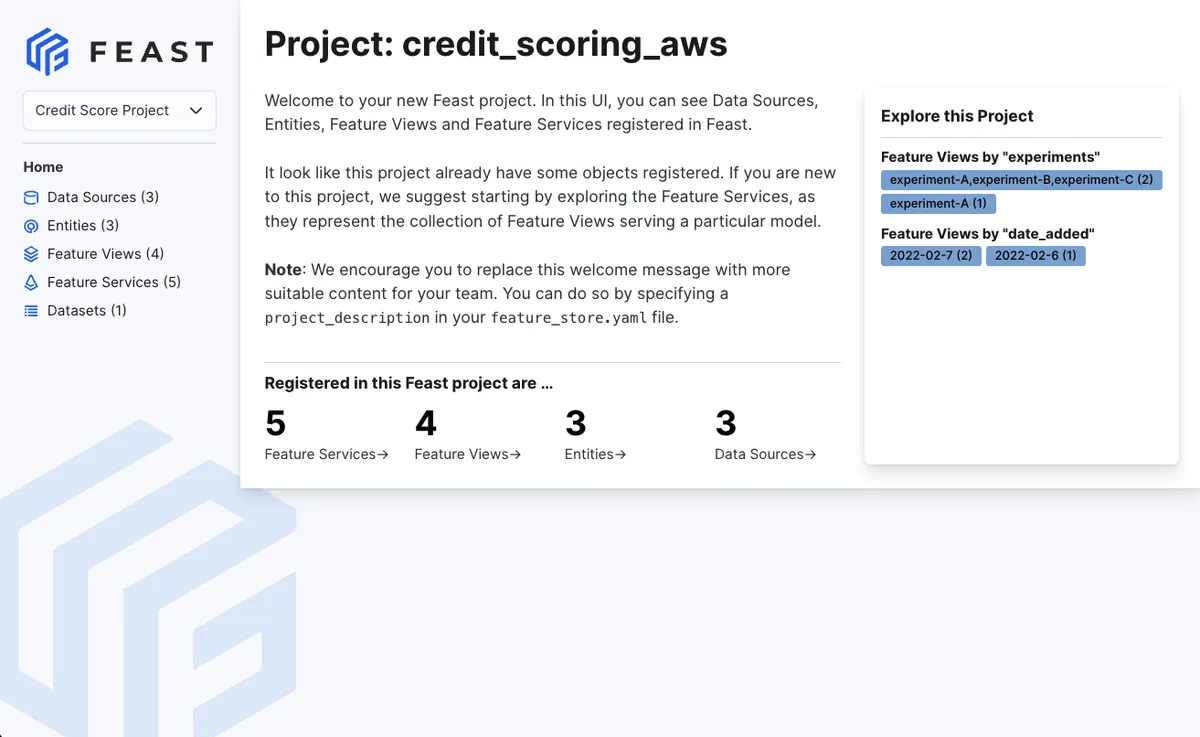
Product screenshot
Trade-offs to evaluate
Feast is a project under active development, and several roadmap capabilities are explicitly marked alpha, beta, or in progress. Evaluate the maturity of the specific integration or serving path required for production before adopting it.
Feast abstracts feature retrieval from storage, but buyers still select and operate the surrounding data infrastructure.
Some transformation and serving capabilities have release-status qualifications, including alpha and beta labels.
Public signals
About these signals
Verified factual signals from public sources. They indicate observable activity or interest, not total adoption, product quality, or cost.
235 GitHub commits 90d7.4k GitHub stars0 vulnerabilities across 1 package
See all signals from 3 sources
PyPI · feast@0.68.0
Alternatives to Feast
The reviewed substitutes for Feast among the ML platforms, and what would make each one the better answer.
Other approaches
A different approach to the same problem. Each substitutes only for the workload named beside it.
- Gemini Enterprise Agent Platform
- Feast defines, registers and serves features across any cloud or on-premises backend. Google's platform, formerly Vertex AI, offers a managed feature store built on BigQuery inside its end-to-end ML suite, which suits teams committed to Google Cloud, while Feast suits teams that want to avoid vendor lock-in or run across more than one environment.Applies to: feature management on BigQuery-centred ML stacks
- Amazon SageMaker
- Feast is an open source feature store that you run on your own infrastructure, with pluggable offline and online stores. Amazon SageMaker includes a managed Feature Store as one part of its wider ML platform, so the choice comes down to whether a team wants a managed service tied to AWS or a portable feature layer it runs and controls itself.Applies to: feature storage and online serving for ML on AWS
- Azure Machine Learning
- Feast is a standalone open source feature store that sits alongside whatever training and serving tools a team already uses. Azure Machine Learning provides a managed feature store as part of its MLOps platform, so the deciding factors are whether the team is standardised on Azure and wants it built in, or prefers an open, self-managed component.Applies to: feature store for enterprise MLOps on Azure
Head to head
Sources
This review is based on Feast’s official website and public GitHub repository, captured on 2026-11-02.