Decision comparison
Bruin vs dbt (data build tool)
dbt and Bruin meet at the SQL transformation layer. dbt is the specialist: models and tests, a Rust-based v2.0 that checks projects at parse time, and hosted plans with Catalog lineage and the Semantic Layer, priced per seat from $100 per user per month on Starter. Bruin covers more of the pipeline in one tool: it also loads data, runs Python and R, and schedules runs in Bruin Cloud, billed by usage at $0.01 per credit with no seats. The choice is not all or nothing: Bruin says dbt models run side by side with Bruin assets and port with their Jinja intact.
Architecture choice. These take different approaches to the same problem. Read the table as a fit question rather than a feature race.
These are different kinds of product — Workflow Orchestrator and Transformation Framework.
Quick Comparison
| Decision factor | Bruin | dbt (data build tool) |
|---|---|---|
| Best for | Data teams that own the whole pipeline and want fewer tools: loading data, transforming it in SQL or Python, checking it and scheduling it from one Git repository and one CLI. The free CLI suits teams that run it themselves; Bruin Cloud suits teams that want managed scheduling and an AI data analyst on the same pipelines. | Teams where SQL writers own the warehouse transformations and want them versioned, tested and reviewed like application code. Self-hosted dbt suits teams that will run the environment; the dbt platform suits teams that want hosted development, Catalog lineage and the Semantic Layer without managing infrastructure. |
| Scope of the tool | A pipeline tool. Ingestr assets load data from databases, warehouses and apps, SQL, Python and R assets transform it, and column checks sit in the same asset definitions. Bruin Cloud adds managed scheduling, run history, backfills, a catalog and AI features on top of the CLI. | A transformation framework. Analysts write select statements called models, and dbt turns them into tables and views in the warehouse, manages the relationships between models and tests the transformations. It works on data that is already in the warehouse; dbt Labs states that dbt never stores your data, and that Fivetran and dbt Labs have merged. |
| How transformations are defined | As SQL files with a short metadata header, or as Python files, in the same repository as the ingestion assets. The header names the asset, its materialization (table, view or incremental table), its dependencies and its checks. Jinja templating avoids repetition, and a dry run validates the whole pipeline before it runs. | As SQL select statements (models) that build on one another, with dbt managing their dependencies and tests. dbt v2.0 is a ground-up rewrite in Rust whose language specification enforces correctness at parse time. It ships as a single binary with no Python runtime, and the v1 Python implementation lives on the 1.latest branch. |
| Pricing and licensing | Open Source: the self-hosted Bruin CLI is free. Team (Bruin Cloud): $0.01 per credit, pay-as-you-go with no seat fees; accounts start with $100 in credits and 50 AI tasks. SQL assets use 250 credits per hour ($2.50/hour), billed per second; Python and ingestion assets are priced by instance size, from 250 credits per hour; AI tasks cost 100 to 300 credits. Scale: custom pricing with committed credits and volume discounts; its plan card mentions annual commitments while the comparison table lists no minimum commitment, so confirm contract terms with Bruin. Official pricing page checked October 21, 2026. | dbt Developer is free for one seat with 3,000 successful models per month. Starter is $100 per user/month for five seats, 15,000 models and 5,000 queried metrics, including $100/month in Wizard credits per account. Enterprise and Enterprise+ are custom priced, with $200/month in Wizard credits on Enterprise. Verified 2026-09-17 against getdbt.com/pricing; the retired Pro and Team names no longer appear. |
| Hosting and operations | The CLI installs with one command on macOS, Linux and Windows (WSL) and runs locally, on EC2, in GitHub Actions, on-prem or air-gapped. Open Source leaves compute and scheduling to you. Bruin Cloud runs pipelines on any cron schedule; SSO, SAML, BYOC and private networking are listed only on the custom Scale plan. | The dbt v2.0 binary runs on macOS and Linux (x86-64 and ARM) and on Windows x86-64. The free Developer plan lists automatic upgrades to the latest dbt release. Enterprise lists SSO, role-based access control and SCIM provisioning, and Enterprise+ adds PrivateLink, IP restrictions and Hybrid Projects that run dbt in your own environment. |
| Testing, lineage and metrics | Checks such as not_null, unique and positive are declared on columns, and a failed check skips the assets downstream. Lineage comes with the CLI; Bruin Cloud adds visual lineage, a searchable asset catalog, governance scoring and an AI data analyst that answers from the governed models with the query attached. | Testing transformations is part of the framework. Starter adds lineage in dbt Catalog, metrics through the dbt Semantic Layer and API access; Enterprise adds column-level lineage, governed metrics with caching and dbt Mesh for multi-project setups. dbt Labs says the Semantic Layer delivers consistent metrics to any dashboard or LLM. |
Bruin
- Best for:
- Data teams that own the whole pipeline and want fewer tools: loading data, transforming it in SQL or Python, checking it and scheduling it from one Git repository and one CLI. The free CLI suits teams that run it themselves; Bruin Cloud suits teams that want managed scheduling and an AI data analyst on the same pipelines.
- Scope of the tool:
- A pipeline tool. Ingestr assets load data from databases, warehouses and apps, SQL, Python and R assets transform it, and column checks sit in the same asset definitions. Bruin Cloud adds managed scheduling, run history, backfills, a catalog and AI features on top of the CLI.
- How transformations are defined:
- As SQL files with a short metadata header, or as Python files, in the same repository as the ingestion assets. The header names the asset, its materialization (table, view or incremental table), its dependencies and its checks. Jinja templating avoids repetition, and a dry run validates the whole pipeline before it runs.
- Pricing and licensing:
- Open Source: the self-hosted Bruin CLI is free. Team (Bruin Cloud): $0.01 per credit, pay-as-you-go with no seat fees; accounts start with $100 in credits and 50 AI tasks. SQL assets use 250 credits per hour ($2.50/hour), billed per second; Python and ingestion assets are priced by instance size, from 250 credits per hour; AI tasks cost 100 to 300 credits. Scale: custom pricing with committed credits and volume discounts; its plan card mentions annual commitments while the comparison table lists no minimum commitment, so confirm contract terms with Bruin. Official pricing page checked October 21, 2026.
- Hosting and operations:
- The CLI installs with one command on macOS, Linux and Windows (WSL) and runs locally, on EC2, in GitHub Actions, on-prem or air-gapped. Open Source leaves compute and scheduling to you. Bruin Cloud runs pipelines on any cron schedule; SSO, SAML, BYOC and private networking are listed only on the custom Scale plan.
- Testing, lineage and metrics:
- Checks such as not_null, unique and positive are declared on columns, and a failed check skips the assets downstream. Lineage comes with the CLI; Bruin Cloud adds visual lineage, a searchable asset catalog, governance scoring and an AI data analyst that answers from the governed models with the query attached.
dbt (data build tool)
- Best for:
- Teams where SQL writers own the warehouse transformations and want them versioned, tested and reviewed like application code. Self-hosted dbt suits teams that will run the environment; the dbt platform suits teams that want hosted development, Catalog lineage and the Semantic Layer without managing infrastructure.
- Scope of the tool:
- A transformation framework. Analysts write select statements called models, and dbt turns them into tables and views in the warehouse, manages the relationships between models and tests the transformations. It works on data that is already in the warehouse; dbt Labs states that dbt never stores your data, and that Fivetran and dbt Labs have merged.
- How transformations are defined:
- As SQL select statements (models) that build on one another, with dbt managing their dependencies and tests. dbt v2.0 is a ground-up rewrite in Rust whose language specification enforces correctness at parse time. It ships as a single binary with no Python runtime, and the v1 Python implementation lives on the 1.latest branch.
- Pricing and licensing:
- dbt Developer is free for one seat with 3,000 successful models per month. Starter is $100 per user/month for five seats, 15,000 models and 5,000 queried metrics, including $100/month in Wizard credits per account. Enterprise and Enterprise+ are custom priced, with $200/month in Wizard credits on Enterprise. Verified 2026-09-17 against getdbt.com/pricing; the retired Pro and Team names no longer appear.
- Hosting and operations:
- The dbt v2.0 binary runs on macOS and Linux (x86-64 and ARM) and on Windows x86-64. The free Developer plan lists automatic upgrades to the latest dbt release. Enterprise lists SSO, role-based access control and SCIM provisioning, and Enterprise+ adds PrivateLink, IP restrictions and Hybrid Projects that run dbt in your own environment.
- Testing, lineage and metrics:
- Testing transformations is part of the framework. Starter adds lineage in dbt Catalog, metrics through the dbt Semantic Layer and API access; Enterprise adds column-level lineage, governed metrics with caching and dbt Mesh for multi-project setups. dbt Labs says the Semantic Layer delivers consistent metrics to any dashboard or LLM.
Public signals
Verified factual signals only. Bars appear only for like-for-like metrics with five weekly assessments for every tool; missing evidence stays explicit. These signals do not establish enterprise adoption, product quality, or total cost.
| Metric | Bruin | dbt (data build tool) |
|---|---|---|
| GitHub commits, 90d(Product adoption) | 656 | 1.0k |
| GitHub stars(Product adoption) | 1,500+ | 14,000+ |
| Hacker News mentions, 90d(Community interest) | 1 | 14 |
| PyPI weekly downloads(Developer adoption) | 3.9k | Not available |
| Search interest(Market interest) | Not available | 41 |
| PyPI weekly downloads(Product adoption) | Not available | 5.8M |
| Stack Overflow questions(Community interest) | Not available | 1.6k |
As of November 9, 2026 — updated weekly.
Health & risk evidence
Observed public-source checks for mapped package versions and repositories.
Bruin
November 9, 2026Package vulnerabilities
PyPI · bruin-sdk@0.5.2
0 vulnerabilities
across 1 package
Repository security score
Not available
dbt (data build tool)
November 9, 2026Package vulnerabilities
PyPI · dbt-core@1.12.6
0 vulnerabilities
across 1 package
Repository security score
github.com/dbt-labs/dbt-core
6.0/10
Interface Preview
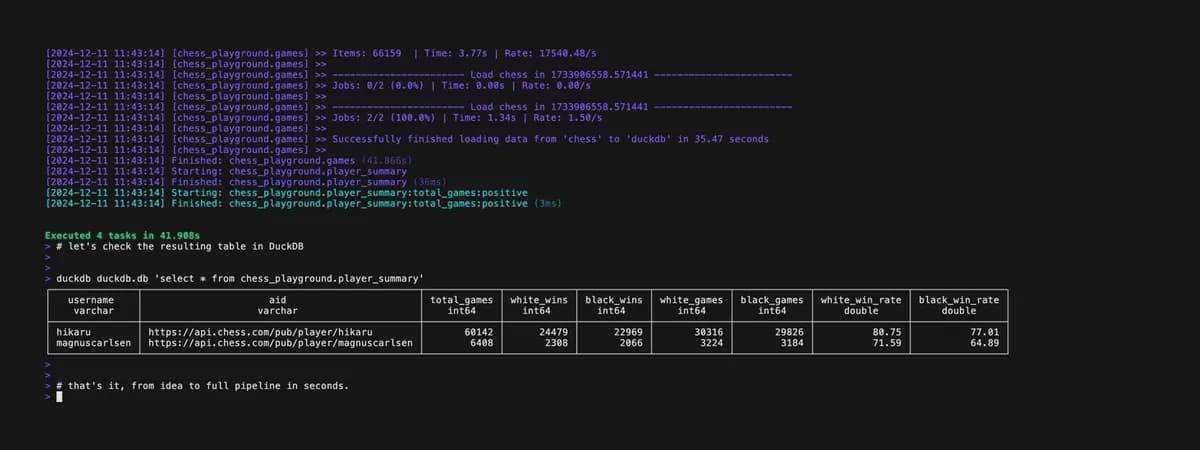
Bruin
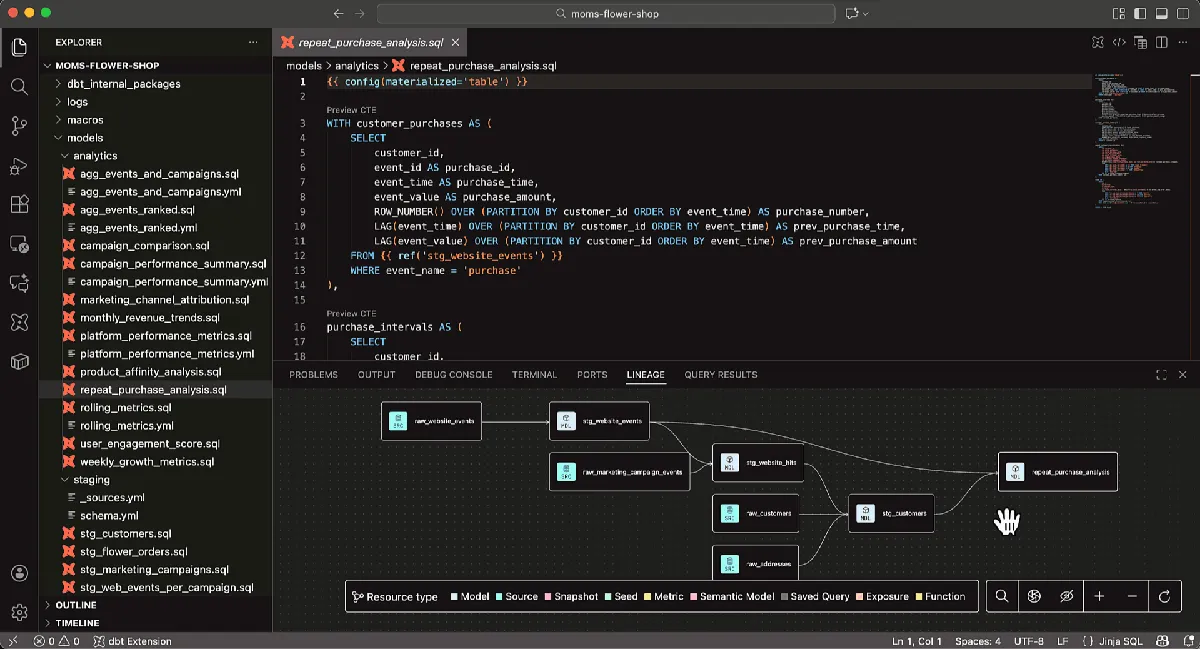
dbt (data build tool)
Feature Comparison
| Feature | Bruin | dbt (data build tool) |
|---|---|---|
| Core capabilities | ||
| Primary job | Ingestion, transformation, checks and scheduling | SQL transformation of data in the warehouse |
| Unit of work | Assets: SQL, Python or R files, plus ingestr assets | Models: select statements built into tables and views |
| Data ingestion | Ingestr assets for databases, warehouses and apps | Data already in the warehouse; Fivetran and dbt Labs have merged |
| Data quality | Column checks in each asset; failures skip downstream assets | Tests on transformations |
| Lineage | In the CLI; visual lineage on Bruin Cloud | dbt Catalog lineage on Starter; column-level lineage on Enterprise |
| Metrics and AI | AI data analyst on Bruin Cloud answers from governed models | Semantic Layer on Starter and above; dbt Wizard billed by tokens |
| Operations | ||
| Install | One-line installer for macOS, Linux and Windows (WSL) | Single binary for macOS and Linux (x86-64, ARM) and Windows x86-64 |
| Hosted option | Bruin Cloud: Team and Scale plans | dbt platform: Developer, Starter, Enterprise and Enterprise+ |
| Migration path | Runs dbt models beside Bruin assets; dbt models port with Jinja intact | v1 Python implementation kept on the 1.latest branch during the move to v2.0 |
| Commercial | ||
| License | Apache 2.0 for the CLI; Bruin Cloud is a paid service | Apache 2.0 source; distributed binary under a dbt product license |
| Free option | Self-hosted CLI with no fee | Self-hosted dbt with no fee; Developer plan free for one seat |
| Paid entry price | $0.01 per credit on Team, no seats | $100 per user per month on Starter |
| Enterprise controls | SSO, SAML and BYOC on custom Scale | SSO, RBAC and SCIM on Enterprise; PrivateLink on Enterprise+ |
Core capabilities
Primary job
Unit of work
Data ingestion
Data quality
Lineage
Metrics and AI
Operations
Install
Hosted option
Migration path
Commercial
License
Free option
Paid entry price
Enterprise controls
Which approach fits
dbt and Bruin meet at the SQL transformation layer. dbt is the specialist: models and tests, a Rust-based v2.0 that checks projects at parse time, and hosted plans with Catalog lineage and the Semantic Layer, priced per seat from $100 per user per month on Starter. Bruin covers more of the pipeline in one tool: it also loads data, runs Python and R, and schedules runs in Bruin Cloud, billed by usage at $0.01 per credit with no seats. The choice is not all or nothing: Bruin says dbt models run side by side with Bruin assets and port with their Jinja intact.
When each approach fits
Choose Bruin if:
Choose Bruin when one data team owns the whole pipeline and wants fewer tools to connect: ingestr assets load the data, SQL and Python assets transform it, column checks stop a bad load from reaching downstream tables, and Bruin Cloud schedules it all without a separate orchestrator. Pricing follows usage rather than people, which suits teams that add analysts often: Team bills $0.01 per credit with unlimited members, SQL assets run at 250 credits ($2.50) an hour, and AI tasks cost 100 to 300 credits each. Keep dbt instead if you rely on the Semantic Layer or dbt Mesh across many projects, or if your organisation has standardised on dbt Enterprise controls such as SCIM.
Choose dbt (data build tool) if:
Choose dbt when your team's job is the transformation layer and the rest of the stack is settled: data already lands in the warehouse through an ingestion tool, and an orchestrator or the dbt platform runs the jobs. dbt v2.0's parse-time checks catch errors before they reach the warehouse, and the hosted plans add Catalog lineage and Semantic Layer metrics that dashboards and LLMs can share; Enterprise adds column-level lineage, SSO, SCIM and dbt Mesh. Budget per seat: Starter is $100 per user per month and lists five developer seats, so five developers come to $500 a month, and dbt State is billed separately at $0.094 per Daily Active Target Table after its trial.
These scenarios reflect the available product evidence. Your requirements, existing stack, and team expertise should guide the final decision.
Frequently Asked Questions
Can I use dbt and Bruin together?
Yes. Bruin says dbt models can run side by side with Bruin assets, that dbt models port with their Jinja intact, and that it reads existing dbt models and tests. A team can keep its dbt project, add Bruin for ingestion and scheduling, and move models over one at a time.
How are the two bills counted?
Differently. dbt's hosted plans charge per seat: Starter is $100 per user per month, so five developers cost 5 x $100 = $500 a month before add-ons. Bruin Team charges no seats and bills the credits used: 100 hours of SQL assets at 250 credits an hour is 25,000 credits, or $250, before AI tasks.
Are both open source?
Both publish Apache 2.0 source code. The Bruin CLI is Apache 2.0, and Bruin Cloud is a paid managed service on top of it. dbt's repository source is Apache 2.0, while the distributed dbt binary adds dbt-specific customizations under a dbt product license.
Does Bruin replace dbt?
For SQL and Python transformations, Bruin can take over dbt's role, and it also covers ingestion and scheduling. Teams that depend on the dbt Semantic Layer, dbt Catalog or dbt Mesh would give those up by switching, so a gradual move can start by running dbt models inside Bruin.