Decision comparison
Dagster vs dbt (data build tool)
Dagster and dbt solve different problems in the data pipeline lifecycle and are more complementary than competitive. Dagster is the orchestration layer that schedules, monitors, and manages data assets across your entire stack, from ingestion through transformation to ML and AI workloads. dbt is the transformation layer that lets analytics engineers build modular, tested SQL models inside the warehouse. The strongest modern data stacks use both: dbt for warehouse transformations and Dagster as the orchestration control plane that runs dbt alongside everything else. Teams choosing between them should consider whether their primary bottleneck is orchestration and pipeline management or warehouse transformation and analytics engineering.
Used together. These are normally used together rather than chosen between. The comparison explains what each one does in the stack.
These are different kinds of product — Workflow Orchestrator and Transformation Framework.
Quick Comparison
| Decision factor | Dagster | dbt (data build tool) |
|---|---|---|
| Primary Function | Data orchestration and pipeline scheduling across ETL, dbt, ML, and AI workloads | SQL-based data transformation and modeling inside cloud warehouses |
| Core Language | Python-native with declarative asset definitions | SQL and Jinja templating with YAML configuration |
| Open Source | Apache-2.0 license, fully open-source core | dbt Core is open-source; dbt Fusion is source-available (Rust rewrite) |
| Cloud Pricing Entry Point | Open-source self-hosted free (Apache-2.0), Solo Plan $10/mo, Starter Plan $100/mo, Starter $1200/mo, Pro and Enterprise Plan contact sales | dbt Developer is free for one seat with 3,000 successful models per month. Starter is $100 per user/month for five seats, 15,000 models and 5,000 queried metrics, including $100/month in Wizard credits per account. Enterprise and Enterprise+ are custom priced, with $200/month in Wizard credits on Enterprise. Verified 2026-09-17 against getdbt.com/pricing; the retired Pro and Team names no longer appear. |
| GitHub Stars | 15,000+ stars on GitHub | 13,000+ stars on GitHub |
| Best For | Teams needing a unified control plane to orchestrate, schedule, and observe all data assets | Analytics engineers building modular, tested SQL transformations with version control and CI/CD |
Dagster
- Primary Function:
- Data orchestration and pipeline scheduling across ETL, dbt, ML, and AI workloads
- Core Language:
- Python-native with declarative asset definitions
- Open Source:
- Apache-2.0 license, fully open-source core
- Cloud Pricing Entry Point:
- Open-source self-hosted free (Apache-2.0), Solo Plan $10/mo, Starter Plan $100/mo, Starter $1200/mo, Pro and Enterprise Plan contact sales
- GitHub Stars:
- 15,000+ stars on GitHub
- Best For:
- Teams needing a unified control plane to orchestrate, schedule, and observe all data assets
dbt (data build tool)
- Primary Function:
- SQL-based data transformation and modeling inside cloud warehouses
- Core Language:
- SQL and Jinja templating with YAML configuration
- Open Source:
- dbt Core is open-source; dbt Fusion is source-available (Rust rewrite)
- Cloud Pricing Entry Point:
- dbt Developer is free for one seat with 3,000 successful models per month. Starter is $100 per user/month for five seats, 15,000 models and 5,000 queried metrics, including $100/month in Wizard credits per account. Enterprise and Enterprise+ are custom priced, with $200/month in Wizard credits on Enterprise. Verified 2026-09-17 against getdbt.com/pricing; the retired Pro and Team names no longer appear.
- GitHub Stars:
- 13,000+ stars on GitHub
- Best For:
- Analytics engineers building modular, tested SQL transformations with version control and CI/CD
Public signals
Verified factual signals only. Bars appear only for like-for-like metrics with five weekly assessments for every tool; missing evidence stays explicit. These signals do not establish enterprise adoption, product quality, or total cost.
| Metric | Dagster | dbt (data build tool) |
|---|---|---|
| Docker Hub pulls(Developer adoption) | 6.2M | Not available |
| GitHub commits, 90d(Product adoption) | 265 | 1.0k |
| GitHub stars(Product adoption) | 16,000+ | 13,000+ |
| Search interest(Market interest) | 1 | 33 |
| Hacker News mentions, 90d(Community interest) | 3 | 11 |
| Product Hunt comments(Community interest) | 11 | Not available |
| Product Hunt rating(Community interest) | 5.0/5 | Not available |
| Product Hunt reviews(Community interest) | 1 | Not available |
| Product Hunt votes(Community interest) | 112 | Not available |
| PyPI weekly downloads(Product adoption) | 1.8M | 5.2M |
| Stack Overflow questions(Community interest) | 171 | 1.6k |
As of September 21, 2026 — updated weekly.
Health & risk evidence
Observed public-source checks for mapped package versions and repositories.
Dagster
September 21, 2026Package vulnerabilities
PyPI · dagster@1.13.23
0 vulnerabilities
across 1 package
Repository security score
github.com/dagster-io/dagster
5.1/10
dbt (data build tool)
September 21, 2026Package vulnerabilities
PyPI · dbt-core@1.12.5
0 vulnerabilities
across 1 package
Repository security score
github.com/dbt-labs/dbt-core
6.0/10
Interface Preview
Dagster
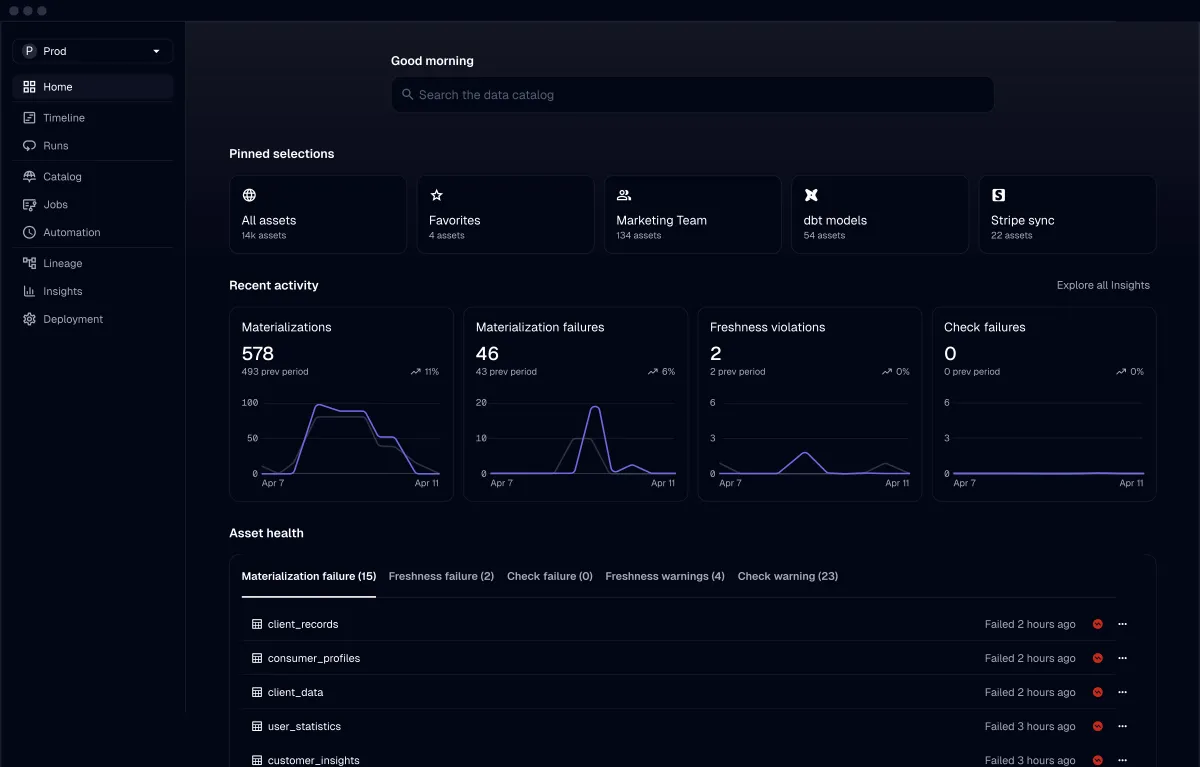
Feature Comparison
| Feature | Dagster | dbt (data build tool) |
|---|---|---|
| Orchestration & Scheduling | ||
| Pipeline Orchestration | Core capability with asset-aware scheduling, partitioning, and dependency resolution | dbt Cloud provides job scheduling; dbt Core requires an external orchestrator like Dagster or Airflow |
| Asset-Centric Model | First-class asset definitions with versioning, partitioning, and freshness tracking | Models function as data assets within the warehouse; no cross-system asset management |
| Cross-System Orchestration | Orchestrates dbt, Spark, Python, Fivetran, and external systems through Dagster Pipes | Focused on warehouse-internal transformations; relies on external tools for cross-system workflows |
| Transformation & Modeling | ||
| SQL Transformation | Supports SQL through integrations but is not a transformation engine itself | Core strength with modular SQL SELECT statements compiled into warehouse tables and views |
| Incremental Processing | Partition-based incremental materialization with backfill support | Incremental models with configurable merge strategies and snapshot support for SCD |
| Semantic Layer | Not a built-in capability; relies on downstream tools for metric definitions | Built-in Semantic Layer for defining consistent metrics delivered to dashboards and LLMs |
| Testing & Quality | ||
| Unit Testing | First-class unit testing for assets and resources with local development support | Schema tests, data tests, and custom test macros for validating model output |
| Data Quality Checks | Asset checks and freshness policies with integration to Great Expectations | Built-in test framework with not_null, unique, accepted_values, and relationships tests |
| CI/CD Integration | Branch deployments in Dagster Cloud with full environment isolation | Git-native CI/CD with pull request workflows, environment promotion, and slim CI |
| Observability & Documentation | ||
| Data Lineage | Built-in lineage graphs spanning all orchestrated assets across systems | Auto-generated lineage DAG within the dbt project; dbt Explorer extends to cross-project |
| Monitoring & Alerting | Real-time health metrics, Slack alerts, AI-powered debugging, and impact analysis | Job monitoring in dbt Cloud with observability signals and proactive test alerts |
| Documentation Generation | Auto-generated documentation from asset definitions with the built-in data catalog | Auto-generated documentation from YAML descriptions with dbt Docs and dbt Explorer |
| Deployment & Ecosystem | ||
| Deployment Options | Self-hosted (single server or Kubernetes), Dagster Cloud (serverless or hybrid) | dbt Core runs anywhere Python runs; dbt Cloud is fully managed SaaS |
| Warehouse Support | Works with any warehouse through integrations; not tied to a specific execution engine | Native adapters for Snowflake, BigQuery, Redshift, Databricks, and many more |
| AI & ML Workflows | Native support for ML pipeline orchestration, experiment tracking, and AI workloads | Focused on structured data transformations; dbt Copilot adds AI-assisted development |
Orchestration & Scheduling
Pipeline Orchestration
Asset-Centric Model
Cross-System Orchestration
Transformation & Modeling
SQL Transformation
Incremental Processing
Semantic Layer
Testing & Quality
Unit Testing
Data Quality Checks
CI/CD Integration
Observability & Documentation
Data Lineage
Monitoring & Alerting
Documentation Generation
Deployment & Ecosystem
Deployment Options
Warehouse Support
AI & ML Workflows
How they fit together
Dagster and dbt solve different problems in the data pipeline lifecycle and are more complementary than competitive. Dagster is the orchestration layer that schedules, monitors, and manages data assets across your entire stack, from ingestion through transformation to ML and AI workloads. dbt is the transformation layer that lets analytics engineers build modular, tested SQL models inside the warehouse. The strongest modern data stacks use both: dbt for warehouse transformations and Dagster as the orchestration control plane that runs dbt alongside everything else. Teams choosing between them should consider whether their primary bottleneck is orchestration and pipeline management or warehouse transformation and analytics engineering.
What each one handles
Use Dagster for:
Choose Dagster when your data pipeline extends beyond warehouse transformations. If you need to orchestrate ingestion from APIs, run dbt models, execute Python-based processing, train ML models, and manage reverse ETL in a single observable pipeline, Dagster provides the unified control plane for all of it. Its asset-centric approach with built-in lineage, partitioning, and branch deployments makes it particularly strong for teams managing complex, multi-system data workflows where reliability and observability across the entire pipeline are critical. The open-source core with Apache-2.0 licensing and managed Dagster Cloud starting at $10/mo give teams flexible deployment paths as they scale.
Use dbt (data build tool) for:
Choose dbt when your primary focus is transforming raw data into analytics-ready datasets inside your cloud warehouse. dbt's SQL-first approach lowers the barrier for analytics engineers who do not write Python, and its built-in testing, documentation, and CI/CD workflows bring software engineering rigor to data modeling. The new Fusion engine delivers 30x quick performance, and the Semantic Layer provides consistent metric definitions across dashboards and AI tools. With 60,000+ teams and deep integrations with every major cloud warehouse, dbt is the industry standard for structured data transformation. Start with the free Developer plan and scale to Starter at $100/user/month as your team grows.
These roles reflect the available product evidence. Most teams run both; which one owns a given job depends on your stack and team.
Frequently Asked Questions
What is the main difference between Dagster and dbt?
Dagster is a data orchestrator that schedules, runs, and monitors entire data pipelines across multiple systems. dbt is a transformation framework that lets you build, test, and document SQL models inside your cloud data warehouse. Dagster controls when and how things run; dbt controls what transformations happen inside the warehouse. Many teams use both together, with Dagster orchestrating dbt runs alongside other pipeline steps.
Can Dagster and dbt be used together?
Yes, and this is one of the most common patterns in modern data stacks. Dagster has a first-class dbt integration that treats each dbt model as a Dagster asset. This gives you Dagster's scheduling, lineage, and observability wrapped around dbt's transformation engine. You get dbt's SQL modeling strengths combined with Dagster's cross-system orchestration, partitioning, and monitoring capabilities.
Do I need Dagster if I already use dbt Cloud?
dbt Cloud includes its own job scheduler, so you can run dbt transformations without a separate orchestrator. However, if your data pipeline involves steps beyond warehouse transformations, such as ingestion from APIs, Python-based processing, ML model training, or reverse ETL, you benefit from Dagster as the orchestration layer that coordinates all of these steps together with your dbt runs in a single observable pipeline.
Which tool is better for a small analytics team just getting started?
dbt is typically the easier starting point for small analytics teams focused on warehouse transformations. Its SQL-first approach means anyone who knows SQL can contribute, and the Developer plan is free. Dagster becomes valuable as your pipeline complexity grows beyond warehouse transformations, requiring orchestration of multiple data sources, ML workflows, or cross-system dependencies.
How do Dagster and dbt compare on open-source community and adoption?
Both have strong open-source communities. Dagster has 16,000+ GitHub stars with an Apache-2.0 license and is written in Python. dbt Core has 13,000+ GitHub stars and has become the de facto standard for SQL-based transformation, with over 60,000 teams using it worldwide and a community of 100,000+ members. dbt's newer Fusion engine is a Rust rewrite that is source-available rather than fully open-source.