Decision comparison
Cursor vs Memctl
Cursor and Memctl serve fundamentally different purposes in the AI development stack. Cursor is a complete AI-powered IDE for writing code, while Memctl is a memory layer that makes any AI coding agent smarter by providing persistent shared context. These tools are complementary rather than competitive.
Memctl is no longer available as an active product
Memctl has been discontinued. Its canonical repository was archived on May 28, 2026 and will receive no further updates, bug fixes, or support. Treat this page as historical context rather than a current product evaluation.
Used together. These are normally used together rather than chosen between. The comparison explains what each one does in the stack.
These are different kinds of product — AI Coding Assistant and Claude Code Tooling.
Quick Comparison
| Decision factor | Cursor | Memctl |
|---|---|---|
| Primary Purpose | Full AI-powered IDE built on VS Code fork with agents, autocomplete, and multi-model support for writing code | Open-source memory server that gives AI coding agents persistent, branch-aware shared context via MCP protocol |
| Pricing | Business Plans $40/user, $20/mo, $60/mo, $200/mo | Free to use, optional paid features |
| AI Integration | Built-in multi-model support including OpenAI, Anthropic, Gemini, and xAI with specialized Tab autocomplete model | Model-agnostic memory layer that works with any MCP-compatible agent including Claude Code, Cursor, and Copilot |
| Team Collaboration | Shared chats, commands, rules, centralized billing, usage analytics, RBAC, and SAML/OIDC SSO on Teams plan | Organization-wide shared memory with team sync, org-level policies, member management, SSO, and audit logs |
| Architecture | Proprietary VS Code fork with cloud-dependent infrastructure, no self-hosting option available for teams | Open-source core under Apache-2.0 license, self-hostable memory server with optional cloud platform features |
| Context Management | Codebase indexing with semantic search for understanding project structure across files and dependencies | Persistent branch-aware memory loading in 12ms, smart indexing of relationships and patterns across codebases |
Cursor
- Primary Purpose:
- Full AI-powered IDE built on VS Code fork with agents, autocomplete, and multi-model support for writing code
- Pricing:
- Business Plans $40/user, $20/mo, $60/mo, $200/mo
- AI Integration:
- Built-in multi-model support including OpenAI, Anthropic, Gemini, and xAI with specialized Tab autocomplete model
- Team Collaboration:
- Shared chats, commands, rules, centralized billing, usage analytics, RBAC, and SAML/OIDC SSO on Teams plan
- Architecture:
- Proprietary VS Code fork with cloud-dependent infrastructure, no self-hosting option available for teams
- Context Management:
- Codebase indexing with semantic search for understanding project structure across files and dependencies
Memctl
- Primary Purpose:
- Open-source memory server that gives AI coding agents persistent, branch-aware shared context via MCP protocol
- Pricing:
- Free to use, optional paid features
- AI Integration:
- Model-agnostic memory layer that works with any MCP-compatible agent including Claude Code, Cursor, and Copilot
- Team Collaboration:
- Organization-wide shared memory with team sync, org-level policies, member management, SSO, and audit logs
- Architecture:
- Open-source core under Apache-2.0 license, self-hostable memory server with optional cloud platform features
- Context Management:
- Persistent branch-aware memory loading in 12ms, smart indexing of relationships and patterns across codebases
Public signals
Verified factual signals only. Bars appear only for like-for-like metrics with five weekly assessments for every tool; missing evidence stays explicit. These signals do not establish enterprise adoption, product quality, or total cost.
| Metric | Cursor | Memctl |
|---|---|---|
| GitHub commits, 90d(Developer adoption) | 0 | Not available |
| GitHub stars(Developer adoption) | 33,000+ | Not available |
| Search interest(Market interest) | 1 | Unavailable |
| Hacker News mentions, 90d(Community interest) | 0 | Not available |
| npm weekly downloads(Developer adoption) | 396.8k | Not available |
| Product Hunt comments(Community interest) | 0 | 1 |
| Product Hunt reviews(Community interest) | 0 | 0 |
| Product Hunt votes(Community interest) | 23 | 4 |
| Stack Overflow questions(Community interest) | 59 | Not available |
As of September 21, 2026 — updated weekly.
Health & risk evidence
Observed public-source checks for mapped package versions and repositories.
Cursor
September 21, 2026Package vulnerabilities
npm · @cursor/sdk@1.0.31
0 vulnerabilities
across 1 package
Repository security score
Not available
Memctl
Package vulnerabilities
Not available
Repository security score
Not available
Interface Preview
Memctl
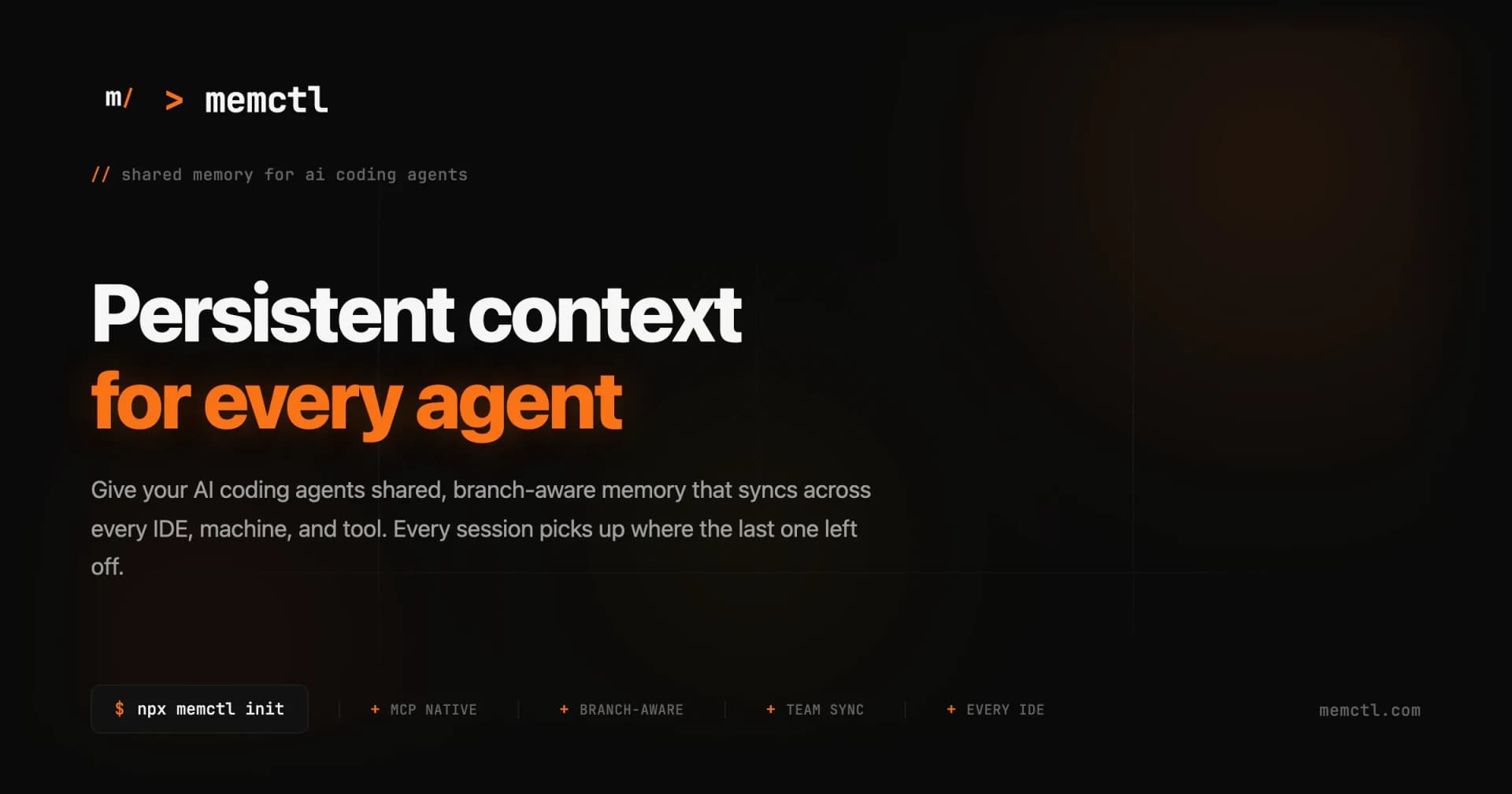
Feature Comparison
| Feature | Cursor | Memctl |
|---|---|---|
| Core Functionality | ||
| Code Generation | AI agents that autonomously write, test, and demo code with cloud agents running in parallel | Does not generate code; provides persistent memory context that improves code generation in other tools |
| Autocomplete | Specialized Tab model predicting next edits with multi-line suggestions at striking speed and precision | No autocomplete functionality; designed as a memory and context layer, not a code editor |
| Context Persistence | Session-based codebase indexing that rebuilds context when opening projects or switching workspaces | Persistent memory scoped by org, project, and branch that loads in 12ms and survives across sessions |
| Integration & Compatibility | ||
| IDE Support | Standalone VS Code fork IDE with additional JetBrains IDE support and terminal-based agent capabilities | Works with Claude Code, Cursor, Copilot, VS Code, JetBrains, Neovim, Windsurf, and Cline via MCP |
| Version Control | Built-in VS Code Git integration with GitHub PR review capabilities through BugBot at $40/user/mo | GitHub-native with branch-aware memory that auto-syncs on push, re-indexes changed files automatically |
| Platform Support | GitHub PR reviews via BugBot, Slack collaboration integration, and terminal agent for CLI workflows | Dashboard, REST API, and MCP server accessible via CLI with SDKs for TypeScript, Python, and Go |
| Team & Enterprise | ||
| Access Control | Role-based access control with SAML/OIDC SSO on Teams plan and SCIM seat management on Enterprise | Organization-level policies for coding standards, security patterns, and forbidden patterns with SSO support |
| Usage Analytics | Usage analytics and reporting dashboard with AI code tracking API and audit logs on Enterprise tier | Full visibility dashboard with MCP read/write logging, memory distribution charts, and real-time activity feeds |
| Deployment Model | Cloud-hosted proprietary platform with no self-hosting option; Enterprise tier includes priority support | Open-source core self-hostable under Apache-2.0; cloud platform adds hosted indexing and team management |
| AI Model & Protocol | ||
| Model Support | Multi-model access to OpenAI GPT-5, Anthropic Opus 4.6, Gemini 3 Pro, Grok, and Cursor's own models | Model-agnostic; works with any AI agent regardless of underlying model through standardized MCP protocol |
| MCP Protocol | Supports MCPs, skills, and hooks for extending agent capabilities within the Cursor IDE environment | MCP is the core protocol; agents read and write memory through MCP tool calls with 12ms response times |
| Agent Capabilities | Autonomous agents that run in parallel using cloud compute, handling builds, tests, and feature demos | Enhances existing agents by providing shared team memory; agents store learnings back for the whole team |
| Data & Security | ||
| Data Privacy | Org-wide privacy mode controls on Teams plan with granular admin and model controls on Enterprise | Self-hostable for full data control; cloud platform provides encryption at rest and GDPR compliance |
| Open Source | Proprietary closed-source VS Code fork with no option to inspect, modify, or self-host the platform | Core MCP server, CLI, and SDKs are open source under Apache-2.0 license on GitHub |
| Audit Trail | AI code tracking API and audit logs available on Enterprise tier for compliance and tracking purposes | Full audit logging with every MCP read/write tracked, available on Business tier and above |
Core Functionality
Code Generation
Autocomplete
Context Persistence
Integration & Compatibility
IDE Support
Version Control
Platform Support
Team & Enterprise
Access Control
Usage Analytics
Deployment Model
AI Model & Protocol
Model Support
MCP Protocol
Agent Capabilities
Data & Security
Data Privacy
Open Source
Audit Trail
How they fit together
Cursor and Memctl serve fundamentally different purposes in the AI development stack. Cursor is a complete AI-powered IDE for writing code, while Memctl is a memory layer that makes any AI coding agent smarter by providing persistent shared context. These tools are complementary rather than competitive.
What each one handles
Use Cursor for:
Choose Cursor if you need a complete AI-powered development environment that handles code generation, autocomplete, and agentic development out of the box. Cursor excels for teams that want a single tool covering the full coding workflow with multi-model AI support, autonomous cloud agents running in parallel, and deep IDE features like GitHub PR reviews via BugBot and Slack integration. The Teams plan at $40/user/mo provides centralized billing, usage analytics, RBAC, and SSO for organizations already standardized on VS Code.
Use Memctl for:
Choose Memctl if your team struggles with AI agents losing context between sessions, duplicating work across team members, or producing inconsistent suggestions. Memctl solves the persistent memory problem that every AI coding tool faces by providing branch-aware shared context that loads in 12ms instead of re-scanning codebases for over a minute. The open-source Apache-2.0 core with self-hosting support makes it ideal for regulated industries and teams needing full data control. At $18/mo for the Pro plan with 25 projects and 10 seats, it adds team-wide AI memory at a fraction of IDE costs.
These roles reflect the available product evidence. Most teams run both; which one owns a given job depends on your stack and team.
Frequently Asked Questions
Can Cursor and Memctl be used together?
Yes, Cursor and Memctl are designed to work together. Memctl explicitly lists Cursor as a supported tool through its MCP protocol integration. When you run Memctl's MCP server alongside Cursor, your Cursor AI agents gain access to persistent, branch-aware memory shared across your entire team. This means Cursor's built-in agents and autocomplete benefit from organizational knowledge, coding conventions, and architectural decisions stored in Memctl, reducing the time agents spend re-learning your codebase each session.
How does Memctl improve AI coding agents that already have codebase indexing like Cursor?
Cursor's codebase indexing scans files to understand project structure, but this context rebuilds each session and stays local to one developer's workspace. Memctl adds a persistent layer on top: architectural decisions, coding conventions, team patterns, and past learnings survive across sessions and are shared across every team member's agents. Memctl reports loading this shared context in 12ms versus the 1 minute 20 seconds a typical agent spends scanning 847 files from scratch. The result is faster agent startup and more consistent suggestions across the team.
What are the key pricing differences between Cursor and Memctl?
Cursor's pricing centers on per-user IDE access: Free hobby tier, $20/mo Pro, $60/mo Pro+, $200/mo Ultra, and $40/user/mo for Teams. Memctl prices by team scale and memory capacity: Free for 3 projects and 1 seat, $5/mo Lite for 10 projects and 3 seats, $18/mo Pro for 25 projects and 10 seats, $59/mo Business for 100 projects and 30 seats, and $149/mo Scale for 150 projects and 100 seats. For a 10-person team, Cursor Teams costs $400/mo while Memctl Pro costs $18/mo, though they serve different purposes and most teams would use both.
Is Memctl open source and can it be self-hosted?
Memctl's core components are open source under the Apache-2.0 license, including the MCP server, CLI, and SDKs for TypeScript, Python, and Go. Teams in regulated industries or with strict data sovereignty requirements can self-host the memory server for full control over their data. The cloud platform adds managed hosting, team management features, hosted indexing, and enterprise capabilities like SSO and audit logs on top of the open-source core. Cursor, by contrast, is a proprietary closed-source VS Code fork with no self-hosting option available.