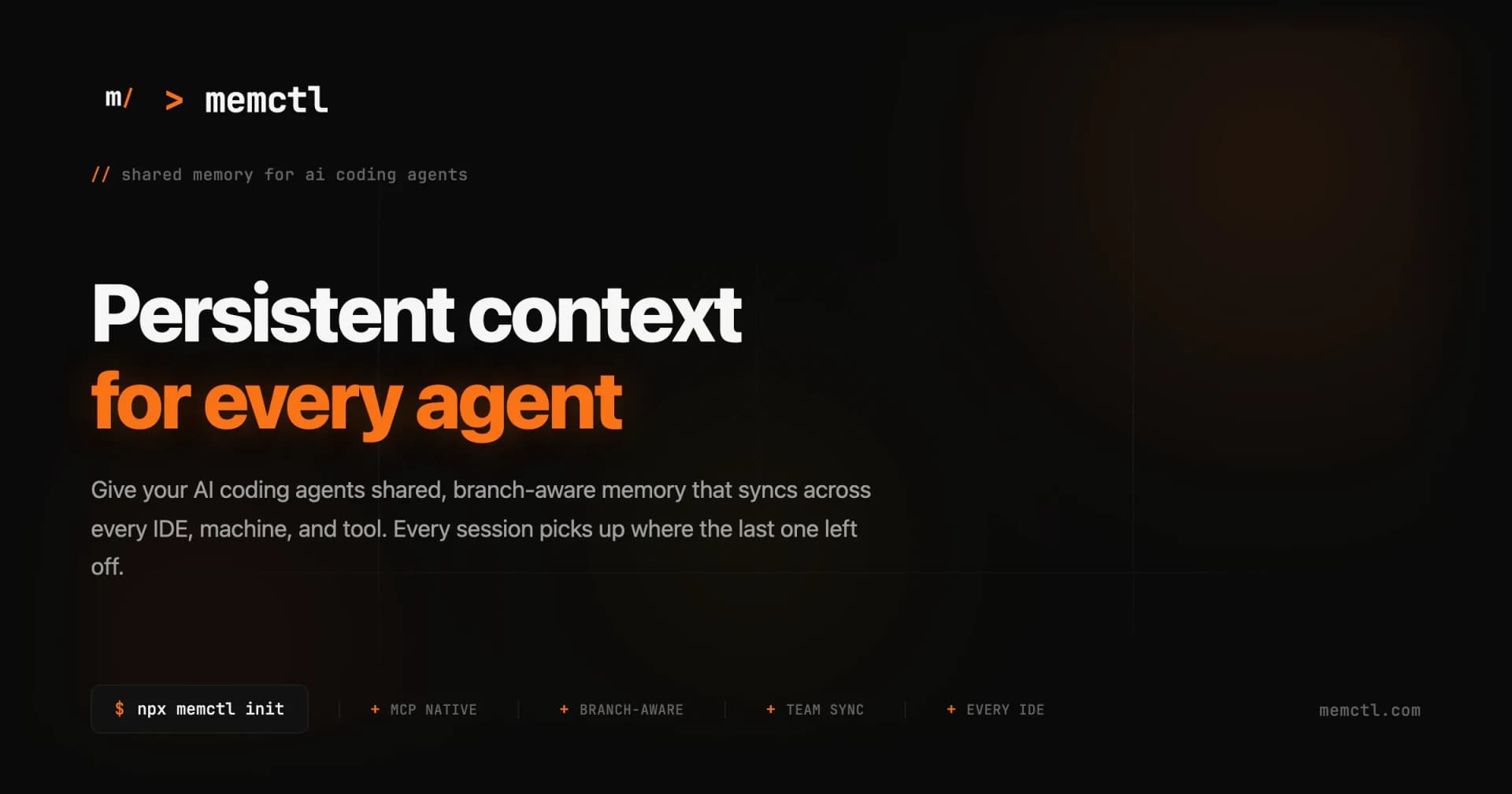
Memctl: product and architecture
Our verdict: Memctl is a promising but early-stage shared-memory layer for AI coding agents, best suited to engineering teams that already use MCP-compatible agents and want project context to persist beyond a single chat or IDE session. This Memctl review finds the core proposition compelling—branch-aware, shared context that follows Git workflows—but its v0.1.0 Public Beta status means teams should adopt it deliberately, with realistic expectations about product maturity and paid-feature detail.
Overview
Memctl is an open-source memory server for AI coding agents. Its purpose is specific: prevent coding agents from starting each session without knowledge of prior architecture decisions, conventions, file organization, or team learnings. Instead of treating an agent interaction as an isolated prompt, Memctl provides persistent, shared context that agents can retrieve and update through the Model Context Protocol (MCP).
The product is positioned as infrastructure for teams using AI-assisted development, not as an AI coding agent itself. Memctl works with agents that support MCP, including Claude Code, Cursor, Copilot, and Windsurf. That distinction matters: it is an enabling layer beneath existing agent workflows, rather than a replacement for the editor, model, or coding interface a team has already chosen.
Memctl’s central differentiator is branch awareness. Context is designed to stay synchronized with Git repositories and branches, so memory can follow the same workflow engineers use for code changes. It also tracks the full history of changes, stores structured memories agents can query, and can be self-hosted—important attributes for teams that need to retain ownership of their data.
The product website identifies Memctl as v0.1.0 Public Beta, which should shape procurement decisions. We recommend Memctl for technically capable teams willing to validate it in a real repository before treating it as a source of record for critical engineering policy. Public adoption signals exist—the site names GitHub, Vercel, Stripe, Supabase, Linear, Notion, Figma, Cloudflare, Prisma, Sentry, PostHog, Datadog, Railway, Shopify, Turso, Upstash, and Grafana—but those names are not enough evidence on their own to establish enterprise-scale deployment patterns or operational reliability.
Key Features and Architecture
Memctl begins with an organization-and-project setup flow: teams create an org and project, authenticate, and allow agents to start building context automatically. This creates a shared scope for knowledge rather than requiring every developer or agent to manually curate a separate local prompt file. The trade-off is organizational setup and authentication overhead; teams need to define which projects and agents should have access before the memory layer is useful.
A setup-check capability verifies configuration, connectivity, and the context an agent can access. This is a practical feature because MCP-based workflows can fail in ways that are otherwise difficult to see: an agent may be connected but lack the expected project knowledge. Memctl provides a direct operational checkpoint instead of leaving teams to infer configuration state from an agent’s answers.
Its repository synchronization model is central to the architecture. After each code push, Memctl syncs repositories, re-indexes changed files, and stores structured memories that agents can query. This is more concrete than a generic “knowledge base” claim: code changes trigger context updates, and changed files are specifically re-indexed. The cost is that teams depend on repository pushes as a key synchronization event, so local work that has not been pushed is outside this described update path.
Agents retrieve context through MCP when a session begins. Memctl returns architecture decisions, coding conventions, and project knowledge to the agent through that protocol. The website states this return happens “in milliseconds,” a meaningful responsiveness claim for an interaction loop where slow retrieval would undermine the benefit of persistent context. Memctl does not require teams to standardize on one branded agent as long as the chosen agent supports MCP.
The write path is equally important. When an agent discovers a pattern or makes an architectural decision, it can store that learning back through MCP; then every agent on the team receives the update. This turns memory into a compounding team asset rather than a static import of repository contents. It also creates a governance concern: the same mechanism that shares useful conventions can spread an incorrect or poorly framed agent-generated decision unless teams establish review expectations.
Project-wide memory covers architecture, file structure, naming conventions, and decision history. Memctl also supports organization-level policies for coding standards, security patterns, and forbidden patterns. For data and platform teams, that policy layer is the most strategically useful part of the feature set: it gives AI coding agents a way to encounter shared engineering constraints without relying entirely on each developer’s manually assembled prompt.
Finally, Memctl is GitHub-native while also working with any Git repository, according to its product materials. Context stays in sync across branches, and the tool is self-hostable. We view the combination of Git-aware context, MCP access, and data ownership as the strongest architectural case for Memctl; the limitation is that the available product data does not specify storage architecture, retention controls, identity model, or security certifications.
Ideal Use Cases
Memctl is strongest for a 10- to 50-person product engineering organization where multiple developers use Claude Code, Cursor, Copilot, or Windsurf on the same repositories. In that setting, AI agents otherwise repeat the same discovery work: locating conventions, understanding component boundaries, and asking why a prior decision was made. Shared MCP-accessible memory directly addresses that repeated context reset, while branch-aware synchronization fits normal pull-request and Git workflows.
A second strong scenario is a data platform or analytics engineering team maintaining a repository of pipelines, transformations, conventions, and infrastructure code. Such teams often rely on institutional knowledge to explain naming rules, architectural choices, and security-sensitive patterns. Memctl’s project-wide memory and organization-level policies can provide those rules to agents alongside repository context, particularly when agents need to apply recurring conventions rather than invent a different approach in each session.
It is also well suited to distributed teams that work across several machines and IDEs. Memctl explicitly syncs context across every IDE, machine, and tool, so a developer is not limited to the agent history on one workstation. That is valuable when a handoff occurs between engineers or when an individual switches from Cursor to another MCP-compatible agent without wanting project knowledge to start from zero.
We recommend Memctl for teams that see AI coding agents as a shared engineering system rather than a set of private, individual productivity tools. Its value grows when agents repeatedly encounter the same project and when a team has decisions worth preserving. A small team working in a short-lived prototype repository may find the setup, governance, and habit change disproportionate to the benefit.
Don’t use Memctl if your primary AI coding workflow does not support MCP. The available product information makes MCP the mechanism through which agents read and write memory, so it is not an optional implementation detail. Also avoid treating Memctl as an automatic replacement for engineering review: it can distribute architecture decisions and policies, but the supplied information does not establish any approval workflow for validating what agents write back.
Strengths & Trade-offs
Memctl’s main strengths are directly tied to its architecture rather than generic claims about developer productivity.
- Shared, persistent agent context: Agents can retain and share project architecture, file structure, naming conventions, and decision history instead of beginning every session with no prior project knowledge.
- MCP-based interoperability: Claude Code, Cursor, Copilot, Windsurf, and other MCP-compatible agents can read and write Memctl memory. Teams can preserve a shared context layer while using different compatible agent interfaces.
- Branch-aware repository synchronization: Memctl works with Git repositories, keeps context synchronized across branches, and re-indexes changed files after pushes. That fits established engineering workflows better than a separate, manually maintained knowledge repository.
- Compounding knowledge loop: Agents can write discovered patterns and architectural decisions back through MCP so subsequent agents receive the update. This is a meaningful capability for organizations trying to make repeated AI use cumulative.
- Policy distribution and ownership options: Organization-level rules can cover coding standards, security patterns, and forbidden patterns, while self-hosting supports teams that want to own their data.
- Accessible entry pricing: The $0 plan supports 3 projects, 1 member, 400 memories per project, and unlimited API calls, giving an individual a low-risk way to test the workflow.
The limitations are just as material and should be addressed before broad rollout.
- Early product maturity: Memctl is
v0.1.0 Public Beta. Teams should not assume the stability, support model, or governance depth of a mature enterprise platform from the supplied evidence. - MCP is a hard dependency: The documented agent interaction relies on MCP. Teams standardized on tools without MCP support cannot get Memctl’s automated read/write workflow as described.
- Push-driven synchronization is a constraint: The stated update flow re-indexes changed files after each push. That leaves a gap between local edits and pushed repository state, which matters when an agent needs the latest unpushed work.
- No documented validation controls for agent-written memory: Agents can write patterns and decisions back for all team agents to receive, but the available information does not specify approval, moderation, or conflict-resolution workflows.
- Free tier is individual-only: Although the $0 plan permits 3 projects, its 1-member limit prevents a genuine shared-team evaluation without upgrading.