Decision comparison
Delta Lake vs Apache Hudi
Delta Lake and Apache Hudi are both excellent open-source lakehouse table formats, but they serve different primary use cases. Delta Lake excels at Databricks-integrated batch workloads with broad engine compatibility and simpler operations, while Apache Hudi leads for streaming-first architectures needing fast upserts and incremental processing.
Direct comparison. These are reviewed substitutes bought for the same job, so the differences below are the ones that decide between them.
Applies to: Choosing between two products of the same kind for one job.
All 2 are open table formats.
Quick Comparison
| Decision factor | Delta Lake | Apache Hudi |
|---|---|---|
| Best For | Databricks-centric lakehouse architectures needing universal format interoperability and batch-heavy ETL workloads | Streaming-first data pipelines requiring fast upserts, incremental processing, and record-level CDC ingestion |
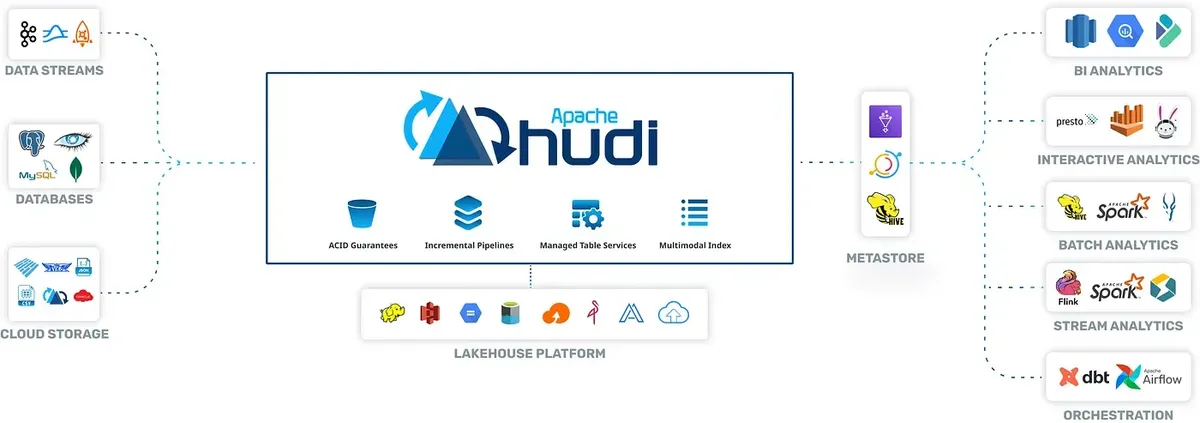
| Architecture | Transaction log-based storage layer using Parquet files with JSON/checkpoint metadata and UniForm cross-format reads | Record-level indexed table format with Copy-on-Write and Merge-on-Read storage types and automatic compaction |
| Pricing Model | Delta Lake is free and open source under the Apache 2.0 license. No license cost for the core Delta Lake format or Delta-rs libraries. Commercial features (Delta Sharing governance, managed Unity Catalog) are available through Databricks Lakehouse Platform with usage-based pricing. Delta Lake is supported natively on AWS, Azure, and Google Cloud platforms. | Apache Hudi is free and open source under the Apache 2.0 license. No license cost for the software. Operational cost covers running Hudi on Spark or Flink, plus object storage (S3, GCS, Azure Blob, HDFS). Commercial managed Hudi services available via Onehouse (Hudi creators), AWS EMR, Databricks, and Google Cloud Dataproc. |
| Ease of Use | Simple SQL-first interface with broad engine compatibility; tight Databricks integration simplifies initial setup significantly | Steeper learning curve requiring understanding of table types, indexing strategies, and compaction tuning for optimal results |
| Scalability | Proven at petabyte scale with scalable metadata handling billions of partitions across distributed Spark clusters | Battle-tested at trillion-record scale at Uber with automatic table services for continuous performance optimization |
| Community/Support | Linux Foundation project with 190+ contributors from 70+ organizations and strong Databricks commercial backing | Apache Software Foundation top-level project with active global community and Onehouse commercial support |
Delta Lake
- Best For:
- Databricks-centric lakehouse architectures needing universal format interoperability and batch-heavy ETL workloads
- Architecture:
- Transaction log-based storage layer using Parquet files with JSON/checkpoint metadata and UniForm cross-format reads
- Pricing Model:
- Delta Lake is free and open source under the Apache 2.0 license. No license cost for the core Delta Lake format or Delta-rs libraries. Commercial features (Delta Sharing governance, managed Unity Catalog) are available through Databricks Lakehouse Platform with usage-based pricing. Delta Lake is supported natively on AWS, Azure, and Google Cloud platforms.
- Ease of Use:
- Simple SQL-first interface with broad engine compatibility; tight Databricks integration simplifies initial setup significantly
- Scalability:
- Proven at petabyte scale with scalable metadata handling billions of partitions across distributed Spark clusters
- Community/Support:
- Linux Foundation project with 190+ contributors from 70+ organizations and strong Databricks commercial backing
Apache Hudi
- Best For:
- Streaming-first data pipelines requiring fast upserts, incremental processing, and record-level CDC ingestion
- Architecture:
- Record-level indexed table format with Copy-on-Write and Merge-on-Read storage types and automatic compaction
- Pricing Model:
- Apache Hudi is free and open source under the Apache 2.0 license. No license cost for the software. Operational cost covers running Hudi on Spark or Flink, plus object storage (S3, GCS, Azure Blob, HDFS). Commercial managed Hudi services available via Onehouse (Hudi creators), AWS EMR, Databricks, and Google Cloud Dataproc.
- Ease of Use:
- Steeper learning curve requiring understanding of table types, indexing strategies, and compaction tuning for optimal results
- Scalability:
- Battle-tested at trillion-record scale at Uber with automatic table services for continuous performance optimization
- Community/Support:
- Apache Software Foundation top-level project with active global community and Onehouse commercial support
Public signals
Verified factual signals only. Bars appear only for like-for-like metrics with five weekly assessments for every tool; missing evidence stays explicit. These signals do not establish enterprise adoption, product quality, or total cost.
| Metric | Delta Lake | Apache Hudi |
|---|---|---|
| Docker Hub pulls(Product adoption) | 39.5k | Not available |
| GitHub commits, 90d(Product adoption) | 355 | 411 |
| GitHub stars(Product adoption) | 8,500+ | 6,000+ |
| Search interest(Market interest) | 5 | 0 |
| Hacker News mentions, 90d(Community interest) | 1 | 0 |
| PyPI weekly downloads(Developer adoption) | 6.6M | 9.1k |
| Stack Overflow questions(Community interest) | 1.4k | 183 |
As of September 14, 2026 — updated weekly.
Health & risk evidence
Observed public-source checks for mapped package versions and repositories.
Delta Lake
September 14, 2026Package vulnerabilities
PyPI · delta-spark@4.4.0
0 vulnerabilities
across 1 package
Repository security score
Not available
Apache Hudi
September 14, 2026Package vulnerabilities
PyPI · hudi@0.4.0
0 vulnerabilities
across 1 package
Repository security score
Not available
Interface Preview
Delta Lake

Apache Hudi
Feature Comparison
| Feature | Delta Lake | Apache Hudi |
|---|---|---|
| Transaction & Consistency | ||
| ACID Transaction Model | Serializable isolation via optimistic concurrency control on a JSON-based transaction log with checkpoint files | Snapshot isolation with non-blocking concurrency controls using timeline-based metadata and multi-version management |
| Conflict Resolution | Automatic retry-based conflict resolution with serializable writes ensuring no lost updates on concurrent commits | Pluggable conflict resolution strategies with OCC and lock-based approaches for longer-running lake transactions |
| Schema Enforcement | Strict schema-on-write enforcement prevents incompatible writes; supports additive schema evolution via mergeSchema option | Schema evolution supports adding, deleting, renaming columns; enforcement fails fast to prevent data corruption in pipelines |
| Data Ingestion & Processing | ||
| Incremental Processing | Change Data Feed captures row-level changes for downstream consumers with batch-oriented incremental reads | Purpose-built incremental processing framework replaces batch pipelines with minute-level latency streaming ingestion |
| Upsert & Delete Operations | MERGE INTO SQL syntax and Scala/Java/Python DML APIs for conditional upserts, updates, and deletes on tables | Record-level fast upserts with pluggable indexing; native support for CDC workloads with out-of-order record handling |
| Streaming Integration | Spark Structured Streaming with exactly-once semantics for unified batch and streaming on same Delta tables | Built-in CDC sources from Debezium and Kafka with native Flink and Spark streaming writers for continuous ingestion |
| Storage & Performance | ||
| Table Storage Types | Single Parquet-based storage format with automatic file compaction, Z-ordering, and liquid clustering for optimization | Dual storage types: Copy-on-Write for read-heavy and Merge-on-Read for write-heavy workloads with automatic compaction |
| Indexing Capabilities | Data skipping via column-level min/max stats, Z-order indexing, and bloom filters for accelerated query performance | Multimodal indexing subsystem with bloom filters, record-level indexes, column stats, and partition-level metadata |
| Table Maintenance | Manual or scheduled OPTIMIZE and VACUUM commands for file compaction, cleanup, and storage management | Fully automated table services continuously orchestrate clustering, compaction, cleaning, file sizing, and indexing |
| Interoperability & Ecosystem | ||
| Cross-Format Compatibility | UniForm enables Delta tables to be read by Iceberg and Hudi clients without data duplication or conversion | Native Parquet and ORC formats with Apache XTable integration for cross-format sync to Iceberg and Delta |
| Query Engine Support | Compatible with Spark, Flink, Presto, Trino, Hive, Snowflake, BigQuery, Athena, Redshift, and Azure Fabric | Supports Spark, Flink, Presto, Trino, Hive, Athena, BigQuery, StarRocks, Apache Doris, Impala, and ClickHouse |
| Cloud Storage Support | Works on S3, ADLS, GCS, HDFS, and local filesystems with platform-agnostic deployment across all major clouds | Supports S3, GCS, ADLS, HDFS, Alibaba Cloud, IBM Cloud, Oracle Cloud, Tencent Cloud, and MinIO object storage |
| Data Management & Governance | ||
| Time Travel & Versioning | Query any historical table version by timestamp or version number; restore tables to previous states for rollback | Query historical data by timestamp with commit-level granularity; roll back to any table version in the timeline |
| Audit & Lineage | Transaction log records every change with full audit trail including operation type, user, timestamp, and metrics | Timeline-based commit history tracks all operations with metadata for debugging data versions and change auditing |
| Data Deduplication | Handled via MERGE operations with user-defined matching conditions; requires explicit dedup logic in pipelines | Built-in deduplication during ingestion with configurable precombine keys for handling duplicate and late-arriving records |
Transaction & Consistency
ACID Transaction Model
Conflict Resolution
Schema Enforcement
Data Ingestion & Processing
Incremental Processing
Upsert & Delete Operations
Streaming Integration
Storage & Performance
Table Storage Types
Indexing Capabilities
Table Maintenance
Interoperability & Ecosystem
Cross-Format Compatibility
Query Engine Support
Cloud Storage Support
Data Management & Governance
Time Travel & Versioning
Audit & Lineage
Data Deduplication
Which to choose
Delta Lake and Apache Hudi are both excellent open-source lakehouse table formats, but they serve different primary use cases. Delta Lake excels at Databricks-integrated batch workloads with broad engine compatibility and simpler operations, while Apache Hudi leads for streaming-first architectures needing fast upserts and incremental processing.
Best-fit scenarios
Choose Delta Lake if:
Choose Delta Lake if your organization relies on Databricks or needs broad query engine compatibility with minimal operational overhead. Delta Lake's simpler single-format storage model and SQL-first approach make it easier to adopt for teams already running Spark workloads. The UniForm feature is particularly valuable if you need to serve data to Iceberg or Hudi consumers without maintaining separate copies. It is a strong choice for batch-heavy ETL pipelines, data warehousing use cases, and environments where operational simplicity is a prominent consideration alongside streaming latency.
Choose Apache Hudi if:
Choose Apache Hudi if your architecture demands real-time incremental processing, frequent upserts, or CDC-driven streaming pipelines. Hudi's dual storage types (Copy-on-Write and Merge-on-Read) give you fine-grained control over read-write performance tradeoffs, and the built-in multimodal indexing delivers quick writes on sizable tables. The automatic table services eliminate manual maintenance overhead at scale. Hudi is the better fit for organizations handling high-velocity data streams, complex CDC workloads from databases like PostgreSQL and MySQL, or environments requiring minute-level analytics freshness.
These scenarios reflect the available product evidence. Your requirements, existing stack, and team expertise should guide the final decision.
Frequently Asked Questions
What are the infrastructure costs of running Delta Lake vs Apache Hudi?
Both Delta Lake and Apache Hudi are free open-source projects under the Apache 2.0 license, so there are no software licensing costs. Your expenses come from compute and storage infrastructure. For Delta Lake on Databricks, plans start at $0.07 per DBU for Standard and $0.22 per DBU for Premium, with Enterprise pricing available on request. For Apache Hudi, the commercial managed service Onehouse offers a free Starter tier for up to 5TB of data, with Growth plans starting at $0.07 per GB per month. Running either project self-managed on Spark or Flink means you only pay for cloud compute instances and object storage fees determined by your cloud provider.
Can Delta Lake and Apache Hudi read each other's table formats?
Yes, cross-format interoperability has improved significantly. Delta Lake's UniForm feature allows Delta tables to be read natively by Hudi and Iceberg clients without data conversion or duplication. On the Hudi side, Apache XTable (formerly OneTable, an incubating Apache project) enables syncing Hudi table metadata to Delta Lake and Iceberg formats. This means organizations are no longer locked into a single table format. However, write interoperability is still one-directional in most cases: you write in your primary format and expose read-only views to other formats. For production deployments, we recommend standardizing on one primary format and using interoperability layers for cross-team access.
Which is better for real-time streaming data pipelines?
Apache Hudi has a clear edge for real-time streaming workloads. Hudi was purpose-built for incremental processing with minute-level analytics latency, and it includes built-in connectors for Kafka, Debezium CDC, and native Flink streaming writers. The Merge-on-Read table type is specifically optimized for high write throughput with fast upserts. Delta Lake supports streaming through Spark Structured Streaming with exactly-once semantics and its Change Data Feed, but it was originally designed with batch-first architecture. For sub-minute latency requirements and high-frequency CDC from databases like PostgreSQL and MySQL, Hudi's architecture is more naturally suited. For batch-dominant workloads with occasional streaming, Delta Lake performs comparably.
How do Delta Lake and Apache Hudi handle table maintenance and optimization?
This is one of the biggest operational differences between the two. Apache Hudi provides fully automated table services that continuously schedule and orchestrate clustering, compaction, cleaning, file sizing, and indexing without manual intervention. This means Hudi tables stay optimized as data volumes grow. Delta Lake requires more manual or scheduled maintenance. You run OPTIMIZE commands for file compaction and Z-ordering, VACUUM for cleaning up old files, and ANALYZE TABLE for statistics collection. On Databricks, some of these are automated through predictive optimization, but self-managed Delta Lake deployments need explicit scheduling via Airflow or similar orchestrators. For large-scale deployments managing hundreds of tables, Hudi's automatic maintenance can significantly reduce operational burden compared to Delta Lake's more hands-on approach.