Decision comparison
Fivetran vs Kestra
Fivetran and Kestra serve fundamentally different roles in the modern data stack. Fivetran excels as a fully managed ELT ingestion platform that eliminates connector maintenance, while Kestra provides a general-purpose orchestration layer for coordinating diverse workflows across data, infrastructure, and AI. Most teams that need both data ingestion and workflow orchestration will use these tools together rather than choosing one over the other.
Used together. These are normally used together rather than chosen between. The comparison explains what each one does in the stack.
These are different kinds of product — ELT Platform and Workflow Orchestrator.
Quick Comparison
| Decision factor | Fivetran | Kestra |
|---|---|---|
| Primary Function | Managed ELT data ingestion | General-purpose workflow orchestration |
| Deployment Model | Fully managed SaaS with hybrid deployment option | Self-hosted (Docker/K8s) or managed cloud |
| Connector/Plugin Count | 700+ pre-built connectors | 1200+ plugins |
| Pricing Approach | Fivetran is consumption-priced on monthly active rows and quoted through its own estimator. The plans are Free, Standard, Enterprise and Business Critical. The Free plan covers up to 500,000 monthly active rows for connections, 3,500 for activations and 5,000 model runs. Fivetran advertises savings of up to 22% on an annual contract. No per-plan price is published. | Kestra publishes no amounts. The Open Source edition is free and self-hosted under Apache-2.0; Cloud Edition and Enterprise Edition are quote-only. Enterprise support comes at Standard, Premium or Platinum level, differing in channels, SLA and coverage. |
| Best For | Teams needing automated, zero-maintenance data ingestion | Teams orchestrating diverse workflows across data, infra, and AI |
Fivetran
- Primary Function:
- Managed ELT data ingestion
- Deployment Model:
- Fully managed SaaS with hybrid deployment option
- Connector/Plugin Count:
- 700+ pre-built connectors
- Pricing Approach:
- Fivetran is consumption-priced on monthly active rows and quoted through its own estimator. The plans are Free, Standard, Enterprise and Business Critical. The Free plan covers up to 500,000 monthly active rows for connections, 3,500 for activations and 5,000 model runs. Fivetran advertises savings of up to 22% on an annual contract. No per-plan price is published.
- Best For:
- Teams needing automated, zero-maintenance data ingestion
Kestra
- Primary Function:
- General-purpose workflow orchestration
- Deployment Model:
- Self-hosted (Docker/K8s) or managed cloud
- Connector/Plugin Count:
- 1200+ plugins
- Pricing Approach:
- Kestra publishes no amounts. The Open Source edition is free and self-hosted under Apache-2.0; Cloud Edition and Enterprise Edition are quote-only. Enterprise support comes at Standard, Premium or Platinum level, differing in channels, SLA and coverage.
- Best For:
- Teams orchestrating diverse workflows across data, infra, and AI
Public signals
Verified factual signals only. Bars appear only for like-for-like metrics with five weekly assessments for every tool; missing evidence stays explicit. These signals do not establish enterprise adoption, product quality, or total cost.
| Metric | Fivetran | Kestra |
|---|---|---|
| GitHub commits, 90d(Developer adoption) | 19 | Not available |
| GitHub stars(Developer adoption) | 134 | Not available |
| Search interest(Market interest) | 1 | 0 |
| Hacker News mentions, 90d(Community interest) | 3 | 0 |
| Product Hunt comments(Community interest) | 9 | 42 |
| Product Hunt rating(Community interest) | 5.0/5 | 5.0/5 |
| Product Hunt reviews(Community interest) | 1 | 1 |
| Product Hunt votes(Community interest) | 85 | 470 |
| PyPI weekly downloads(Developer adoption) | 29.0k | 2.4M |
| Stack Overflow questions(Community interest) | 22 | Not available |
| Docker Hub pulls(Product adoption) | Not available | 2.6M |
| GitHub commits, 90d(Product adoption) | Not available | 1.4k |
| GitHub stars(Product adoption) | Not available | 28,000+ |
As of September 21, 2026 — updated weekly.
Health & risk evidence
Observed public-source checks for mapped package versions and repositories.
Fivetran
September 21, 2026Package vulnerabilities
PyPI · fivetran-connector-sdk@2.12.1
0 vulnerabilities
across 1 package
Repository security score
Not available
Kestra
September 21, 2026Package vulnerabilities
PyPI · kestra@2.0.0
0 vulnerabilities
across 1 package
Repository security score
github.com/kestra-io/kestra
5.0/10
Interface Preview
Kestra
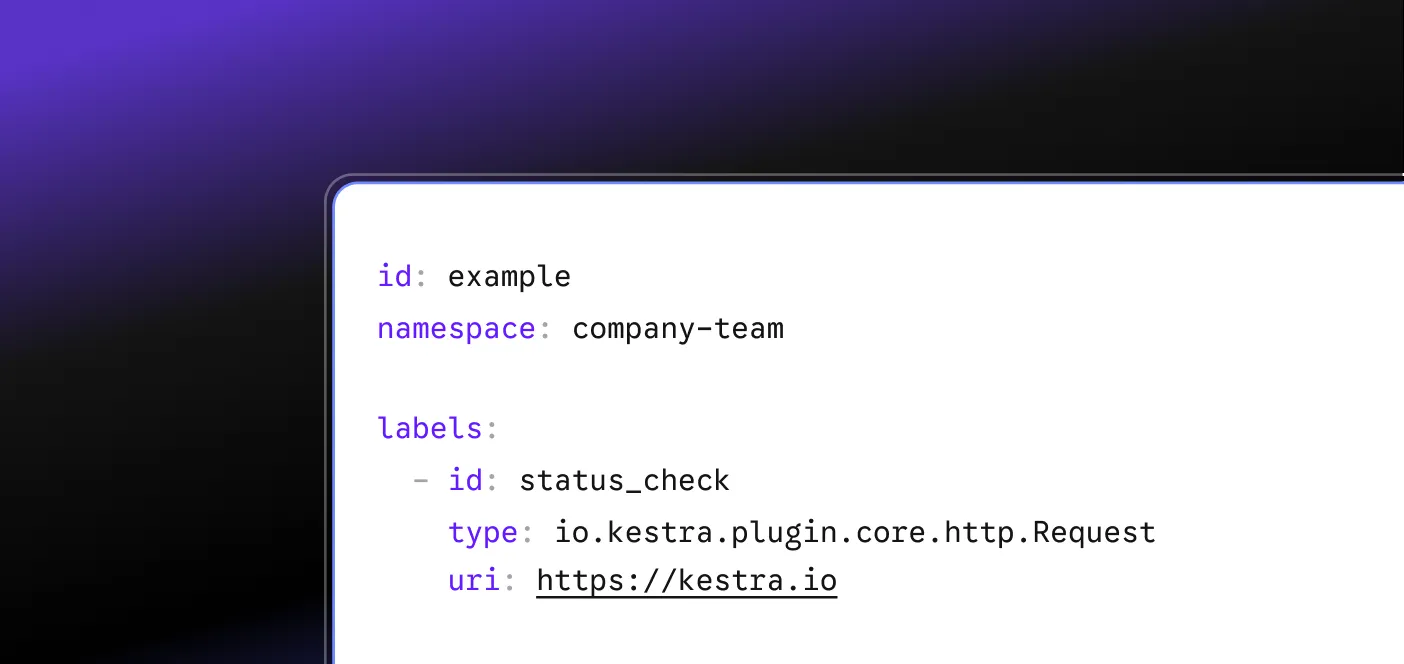
Feature Comparison
| Feature | Fivetran | Kestra |
|---|---|---|
| Data Integration | ||
| Pre-built data connectors | 700+ fully managed connectors for SaaS, databases, ERPs, and files | Integrations available through plugin system; not connector-focused |
| Change data capture (CDC) | Built-in log-based CDC for efficient database replication | Not a core feature; requires external tools or custom scripts |
| Schema evolution handling | Automatic schema migration and drift detection (22.2M+ changes/month) | No built-in schema management; handled by downstream tools |
| Orchestration & Workflow | ||
| Workflow definition | UI-driven connector configuration with scheduling controls | Declarative YAML with branching, loops, parallelism, and failure handling |
| Event-driven triggers | Schedule-based syncs (15-min to real-time depending on tier) | Native triggers for webhooks, Kafka, S3/GCS/Azure files, message queues, and APIs |
| Multi-language support | Connector SDK for custom connectors; no general scripting | Execute tasks in Python, R, Java, Julia, Ruby, Bash, or any language |
| Deployment & Operations | ||
| Deployment options | Fully managed SaaS; hybrid deployment available on Enterprise tier | Self-hosted via Docker/Kubernetes/VM, enterprise on-prem, or managed cloud |
| API access | REST API for pipeline management included in all tiers | API-first design; full coverage across workflow operations and administration |
| Infrastructure as Code | Terraform provider available for connector management | Terraform provider, Git sync, CI/CD integration, and version-controlled YAML flows |
| Security & Compliance | ||
| Compliance certifications | SOC 1 & 2, GDPR, HIPAA BAA, ISO 27001, PCI DSS Level 1, HITRUST | Enterprise edition includes RBAC, SSO, and audit logs; certifications not listed |
| Access controls | Role-based access control on all tiers; custom roles on Enterprise | RBAC and multi-tenancy available in Enterprise edition |
| Data residency | Hybrid deployment keeps data in your environment; customer-managed encryption keys on Business Critical | Full control via self-hosting; air-gapped deployments supported in Enterprise |
| Ecosystem & Extensibility | ||
| Transformation support | Built-in dbt integration with Quickstart data models; rELT for reverse ETL | Orchestrates dbt, Airbyte, Spark, and quality checks within workflow definitions |
| Custom extensibility | Connector SDK for building custom source connectors; partner-built connector ecosystem | Open plugin architecture; build custom plugins in Java with full execution semantics |
| Observability | Monitoring dashboards with sync health logs, alerts, and schema change tracking | Built-in execution timeline, per-task logs, outputs visualization, and external log aggregator support |
Data Integration
Pre-built data connectors
Change data capture (CDC)
Schema evolution handling
Orchestration & Workflow
Workflow definition
Event-driven triggers
Multi-language support
Deployment & Operations
Deployment options
API access
Infrastructure as Code
Security & Compliance
Compliance certifications
Access controls
Data residency
Ecosystem & Extensibility
Transformation support
Custom extensibility
Observability
How they fit together
Fivetran and Kestra serve fundamentally different roles in the modern data stack. Fivetran excels as a fully managed ELT ingestion platform that eliminates connector maintenance, while Kestra provides a general-purpose orchestration layer for coordinating diverse workflows across data, infrastructure, and AI. Most teams that need both data ingestion and workflow orchestration will use these tools together rather than choosing one over the other.
What each one handles
Use Fivetran for:
Data teams that need reliable, zero-maintenance data ingestion from SaaS apps, databases, and ERPs into a cloud warehouse. Fivetran is the stronger choice when your primary challenge is centralizing data from dozens of sources without dedicating engineering time to building and maintaining connectors.
Use Kestra for:
Engineering teams that need a flexible orchestration platform to coordinate data pipelines, infrastructure automation, and AI workflows. Kestra is the stronger choice when you require language-agnostic task execution, event-driven triggers, and full control over your deployment environment with an open-source foundation.
These roles reflect the available product evidence. Most teams run both; which one owns a given job depends on your stack and team.
Frequently Asked Questions
Can Fivetran and Kestra be used together?
Yes. A common architecture uses Fivetran for automated data ingestion into a warehouse, then Kestra to orchestrate downstream transformations, quality checks, and data activation workflows. Kestra can trigger workflows based on Fivetran sync completions via webhooks or API triggers.
Is Kestra a direct replacement for Fivetran?
No. Kestra is a workflow orchestration platform, not a managed connector service. While you can build data ingestion workflows in Kestra using plugins or custom scripts, you would need to handle connector maintenance, schema evolution, and CDC yourself. Fivetran handles all of that automatically.
Which tool has lower total cost of ownership for small teams?
Kestra's open-source edition is free forever for self-hosted deployments, making it cost-effective if you have the infrastructure expertise to manage it. Fivetran's free tier provides 500,000 Monthly Active Rows at no cost, which covers many small-scale ingestion needs without any infrastructure management overhead.
Does Kestra support the same number of data sources as Fivetran?
The tools measure integrations differently. Fivetran offers 700+ purpose-built data connectors that handle extraction, schema mapping, and incremental loading automatically. Kestra provides 1900+ plugins and integrations that cover a broader range of tasks beyond data ingestion, including infrastructure automation, CI/CD, and AI workflows.
Which tool is better for teams already using dbt?
Both integrate with dbt. Fivetran provides native dbt integration with Quickstart data models that accelerate modeling on ingested data. Kestra can orchestrate dbt runs as part of larger workflow pipelines, giving you more control over when and how transformations execute alongside other tasks.