Kestra: product and architecture
Our verdict in this Kestra review: Kestra is a strong fit for engineering teams that want workflow orchestration expressed as code without giving up a low-code operational interface. Its declarative YAML approach, event-driven triggers, Git sync, remote execution, and 600+ plugins give it a broad orchestration remit across data engineering, automation, DevOps, ETL, and AI-agent-adjacent work. We recommend Kestra for teams that need one control plane for varied workflows and are prepared to standardize on its YAML-based model; avoid it when your primary need is a narrowly focused data-ingestion product or when your organization cannot invest in operating disciplined workflow definitions.
Overview
Kestra positions itself as an open-source workflow orchestration platform for engineers who need to build and govern workflows as Everything-as-Code while retaining a UI-driven operating experience. Its central proposition is direct: define flows in YAML, work from an embedded code editor, execute from the UI, and scale on infrastructure chosen by the team. That is a practical middle ground for organizations where developers need code-oriented controls but operators and analysts also need visibility into workflow state.
The platform describes itself as addressing a recurring orchestration problem: automation tools can sideline developers and leave organizations with fragmented systems. Kestra brings together a low-code UI, full-code API, Git synchronization, remote execution, and more than 600 plugins. The benefit is breadth, but the trade-off is that teams must establish conventions for YAML, version control, plugin selection, and ownership rather than treating orchestration as an isolated scheduling task.
Public adoption signals are substantial, but they should not be treated as proof of enterprise suitability for every use case. Kestra’s website cites 750+ contributors, 120k deployments, and 1b+ workflows executed, while its GitHub repository records 27,793 stars. The repository’s latest release is v1.3.30, dated July 28, 2026, and its last push was August 13, 2026; these are useful signs of public activity, not a substitute for validating support, governance, and operational requirements in your own environment.
Kestra is best understood as a general orchestration platform rather than only a data-pipeline scheduler. Its repository topics include data engineering, data orchestration, DevOps, ETL, automation, control plane, and AI agents, and the primary implementation language is Java. That scope is valuable for data leaders seeking consolidation, but it also means a team should decide where Kestra is the system of record for orchestration and where specialist tools should remain in place.
Key Features and Architecture
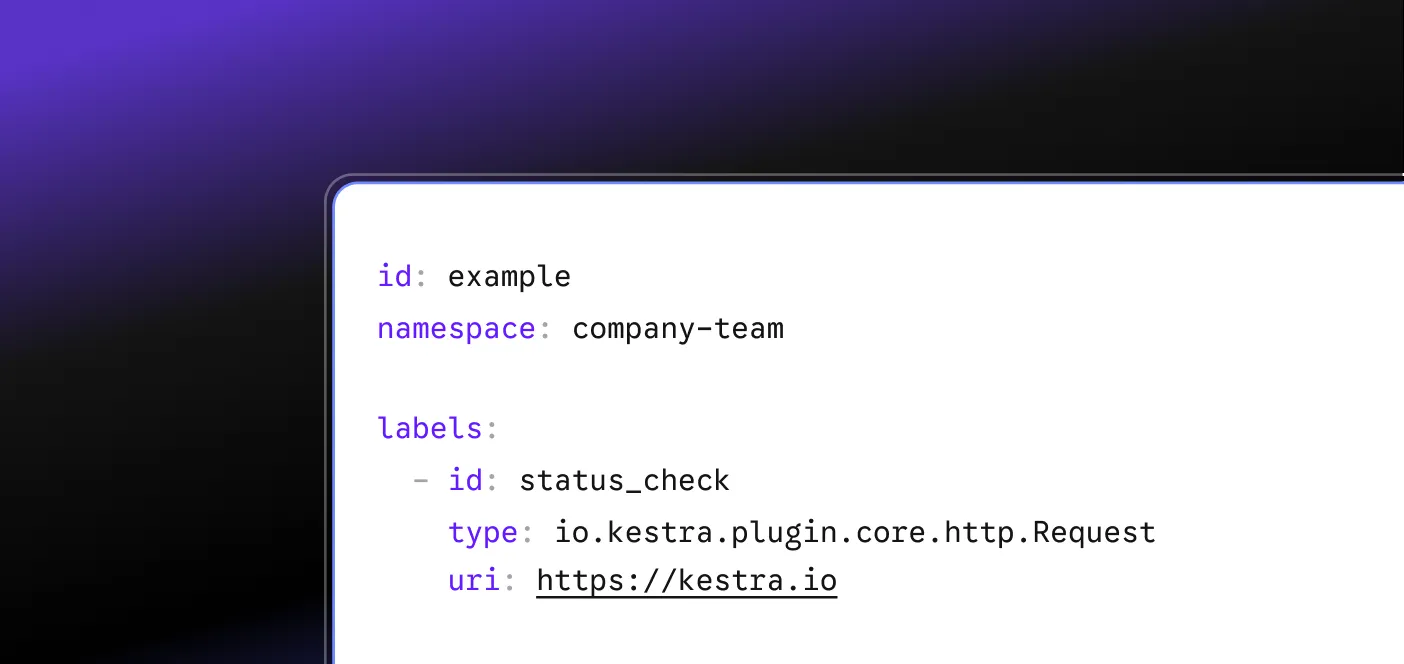
Kestra’s core authoring model is declarative orchestration. Teams define flows in YAML, which gives workflow logic a text-based form that can be maintained with source-control practices rather than being trapped in a visual-only canvas. The embedded Code Editor and direct UI execution create a practical authoring loop, but YAML standardization is still a real engineering responsibility: inconsistent templates and naming conventions will weaken the benefits of declarative workflows.
Event-based triggering is one of Kestra’s most important technical capabilities. Workflows can run on schedules, through webhooks, APIs, event-based triggers, or in real time with stated millisecond latency. This lets a single orchestration model handle recurring batch jobs alongside external events, though teams should validate trigger semantics and failure behavior against their own event sources before using it for mission-critical processes.
The platform also supplies execution controls that matter in production operations:
- Retries and failure policies let teams define how task failures are handled instead of relying solely on manual reruns.
- Timeouts and concurrency limits provide explicit execution boundaries for tasks and flows.
- Worker group assignment and task runners provide execution-placement controls for workloads that need to run in designated environments.
- Automatic log capture centralizes execution output for review and troubleshooting.
- Error handling and conditional branching let workflows respond differently to success, failure, and runtime conditions.
- High concurrency, plugin versioning, external log aggregators, and an internal secret manager are listed under Kestra’s Scale & Reliability capabilities.
Kestra’s architecture is explicitly designed for remote execution: tasks can run anywhere and in any language. That is a meaningful differentiator for heterogeneous estates, especially where data workloads, operational automation, and application workflows cannot all run in the same environment. The cost is governance complexity: “run anywhere” requires teams to define where tasks are allowed to execute, how secrets are managed, and how logs are retained.
Git sync and the full-code API complement the YAML flow model. Git synchronization makes workflow definitions compatible with review-based development processes, while the API provides a programmatic path for teams that do not want the UI to be their only integration point. Kestra also states that its YAML flows can scale to any infrastructure and frames this as no vendor lock-in; the concrete evidence supplied is the YAML definition model, embedded editor, UI execution, and infrastructure flexibility, not a guarantee that migrations will be effortless.
The official feature material presents outcomes of 6x faster infrastructure delivery, 90% lower legacy tooling cost, 10x faster pipeline delivery, 90% fewer manual backfills, and 50x less pipeline maintenance. Treat these as vendor-provided outcome claims, not independently established benchmarks. They are useful hypotheses to test during an evaluation, particularly for organizations replacing manual backfill practices or fragmented legacy automation.
Ideal Use Cases
Kestra is well suited to a data engineering team of roughly 5 to 20 people that manages both scheduled pipelines and event-triggered operational workflows. Such a team can use YAML definitions and Git sync to review changes, then rely on retries, timeout controls, concurrency limits, and automatic log capture to operate workflows consistently. The platform is particularly compelling when the team needs to orchestrate work in multiple execution environments rather than forcing every task into one runtime.
A second strong use case is a data organization that is consolidating ETL, data-orchestration, and broader automation workflows under a shared control plane. Kestra’s stated 600+ plugins, full-code API, remote execution, and ability to run tasks in any language make it relevant where workflow inputs and outputs extend beyond a single data stack. We recommend it for data leaders who have a concrete consolidation goal and can set ownership rules across analytics engineering, data engineering, and platform engineering.
Kestra also fits teams handling event-responsive processes where a schedule alone is insufficient. A workflow can be initiated through webhooks, APIs, event-based triggers, or real-time triggers with millisecond latency, while conditional branching and failure policies provide control over downstream behavior. This is useful for organizations whose operational workflow starts with an external system event and must coordinate follow-on data or automation work.
For a larger platform team, worker groups, task runners, high concurrency, plugin versioning, external log aggregators, and an internal secret manager make Kestra relevant to scale-and-reliability requirements. The available material does not quantify maximum throughput, maximum worker count, or supported deployment topology, so capacity planning still requires direct validation. Do not treat the cited 120k deployments or 1b+ workflows executed as a performance guarantee for a particular workload size.
Don’t use Kestra if the requirement is solely to move data between sources and destinations with no broader need for orchestration, scheduling, event handling, or execution controls. In that situation, a specialized ingestion-focused evaluation may be more appropriate than adopting a general workflow platform. Also avoid it if your team cannot commit to maintaining YAML workflow definitions and Git-based change practices; its declarative model is a strength only when those operating disciplines are real.
Strengths & Trade-offs
Kestra’s strengths are concrete, but each one comes with an operational cost. In our evaluation, its clearest advantage is the combination of declarative YAML workflows with UI execution, Git synchronization, and a full-code API. That makes it more suitable than a UI-only automation approach for teams that need reviewable workflow definitions, but it requires engineering standards around repositories, flow design, and change control.
Pros
- YAML-based declarative orchestration makes workflow definitions text-based and maintainable through Git-oriented processes rather than depending only on a graphical interface.
- Schedules, webhooks, APIs, event-based triggers, and stated millisecond-latency real-time triggering support more than one orchestration pattern in the same platform.
- Retries, failure policies, timeouts, concurrency limits, conditional branching, and automatic log capture provide production controls directly in the orchestration layer.
- Remote execution enables tasks to run anywhere and in any language, which is useful when data and automation workloads span different environments.
- More than 600 plugins provide breadth for teams trying to reduce fragmentation across workflow tooling.
- The Apache-2.0 license and public repository activity, including 27,793 GitHub stars and v1.3.30, give evaluators concrete open-source signals to examine.
Cons
- Kestra’s YAML-first model is weak for teams that want orchestration with no code-like configuration discipline; flow quality depends on conventions that the platform cannot create for you.
- The Free tier is explicitly limited to one user, making it unsuitable as the stated free collaboration option for a multi-person data team.
- Plan-level feature mapping is incomplete in the supplied pricing data: Scale & Reliability capabilities are listed, but their availability by Free, Pro, and Business tier is not specified.
- Neither paid edition carries a published price, so a managed or enterprise deployment cannot be budgeted without a quote.
- “Run tasks anywhere” increases flexibility but also increases the need to govern execution placement, logs, worker groups, and secrets across environments.
The final trade-off is scope. Kestra’s broad positioning across automation, data orchestration, DevOps, ETL, and AI-agent topics can reduce tool sprawl, but a broader control plane demands stronger platform ownership. Teams that only need a narrow pipeline function should resist adopting it merely because it can do more.