Decision comparison
Dagster vs Kestra
Dagster excels at asset-centric data orchestration for Python-heavy data engineering teams, while Kestra provides a language-agnostic, event-driven platform with broader orchestration scope covering data, infrastructure, and AI workflows from a single declarative interface.
Architecture choice. These take different approaches to the same problem. Read the table as a fit question rather than a feature race.
All 2 are workflow orchestrators.
Quick Comparison
| Decision factor | Dagster | Kestra |
|---|---|---|
| Orchestration Model | Asset-centric orchestration treating pipelines as data asset collections with built-in lineage graphs and dependency tracking | Declarative YAML-based orchestration with event-driven triggers, webhooks, APIs, and real-time execution capabilities |
| Configuration Language | Python-native with decorators and type annotations, strong IDE support, unit testing, and CI/CD-native workflows | YAML declarative syntax with embedded code editor, Git sync in both directions, and Terraform provider integration |
| Plugin Ecosystem | Native integrations for Snowflake, BigQuery, dbt, Databricks, Fivetran, Great Expectations, and Spark out of the box | 1,200+ plugins covering databases, warehouses, cloud services, CI/CD, and security tools with custom plugin support |
| Deployment Options | Self-hosted single server, Kubernetes, or managed Dagster Cloud with hybrid bring-your-own-infrastructure patterns | Docker, Kubernetes via Helm charts, single-VM setups, plus Enterprise cloud, on-prem, and air-gapped deployments |
| Community Adoption | 16,000+ GitHub stars with Apache-2.0 license, Python-based, latest release 1.13.1 as of April 2026 | 28,000+ GitHub stars with Apache-2.0 license, Java-based, 120k deployments, 1B+ workflows executed globally |
| Pricing Entry Point | Open-source self-hosted free (Apache-2.0), Solo Plan $10/mo, Starter Plan $100/mo, Starter $1200/mo, Pro and Enterprise Plan contact sales | Kestra publishes no amounts. The Open Source edition is free and self-hosted under Apache-2.0; Cloud Edition and Enterprise Edition are quote-only. Enterprise support comes at Standard, Premium or Platinum level, differing in channels, SLA and coverage. |
Dagster
- Orchestration Model:
- Asset-centric orchestration treating pipelines as data asset collections with built-in lineage graphs and dependency tracking
- Configuration Language:
- Python-native with decorators and type annotations, strong IDE support, unit testing, and CI/CD-native workflows
- Plugin Ecosystem:
- Native integrations for Snowflake, BigQuery, dbt, Databricks, Fivetran, Great Expectations, and Spark out of the box
- Deployment Options:
- Self-hosted single server, Kubernetes, or managed Dagster Cloud with hybrid bring-your-own-infrastructure patterns
- Community Adoption:
- 16,000+ GitHub stars with Apache-2.0 license, Python-based, latest release 1.13.1 as of April 2026
- Pricing Entry Point:
- Open-source self-hosted free (Apache-2.0), Solo Plan $10/mo, Starter Plan $100/mo, Starter $1200/mo, Pro and Enterprise Plan contact sales
Kestra
- Orchestration Model:
- Declarative YAML-based orchestration with event-driven triggers, webhooks, APIs, and real-time execution capabilities
- Configuration Language:
- YAML declarative syntax with embedded code editor, Git sync in both directions, and Terraform provider integration
- Plugin Ecosystem:
- 1,200+ plugins covering databases, warehouses, cloud services, CI/CD, and security tools with custom plugin support
- Deployment Options:
- Docker, Kubernetes via Helm charts, single-VM setups, plus Enterprise cloud, on-prem, and air-gapped deployments
- Community Adoption:
- 28,000+ GitHub stars with Apache-2.0 license, Java-based, 120k deployments, 1B+ workflows executed globally
- Pricing Entry Point:
- Kestra publishes no amounts. The Open Source edition is free and self-hosted under Apache-2.0; Cloud Edition and Enterprise Edition are quote-only. Enterprise support comes at Standard, Premium or Platinum level, differing in channels, SLA and coverage.
Public signals
Verified factual signals only. Bars appear only for like-for-like metrics with five weekly assessments for every tool; missing evidence stays explicit. These signals do not establish enterprise adoption, product quality, or total cost.
| Metric | Dagster | Kestra |
|---|---|---|
| Docker Hub pulls(Developer adoption) | 6.2M | Not available |
| GitHub commits, 90d(Product adoption) | 265 | 1.4k |
| GitHub stars(Product adoption) | 16,000+ | 28,000+ |
| Search interest(Market interest) | 1 | 0 |
| Hacker News mentions, 90d(Community interest) | 3 | 0 |
| Product Hunt comments(Community interest) | 11 | 42 |
| Product Hunt rating(Community interest) | 5.0/5 | 5.0/5 |
| Product Hunt reviews(Community interest) | 1 | 1 |
| Product Hunt votes(Community interest) | 112 | 470 |
| PyPI weekly downloads(Product adoption) | 1.8M | Not available |
| Stack Overflow questions(Community interest) | 171 | Not available |
| Docker Hub pulls(Product adoption) | Not available | 2.6M |
| PyPI weekly downloads(Developer adoption) | Not available | 2.4M |
As of September 21, 2026 — updated weekly.
Health & risk evidence
Observed public-source checks for mapped package versions and repositories.
Dagster
September 21, 2026Package vulnerabilities
PyPI · dagster@1.13.23
0 vulnerabilities
across 1 package
Repository security score
github.com/dagster-io/dagster
5.1/10
Kestra
September 21, 2026Package vulnerabilities
PyPI · kestra@2.0.0
0 vulnerabilities
across 1 package
Repository security score
github.com/kestra-io/kestra
5.0/10
Interface Preview
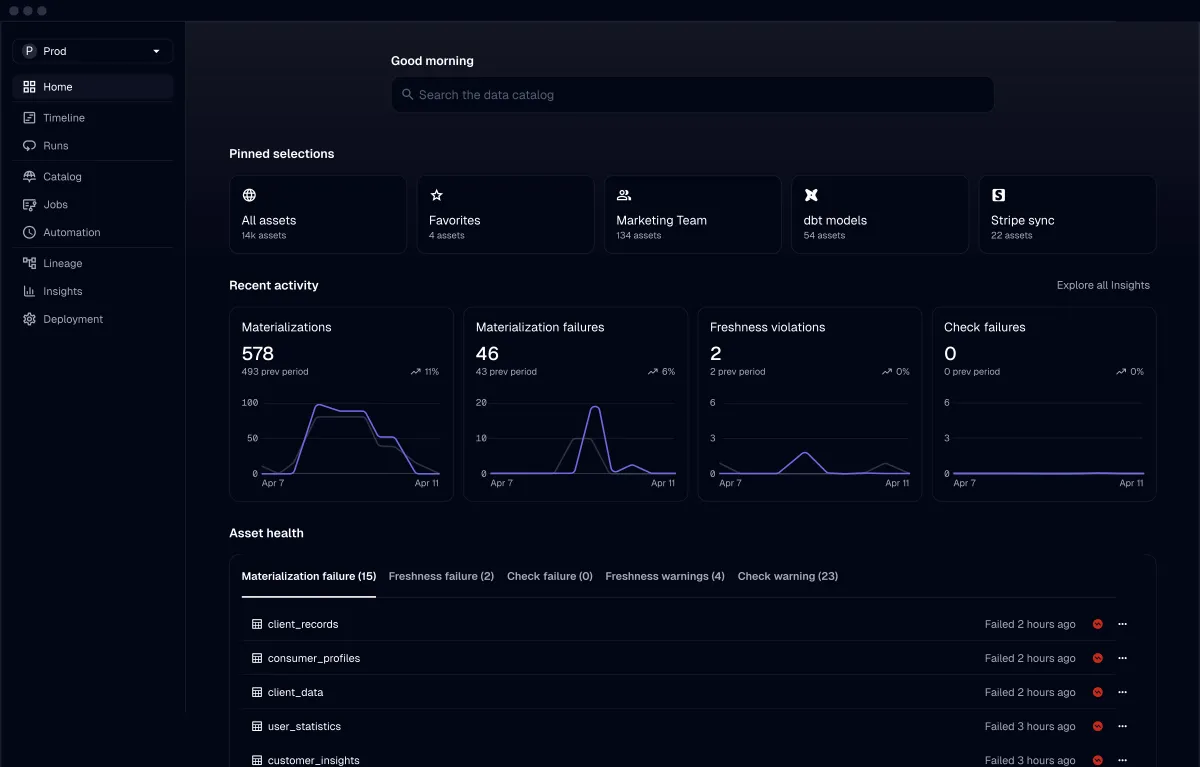
Dagster
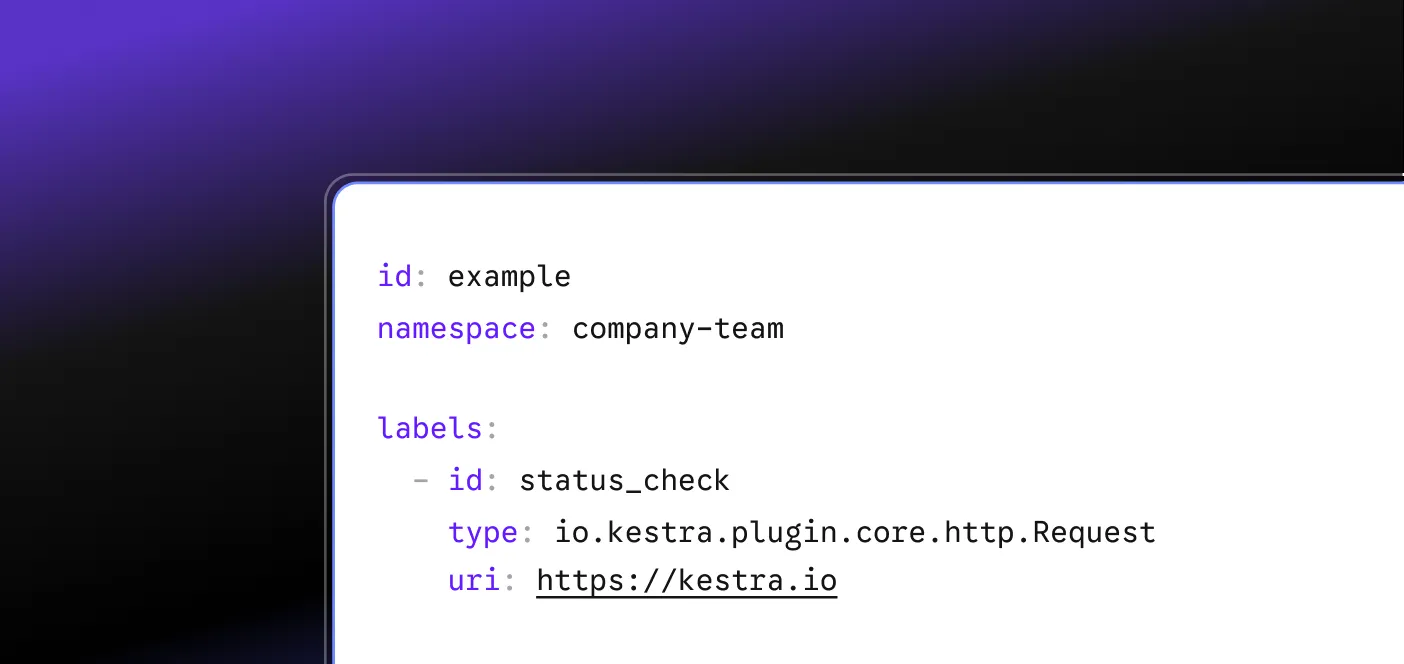
Kestra
Feature Comparison
| Feature | Dagster | Kestra |
|---|---|---|
| Orchestration & Workflow | ||
| Orchestration Paradigm | Asset-centric with data lineage graphs, dependency tracking, and asset versioning as first-class concepts | Declarative YAML flows with task dependencies, branching, loops, parallelism, and failure handling built in |
| Event-Driven Triggers | Schedule-based and sensor-driven materialization of assets with freshness policies and auto-materialize rules | Native triggers for S3/GCS/Azure files, webhooks, Kafka, database changes, message queues with millisecond latency |
| Partitioning & Backfills | First-class partition definitions with time-based, static, and dynamic partitions plus incremental materialization | Backfill support from UI without redeploying code, automatic catch-up after outages for scheduled workflows |
| Developer Experience | ||
| Primary Language | Python-native with decorators, type annotations, and full IDE support for autocomplete and refactoring | Language-agnostic: YAML for orchestration, business logic in Python, R, Java, Julia, Ruby, Bash, or any language |
| Testing & CI/CD | Built-in unit testing framework, local development environment, branch deployments, and CI/CD-native workflow | Git sync in both directions, Terraform provider for infrastructure-as-code, CI/CD integration via API-first design |
| Code Editor | Standard Python IDE workflow with Dagster CLI for local development and Dagit web UI for monitoring | Embedded web-based code editor with built-in documentation, live flow topology, and YAML validation |
| Observability & Monitoring | ||
| Data Lineage | Built-in asset lineage graphs with auto-generated documentation, ownership tracking, and data catalog | Live workflow topology with execution timeline, per-task logs, outputs visualization, and metrics tracking |
| Alerting | Intelligent alerts in Slack with AI-powered debugging and impact analysis for data incident resolution | Recovery workflows with retries, alerts, and replay capabilities to reduce mean time to recovery |
| Health Metrics | Real-time freshness tracking, performance monitoring, cost tracking, and reliability dashboards built in | Execution success ratio monitoring, task-level status tracking, and integration with external log aggregators like Datadog |
| Enterprise & Security | ||
| Access Control | SSO with Google, GitHub, and SAML IdPs, RBAC, SCIM provisioning, and multi-tenant code deployments | Enterprise edition adds RBAC, SSO, audit logs, and multi-tenancy with isolated workers and dedicated task runners |
| Compliance | SOC 2 Type II certified, HIPAA compliant, audit logs with retention policies, independently audited | Enterprise edition with audit logs, secret management (internal and external), and air-gapped deployment support |
| Scalability | Flexible deployment on single server or Kubernetes, hybrid cloud with North American and European regions | Horizontal scaling of execution capacity, fault-tolerant architecture, worker groups, and high concurrency support |
| Integration & Ecosystem | ||
| Data Tool Integrations | Native connectors for Snowflake, BigQuery, dbt, Databricks, Fivetran, Great Expectations, and Spark | 1,200+ plugins covering Liquibase, DuckDB, dbt, Airbyte, Databricks, MongoDB, and custom plugin builder |
| Infrastructure Integration | Dagster Pipes for first-class observability of jobs running in external systems like Databricks and Spark | Terraform, Ansible, and CI/CD workflow automation with Docker-enabled execution environments by default |
| API Access | GraphQL API for programmatic access to assets, runs, and schedules with webhook-based automation | Full REST API coverage across the platform for workflow management, execution, and administration |
Orchestration & Workflow
Orchestration Paradigm
Event-Driven Triggers
Partitioning & Backfills
Developer Experience
Primary Language
Testing & CI/CD
Code Editor
Observability & Monitoring
Data Lineage
Alerting
Health Metrics
Enterprise & Security
Access Control
Compliance
Scalability
Integration & Ecosystem
Data Tool Integrations
Infrastructure Integration
API Access
Which approach fits
Dagster excels at asset-centric data orchestration for Python-heavy data engineering teams, while Kestra provides a language-agnostic, event-driven platform with broader orchestration scope covering data, infrastructure, and AI workflows from a single declarative interface.
When each approach fits
Choose Dagster if:
Choose Dagster if your team works primarily in Python and needs deep data asset management with built-in lineage, observability, and a data catalog. Dagster is the stronger choice for teams running dbt transformations, Snowflake or BigQuery pipelines, and ML workflows where asset versioning, partitioning, and freshness tracking are critical. Its SOC 2 Type II and HIPAA compliance make it well-suited for regulated industries. The managed Dagster Cloud with hybrid deployment options reduces operational burden for teams that want to focus on building data products rather than managing infrastructure.
Choose Kestra if:
Choose Kestra if your organization needs a universal orchestration platform that spans data pipelines, infrastructure automation, and AI workflows without being tied to a single programming language. Kestra's YAML-based declarative syntax makes it accessible to non-Python engineers, and its 1,200+ plugin ecosystem provides the broadest integration coverage. With 28,000+ GitHub stars and 120k deployments, Kestra has proven scale. Its event-driven architecture with millisecond-latency triggers, Terraform provider, and Docker-native execution make it ideal for platform engineering teams orchestrating across multiple domains and technology stacks.
These scenarios reflect the available product evidence. Your requirements, existing stack, and team expertise should guide the final decision.
Frequently Asked Questions
What is the main architectural difference between Dagster and Kestra?
Dagster uses an asset-centric model where pipelines are collections of data assets with built-in lineage and dependency tracking, written in Python with decorators and type annotations. Kestra uses a declarative YAML-based approach where workflows define tasks, dependencies, conditions, and triggers in a language-agnostic format. Dagster focuses on data asset management with versioning and partitioning as first-class concepts, while Kestra prioritizes universal orchestration across data, infrastructure, and AI workflows with 1,200+ plugins and support for business logic in any programming language.
How do Dagster and Kestra compare on pricing for small teams?
Both platforms offer free open-source self-hosted editions under the Apache-2.0 license. For managed services, Dagster starts at $10/mo for its Solo Plan (7.5k credits, 1 user, 1 code location) and $100/mo for the Starter Plan (30k credits, up to 3 users, 5 code locations). Both include a 30-day free trial. Kestra offers a free tier for 1 user, with its Pro plan at $25/mo. Kestra's open-source edition includes unlimited executions and 1,200+ plugins, while Dagster's open-source version provides unlimited orchestration with its full Python framework and integrations.
Which platform has better community support and ecosystem?
Kestra is prominent in raw GitHub popularity with 26,720 stars compared to Dagster's 27,000+ stars, and reports 120k deployments with over 1 billion workflows executed globally. Dagster has a mature Python ecosystem with native integrations for major data tools like Snowflake, BigQuery, dbt, and Databricks. Kestra offers an extensive plugin ecosystem with 1,200+ plugins covering databases, cloud services, CI/CD tools, and infrastructure automation. Both are Apache-2.0 licensed and actively maintained, with Dagster's latest release at 1.13.1 and Kestra's at v1.3.11 as of April 2026.
Can Dagster or Kestra handle infrastructure and AI workflow orchestration?
Both platforms support AI and infrastructure workflows, but with different approaches. Dagster treats AI and ML workflows as extensions of its data asset model, supporting data prep, model training, and experiment tracking within its Python-native framework. Kestra positions itself as a universal orchestrator handling data pipelines, infrastructure automation (Terraform, Ansible), and AI workflows from a single platform. Kestra reports 50x less pipeline maintenance and 3x quicker AI delivery cycles for AI automation use cases. Dagster offers Dagster Pipes for observability of jobs running in external systems like Databricks and Spark clusters.