Decision comparison
Kestra vs Prefect
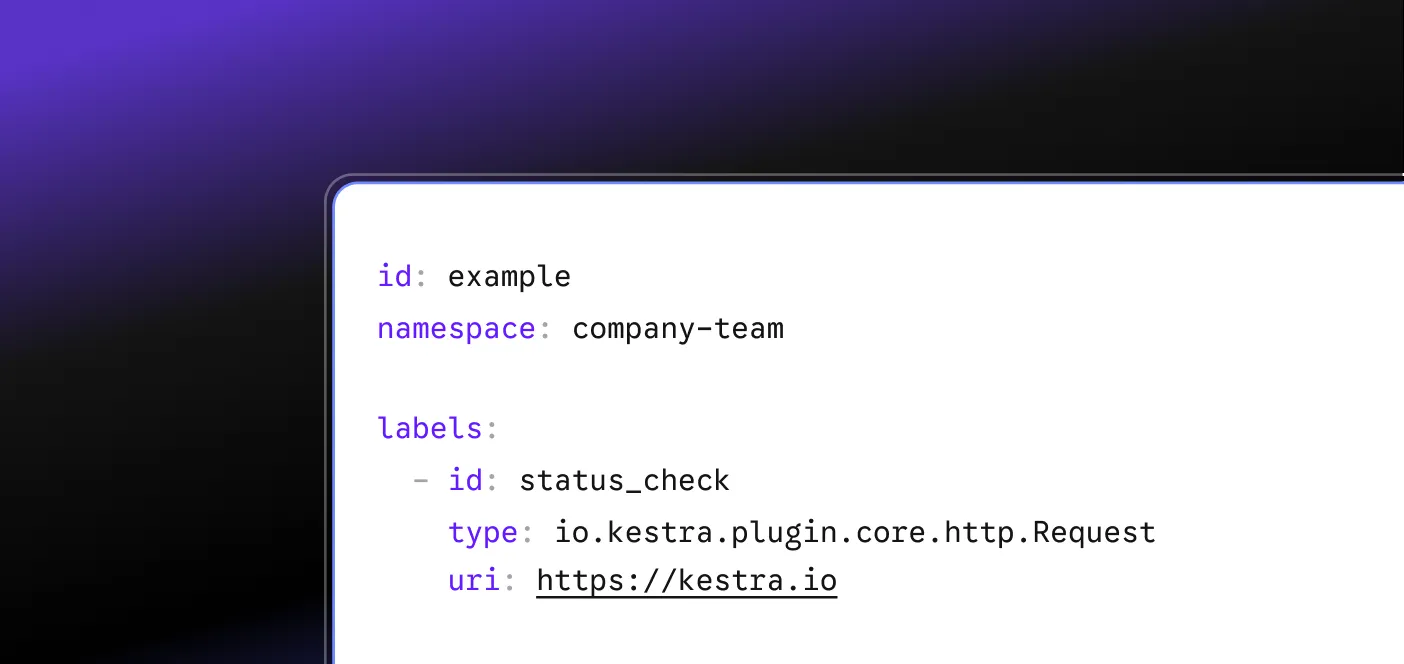
Kestra and Prefect represent two distinct philosophies in workflow orchestration. Kestra takes a declarative, language-agnostic approach with YAML-based definitions and a rich visual UI that welcomes both developers and non-technical team members. Prefect doubles down on Python, letting data engineers turn existing functions into production workflows with minimal ceremony. Both are open-source under Apache-2.0, both offer enterprise and cloud tiers, and both have active communities. The right choice depends on your team's language preferences, how many non-Python workloads you run, and whether a visual workflow builder matters to your organization.
Architecture choice. These take different approaches to the same problem. Read the table as a fit question rather than a feature race.
All 2 are workflow orchestrators.
Quick Comparison
| Decision factor | Kestra | Prefect |
|---|---|---|
| Workflow Definition | Declarative YAML with visual UI editor and embedded code editor | Python decorators that turn functions into flows and tasks with zero boilerplate |
| Language Support | Language-agnostic: Python, R, Java, Julia, Ruby, Bash, SQL, and any containerized language | Python-first; other languages run inside Python-orchestrated containers |
| Deployment Model | Self-hosted on Docker or Kubernetes; Enterprise edition with managed cloud option | Self-hosted open-source or managed Prefect Cloud with hybrid worker model |
| Plugin Ecosystem | 1200+ plugins covering databases, cloud services, CI/CD, and infrastructure tools | Integration library for dbt, Kubernetes, Docker, AWS, GCP, Azure, and Snowflake |
| Community & Adoption | 28,000+ GitHub stars, 750+ contributors, Apache-2.0 license, 120k deployments reported | 23,000+ GitHub stars, Apache-2.0 license, SOC 2 Type II certified cloud platform |
| Best For | Teams needing polyglot orchestration with low-code UI access for non-developers | Python-heavy data and ML teams wanting decorator-based orchestration with managed cloud |
Kestra
- Workflow Definition:
- Declarative YAML with visual UI editor and embedded code editor
- Language Support:
- Language-agnostic: Python, R, Java, Julia, Ruby, Bash, SQL, and any containerized language
- Deployment Model:
- Self-hosted on Docker or Kubernetes; Enterprise edition with managed cloud option
- Plugin Ecosystem:
- 1200+ plugins covering databases, cloud services, CI/CD, and infrastructure tools
- Community & Adoption:
- 28,000+ GitHub stars, 750+ contributors, Apache-2.0 license, 120k deployments reported
- Best For:
- Teams needing polyglot orchestration with low-code UI access for non-developers
Prefect
- Workflow Definition:
- Python decorators that turn functions into flows and tasks with zero boilerplate
- Language Support:
- Python-first; other languages run inside Python-orchestrated containers
- Deployment Model:
- Self-hosted open-source or managed Prefect Cloud with hybrid worker model
- Plugin Ecosystem:
- Integration library for dbt, Kubernetes, Docker, AWS, GCP, Azure, and Snowflake
- Community & Adoption:
- 23,000+ GitHub stars, Apache-2.0 license, SOC 2 Type II certified cloud platform
- Best For:
- Python-heavy data and ML teams wanting decorator-based orchestration with managed cloud
Public signals
Verified factual signals only. Bars appear only for like-for-like metrics with five weekly assessments for every tool; missing evidence stays explicit. These signals do not establish enterprise adoption, product quality, or total cost.
| Metric | Kestra | Prefect |
|---|---|---|
| Docker Hub pulls(Product adoption) | 2.6M | 224.6M |
| GitHub commits, 90d(Product adoption) | 1.4k | 394 |
| GitHub stars(Product adoption) | 28,000+ | 23,000+ |
| Search interest(Market interest) | 0 | 0 |
| Hacker News mentions, 90d(Community interest) | 0 | 1 |
| Product Hunt comments(Community interest) | 42 | 0 |
| Product Hunt rating(Community interest) | 5.0/5 | 5.0/5 |
| Product Hunt reviews(Community interest) | 1 | 3 |
| Product Hunt votes(Community interest) | 470 | 5 |
| PyPI weekly downloads(Developer adoption) | 2.4M | Not available |
| PyPI weekly downloads(Product adoption) | Not available | 1.6M |
| Stack Overflow questions(Community interest) | Not available | 212 |
As of September 21, 2026 — updated weekly.
Health & risk evidence
Observed public-source checks for mapped package versions and repositories.
Kestra
September 21, 2026Package vulnerabilities
PyPI · kestra@2.0.0
0 vulnerabilities
across 1 package
Repository security score
github.com/kestra-io/kestra
5.0/10
Prefect
September 21, 2026Package vulnerabilities
PyPI · prefect@3.8.6
0 vulnerabilities
across 1 package
Repository security score
github.com/PrefectHQ/prefect
6.9/10
Interface Preview
Kestra
Prefect

Feature Comparison
| Feature | Kestra | Prefect |
|---|---|---|
| Workflow Authoring | ||
| Workflow Definition Language | Declarative YAML with visual flow builder and embedded code editor | Python code with @flow and @task decorators; no separate DSL required |
| Visual Workflow Editor | Built-in web UI with drag-and-drop flow builder and live topology view | Cloud dashboard for monitoring; workflow authoring is code-only in Python |
| Version Control Integration | Bidirectional Git sync, revision history, rollback, and Terraform provider | Standard Git workflows; deployments managed via prefect.yaml or Python scripts |
| Execution & Scheduling | ||
| Event-Driven Triggers | Native triggers for webhooks, S3/GCS/Azure file events, Kafka, database changes, and message queues | Event-driven automations with webhook triggers, scheduled deployments, and custom event handlers |
| Retry & Error Handling | Built-in retries, failure policies, timeouts, concurrency limits, and conditional branching | Automatic retries with configurable delays, exponential backoff, and task-level error handling |
| Backfill Support | UI-based backfills that catch up after outages without redeploying code | Backfill runs triggered programmatically or via the cloud UI |
| Scalability & Deployment | ||
| Deployment Options | Docker, Kubernetes via Helm charts, single-VM; Enterprise supports air-gapped and hybrid | Self-hosted with Docker/Kubernetes or managed Prefect Cloud with autoscaling workers |
| Horizontal Scaling | Worker groups and task runners with high-concurrency support in Enterprise edition | Work pools and workers with cloud-managed autoscaling and concurrent task execution |
| Multi-Language Runtime | Docker-enabled execution for any language with isolated runtime environments out of the box | Python-native execution; other languages require container-based infrastructure tasks |
| Observability & Governance | ||
| Execution Monitoring | Execution timeline, per-task logs, outputs visualization, and live workflow topology | Flow run dashboard with task-level logs, state history, and radar activity views |
| Enterprise Security | Enterprise edition adds SSO, RBAC, audit logs, multi-tenancy, and secret management | Cloud offers enterprise SSO, RBAC, SOC 2 Type II compliance, and 99.99% uptime SLA |
| API Access | Full REST API covering workflow operations, executions, and administration | REST API and Python SDK for programmatic workflow management and integration |
| Ecosystem & Integrations | ||
| Plugin Count | 1200+ plugins including databases, warehouses, queues, cloud services, and CI/CD tools | Growing integration library with first-party support for major data and cloud platforms |
| dbt Integration | Native dbt plugin for running transformations on BigQuery, DuckDB, and other targets | First-party prefect-dbt integration for orchestrating dbt Core and dbt Cloud jobs |
| AI/ML Workflow Support | AI orchestration use cases with dedicated blueprints for agents, RAG pipelines, and retraining | ML workflow orchestration via Prefect Cloud; Prefect Horizon for managed MCP server infrastructure |
Workflow Authoring
Workflow Definition Language
Visual Workflow Editor
Version Control Integration
Execution & Scheduling
Event-Driven Triggers
Retry & Error Handling
Backfill Support
Scalability & Deployment
Deployment Options
Horizontal Scaling
Multi-Language Runtime
Observability & Governance
Execution Monitoring
Enterprise Security
API Access
Ecosystem & Integrations
Plugin Count
dbt Integration
AI/ML Workflow Support
Which approach fits
Kestra and Prefect represent two distinct philosophies in workflow orchestration. Kestra takes a declarative, language-agnostic approach with YAML-based definitions and a rich visual UI that welcomes both developers and non-technical team members. Prefect doubles down on Python, letting data engineers turn existing functions into production workflows with minimal ceremony. Both are open-source under Apache-2.0, both offer enterprise and cloud tiers, and both have active communities. The right choice depends on your team's language preferences, how many non-Python workloads you run, and whether a visual workflow builder matters to your organization.
When each approach fits
Choose Kestra if:
Choose Kestra when your team runs polyglot workloads across Python, Java, R, and shell scripts, or when non-developer stakeholders need to build and monitor workflows through a visual UI. Kestra's declarative YAML approach and 1200+ plugin ecosystem make it particularly strong for organizations standardizing orchestration across data engineering, infrastructure automation, and AI pipelines under a single platform. The ability to define everything as code while still offering a low-code interface gives teams flexibility without forcing a single programming language.
Choose Prefect if:
Choose Prefect when your workflows are primarily Python-based and your team values writing orchestration logic as native Python code rather than YAML. Prefect's decorator-based approach means existing Python scripts become production workflows with minimal refactoring. The managed Prefect Cloud platform with autoscaling workers, SOC 2 Type II compliance, and 99.99% uptime SLA makes it a strong pick for teams that want enterprise-grade orchestration without managing infrastructure. Prefect Horizon adds managed AI infrastructure for deploying MCP servers.
These scenarios reflect the available product evidence. Your requirements, existing stack, and team expertise should guide the final decision.
Frequently Asked Questions
Can I migrate from Prefect to Kestra or vice versa?
Both tools use fundamentally different workflow definition approaches, so migration requires rewriting workflow logic. Moving from Prefect to Kestra means converting Python decorator-based flows into YAML definitions, while the reverse means translating YAML flows into Python code. Both platforms support standard data formats and common integrations, so the data layer and external connections typically transfer without major changes. Kestra's website references users who migrated from Prefect, noting the process as straightforward due to the declarative syntax.
Which tool has better support for non-Python languages?
Kestra has a clear advantage for polyglot workflows. It natively supports Python, R, Java, Julia, Ruby, Bash, SQL, and any language that runs in a Docker container, with isolated runtime environments enabled by default. Prefect is designed as a Python-first framework, meaning all orchestration logic must be written in Python. You can still run non-Python code from within Prefect tasks using subprocess calls or container-based execution, but the orchestration layer itself remains Python.
How do the open-source editions compare?
Both tools are open-source under the Apache-2.0 license. Kestra's open-source edition includes full orchestration capabilities, unlimited executions, 1200+ plugins, and event-driven triggers. Prefect's open-source edition provides the core Python orchestration framework with flows, tasks, retries, and a local server for monitoring. The main differences in open-source tiers relate to enterprise features: Kestra reserves SSO, RBAC, audit logs, and multi-tenancy for its Enterprise edition, while Prefect gates similar capabilities behind Prefect Cloud.
Which platform is easier to get started with?
The answer depends on your background. Python developers often find Prefect faster to adopt because they can add decorators to existing scripts and have a running workflow in minutes. Teams with mixed technical backgrounds may find Kestra more accessible thanks to its visual UI, embedded code editor, and 680+ ready-to-use blueprint templates. Kestra can be installed via a single Docker command, while Prefect requires a Python environment and pip install. Both tools offer comprehensive documentation and active community support through Slack and GitHub.
How do Kestra and Prefect handle managed cloud offerings?
Prefect Cloud is a mature managed platform offering autoscaling workers, enterprise SSO, SOC 2 Type II compliance, and a 99.99% uptime SLA. It follows a hybrid execution model where the control plane runs in the cloud while workers execute in your infrastructure. Kestra presents Cloud as a managed platform, separately from its Enterprise Edition, alongside on-premises and air-gapped deployment support. Both platforms let you keep sensitive data within your own infrastructure while offloading orchestration management to the vendor.