Decision comparison
Fivetran vs Sling
Fivetran is the enterprise-grade managed ELT platform with the broadest connector library and zero-maintenance pipelines, while Sling is a lightweight, open-source CLI tool built for engineers who want fast, flexible data replication with full control over deployment.
Direct comparison. These are reviewed substitutes bought for the same job, so the differences below are the ones that decide between them.
All 2 are ELT platforms.
Quick Comparison
| Decision factor | Fivetran | Sling |
|---|---|---|
| Best For | Enterprise teams needing fully managed, zero-maintenance data pipelines with hundreds of pre-built connectors | Engineers and small teams who want a fast, lightweight CLI-first ELT tool |
| Pricing Model | Fivetran is consumption-priced on monthly active rows and quoted through its own estimator. The plans are Free, Standard, Enterprise and Business Critical. The Free plan covers up to 500,000 monthly active rows for connections, 3,500 for activations and 5,000 model runs. Fivetran advertises savings of up to 22% on an annual contract. No per-plan price is published. | Free for up to 30 users, Premium at $2.00 per user per month, Business at $4.00 per user per month. Open-source self-hosted available under GPL-3.0 license. |
| Connector Library | 700+ fully managed connectors covering SaaS apps, databases, ERPs, files, and event streams | Supports databases like PostgreSQL, MySQL, Snowflake, BigQuery plus cloud storage and REST APIs |
| Deployment Options | Fully managed SaaS with optional hybrid deployment for on-premise security requirements | Self-hosted CLI or agent-based platform that runs on Mac, Linux, or Windows |
| Open Source | Closed-source commercial platform with a Connector SDK for building custom connectors | Fully open-source CLI under GPL-3.0 license with 800+ GitHub stars and active development |
| Learning Curve | Low barrier to entry with a guided UI, automated schema management, and minimal configuration | Requires comfort with YAML configs and CLI tooling but offers straightforward replication setup |
Fivetran
- Best For:
- Enterprise teams needing fully managed, zero-maintenance data pipelines with hundreds of pre-built connectors
- Pricing Model:
- Fivetran is consumption-priced on monthly active rows and quoted through its own estimator. The plans are Free, Standard, Enterprise and Business Critical. The Free plan covers up to 500,000 monthly active rows for connections, 3,500 for activations and 5,000 model runs. Fivetran advertises savings of up to 22% on an annual contract. No per-plan price is published.
- Connector Library:
- 700+ fully managed connectors covering SaaS apps, databases, ERPs, files, and event streams
- Deployment Options:
- Fully managed SaaS with optional hybrid deployment for on-premise security requirements
- Open Source:
- Closed-source commercial platform with a Connector SDK for building custom connectors
- Learning Curve:
- Low barrier to entry with a guided UI, automated schema management, and minimal configuration
Sling
- Best For:
- Engineers and small teams who want a fast, lightweight CLI-first ELT tool
- Pricing Model:
- Free for up to 30 users, Premium at $2.00 per user per month, Business at $4.00 per user per month. Open-source self-hosted available under GPL-3.0 license.
- Connector Library:
- Supports databases like PostgreSQL, MySQL, Snowflake, BigQuery plus cloud storage and REST APIs
- Deployment Options:
- Self-hosted CLI or agent-based platform that runs on Mac, Linux, or Windows
- Open Source:
- Fully open-source CLI under GPL-3.0 license with 800+ GitHub stars and active development
- Learning Curve:
- Requires comfort with YAML configs and CLI tooling but offers straightforward replication setup
Public signals
Verified factual signals only. Bars appear only for like-for-like metrics with five weekly assessments for every tool; missing evidence stays explicit. These signals do not establish enterprise adoption, product quality, or total cost.
| Metric | Fivetran | Sling |
|---|---|---|
| GitHub commits, 90d(Developer adoption) | 19 | Not available |
| GitHub stars(Developer adoption) | 134 | Not available |
| Search interest(Market interest) | 1 | 1 |
| Hacker News mentions, 90d(Community interest) | 3 | Not available |
| Product Hunt comments(Community interest) | 9 | Not available |
| Product Hunt rating(Community interest) | 5.0/5 | Not available |
| Product Hunt reviews(Community interest) | 1 | Not available |
| Product Hunt votes(Community interest) | 85 | Not available |
| PyPI weekly downloads(Developer adoption) | 29.0k | Not available |
| Stack Overflow questions(Community interest) | 22 | Not available |
| Docker Hub pulls(Product adoption) | Not available | 17.2k |
| GitHub commits, 90d(Product adoption) | Not available | 180 |
| GitHub stars(Product adoption) | Not available | 906 |
| PyPI weekly downloads(Product adoption) | Not available | 40.3k |
As of September 21, 2026 — updated weekly.
Health & risk evidence
Observed public-source checks for mapped package versions and repositories.
Fivetran
September 21, 2026Package vulnerabilities
PyPI · fivetran-connector-sdk@2.12.1
0 vulnerabilities
across 1 package
Repository security score
Not available
Sling
September 21, 2026Package vulnerabilities
PyPI · sling@1.6.3
0 vulnerabilities
across 1 package
Repository security score
github.com/slingdata-io/sling-cli
3.8/10
Interface Preview
Sling
Feature Comparison
| Feature | Fivetran | Sling |
|---|---|---|
| Data Ingestion | ||
| Pre-built Connectors | 700+ fully managed connectors | 20+ database connectors plus file and API sources |
| Change Data Capture (CDC) | Log-based CDC for efficient database replication | CDC via transaction log reading (Advanced plan) |
| File Ingestion | File replication from cloud storage and local sources | CSV, Parquet, JSON, Excel with auto-schema detection |
| Data Processing | ||
| Incremental Syncs | Automatic incremental updates with schema evolution | Incremental, full-refresh, truncate, snapshot, and backfill modes |
| Transformations | Built-in dbt integration with Quickstart data models | Column hashing, encoding, parsing, and custom transforms |
| Parallel Processing | Managed parallel pipeline execution across connectors | Parallel stream runs with automatic retries on failure |
| Deployment & Architecture | ||
| Hosting Model | Fully managed SaaS with hybrid deployment option | Self-hosted CLI or self-hosted platform (Advanced plan) |
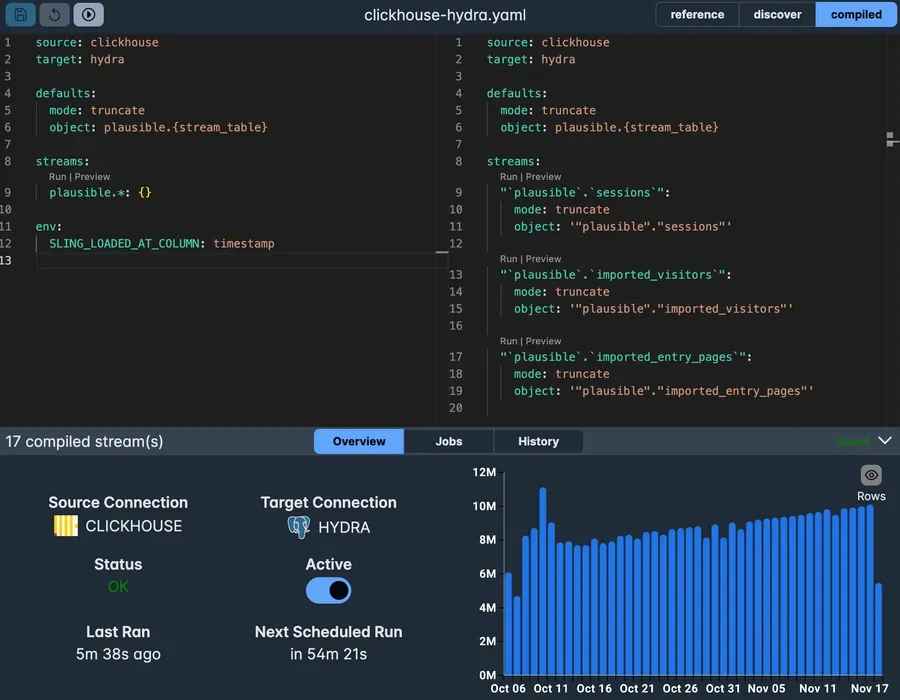
| Configuration | Web UI with point-and-click connector setup | YAML-based configuration with CLI or web editor |
| API Access | REST API for programmatic pipeline management | REST API available on Platform plans |
| Monitoring & Security | ||
| Observability | Dashboards with logs, alerts, and sync health monitoring | Volume, freshness, and schema change monitoring with alert rules |
| Security Certifications | SOC 1 & 2, GDPR, HIPAA, ISO 27001, PCI DSS Level 1, HITRUST | Self-hosted deployment for full data control; no listed certifications |
| Access Control | Role-based access control with SCIM provisioning (Enterprise) | User roles and permissions on Advanced plan |
| Ecosystem & Integrations | ||
| Orchestration Integration | Integrates with dbt, orchestration tools via REST API and webhooks | Native Dagster embedded ELT integration and pipeline hooks |
| Destination Support | Data warehouses, data lakes, and databases across all major clouds | Snowflake, BigQuery, Redshift, DuckDB, and 20+ database targets |
| Custom Connectors | Connector SDK and partner-built connector ecosystem | Custom REST API specs via YAML-based configuration |
Data Ingestion
Pre-built Connectors
Change Data Capture (CDC)
File Ingestion
Data Processing
Incremental Syncs
Transformations
Parallel Processing
Deployment & Architecture
Hosting Model
Configuration
API Access
Monitoring & Security
Observability
Security Certifications
Access Control
Ecosystem & Integrations
Orchestration Integration
Destination Support
Custom Connectors
Which to choose
Fivetran is the enterprise-grade managed ELT platform with the broadest connector library and zero-maintenance pipelines, while Sling is a lightweight, open-source CLI tool built for engineers who want fast, flexible data replication with full control over deployment.
Best-fit scenarios
Choose Fivetran if:
We recommend Fivetran for mid-to-large organizations that need to consolidate data from dozens or hundreds of SaaS applications, databases, and event streams into a cloud warehouse without dedicating engineering time to pipeline maintenance. Its 700+ managed connectors, automatic schema evolution, and enterprise security certifications make it the stronger choice when reliability and compliance matter more than cost.
Choose Sling if:
We recommend Sling for data engineers and small teams who prefer a code-first, CLI-driven workflow and want to avoid vendor lock-in. Its open-source core, Go-based streaming engine, and YAML configuration make it a compelling option for teams already comfortable with infrastructure tooling. The free CLI handles most common ELT patterns, and the paid Platform tiers add scheduling, parallel runs, and CDC at a fraction of enterprise platform pricing.
These scenarios reflect the available product evidence. Your requirements, existing stack, and team expertise should guide the final decision.
Frequently Asked Questions
How does Fivetran's pricing compare to Sling's pricing?
Fivetran uses a usage-based pricing model tied to monthly active rows (MAR). Its Free tier includes 500,000 MAR, while Standard and Enterprise tiers scale up with additional features like 1-minute syncs and hybrid deployment. Sling takes a different approach: the CLI is completely free and open-source under GPL-3.0, and the Platform plans start at $99/mo for Standard and $249/mo for Advanced. For teams with modest data volumes, Sling can be significantly cheaper. For organizations with complex connector needs, Fivetran's managed approach may reduce total engineering costs despite the higher sticker price.
Can Sling replace Fivetran for enterprise data pipelines?
Sling can handle many of the same core ELT tasks as Fivetran, including database replication, incremental syncs, and CDC. However, Fivetran offers a much larger library of pre-built, fully managed connectors (700+ vs Sling's smaller set of database and API connectors). Enterprises that rely on dozens of SaaS data sources will find Fivetran's connector coverage hard to match. That said, Sling's self-hosted deployment model, open-source codebase, and lower cost make it a viable alternative for teams with primarily database-to-warehouse workflows.
Which tool is better for database replication and CDC?
Both tools support change data capture for database replication. Fivetran provides log-based CDC as a core feature across its managed connectors, handling schema changes and incremental updates automatically. Sling also supports CDC by reading database transaction logs, capturing inserts, updates, and deletes with resumable initial loads. Sling's CDC feature is available on the Advanced plan ($249/mo). For pure database-to-warehouse replication, both tools are capable, but Fivetran requires less hands-on configuration while Sling offers more control over the replication process.
Is Sling truly open source and how does that affect the comparison?
Yes, Sling's CLI is fully open-source under the GPL-3.0 license with the source code available on GitHub (839 stars). This means you can inspect the code, contribute to it, and run it anywhere without paying licensing fees. Fivetran is a closed-source commercial product. The open-source nature of Sling gives teams full transparency into how data moves through their pipelines and the ability to self-host everything. For organizations with strict data residency requirements or those that want to avoid vendor lock-in, Sling's open-source model is a meaningful advantage.
How do Fivetran and Sling differ in terms of setup and configuration?
Fivetran is designed for minimal configuration. You connect a source through the web UI, select your destination, and the platform handles schema detection, incremental syncs, and ongoing maintenance automatically. Sling takes a code-first approach where you define replications in YAML files and run them via the CLI or the Platform's built-in editor. Sling's approach appeals to engineers who want version-controlled pipeline definitions and scriptable workflows, while Fivetran's UI-driven setup is faster for non-technical users or teams that want to get pipelines running without writing configuration files.