Vibio vs Didit v3
Vibio and Didit v3 operate in fundamentally different security domains. Vibio scans application codebases for security vulnerabilities using deterministic checks and AI review, while Didit v3 verifies end-user identities through biometric checks and document verification. These tools solve different problems and serve different teams within an organization.
Vibio3.9Didit v34.5
Security
Quick Comparison
| Feature | Vibio | Didit v3 |
|---|---|---|
| Primary Focus | Application and codebase security vulnerability scanning | Identity verification and KYC/AML compliance for end users |
| Security Approach | Runs 50+ deterministic, rule-based checks followed by AI-powered deep review that validates each finding | AI-powered biometric checks including face scan, liveness detection, and document verification to fight fraud including deepfakes |
| Integration Method | URL scan requiring no repo access, or read-only GitHub connection for full codebase analysis | No-code hosted links, native iOS/Android SDKs, Web SDK, iframe/webview, or standalone server-to-server APIs |
| Pricing Model | Free plan available, paid plans start at $29/mo | Usage-based pricing starting at $0.03 per user, with additional tiers including $0.05, $0.07, $0.10, $0.15, $0.20, $0.27, $0.28, $0.30, $0.57, $1.35, and $149/month |
| Target User | Developers, solo builders, and engineering teams shipping code to production | Operations and compliance teams at companies onboarding users who need identity verification |
| Compliance Scope | Focuses on production-readiness audits across auth, CI/CD, type safety, and dependencies | Covers KYC/AML in EU, US, LATAM, and APAC with GDPR, ISO 27001, ISO 27017, and ISO 27018 certifications |
| Automation Level | Groups findings into ordered Fix Packs with Cursor prompts and PRs for step-by-step remediation | Auto-approve and auto-reject rules based on verification outcomes with real-time dashboard tracking |
Vibio
- Primary Focus:
- Application and codebase security vulnerability scanning
- Security Approach:
- Runs 50+ deterministic, rule-based checks followed by AI-powered deep review that validates each finding
- Integration Method:
- URL scan requiring no repo access, or read-only GitHub connection for full codebase analysis
- Pricing Model:
- Free plan available, paid plans start at $29/mo
- Target User:
- Developers, solo builders, and engineering teams shipping code to production
- Compliance Scope:
- Focuses on production-readiness audits across auth, CI/CD, type safety, and dependencies
- Automation Level:
- Groups findings into ordered Fix Packs with Cursor prompts and PRs for step-by-step remediation
Didit v3
- Primary Focus:
- Identity verification and KYC/AML compliance for end users
- Security Approach:
- AI-powered biometric checks including face scan, liveness detection, and document verification to fight fraud including deepfakes
- Integration Method:
- No-code hosted links, native iOS/Android SDKs, Web SDK, iframe/webview, or standalone server-to-server APIs
- Pricing Model:
- Usage-based pricing starting at $0.03 per user, with additional tiers including $0.05, $0.07, $0.10, $0.15, $0.20, $0.27, $0.28, $0.30, $0.57, $1.35, and $149/month
- Target User:
- Operations and compliance teams at companies onboarding users who need identity verification
- Compliance Scope:
- Covers KYC/AML in EU, US, LATAM, and APAC with GDPR, ISO 27001, ISO 27017, and ISO 27018 certifications
- Automation Level:
- Auto-approve and auto-reject rules based on verification outcomes with real-time dashboard tracking
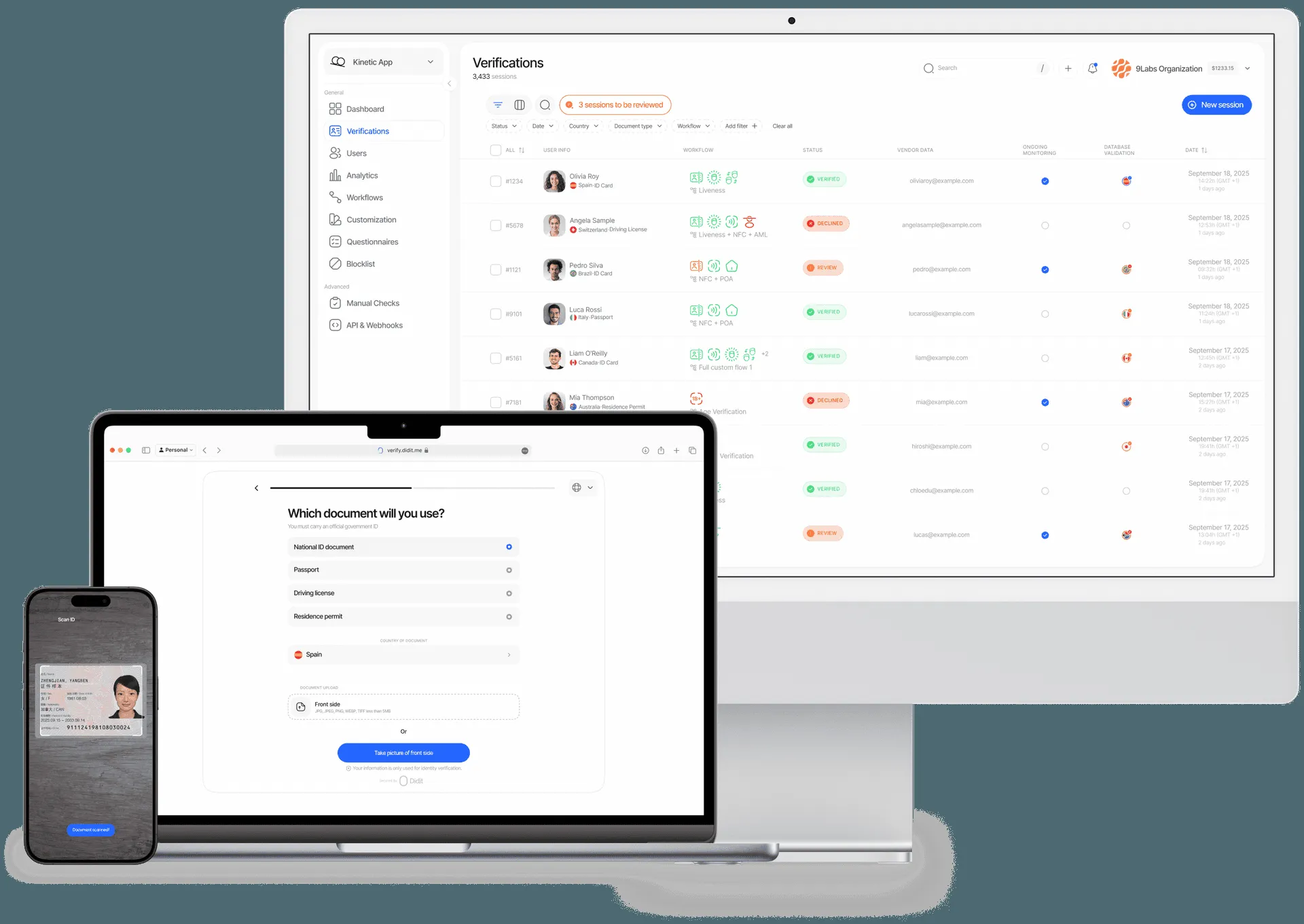
Interface Preview
Didit v3
Feature Comparison
| Feature | Vibio | Didit v3 |
|---|---|---|
| Security Scanning | ||
| Deterministic Rule-Based Checks | — | — |
| AI-Powered Analysis | — | — |
| Framework-Specific Detection | — | — |
| Integration & Setup | ||
| No-Code Setup | — | — |
| API & SDK Support | — | — |
| Results Delivery | — | — |
| Compliance & Coverage | ||
| Regulatory Compliance | — | — |
| Global Coverage | — | — |
| Data Privacy | — | — |
| Automation & Workflow | ||
| Automated Decision-Making | — | — |
| Workflow Customization | — | — |
| Remediation Support | — | — |
| Pricing & Scale | ||
| Free Tier | — | — |
| Paid Plans | — | — |
| Scaling Model | — | — |
Security Scanning
Deterministic Rule-Based Checks
Vibio—
Didit v3—
AI-Powered Analysis
Vibio—
Didit v3—
Framework-Specific Detection
Vibio—
Didit v3—
Integration & Setup
No-Code Setup
Vibio—
Didit v3—
API & SDK Support
Vibio—
Didit v3—
Results Delivery
Vibio—
Didit v3—
Compliance & Coverage
Regulatory Compliance
Vibio—
Didit v3—
Global Coverage
Vibio—
Didit v3—
Data Privacy
Vibio—
Didit v3—
Automation & Workflow
Automated Decision-Making
Vibio—
Didit v3—
Workflow Customization
Vibio—
Didit v3—
Remediation Support
Vibio—
Didit v3—
Pricing & Scale
Free Tier
Vibio—
Didit v3—
Paid Plans
Vibio—
Didit v3—
Scaling Model
Vibio—
Didit v3—
Our Verdict
Vibio and Didit v3 operate in fundamentally different security domains. Vibio scans application codebases for security vulnerabilities using deterministic checks and AI review, while Didit v3 verifies end-user identities through biometric checks and document verification. These tools solve different problems and serve different teams within an organization.
When to Choose Each
Choose Vibio if:
Development teams shipping web applications to production who need systematic security auditing of their codebase, authentication patterns, CI/CD pipelines, and dependency management. This includes solo builders using AI coding assistants like Cursor or Copilot who want to catch the security gaps that AI-generated code often introduces, as well as experienced engineering teams running pre-launch audits or ongoing production health checks across their TypeScript and JavaScript projects.
Choose Didit v3 if:
Operations and compliance teams at companies that need to verify user identities during onboarding, meet KYC/AML regulatory requirements across multiple jurisdictions, and automate identity verification decisions at scale. This includes fintech companies, marketplaces, and any business operating in the EU, US, LATAM, or APAC that requires GDPR-compliant identity checks with biometric fraud detection, document verification, and configurable approval workflows without engineering overhead.
This verdict is based on general use cases. Your specific requirements, existing tech stack, and team expertise should guide your final decision.
Frequently Asked Questions
Can Vibio and Didit v3 be used together in the same application?
These two tools address completely separate layers of application security and can run independently without overlap. Vibio scans your codebase and URLs for vulnerabilities in authentication patterns, security headers, input validation, and CI/CD configuration. Didit v3 handles the identity verification layer where your end users prove who they are through face scans, document checks, and biometric matching. A company building a fintech application could use Vibio to audit its codebase for security gaps before launch, while simultaneously integrating Didit v3 to handle KYC verification during user onboarding. The two tools never interact with each other because they operate at different stages of the security stack.
How do the free tiers compare between Vibio and Didit v3?
Vibio offers a free plan that provides access to its security scanning capabilities, allowing developers to run checks against their URL or GitHub repository without upfront cost. Paid tiers expand the scanning features available beyond the free plan. Didit v3 takes a different approach by providing 500 free identity verification checks per month for core KYC features including ID verification, face match, passive liveness, and IP analysis. After the 500 free checks, Didit charges on a pay-per-use basis starting at $0.03 per user, with no contracts or setup fees. The free tiers reflect each tool's pricing model: Vibio gates by plan features while Didit gates by verification volume.
What technical expertise is required to set up each tool?
Vibio requires minimal technical setup for its URL scan, which runs with zero repository access by making standard HTTP requests to public endpoints to check security headers, exposed keys, and rate limiting. For full codebase analysis, connecting a GitHub repository requires read-only permissions and no additional configuration. Didit v3 offers a no-code path through its visual workflow builder and hosted verification pages, where teams can design identity flows by dragging and dropping features like ID verification, liveness, and AML screening. For deeper integration, Didit provides native iOS and Android SDKs, a Web SDK, iframe embedding, and server-to-server APIs. Both tools prioritize fast time-to-value, but Didit offers more integration paths to accommodate teams with varying levels of engineering resources.
How does each tool handle data privacy and code security?
Vibio extracts code into a temporary workspace only for the duration of the scan, then deletes the workspace once analysis completes and findings are generated. Scan results including findings, fix packs, and artifacts are stored, but source code is not retained. GitHub connections use read-only permissions, and Vibio never modifies files, pushes commits, or makes changes to infrastructure. Didit v3 operates under GDPR compliance with full data retention controls and holds ISO 27001, ISO 27017, and ISO 27018 certifications covering information security management, cloud security, and protection of personally identifiable information. Both tools have designed their data handling to minimize exposure of sensitive information during the verification or scanning process.