300+ Tools CoveredSource Data Updated Weeklydates

Tool intelligence profile

Edgee

Reduce LLM costs by up to 50% with edge-native token compression. One OpenAI-compatible API for 200+ models, intelligent routing, and instant ROI.

Visit Site →
Type
LLM Gateway
Category
Deployment
Cloud (managed)
Last updatedSeptember 20, 2026

Editor's Take

We recommend Edgee for AI teams that want one OpenAI-compatible API across 200+ models and can benefit from edge-native token compression advertised to reduce LLM costs by up to 50%. Its usage-based model fits variable workloads, but public context provided here does not establish enterprise adoption, realized savings, or reliability at scale.

— Egor Burlakov, Editor

Evaluate Edgee

Edgee: product and architecture

Our Edgee review verdict: Edgee is a focused AI gateway for teams whose LLM bills are dominated by large, repetitive input prompts and who want to reduce those costs without rewriting application code. Its core promise is concrete—compress prompts before they reach the model provider, with up to 50% input-token reduction—rather than a broad claim to manage every part of an AI stack. We recommend Edgee for engineering teams that already know token spend is a material operating cost and can validate semantic preservation against their own production prompts.

The platform routes requests through an OpenAI-compatible API and supports routing across 200+ models. That scope matters for teams avoiding a single-provider integration, but Edgee’s value is still concentrated in request-path optimization: fewer input tokens, provider routing, request metadata, and cost alerts. The public product description cites 3B+ requests per month and 100+ global points of presence, which are useful operational signals, though they are not substitutes for an enterprise SLA, latency benchmark, or proof of adoption in a particular regulated industry.

Overview

Edgee positions itself as an “AI Gateway” that compresses prompts at the edge before forwarding them to an LLM provider. The operating model is straightforward: applications send their existing requests to Edgee’s OpenAI-compatible endpoint, Edgee removes redundant prompt content while preserving meaning, and the compressed request is sent onward to the chosen provider. This is an attractive design when the expensive part of an AI workload is input context rather than output generation.

The product’s stated ceiling is up to 50% input-token reduction, and its headline claims 3B+ requests per month across 100+ global PoPs. Those numbers make the tool relevant for high-throughput AI services, but they should be treated as vendor-supplied scale and performance context rather than as a guarantee of savings for every prompt. Compression value depends on how repetitive, verbose, and structurally compressible a team’s actual prompt traffic is.

Edgee is not a general-purpose model-building environment, data warehouse, annotation platform, or observability suite. It is specifically aimed at cost optimization and gateway control for LLM request traffic. That narrowness is a strength when the immediate problem is provider spend; it is a weakness if the organization instead needs model training, data labeling, retrieval quality evaluation, or complete application observability.

The available open-source evidence reinforces that focus. Edgee’s official CLI repository is written primarily in Rust, carries an Apache-2.0 license, has 125 GitHub stars, and lists topics including llm-gateway, token-compression, context-optimization, and cost-optimization. Its latest release is v0.3.8, dated 2026-08-06, and the repository was last pushed on 2026-08-07; these are public activity signals, not definitive evidence of enterprise maturity.

Key Features and Architecture

  • Edge-native prompt compression: Edgee compresses prompts before they reach an LLM provider. The product describes this as intelligent token compression that removes redundancy while preserving meaning, targeting up to 50% input-token reduction. This architecture attacks input-token spend directly, but teams must test whether their domain-specific instructions, tables, schemas, and examples retain the needed meaning after compression.

  • OpenAI-compatible API: Edgee provides one OpenAI-compatible API, allowing applications using that interface style to direct requests through the gateway without adopting a wholly new provider-specific API surface. “Same code, fewer tokens, lower bills” is the core implementation proposition. Compatibility reduces integration disruption, but it does not eliminate the need for regression tests around prompt behavior, model responses, and application-level reliability.

  • Routing across 200+ models: The gateway can route across more than 200 models. This creates a control point for teams working with multiple LLM providers or model choices, especially when they want a consistent request path. The trade-off is architectural dependence on a gateway layer: routing policy, failure handling, and provider behavior now need to be understood through both the application and Edgee.

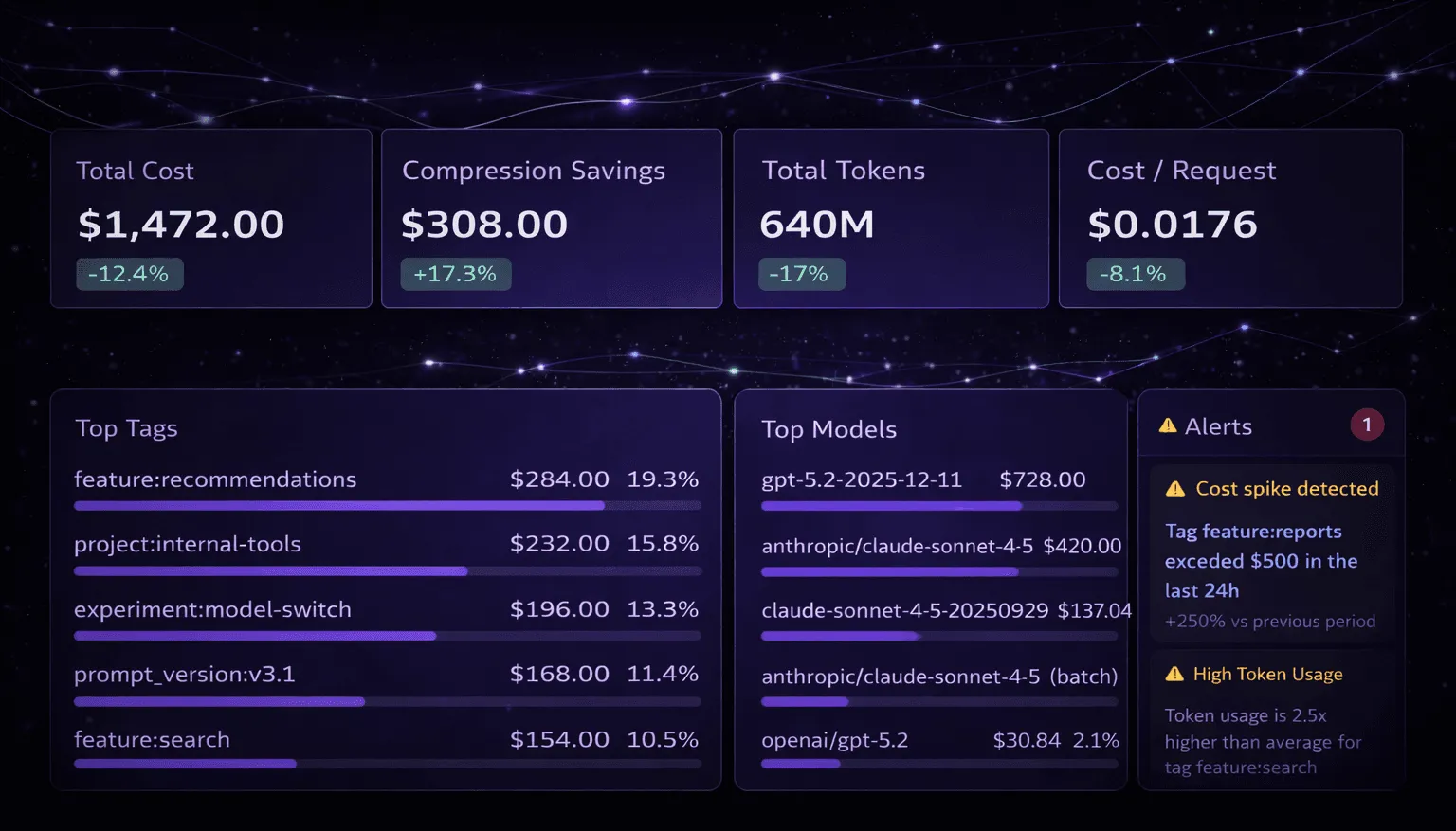
  • Custom request metadata: Teams can tag requests with custom metadata to track usage and costs. For data and analytics leaders, this can make it easier to allocate AI spending to products, tenants, environments, or internal teams. Metadata only produces useful governance when naming conventions and ownership are disciplined; Edgee cannot fix ambiguous cost-center design on its own.

  • Cost-spike alerts: Edgee says it can alert teams when costs spike before those spikes become a problem. This is valuable for agentic workflows, coding assistants, and workloads where prompt growth can quietly change unit economics. The supplied product information does not specify alert thresholds, delivery channels, retention periods, or reporting granularity, so buyers should validate those operational details before treating it as their primary cost-governance system.

  • CLI support for developer tools: The official Edgee CLI repository describes routing Claude Code, Codex, Cursor, VS Code + Copilot, and additional tools through Edgee’s hosted gateway. This is a distinct deployment path from embedding the gateway into a production application. It can help control developer-assistant token spend, but it also means organizations need clear policy for which developer traffic is routed and how that traffic is attributed.

Ideal Use Cases

A strong Edgee use case is a product engineering team of roughly 10 to 50 developers operating an AI feature with long system prompts, repeated policy text, or verbose context wrappers. If the service makes enough requests that input tokens dominate the bill, the stated up-to-50% input-token reduction can be worth validating quickly. We recommend Edgee for these teams when they can run controlled comparisons between original and compressed prompts, checking both token consumption and task quality.

A second use case is an analytics or data platform team supporting multiple internal AI applications through a shared gateway. The ability to use one OpenAI-compatible API across 200+ models, attach custom metadata, and monitor cost spikes gives central teams a practical place to standardize attribution. This is especially relevant when a data leader needs to answer which business unit, environment, or feature is driving LLM spend rather than receiving one undifferentiated provider invoice.

A third use case is a developer-experience program using tools such as Claude Code, Codex, Cursor, or VS Code + Copilot. Edgee’s official CLI is built to route those tools through its hosted gateway, making it relevant to organizations that want visibility into coding-assistant usage and a way to reduce prompt-token cost. The latest CLI release, v0.3.8, is a useful reference point for teams validating the current integration path.

Do not use Edgee as the primary answer if your main issue is output-token cost, model quality, training custom models, or evaluating retrieval accuracy. Its supplied documentation makes a specific promise about compressing prompts and reducing input tokens; it does not establish broader capabilities in those areas. Avoid it as well if your prompts are already short, highly compressed, or so semantically sensitive that you cannot invest in response-quality validation.

Strengths & Trade-offs

Pros

  • Edgee targets a measurable cost driver: input tokens. Its stated up-to-50% input-token reduction gives teams a clear hypothesis to test against real provider invoices rather than a vague efficiency claim.
  • The OpenAI-compatible API can reduce migration friction for applications already built around that interface. Teams can introduce a gateway layer without redesigning every LLM call around a new proprietary request format.
  • Routing across 200+ models gives platform teams a single integration point for multi-model traffic. That is useful when provider choice changes over time or when different products need different models.
  • Custom metadata and cost-spike alerts address operational governance, not just token compression. Data leaders can use request tags to make AI spend more attributable to teams, products, or environments.
  • The official CLI supports routing Claude Code, Codex, Cursor, and VS Code + Copilot through Edgee’s hosted gateway. That makes the product applicable to both production application traffic and selected developer-tool workflows.
  • The public CLI repository has 125 GitHub stars, uses Rust as its primary language, and was released as v0.3.8 on 2026-08-06. These are useful signs that buyers can inspect a current official integration artifact.

Cons

  • Edgee’s stated savings apply to input tokens, not all LLM cost. Teams with output-heavy workloads should not assume a 50% reduction in their total provider bill.
  • Semantic preservation is central to the product’s compression claim, but the provided information does not publish quality benchmarks, error rates, or workload-specific validation results. Buyers must run their own acceptance tests.
  • The available pricing information does not include dollar amounts, usage thresholds, enterprise minimums, or optional-service costs. This makes accurate budgeting impossible without a vendor quote and representative traffic data.
  • The product introduces another request-path dependency between the application and LLM provider. That can improve governance, but it adds an operational layer that teams must monitor and troubleshoot.
  • The official repository describes a hosted gateway and CLI, but the supplied evidence does not specify enterprise controls such as data residency, retention, SLA terms, or compliance certifications. These omissions are material for regulated workloads.
Edgee pricing

Starting at
Usage-based
Free access
No free option documented

View full Edgee pricing intelligence →

Alternatives to Edgee

The reviewed substitutes for Edgee among the LLM gateways, and what would make each one the better answer.

Other approaches

A different approach to the same problem. Each substitutes only for the workload named beside it.

Anthropic
Choose Anthropic when your workloads benefit from Claude's strengths in nuanced instruction-following and you do not need to fan out across multiple model providers.
LiteLLM
Both sit in the request path to reduce LLM cost, but LiteLLM is a general gateway with governance and Edgee narrows to edge token compression. They compete only when cost reduction is the whole requirement.Applies to: Reducing LLM spend in the request path
See detailed alternatives analysis

If you are evaluating Edgee alternatives, you are likely running into one of two scenarios: you want to go directly to LLM providers without a gateway layer, or you need a broader AI platform that handles model hosting, training, and deployment alongside inference routing. Edgee is an open-source AI gateway written in Rust (Apache-2.0 license, 54 GitHub stars) that compresses prompts at the edge before forwarding them to LLM providers, claiming up to 50% input token reduction. It supports an OpenAI-compatible API across providers like OpenAI, Anthropic, and Mistral, with usage-based pricing and no markup on provider costs. We evaluated the top Edgee alternatives across architecture, pricing, and real-world fit to help you decide whether a gateway, a direct provider, or a full AI platform better suits your needs.

Top Alternatives Overview

OpenAI is the dominant LLM provider and the most common backend that Edgee routes requests to. Rather than routing through a gateway, teams can call OpenAI's API directly for frontier models like GPT-5.4 with up to 1.05 million token context windows and 128K max output tokens. OpenAI rated 9.2/10 across 41 reviews and provides its own agent-building platform, Realtime API for voice, and enterprise features including SOC 2 Type 2 compliance with data encryption at rest (AES-256) and in transit (TLS 1.2+). Choose OpenAI directly when you rely on a single provider and want the simplest integration path without an intermediary gateway.

Anthropic builds the Claude model family with a strong emphasis on AI safety and interpretability. Their API offers tiered pricing with a free tier, Pro at $20/month, Team at $25/user/month, and Enterprise plans. Anthropic is a direct competitor to OpenAI as an LLM provider rather than a gateway, meaning you trade Edgee's multi-provider routing for access to Claude's distinctive long-context reasoning capabilities. Choose Anthropic when your workloads benefit from Claude's strengths in nuanced instruction-following and you do not need to fan out across multiple model providers.

Hugging Face takes an entirely different approach as the open-source ML community platform hosting over 2 million models. Rated 9.9/10 across 11 reviews with 159,637 GitHub stars on its Transformers library, Hugging Face provides Inference Providers that access 45,000+ models through a unified API with no service fees. Their Pro plan is $9/month, Team at $20/user/month, Enterprise starting at $50/user/month, with GPU compute from $0.60/hour. Choose Hugging Face when you want access to a vast model catalog, need to fine-tune or self-host open-source models, or want to switch between hundreds of model architectures without vendor lock-in.

Zylon provides a private on-premise AI platform specifically designed for regulated industries including financial services, healthcare, and government. Unlike Edgee's cloud-edge approach, Zylon deploys AI models entirely within your own infrastructure with full data control, governance, and compliance frameworks. Choose Zylon when data residency requirements or regulatory constraints prevent any LLM traffic from leaving your network.

Perplexity Computer unifies multiple AI capabilities into a single autonomous system that orchestrates 19 models in parallel, routing tasks to the best model automatically. It handles research, code generation, design, and deployment end-to-end with built-in spend controls. Choose Perplexity Computer when you need an autonomous AI agent platform rather than a developer-focused API gateway, and your use case involves complex multi-step workflows that benefit from automated model orchestration.

Architecture and Approach Comparison

Edgee sits between your application and LLM providers as a reverse-proxy gateway running at the edge. Written in Rust for performance, it intercepts API calls, applies token compression to reduce prompt size while preserving semantic meaning, then forwards the compressed request to your chosen provider. It normalizes responses across models so you can swap providers without code changes. The architecture also includes edge tools, edge models for classification and routing, and the ability to deploy private open-source LLMs through the same gateway API.

OpenAI and Anthropic are direct LLM providers with fundamentally different architectures. OpenAI operates a massive inference infrastructure serving frontier models with context windows exceeding one million tokens. Anthropic runs its own infrastructure for the Claude model family. Both expose REST APIs that applications call directly. When you use Edgee, these providers sit behind the gateway; without it, your application connects to their endpoints directly, trading token compression savings for reduced latency from eliminating the proxy hop.

Hugging Face operates as both a model registry and an inference platform. Its Inference Providers aggregate models from multiple AI companies through a single API, which overlaps with Edgee's multi-provider routing. However, Hugging Face goes far beyond gateway functionality: it hosts model weights, provides training infrastructure, supports fine-tuning with PEFT and TRL libraries, and runs community-built demo applications in Spaces. The Transformers library is the de facto standard for working with pre-trained models in Python and PyTorch.

Zylon inverts the architecture entirely by running models on-premise. There is no cloud gateway, no edge proxy, and no external API calls. All inference happens within your own data center or private cloud, which eliminates token-cost optimization as a concern since you control the compute directly. This is architecturally the opposite of Edgee's cloud-edge model.

Perplexity Computer operates at a higher abstraction level than Edgee, orchestrating multiple models as autonomous agents rather than acting as a transparent proxy. It decides which model to use for each sub-task, manages context across multi-step workflows, and handles tool use internally.

Pricing Comparison

Edgee offers a Free plan for one developer at €0 and a paid Team plan at €29 per developer per month. Team includes everything in Free plus BYOK with a daily allowance on Edgee models, fallback and reroute models, team observability, per-seat spending caps, and GitHub attribution by repository and pull request. Enterprise is listed as Custom and adds private OSS-model hosting, SSO/SAML, private gateway options, custom data residency and privacy controls, and dedicated support with an SLA.

PlanPublished priceScope and included billing details
Free€0One developer; token compression, dashboard access, and support for connected coding agents.
Team€29 per developer per monthAdds team controls, routing features, and a token pool with each Team seat.
EnterpriseCustomIncludes Enterprise features such as private models and gateway options; the supplied pricing evidence does not publish an amount or licensing terms.

For tokens supplied through a developer’s own subscription or API keys, Edgee says the provider is paid directly and that there is no markup. Tokens supplied by Edgee are included through a Team or Enterprise token pool; topping up Edgee credits carries a 5% platform fee. Private OSS models hosted by Edgee are billed per GPU hour, while the supplied pricing evidence does not specify an amount.

The open-source repository is for the Edgee CLI, not the production gateway: routing, compression, metering, billing, and observability are operated separately by Edgee. The repository explicitly states that self-hosting is not supported there. Buyers evaluating Enterprise private-gateway options should confirm the deployment model, applicable licensing, token allowance, and any custom pricing details with Edgee.

When to Consider Switching

Switch to OpenAI directly when you use a single LLM provider and your monthly token spend is low enough that compression savings do not offset gateway complexity. OpenAI's native SDK, batch API discounts, and cached prompt features provide their own cost optimization without an intermediary.

Switch to Anthropic when your primary workloads are best served by Claude models and you want a direct relationship with the provider. Anthropic's prompt caching and tiered pricing already address cost management for single-provider deployments.

Switch to Hugging Face when you need more than inference routing. If your team fine-tunes models, trains custom architectures, or needs access to thousands of open-source models beyond the major commercial providers, Hugging Face's ecosystem provides training, hosting, and inference in one platform with the Pro plan at $9/month for individual developers.

Switch to Zylon when regulatory requirements in financial services, healthcare, or government mandate that no LLM traffic leaves your network perimeter. Edgee's edge architecture still routes through external infrastructure, which may not satisfy strict data residency rules.

Switch to Perplexity Computer when you need autonomous AI agents that orchestrate multiple models for complex workflows, rather than a transparent API proxy that your application must explicitly manage.

Stay with Edgee when you call multiple LLM providers, want a single OpenAI-compatible API endpoint, and your workloads are token-heavy. Edgee's compression, cost governance tags, and spend alerts are purpose-built for teams managing multi-provider AI traffic at scale.

Migration Considerations

Migrating away from Edgee is straightforward in most cases because Edgee uses an OpenAI-compatible API format. If you are switching to OpenAI directly, the code change is typically updating the base URL from Edgee's endpoint to OpenAI's API endpoint and removing the Edgee API key. The request and response formats should remain compatible since Edgee mirrors the OpenAI specification.

Moving to Anthropic requires more work because Anthropic's native API uses a different message format than OpenAI's convention. You will need to update request payloads, handle Anthropic-specific features like system prompts separately, and adjust response parsing. SDK libraries for both Python and TypeScript handle most of these differences, but plan for a few days of integration work.

Switching to Hugging Face's Inference Providers involves mapping your current model identifiers to Hugging Face's model naming convention and updating authentication. If you are also adopting Hugging Face for training and fine-tuning, budget time for learning the Transformers library, setting up model repositories, and configuring compute resources for training jobs.

For Zylon, the migration is fundamentally different since you are moving from cloud-based inference to on-premise deployment. This requires provisioning GPU infrastructure, deploying model weights to local servers, and configuring network security. Plan for weeks of infrastructure setup rather than a quick endpoint swap.

One practical concern when leaving Edgee is losing the cost governance features: request tagging by team, feature, or project, and spend alerts for budget anomalies. Before migrating, ensure your target platform or a separate observability tool can replicate this cost visibility. OpenAI's usage dashboard and Anthropic's admin console provide some of this functionality, but neither matches Edgee's granular tagging and alerting capabilities out of the box.

Public signals

About these signals

Verified factual signals from public sources. They indicate observable activity or interest, not total adoption, product quality, or cost.

129 GitHub commits 90d133 GitHub stars0 vulnerabilities across 1 package

See all signals from 4 sources
Source
Signals
Last updated
GitHub
Commits 90d:129↓2Stars:133↑3
September 21, 2026
PyPI
Weekly downloads:1↓2
September 21, 2026
Product Hunt
Comments:57Rating:5.0/5Reviews:2Votes:196
September 21, 2026
OSV
Package vulnerabilities:0 vulnerabilitiesacross 1 package

PyPI · edgee@1.0.5

September 21, 2026
Edgee product dashboard and interface

Frequently asked questions

What is Edgee?

Edgee is an AI-powered business intelligence tool that simplifies tokenization and analysis, helping organizations make data-driven decisions.

Is Edgee free to use?

The pricing model for Edgee has not been publicly disclosed. Contact their sales team for more information on pricing plans.

How does Edgee compare to similar business intelligence tools?

Edgee's unique AI-driven approach sets it apart from other BI solutions. While some tools may focus solely on data visualization, Edgee takes a holistic approach by providing tokenization and analysis capabilities.

Is Edgee suitable for small businesses?

While Edgee's pricing model is unknown, its scalability and customization options make it potentially suitable for small businesses looking to gain insights from their data. However, contact the sales team to determine if Edgee aligns with your budget.

Can I use Edgee for sentiment analysis?

Yes, Edgee's AI capabilities include sentiment analysis, allowing you to gauge customer opinions and emotions about your brand or products.

Related LLM Gateways

Other LLM gateways in the catalog. Same kind of product, not a substitution recommendation.