Buying snapshot
Scroll sideways to see all columns. With a keyboard, focus this table and use the arrow keys.
| Decision point | What Pulumi states |
|---|---|
License | Apache 2.0 for the CLI, language SDKs and core engine |
Deployment | Hosted Pulumi Cloud, or your own backend on any cloud or on-premises storage; self-hosted Pulumi Cloud on the Enterprise edition |
Languages | TypeScript, JavaScript, Python, Go, .NET, Java, YAML or HCL |
Clouds | AWS, Azure, Google Cloud, Kubernetes and 300+ providers |
Installation | Install script (curl -fsSL https://get.pulumi.com/ | sh) |
Billing model | Pulumi Credits at $1 each; resources, secrets, workflow minutes and Neo tokens draw from one pool |
Compliance | SOC 2 Type II certified |
Support | Every edition includes the support agent and ticket submission |
Our take
Pulumi suits teams where the people who write services also own the infrastructure and want type checking, tests and shared packages to apply to it. If you only need the engine, the open-source CLI with a self-managed backend costs nothing; buy Pulumi Cloud when collaboration, policy enforcement or audit logs are the actual requirement.
Evaluate Pulumi
Where it stands out
Components ship as packages. Reusable components are shared through npm, PyPI and NuGet with IDE type checking, so a vetted pattern becomes a versioned dependency.
Tests with standard tools. Unit tests for infrastructure code, integration tests for pre-production and smoke tests for releases use industry-standard tools.
A genuinely free path. You can run Pulumi entirely offline and manage state yourself; Pulumi says there are no restrictions on the open-source project.
Secrets in one place. Pulumi ESC pulls from Vault, AWS Secrets Manager, Azure Key Vault and more, issues short-lived OIDC credentials, and works with or without Pulumi IaC.
Policy as code. Pulumi lists over 150 built-in policies, or you can write your own in your language of choice; Enterprise adds conformance packs for CIS, CIS Kubernetes, CMMC, HITRUST, ISO 27001, NIST and PCI DSS.
Agent support. Pulumi publishes open-source skills for coding agents and sells Pulumi Neo, which respects RBAC roles and policies and supports human-in-the-loop approvals.
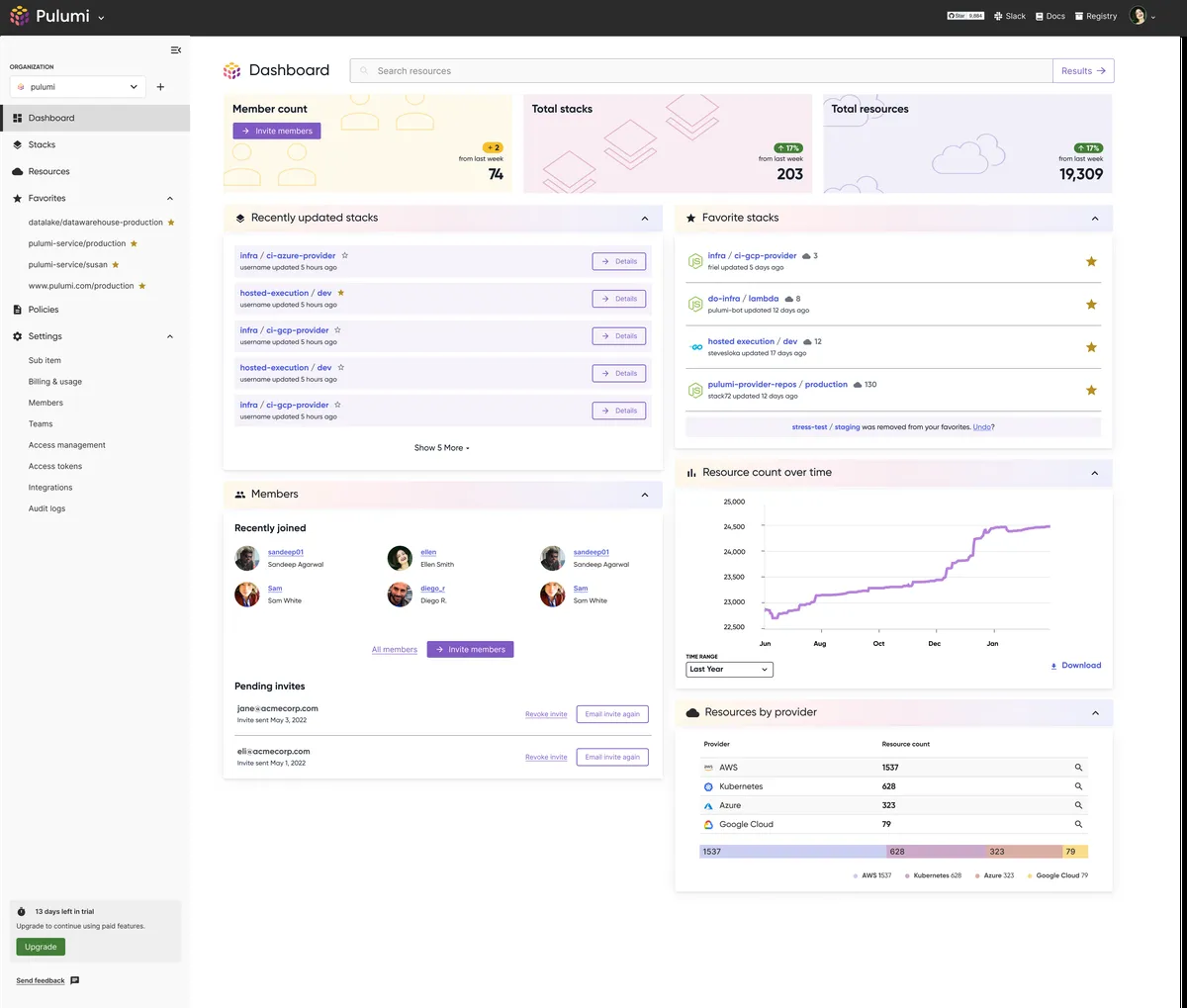
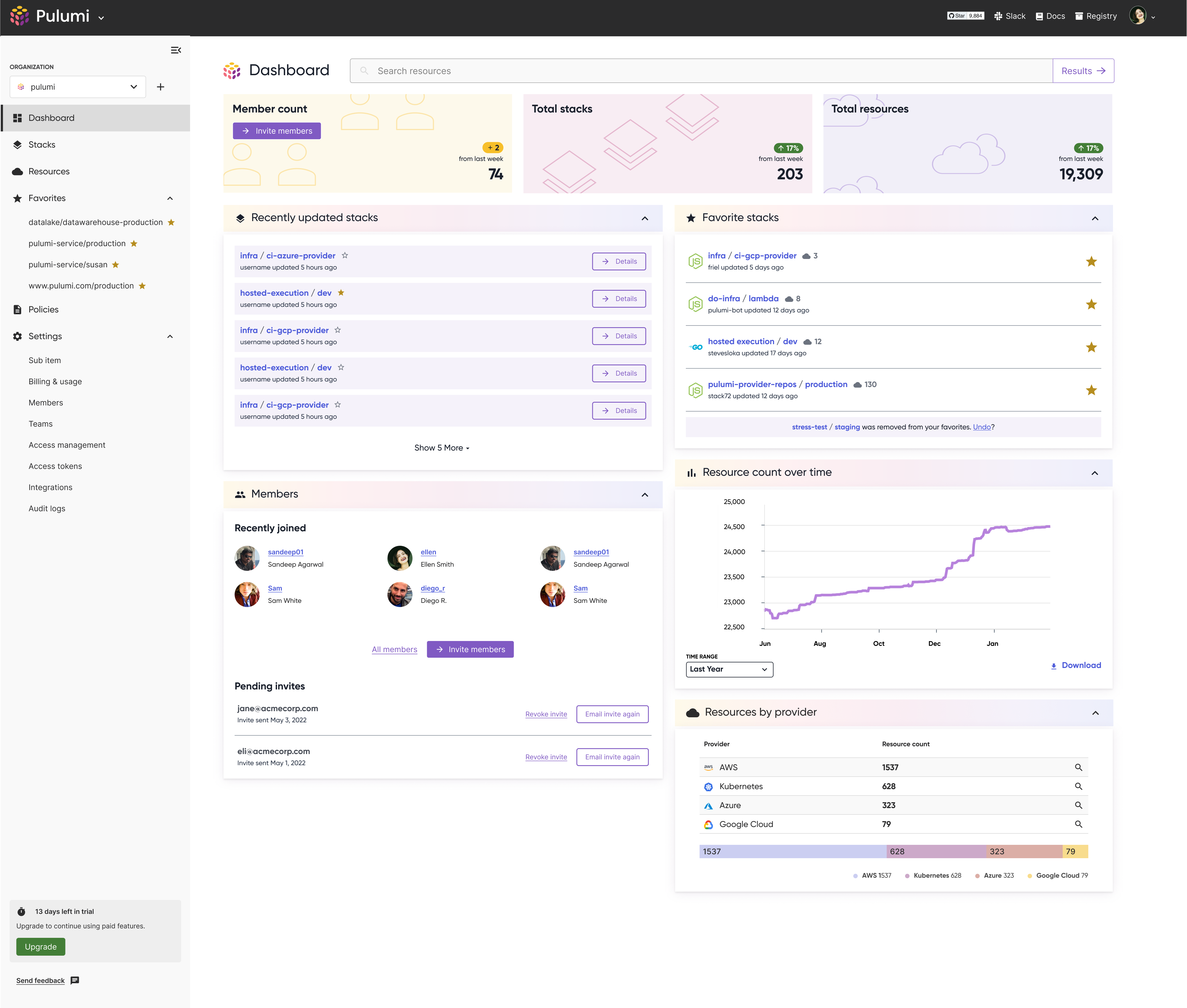
Product screenshot
Trade-offs to weigh
Usage-based bills need a resource count. Every resource declared in a program counts, including component resources and stacks, and a partial resource hour is billed as a full hour. Counting URNs in exported stack state gives an estimate before you buy.
Governance sits on Pro and above. SAML/SSO, advanced RBAC, preventative policies, audit logs and drift detection start on Pro; Essentials runs policy results in advisory mode only.
Self-hosting Pulumi Cloud is an Enterprise-plus-Platinum commitment. Self-hosted Pulumi Cloud is offered on Enterprise, and self-hosted customers require Platinum support, which is priced through sales.
Neo token use varies. Neo tasks, pull-request annotations and natural-language search consume tokens, and Pulumi says volume varies with the number, complexity and duration of Neo activities.
Pricing and plan conditions
Essentials and Pro are sold month to month with a credit card; Enterprise is sold through a sales-led contract. The up-front monthly fee buys a pool of Pulumi Credits; unused monthly credits expire at the end of each term, and usage beyond the pool is billed in arrears. Annual commitment pricing is on Pro and Enterprise only. Pulumi offers a 14-day money-back guarantee, and sales tax may be added in some jurisdictions.
Scroll sideways to see all columns. With a keyboard, focus this table and use the arrow keys.
| Plan | Published price | What it adds |
|---|---|---|
Free | $0, no credit card required | 1 user, IaC state management, Pulumi Deployments, basic Pulumi ESC, unlimited projects, stacks and environments, unlimited updates and history, up to 500 workflow minutes; no limit on managed resources; no Neo, Resource Search or Property Search |
Essentials | $40/month; IaC resources $0.1825 per resource per month | Everything in Free, plus unlimited users, collaboration and CI/CD, Neo code reviews, Resource and Property Search, OIDC tokens, webhooks, secrets rotation, an uptime commitment and support tickets; includes up to 500 IaC resources |
Pro | $400 monthly fee; IaC resources from $0.365 per resource per month, with volume discounts | Everything in Essentials, plus custom policy packs, Neo scheduled tasks, internal developer platform, time-to-live stacks and customer-managed keys; includes up to 2,000 resources |
Enterprise | Custom, through a sales-led contract; IaC resources from $0.5475 per resource per month | Everything in Pro, plus self-hosting, conformance packs, SCIM user and group sync, automated audit log export, unlimited custom policy packs, policy remediation, contract pricing and invoicing, and bring your own key for Neo |
Scroll sideways to see all columns. With a keyboard, focus this table and use the arrow keys.
| Meter | Published rate |
|---|---|
ESC secrets | 25 free on Free; $0.50 per secret per month on Essentials, $0.75 on Pro, $1.00 on Enterprise |
ESC ReadOpen API calls | First 10K calls per month free, then $0.1 per 10K calls; Pulumi's example: 15,000 calls cost $0.05 |
Workflow minutes | 500 free on Free; $0.01 per minute; one shared pool for Discovery and Deployments |
Neo tokens | $3 per million tokens; with Enterprise BYOK your model provider bills you and Pulumi charges no Neo tokens for those requests |
Paid support plans | Standard or Bronze on Essentials, Pro and Enterprise: Standard $625/month or $7,500/year, or included with a contract of at least one year; Bronze $1,250/month or $15,000/year; Silver, Gold and Platinum through sales |
Pulumi's own worked example: storing secrets for 4 days on Essentials costs 4 x 24 x 0.5 / 730 = $0.0657. Scaling startups can apply for $10,000 in free credits.
Public signals
About these signals
Verified factual signals from public sources. They indicate observable activity or interest, not total adoption, product quality, or cost.
690 GitHub commits 90d25.9k GitHub stars0 vulnerabilities across 1 package
See all signals from 4 sources
PyPI · pulumi@3.274.1
Alternatives
Teams on Terraform, AWS CloudFormation or Azure Resource Manager can use Pulumi's converters to migrate code and resource state, with Neo to assist. Its homepage also announces native support for Terraform and HCL, so a team can move without first rewriting everything in a general-purpose language.
Alternatives to Pulumi
The reviewed substitutes for Pulumi among the infrastructure as code, and what would make each one the better answer.
Other approaches
A different approach to the same problem. Each substitutes only for the workload named beside it.
- OpenTofu
- Both are answers to Terraform's licence change, reached from opposite directions: OpenTofu keeps the HCL authoring model and changes the governance, Pulumi keeps a commercial vendor and changes the authoring model. A team leaving Terraform weighs them against each other, and the choice is whether the objection was to the licence or to the language.Applies to: Choosing an infrastructure-as-code tool after leaving Terraform. OpenTofu stands in when HCL is right and the objection was licensing; Pulumi stands in when the objection was the configuration language itself and general-purpose code with tests is the goal.
- Terraform
- The same job with a different authoring model. Terraform constrains infrastructure to HCL, which is what makes a plan diff predictable to a reviewer; Pulumi expresses it in TypeScript, Python, Go or .NET, so loops, tests, type checking and package managers come from the language. Conditional because the right answer follows from who maintains the code: a full programming language buys abstraction and testing at the cost of the constraint that makes review easy.Applies to: Declaring cloud infrastructure as code. Pulumi stands in for Terraform when the people writing infrastructure are programmers who want their own language and tooling, or when reusable components should ship through npm and PyPI; Terraform stands in when a constrained configuration language suits the reviewers, or the estate is already written in HCL.