Acknowledgment
Special thanks to Denny Lee, PM Director, Startups & Ecosystems at Databricks, for his feedback and input during the development of this article.
If you ask ten teams how they chose their data platform, at least seven will say something like, “We made a spreadsheet”. The spreadsheet was a feature matrix, the winner was the vendor with the most green cells and the smoothest demo, and six months later the team was wondering why life felt more complicated, not less.
This is the odd thing about platform evaluations: they often look rigorous precisely when they are least thoughtful. A large feature matrix creates the impression of engineering discipline, but in practice it often replaces architectural thinking with accounting that feels objective because it has rows and columns.
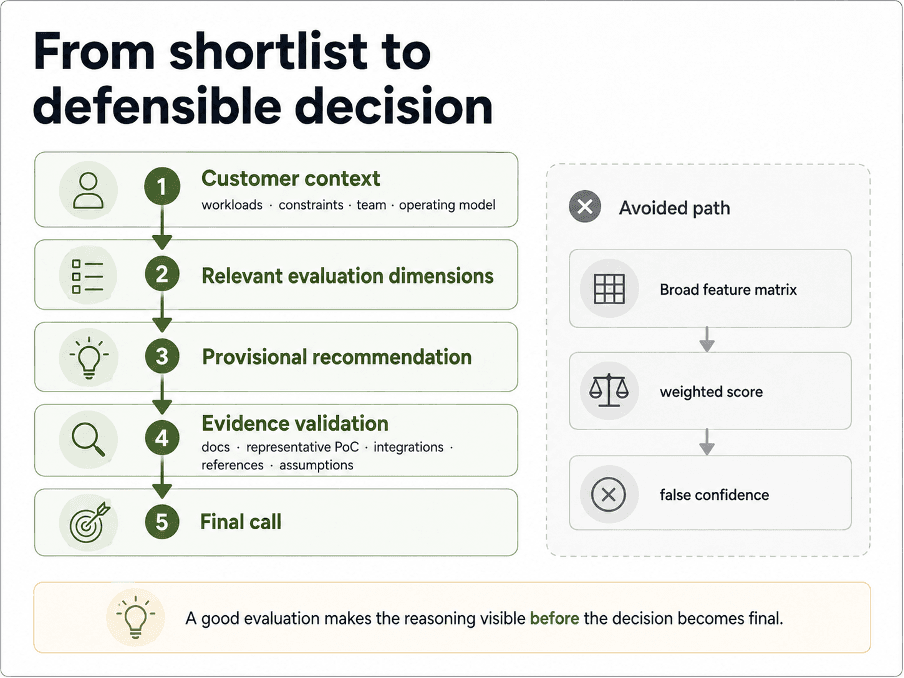
The evaluation process is straightforward: define the decision, identify the constraints, compare the shortlist on the dimensions that matter, validate the recommendation with evidence, and only then make the final call. To make this concrete, this guide follows three fictional but suspiciously familiar teams:
- Sophia runs BI at a retailer with a small SQL-first team.
- Arun leads the data platform group at a midsize bank that is trying to modernize without creating a second mess.
- Maya owns product analytics at a SaaS company where real-time dashboards are not a luxury but part of the product itself.
The same evaluation framework applies to all three scenarios, but the result should not be identical. The goal of this article is not to argue that one platform wins every time, but to show how to evaluate a shortlist in a way that reflects actual workloads, operating models, and trade-offs.
The wrong way to start
If teams jump directly into the ‘spreadsheet mode’ without a clearly defined decision, broad capabilities become noise and fundamentally different products begin to look artificially comparable.
Imagine Sophia's BI team opening a spreadsheet with columns for Databricks, Snowflake, and BigQuery. They score notebook support, SQL features, governance controls, ML tooling, connectors, dashboarding, and a dozen other capabilities, and it looks like due diligence. However, if Sophia mostly needs trusted reporting, stable query performance, and low operational overhead for a small SQL-first team, then a long list of ML capabilities is not neutral information, but noise, and the spreadsheet answers a question Sophia never meant to ask.
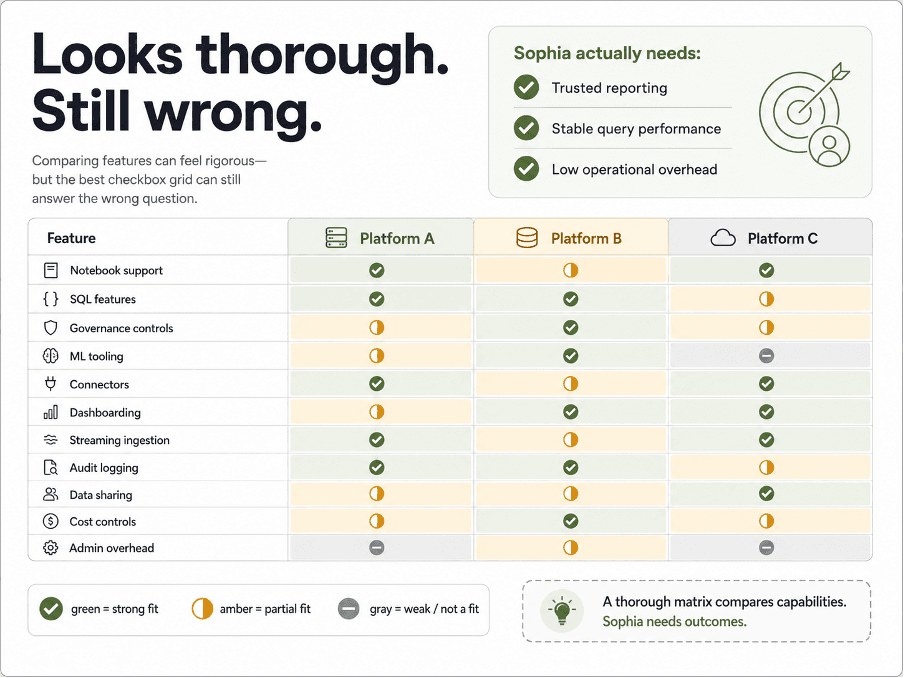
Evaluation criteria must therefore follow customer context: Sophia optimizes for simplicity, Arun for consolidation and control, and Maya for latency and reliability.
Decision context
Before comparing platforms, we should define the decision and the hard constraints. This is the part most teams try to skip because it feels slower than vendor demos, but it is the part that keeps the evaluation from drifting into theater.
Start with decision context:
- Current architecture and the pain that is severe enough to justify change.
- Core workloads today, plus the workloads likely to matter over the next two to three years.
- Data volume, concurrency, latency targets, and operational requirements.
- Existing tools, contracts, and technical choices that have to remain in place.
- Team skills, operating model, and measurable success criteria.
Then define hard constraints:
- Security, identity, compliance, and audit requirements.
- Cloud, deployment, residency, and networking constraints.
- Required integrations with the existing stack.
- Minimum expectations for scale, reliability, and vendor support.
This changes the conversation immediately. Sophia's retailer has an existing BI stack, a small SQL-oriented team, and a mandate to keep operations light. Arun's bank has stricter controls around security, identity, audit, and likely data residency, which means platform governance and administrative control are not optional nice-to-haves but design requirements. Maya's company lives on operational dashboards, so concurrency, latency, failure handling, and observability matter in a way they do not for a batch-heavy reporting shop.
A customer with strict EU data residency requirements and a pre-existing BI layer should not evaluate platforms the same way as a greenfield team trying to build a unified data-and-AI foundation. That sounds obvious when written plainly, which is one reason teams avoid stating it plainly. Once the context is explicit, many fashionable comparisons become unnecessary.
Evaluation dimensions
With the decision context and hard constraints defined, compare the shortlist only on the few dimensions that can materially affect the outcome. At this stage, use public evidence—documentation, reference architectures, integration catalogues, pricing, technical limits, and relevant published customer examples—to eliminate weak fits and identify a provisional leader. Full proofs of concept come later.
| Dimension | What to verify | Why it matters |
|---|---|---|
| Workload and architecture fit | Map the organization’s main workloads to the platform’s documented architecture. Identify which are supported directly and which require additional services or significant redesign. | A platform can look strong on paper and still be the wrong choice if it is optimized for a different kind of work. |
| Governance and operational control | Confirm documented support for identity integration, access controls, lineage, audit export, residency, and separation of duties. Record any requirement that depends on an external service or custom implementation. | In regulated or production-heavy environments, governance is not a bonus feature. It is what keeps the platform usable. |
| Interoperability and portability | Check support for the most important existing systems, open formats, APIs, and realistic data-export or coexistence paths. | A platform that is easier to connect, replace, or run alongside other tools is usually cheaper over time, because it avoids lock-in and reduces the cost of future change. |
| AI and ML lifecycle fit | Map the required lifecycle—from experimentation to deployment and monitoring—to the platform’s documented native and external components. | Many teams say they need AI before they know what part of the AI lifecycle they actually need. |
| Developer and operator experience | Review the documented setup, deployment, observability, recovery, and administration model, along with the skills and tools it requires. | A platform that is powerful but hard to operate can become an organizational tax. |
| Performance and scalability | Look for published limits and benchmarks that disclose data volume, workload type, concurrency, latency percentiles, and test conditions. Treat results without a transparent methodology as directional only. | Real performance is workload-specific, and benchmark scores alone are not a reliable way to judge it. |
| Total cost and cost predictability | Build a directional estimate for normal usage, peak demand, and expected growth using public pricing and the same assumptions for every platform. | Cost surprises usually come from architecture, not from the line item on the pricing page. |
| Migration effort and time to value | Review compatibility guidance, migration tooling, architectural changes, and relevant migration examples to estimate the likely scope of work. | The best platform is often the one the team can actually land successfully. |
Treat hard constraints as pass-or-fail gates, not weighted criteria. Eliminate any platform that cannot satisfy them, then compare the remaining options on the three to five dimensions that most directly affect the customer’s success. The goal is not to calculate a universal score, but to make the decisive trade-offs explicit.
Applying the Framework: Three Representative Scenarios
Let’s apply the framework to three fictional but representative situations. Each team evaluates the same shortlist—BigQuery, Databricks, and Snowflake—but uses only the dimensions that materially affect its decision. Treating every dimension as equally important would simply recreate the feature-matrix problem.
Sophia: SQL-first analytics
Sophia runs BI at a retailer with a small SQL-first team. She needs trusted reporting, strong governance, predictable cost, and minimal operational overhead—not a broad data-and-AI platform that her team must learn and operate.
Provisional recommendation: based on the dimensions below, Snowflake emerges as the leading option because it offers the cleanest balance of SQL-first analytics, governance, and operating simplicity.
| Framework dimension | Sophia’s requirement | BigQuery | Databricks | Snowflake |
|---|---|---|---|---|
| Workload and architecture fit | SQL-first BI and trusted reporting | Strong fit for managed SQL analytics | Broader than needed for this use case | Strong fit for warehouse-style analytics and BI workloads |
| Governance and operational control | Clear governance with limited team overhead | Good managed controls, especially in Google Cloud | Governance is possible, but more complex as scope grows | Strong governance and predictable operating model |
| Cost predictability and time to value | Predictable spend and fast adoption | Can work well, especially in GCP | More moving parts for a narrow BI use case | Easier to explain to finance and quicker to adopt |
Arun: enterprise modernization
Arun leads data-platform modernization at a bank with a mixed estate spanning legacy systems, cloud services, and multiple data tools. The bank is not standardized on a single cloud provider. It wants to bring data engineering, analytics, governance, and AI onto a more unified foundation without creating a risky big-bang migration or another layer of fragmented governance.
Provisional recommendation: based on public evidence, Databricks emerges as the leading candidate because Arun’s primary objective is to consolidate data engineering, analytics, and AI under a common governance model across a mixed technology estate. Snowflake would become more compelling if the modernization were primarily warehouse-led, while BigQuery would strengthen materially if the bank were standardized on Google Cloud.
| Framework dimension | Arun’s requirement | BigQuery | Databricks | Snowflake |
|---|---|---|---|---|
| Workload and architecture fit | Unified engineering, analytics, governance, and AI foundation | Strong managed analytics; broader engineering and AI needs may rely on adjacent services | Strong fit for mixed data-and-AI workloads on one platform | Strong for warehouse-led analytics; narrower fit for broader modernization |
| Security, governance, and auditability | Centralized controls, lineage, auditability, and separation of duties | Strong cloud-native controls, but governance may span several services | Strong cross-workload governance for engineering, analytics, and AI | Strong SQL-centric governance across a narrower workload scope |
| Interoperability and migration sequencing | Phased coexistence without creating another governance layer | Supports phased analytics modernization, but cross-platform coexistence requires careful design | Supports phased consolidation across mixed workloads | Good fit for analytics-first modernization and coexistence |
| Operating-model and skills fit | Multi-team adoption without more tools or specialist support | Low infrastructure burden, but teams may need to operate across multiple services | Can reduce fragmentation, but requires broader platform skills | Familiar and relatively simple for SQL-focused teams |
| Consolidation value and three-year cost | Enough tool and effort reduction to justify migration costs | Can simplify analytics operations, but offers less consolidation across the wider estate | Highest consolidation potential if duplicated tools can be retired | Strong for analytics consolidation; less impact across the wider data-and-AI estate |
Maya: real-time analytics
Maya owns product analytics at a SaaS company whose dashboards are effectively part of the product. Her requirements are demanding: low latency, high concurrency, reliability, observability, and clean integration with the existing application stack. She does not get to treat stale data as a minor annoyance. In her world, stale data is a product problem.
Provisional recommendation: based on the dimensions below, BigQuery is the strongest candidate to validate for the immediate decision because its managed, SQL-native real-time capabilities align well with Maya’s need for low operational overhead. Databricks should remain on the shortlist: Lakehouse//RT is currently in beta and is designed for low-latency, high-concurrency operational analytics and BI workloads. As the capability matures, Maya’s team should re-evaluate it against representative latency and concurrency tests.
| Framework dimension | Maya’s requirement | BigQuery | Databricks | Snowflake |
|---|---|---|---|---|
| Workload and architecture fit | Real-time dashboards and operational analytics | Strong fit for SQL-native, event-driven analytics | Promising, but newer for this use case | Strong fit for governed analytics |
| Performance and reliability | Low latency with low operational overhead | Continuous queries support real-time processing; representative testing must confirm dashboard latency and concurrency | Worth revisiting as Lakehouse//RT matures | Strong option for high-concurrency analytics |
| Operating model | Small team, minimal platform work | Fully managed model reduces infrastructure management | More platform complexity than Maya needs now | Also managed, but less tightly aligned to this use case |
| Time horizon | Needs a decision now, but can revisit later | Good immediate choice | Keep on the watch list for a future re-evaluation | Strong fallback if workload shifts |
Evidence-Based Validation
Once the framework has identified a leading candidate, the team should move from public evidence to environment-specific validation of the assumptions most likely to overturn the recommendation. What gets tested should follow the scenario: for Sophia, that might be operational effort and cost; for Maya, representative queries at expected volume and concurrency; for Arun, controls, phased coexistence, and whether consolidation really reduces complexity.
For Arun in particular, deeper validation matters because the recommendation depends on whether consolidation actually works in the bank’s environment. That might mean running a representative workflow with realistic access patterns; testing identity integration, separation of duties, lineage, auditability, and governance controls; verifying coexistence with a critical legacy system during a phased migration; and confirming that the expected reduction in tools and operating effort justifies migration, training, and dual-running costs. References from similarly regulated organizations can help test the operating-model assumptions. A generic demo can show that a platform works; it cannot show that consolidation will work in Arun’s environment.
Conclusion
The three scenarios show why the same platform question can produce different answers. Sophia, Arun, and Maya evaluate the same shortlist, but their workloads, constraints, and operating models lead them toward different choices.
That is not a weakness in the framework; it is the point. A strong evaluation does not manufacture a universal winner. It makes the reasoning visible—and produces a decision the team can explain, defend, and build on with confidence.