Decision comparison
AgentVault vs ClawBox
AgentVault and ClawBox play different roles around the same agent framework. ClawBox is the place an OpenClaw agent lives: a small NVIDIA box that runs a private assistant all day and talks to you over Telegram, WhatsApp or Discord. AgentVault is a guard for an OpenClaw agent: software that blocks risky file reads, commands and network calls and asks you before they run. Pick ClawBox if you want an assistant without building or hosting one. Pick AgentVault if you already run OpenClaw on a computer that holds real keys and you want hard stops on what it can do. Running AgentVault on a ClawBox is not documented by either project, so test it before you count on it.
Used together. These are normally used together rather than chosen between. The comparison explains what each one does in the stack.
These are different kinds of product — AI Security and AI Hardware.
Quick Comparison
| Decision factor | AgentVault | ClawBox |
|---|---|---|
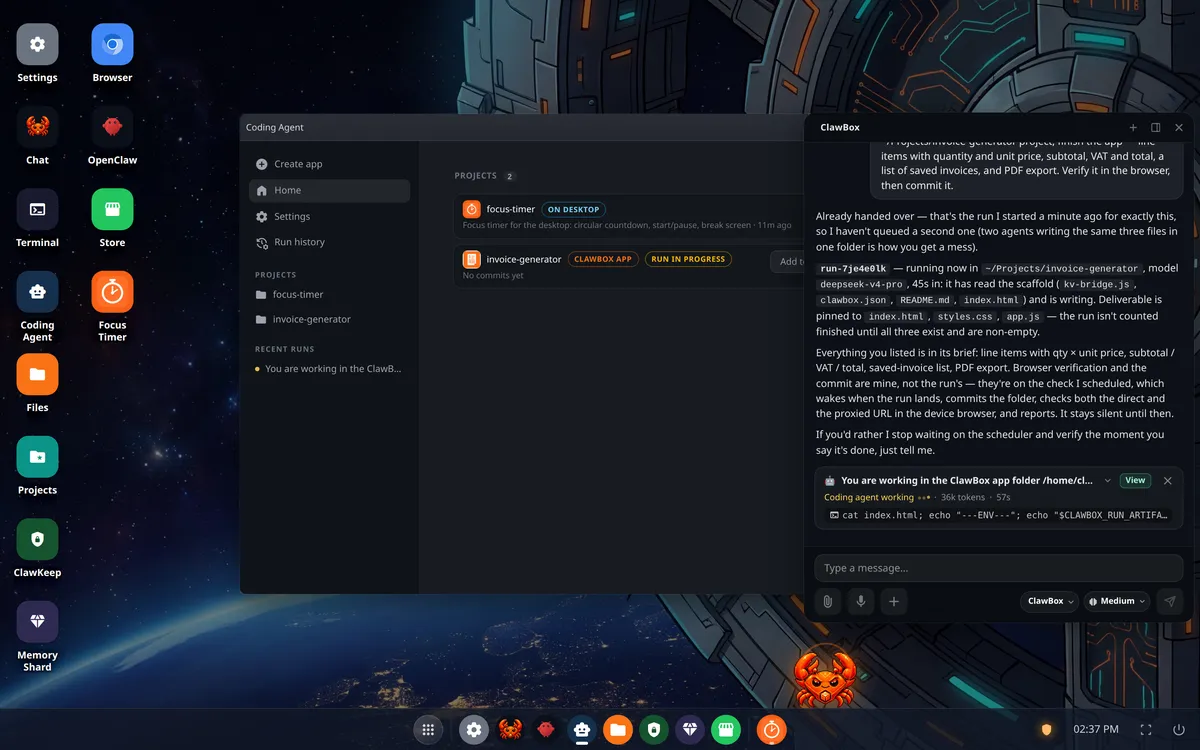
| Best For | A developer who already runs an OpenClaw agent on a laptop or server and wants to stop it from leaking keys or damaging the machine. AgentVault adds a guard around the agent; it does not run the agent for you. | Individuals and small teams who want a private AI assistant running 24/7 on hardware they own, reached through Telegram, WhatsApp or Discord, without setting up a server. ClawBox ships with OpenClaw pre-installed, and its site says it can run Hermes Agent instead. |
| Pricing | AgentVault is free and open source under the MIT license: a GitHub project that wraps AI agents with action-level security monitoring for OpenClaw. It has no paid plans and publishes no prices; the agentvault.ai domain now belongs to a different company. Verified 2026-10-05 against https://github.com/hugoventures1-glitch/agentvault. | ClawBox is a €749 one-time hardware purchase (NVIDIA Jetson Orin Nano 8GB, 67 TOPS, 512GB NVMe SSD) that runs OpenClaw or Hermes Agent, with free worldwide shipping and a 30-day money-back policy; no subscription is required. Optional ClawBox AI plans add managed cloud models, voice, image generation and the Coding Agent: Free €0/month (20M tokens a week), Pro €9/month or €89/year (100M tokens a week, Coding Agent, Memory Shard, persistent link) and Max €49/month or €479/year (500M tokens a week). Verified 2026-10-05 against https://clawbox.com/clawbox-price. |
| Deployment | Software only. You install it with npm on the machine where OpenClaw runs (npm install -g agentvault), wrap the agent (agentvault wrap openclaw), and open the dashboard (agentvault dashboard). | A dedicated device: an NVIDIA Jetson Orin Nano with 8GB RAM, a 512GB NVMe SSD and a carbon fiber case, drawing about 15 watts, per its maker. It runs on your home or office network, and its maker lists remote access with hybrid cloud routing. |
| Learning Curve | Moderate. Setup is three commands, but you should read the code first, because it sits between the agent and your credentials. Day to day, a person must answer an approval prompt whenever the agent tries a risky action. | Low. Its site describes plugging in power and network, then a 5-minute setup wizard, with no config files and no terminal. The device arrives configured, so you do not install OpenClaw yourself. |
| Category Focus | Action-level security for AI agents. It lets a prompt injection reach the agent and stops the file read, command or network call that follows. It is an early single-maintainer project, created on 2026-02-09 and last pushed on 2026-02-10. | Personal AI assistant hardware. Its maker lists browser automation with local web browsing and form filling, an always-on assistant with persistent memory, calendar and smart home control, and 67 TOPS of AI performance. |
| Security Model | Deep file system interception (it catches reads of ~/.aws/credentials and ~/.ssh/id_rsa), dangerous command detection (rm -rf, curl | bash, privilege escalation), human-in-the-loop approvals, network monitoring, and a SQLite audit trail of every action. | Privacy by location: its maker says AI processing stays on the device and your data has no cloud dependency, and its site says nothing inbound reaches the box. It describes no action-level blocking or approval of what the assistant does. |
AgentVault
- Best For:
- A developer who already runs an OpenClaw agent on a laptop or server and wants to stop it from leaking keys or damaging the machine. AgentVault adds a guard around the agent; it does not run the agent for you.
- Pricing:
- AgentVault is free and open source under the MIT license: a GitHub project that wraps AI agents with action-level security monitoring for OpenClaw. It has no paid plans and publishes no prices; the agentvault.ai domain now belongs to a different company. Verified 2026-10-05 against https://github.com/hugoventures1-glitch/agentvault.
- Deployment:
- Software only. You install it with npm on the machine where OpenClaw runs (npm install -g agentvault), wrap the agent (agentvault wrap openclaw), and open the dashboard (agentvault dashboard).
- Learning Curve:
- Moderate. Setup is three commands, but you should read the code first, because it sits between the agent and your credentials. Day to day, a person must answer an approval prompt whenever the agent tries a risky action.
- Category Focus:
- Action-level security for AI agents. It lets a prompt injection reach the agent and stops the file read, command or network call that follows. It is an early single-maintainer project, created on 2026-02-09 and last pushed on 2026-02-10.
- Security Model:
- Deep file system interception (it catches reads of ~/.aws/credentials and ~/.ssh/id_rsa), dangerous command detection (rm -rf, curl | bash, privilege escalation), human-in-the-loop approvals, network monitoring, and a SQLite audit trail of every action.
ClawBox
- Best For:
- Individuals and small teams who want a private AI assistant running 24/7 on hardware they own, reached through Telegram, WhatsApp or Discord, without setting up a server. ClawBox ships with OpenClaw pre-installed, and its site says it can run Hermes Agent instead.
- Pricing:
- ClawBox is a €749 one-time hardware purchase (NVIDIA Jetson Orin Nano 8GB, 67 TOPS, 512GB NVMe SSD) that runs OpenClaw or Hermes Agent, with free worldwide shipping and a 30-day money-back policy; no subscription is required. Optional ClawBox AI plans add managed cloud models, voice, image generation and the Coding Agent: Free €0/month (20M tokens a week), Pro €9/month or €89/year (100M tokens a week, Coding Agent, Memory Shard, persistent link) and Max €49/month or €479/year (500M tokens a week). Verified 2026-10-05 against https://clawbox.com/clawbox-price.
- Deployment:
- A dedicated device: an NVIDIA Jetson Orin Nano with 8GB RAM, a 512GB NVMe SSD and a carbon fiber case, drawing about 15 watts, per its maker. It runs on your home or office network, and its maker lists remote access with hybrid cloud routing.
- Learning Curve:
- Low. Its site describes plugging in power and network, then a 5-minute setup wizard, with no config files and no terminal. The device arrives configured, so you do not install OpenClaw yourself.
- Category Focus:
- Personal AI assistant hardware. Its maker lists browser automation with local web browsing and form filling, an always-on assistant with persistent memory, calendar and smart home control, and 67 TOPS of AI performance.
- Security Model:
- Privacy by location: its maker says AI processing stays on the device and your data has no cloud dependency, and its site says nothing inbound reaches the box. It describes no action-level blocking or approval of what the assistant does.
Public signals
Verified factual signals only. Bars appear only for like-for-like metrics with five weekly assessments for every tool; missing evidence stays explicit. These signals do not establish enterprise adoption, product quality, or total cost.
| Metric | AgentVault | ClawBox |
|---|---|---|
| GitHub commits, 90d(Product adoption) | 0 | Not available |
| GitHub stars(Product adoption) | 2 | Not available |
| Product Hunt comments(Community interest) | 1 | 1 |
| Product Hunt reviews(Community interest) | 0 | 0 |
| Product Hunt votes(Community interest) | 2 | 3 |
As of October 19, 2026 — updated weekly.
Interface Preview
ClawBox
Feature Comparison
| Feature | AgentVault | ClawBox |
|---|---|---|
| Core Architecture | ||
| What you get | Software that wraps an agent you already run | A hardware appliance with an agent pre-installed |
| Primary function | Security monitoring and control of agent actions | Always-on personal AI assistant with browser automation |
| Agent framework | Wraps OpenClaw (agentvault wrap openclaw) | Runs OpenClaw; its site says Hermes Agent is also available |
| Security and Privacy | ||
| Action blocking | Blocks rm -rf, curl | bash and privilege escalation attempts | Not described; it runs the assistant rather than policing it |
| Sensitive files | Intercepts agent reads of ~/.aws/credentials and ~/.ssh/id_rsa | Data stays on the device, per its maker |
| Human approvals | Every risky action waits for explicit permission | Not described |
| Network exposure | Logs all outbound connections and data exfiltration attempts | Its site says nothing inbound reaches the box |
| Operations and Monitoring | ||
| Dashboard | Real-time web UI of what the agent is doing | Web interface plus Telegram, WhatsApp and Discord chat |
| Records | SQLite audit trail of every action | Persistent assistant memory across conversations |
| Uptime | Runs while the host machine runs | Dedicated device built to run 24/7 at about 15 watts |
| AI Capabilities | ||
| Model inference | None of its own; it watches actions, not model calls | 67 TOPS NVIDIA Jetson Orin Nano for local models |
| Cloud models | Not involved | Hybrid cloud routing, per its maker |
| Browser automation | Outside its scope | Local web browsing and form filling |
| Cost and Project | ||
| Cost basis | No license fee (MIT); no paid plans | One-time hardware purchase; no required subscription |
| Maturity | Single-maintainer project; created 2026-02-09, last push 2026-02-10 | Sold as a product with a 30-day money-back guarantee |
Core Architecture
What you get
Primary function
Agent framework
Security and Privacy
Action blocking
Sensitive files
Human approvals
Network exposure
Operations and Monitoring
Dashboard
Records
Uptime
AI Capabilities
Model inference
Cloud models
Browser automation
Cost and Project
Cost basis
Maturity
How they fit together
AgentVault and ClawBox play different roles around the same agent framework. ClawBox is the place an OpenClaw agent lives: a small NVIDIA box that runs a private assistant all day and talks to you over Telegram, WhatsApp or Discord. AgentVault is a guard for an OpenClaw agent: software that blocks risky file reads, commands and network calls and asks you before they run. Pick ClawBox if you want an assistant without building or hosting one. Pick AgentVault if you already run OpenClaw on a computer that holds real keys and you want hard stops on what it can do. Running AgentVault on a ClawBox is not documented by either project, so test it before you count on it.
What each one handles
Use AgentVault for:
Choose AgentVault if you already run OpenClaw on a laptop or server that holds cloud keys, SSH keys or anything else you cannot afford to lose. It catches reads of ~/.aws/credentials and ~/.ssh/id_rsa, blocks rm -rf and curl | bash, logs outbound connections, and records every action in SQLite. It costs nothing to license and installs in three commands. Accept that it is an early single-maintainer project with unshipped roadmap items. ClawBox loses this case because buying a separate device does not secure the machine you already use, and ClawBox describes no blocking or approval of agent actions.
Use ClawBox for:
Choose ClawBox if you want a private assistant running around the clock without setting up a server or touching a terminal. You plug it in, follow a 5-minute wizard, and chat with it over Telegram, WhatsApp or Discord. It runs on an NVIDIA Jetson Orin Nano at about 15 watts, keeps your data on the device, and handles browser tasks and persistent memory. You pay once for the hardware, with no required subscription. AgentVault loses this case because it is not an assistant at all; it only guards an agent you have already set up yourself, and it needs a person to answer its approval prompts.
These roles reflect the available product evidence. Most teams run both; which one owns a given job depends on your stack and team.
Frequently Asked Questions
Can AgentVault and ClawBox be used together?
In principle they fit: ClawBox runs OpenClaw, and AgentVault was built to wrap OpenClaw. In practice, neither project documents running AgentVault on a ClawBox. ClawBox is an ARM-based NVIDIA Jetson device set up through a wizard, without a terminal, while AgentVault is installed with npm and needs a person to answer approval prompts. If you want both, test the install on the device first and decide who will answer the approvals.
Which tool requires less technical knowledge to set up?
ClawBox, clearly. Its site describes plugging in power and network and then a 5-minute wizard, with no config files and no terminal. The device arrives configured. AgentVault needs a developer: you install a global npm package, wrap your existing OpenClaw agent, and should read the code first. It also needs ongoing attention, because every risky action waits for a person.
How do the ongoing costs compare between AgentVault and ClawBox?
AgentVault has no license fee: it is free and open source under MIT, with no paid plans. Its ongoing cost is the computer it runs on and the time spent on approvals. ClawBox is a one-time hardware purchase with no required subscription, and its maker puts the device at about 15 watts, so the running cost is mostly electricity. Optional ClawBox AI cloud plans and credits cost extra, per its site. Check clawbox.com for the current device price, and note its 30-day money-back guarantee.
Does ClawBox include security monitoring like AgentVault?
No. ClawBox's security story is about where data lives: its maker says processing stays on the device with no cloud dependency, and its site says nothing inbound reaches the box. AgentVault's story is about what the agent may do: it intercepts sensitive file reads, blocks dangerous commands, logs outbound connections and asks a person to approve risky actions. These answer different threats, so having one does not replace the other.
What AI models can each tool work with?
AgentVault does not run models. It watches the file, command and network actions of the OpenClaw agent it wraps, whatever model that agent uses. ClawBox runs local models on its 67 TOPS NVIDIA Jetson Orin Nano, and its maker lists hybrid cloud routing for tasks that need a cloud model. Its site also says you can switch the box between OpenClaw and Hermes Agent.