Decision comparison
Apache Airflow vs Sling
Apache Airflow excels as a general-purpose workflow orchestrator for complex, multi-step data pipelines requiring Python flexibility, while Sling specializes in fast, configuration-driven ELT data replication between databases and storage systems with minimal setup.
Used together. These are normally used together rather than chosen between. The comparison explains what each one does in the stack.
These are different kinds of product — Workflow Orchestrator and ELT Platform.
Quick Comparison
| Decision factor | Apache Airflow | Sling |
|---|---|---|
| Best For | Complex workflow orchestration across diverse systems using Python-based DAGs with dependency management | Streamlined ELT data replication between databases, files, and cloud storage with minimal configuration |
| Primary Approach | DAG-based workflow orchestration with Python code defining task dependencies, scheduling, and monitoring | YAML-configured data replication with a Go-powered streaming engine optimized for ELT operations |
| Ease of Use | Requires Python expertise and understanding of DAG concepts, with a steep learning curve for new users | CLI-first design with YAML configuration files, quick setup, and minimal coding required for data jobs |
| Scalability | Modular architecture using message queues to orchestrate arbitrary numbers of workers at enterprise scale | Go-based streaming engine with parallel streams, retries, and stream chunking for efficient processing |
| Integration Ecosystem | Extensive plug-and-play operators for GCP, AWS, Azure, and hundreds of third-party services and databases | Connects to databases like PostgreSQL, MySQL, Snowflake, BigQuery, plus cloud storage and REST APIs |
| Pricing | Free and open-source under the Apache License 2.0 | Free for up to 30 users, Premium at $2.00 per user per month, Business at $4.00 per user per month. Open-source self-hosted available under GPL-3.0 license. |
Apache Airflow
- Best For:
- Complex workflow orchestration across diverse systems using Python-based DAGs with dependency management
- Primary Approach:
- DAG-based workflow orchestration with Python code defining task dependencies, scheduling, and monitoring
- Ease of Use:
- Requires Python expertise and understanding of DAG concepts, with a steep learning curve for new users
- Scalability:
- Modular architecture using message queues to orchestrate arbitrary numbers of workers at enterprise scale
- Integration Ecosystem:
- Extensive plug-and-play operators for GCP, AWS, Azure, and hundreds of third-party services and databases
- Pricing:
- Free and open-source under the Apache License 2.0
Sling
- Best For:
- Streamlined ELT data replication between databases, files, and cloud storage with minimal configuration
- Primary Approach:
- YAML-configured data replication with a Go-powered streaming engine optimized for ELT operations
- Ease of Use:
- CLI-first design with YAML configuration files, quick setup, and minimal coding required for data jobs
- Scalability:
- Go-based streaming engine with parallel streams, retries, and stream chunking for efficient processing
- Integration Ecosystem:
- Connects to databases like PostgreSQL, MySQL, Snowflake, BigQuery, plus cloud storage and REST APIs
- Pricing:
- Free for up to 30 users, Premium at $2.00 per user per month, Business at $4.00 per user per month. Open-source self-hosted available under GPL-3.0 license.
Public signals
Verified factual signals only. Bars appear only for like-for-like metrics with five weekly assessments for every tool; missing evidence stays explicit. These signals do not establish enterprise adoption, product quality, or total cost.
| Metric | Apache Airflow | Sling |
|---|---|---|
| Docker Hub pulls(Product adoption) | 1.6B | 17.2k |
| GitHub commits, 90d(Product adoption) | 2.0k | 180 |
| GitHub stars(Product adoption) | 46,000+ | 906 |
| Search interest(Market interest) | 2 | 1 |
| Hacker News mentions, 90d(Community interest) | 1 | Not available |
| PyPI weekly downloads(Product adoption) | 1.8M | 40.3k |
| Stack Overflow questions(Community interest) | 10.6k | Not available |
As of September 21, 2026 — updated weekly.
Health & risk evidence
Observed public-source checks for mapped package versions and repositories.
Apache Airflow
September 21, 2026Package vulnerabilities
PyPI · apache-airflow@3.3.2
0 vulnerabilities
across 1 package
Repository security score
github.com/apache/airflow
7.3/10
Sling
September 21, 2026Package vulnerabilities
PyPI · sling@1.6.3
0 vulnerabilities
across 1 package
Repository security score
github.com/slingdata-io/sling-cli
3.8/10
Interface Preview
Apache Airflow
Sling
Feature Comparison
| Feature | Apache Airflow | Sling |
|---|---|---|
| Core Architecture | ||
| Programming Model | Python-based DAGs define workflows as directed acyclic graphs with task dependencies and scheduling logic | YAML configuration files define replication jobs with source-target connections and load mode settings |
| Execution Engine | Modular scheduler with configurable executors including Local, Celery, and Kubernetes for distributed execution | Go-powered streaming engine that holds minimal data in memory for efficient high-throughput processing |
| Extensibility | Custom operators, hooks, and sensors can be built in Python to extend functionality for any use case | Hooks and pipelines support HTTP requests, SQL queries, file operations, and custom pre/post-replication logic |
| Data Movement | ||
| Load Modes | Supports custom data transfer logic through operators; users build their own load patterns in Python code | Built-in modes including full-refresh, truncate, incremental merge/append, snapshot, and backfill operations |
| Schema Handling | No built-in schema management; users implement schema operations through custom tasks and operators | Automatic schema detection, schema evolution, and schema migration of PKs, FKs, indexes, and constraints |
| Change Data Capture | No native CDC support; requires third-party tools or custom operator implementations for CDC workflows | Native CDC reads database transaction logs for continuous replication of inserts, updates, and deletes |
| Monitoring & Operations | ||
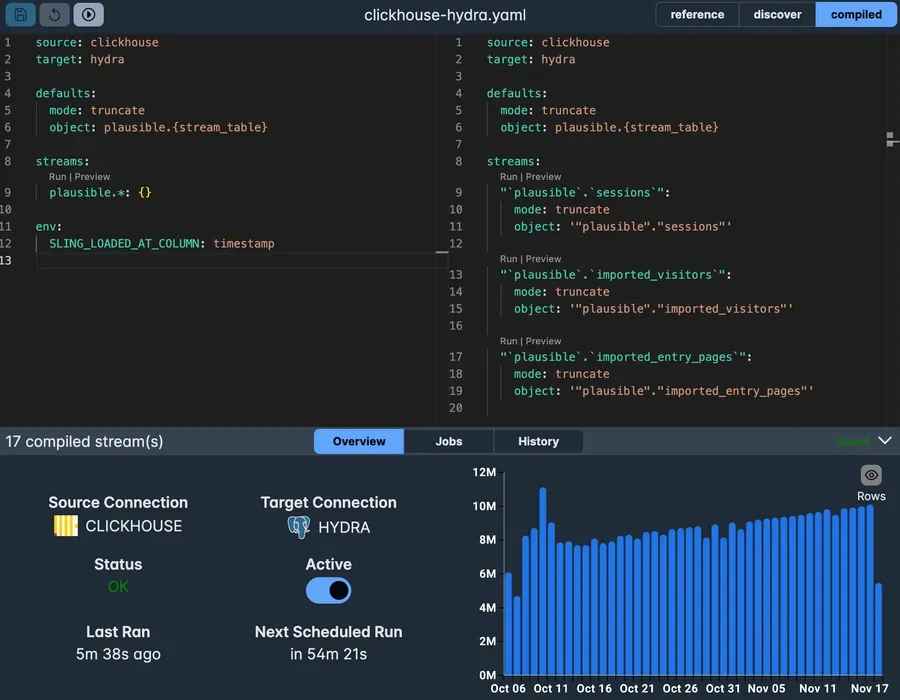
| Web Interface | Full-featured web UI for monitoring, scheduling, and managing workflows with task status and log visibility | Platform UI with built-in editor, job history, execution details, and agent management dashboard |
| Alerting | Configurable email alerts, SLA monitoring, and callback functions for task state changes and failures | Email, Slack, and MS Teams alerts on Standard plan; observability monitoring for volume and freshness |
| Observability | Task logs, Gantt charts, tree views, and integration with external monitoring tools via StatsD and Prometheus | OpenTelemetry logging to any OTLP endpoint; monitors volume, existence, freshness, and schema changes |
| Deployment & Security | ||
| Deployment Options | Self-hosted on any infrastructure; managed options available through providers like Astronomer and MWAA | Free CLI runs anywhere; Platform available as cloud-hosted or self-hosted on Advanced plan |
| Access Control | Role-based access control with configurable permissions for DAGs, connections, and admin functions | User roles with granular permissions on Advanced plan; audit logs for compliance and security monitoring |
| Version Control | DAGs stored as Python files naturally integrate with Git repositories for versioning and CI/CD pipelines | Git integration on Advanced plan connects to GitHub, GitLab, or Bitbucket for pipeline version control |
| Data Transformation | ||
| Transform Capabilities | Full Python ecosystem available for transformations; any library or custom code can be used within tasks | Built-in transforms for column hashing, encoding/decoding, UUID parsing, accent cleaning, and more |
| Quality Checks | No built-in data quality; integrates with external frameworks like Great Expectations or custom validation tasks | Native quality checks monitor schema and data deviations with automatic alerts and custom check definitions |
| Workflow Composition | Complex DAGs with branching, conditional execution, sub-DAGs, task groups, and dynamic task generation | Pipelines with hooks for pre/post-replication actions including HTTP requests, SQL queries, and notifications |
Core Architecture
Programming Model
Execution Engine
Extensibility
Data Movement
Load Modes
Schema Handling
Change Data Capture
Monitoring & Operations
Web Interface
Alerting
Observability
Deployment & Security
Deployment Options
Access Control
Version Control
Data Transformation
Transform Capabilities
Quality Checks
Workflow Composition
How they fit together
Apache Airflow excels as a general-purpose workflow orchestrator for complex, multi-step data pipelines requiring Python flexibility, while Sling specializes in fast, configuration-driven ELT data replication between databases and storage systems with minimal setup.
What each one handles
Use Apache Airflow for:
Choose Apache Airflow when you need a comprehensive workflow orchestration platform for complex data pipelines involving multiple steps, dependencies, and diverse systems. Airflow is the stronger choice for teams with Python expertise who need to coordinate tasks across cloud platforms like GCP, AWS, and Azure using its extensive library of plug-and-play operators. With 46,000+ GitHub stars and an active open-source community, Airflow provides enterprise-grade reliability at zero licensing cost under the Apache License 2.0. It is particularly well-suited for ML pipeline orchestration, infrastructure management, and any scenario requiring conditional logic, branching workflows, or dynamic task generation.
Use Sling for:
Choose Sling when your primary need is moving data between databases, files, and cloud storage systems with minimal configuration overhead. Sling's Go-powered streaming engine delivers high-performance ELT operations while its YAML-based configuration eliminates the need to write Python code for common data replication tasks. The free CLI tool supports PostgreSQL, MySQL, Oracle, Snowflake, BigQuery, Redshift, and cloud storage providers out of the box. Sling is the better fit for teams that need built-in CDC, automatic schema detection, incremental loading, and data quality checks without building custom operators. The Platform tiers starting at $99/mo add scheduling, parallel streams, and team collaboration features.
These roles reflect the available product evidence. Most teams run both; which one owns a given job depends on your stack and team.
Frequently Asked Questions
Can Apache Airflow and Sling be used together?
Yes, Apache Airflow and Sling complement each other well in a modern data stack. Airflow serves as the orchestration layer, managing the overall workflow dependencies, scheduling, and monitoring, while Sling handles the actual data movement between sources and destinations. You can invoke Sling CLI commands from within Airflow tasks using the BashOperator or PythonOperator, letting Airflow manage the when and Sling manage the how of data replication. This combination gives you Airflow's DAG-based dependency management alongside Sling's optimized streaming engine for efficient ELT operations.
Which tool has a lower learning curve for data engineers new to pipeline tools?
Sling has a significantly lower learning curve compared to Apache Airflow. Sling's YAML-based configuration approach means you can define and run data replication jobs without writing any code. The CLI tool can be installed and running within minutes, and common operations like database-to-warehouse replication require just a few lines of YAML. Apache Airflow, by contrast, requires Python programming knowledge, understanding of DAG concepts, and familiarity with its operator ecosystem. Users commonly cite Airflow's steep learning curve as a drawback, though the payoff is greater flexibility for complex orchestration scenarios.
How do the open-source licensing models differ between Airflow and Sling?
Apache Airflow is licensed under the Apache License 2.0, a permissive open-source license that allows commercial use, modification, and distribution without restrictions. The entire platform is free with no paid tiers. Sling's CLI tool is open-source under the GPL-3.0 license, which requires derivative works to also be open-source. The Sling Platform, which adds the web UI, scheduling, parallel streams, and team features, offers a Free tier, a Standard tier at $99/mo, and an Advanced tier at $249/mo. The Advanced tier adds CDC, schema migration, self-hosting, Git integration, user roles, and audit logs.
Which tool is better for handling Change Data Capture (CDC) workflows?
Sling has a clear advantage for CDC workflows with its native Change Data Capture support available on the Advanced plan. Sling reads database transaction logs to continuously replicate row-level changes including inserts, updates, and deletes, with resumable initial loads and incremental sync built in. Apache Airflow does not include native CDC functionality. To implement CDC with Airflow, you would need to integrate third-party CDC tools like Debezium or write custom operators that interact with database change logs. This makes Sling the more straightforward choice when CDC is a core requirement for your data pipeline.