Decision comparison
Apache Airflow vs Y42
Apache Airflow and Y42 represent two fundamentally different philosophies for data pipeline management. Airflow is the industry-standard open-source orchestrator that gives data engineers maximum control and flexibility, backed by a massive community and proven at scale by thousands of companies from startups to tech giants. Y42 is a modern turnkey platform that bundles orchestration, transformation, and observability into a managed workspace, eliminating the infrastructure overhead that makes Airflow challenging to operate. The right choice depends on whether your team prioritizes control and extensibility or speed and simplicity.
Direct comparison. These are reviewed substitutes bought for the same job, so the differences below are the ones that decide between them.
All 2 are workflow orchestrators.
Quick Comparison
| Decision factor | Apache Airflow | Y42 |
|---|---|---|
| Primary Approach | Code-first workflow orchestration using Python DAGs with full programmatic control | Turnkey platform combining orchestration, transformation, and observability in a unified workspace |
| Setup Complexity | Requires dedicated infrastructure setup, Python expertise, and ongoing DevOps maintenance | Minimal setup with browser-based UI; connect a data warehouse and start building immediately |
| Infrastructure Management | Self-managed; teams deploy and maintain scheduler, workers, metadata database, and web server | Fully managed; Y42 handles all orchestration infrastructure and scaling |
| Transformation Support | Orchestrates external transformation tools; not a transformation engine itself | Native SQL/dbt Core and Python asset support with built-in transformation capabilities |
| Pricing Model | Free and open-source under the Apache License 2.0 | Free plan available, Business plan $500/mo (2 spaces included, 3 users included), Enterprise plan custom |
| Best For | Data engineers who need maximum flexibility and control over complex pipeline orchestration | Data practitioners who want unified orchestration, transformation, and observability without DevOps overhead |
Apache Airflow
- Primary Approach:
- Code-first workflow orchestration using Python DAGs with full programmatic control
- Setup Complexity:
- Requires dedicated infrastructure setup, Python expertise, and ongoing DevOps maintenance
- Infrastructure Management:
- Self-managed; teams deploy and maintain scheduler, workers, metadata database, and web server
- Transformation Support:
- Orchestrates external transformation tools; not a transformation engine itself
- Pricing Model:
- Free and open-source under the Apache License 2.0
- Best For:
- Data engineers who need maximum flexibility and control over complex pipeline orchestration
Y42
- Primary Approach:
- Turnkey platform combining orchestration, transformation, and observability in a unified workspace
- Setup Complexity:
- Minimal setup with browser-based UI; connect a data warehouse and start building immediately
- Infrastructure Management:
- Fully managed; Y42 handles all orchestration infrastructure and scaling
- Transformation Support:
- Native SQL/dbt Core and Python asset support with built-in transformation capabilities
- Pricing Model:
- Free plan available, Business plan $500/mo (2 spaces included, 3 users included), Enterprise plan custom
- Best For:
- Data practitioners who want unified orchestration, transformation, and observability without DevOps overhead
Public signals
Verified factual signals only. Bars appear only for like-for-like metrics with five weekly assessments for every tool; missing evidence stays explicit. These signals do not establish enterprise adoption, product quality, or total cost.
| Metric | Apache Airflow | Y42 |
|---|---|---|
| Docker Hub pulls(Product adoption) | 1.6B | Not available |
| GitHub commits, 90d(Product adoption) | 2.0k | Not available |
| GitHub stars(Product adoption) | 46,000+ | Not available |
| Search interest(Market interest) | 2 | Unavailable |
| Hacker News mentions, 90d(Community interest) | 1 | 0 |
| PyPI weekly downloads(Product adoption) | 1.8M | Not available |
| Stack Overflow questions(Community interest) | 10.6k | Not available |
As of September 21, 2026 — updated weekly.
Health & risk evidence
Observed public-source checks for mapped package versions and repositories.
Apache Airflow
September 21, 2026Package vulnerabilities
PyPI · apache-airflow@3.3.2
0 vulnerabilities
across 1 package
Repository security score
github.com/apache/airflow
7.3/10
Y42
Package vulnerabilities
Not available
Repository security score
Not available
Interface Preview
Apache Airflow
Y42
Feature Comparison
| Feature | Apache Airflow | Y42 |
|---|---|---|
| Pipeline Orchestration | ||
| DAG-Based Scheduling | Industry-standard DAG framework with cron-based and event-driven scheduling for batch workflows | Declarative orchestrator and scheduler with built-in scheduling and dependency management |
| Dynamic Pipeline Generation | Full Python-based dynamic DAG generation with loops, conditionals, and runtime parameterization | Declarative pipeline definitions with branch environments for iterating on pipeline logic |
| Task Retry and Error Handling | Configurable retries, SLA monitoring, failure callbacks, and backfill capabilities for every task | Built-in observability with proactive error prevention and pipeline monitoring |
| Development Experience | ||
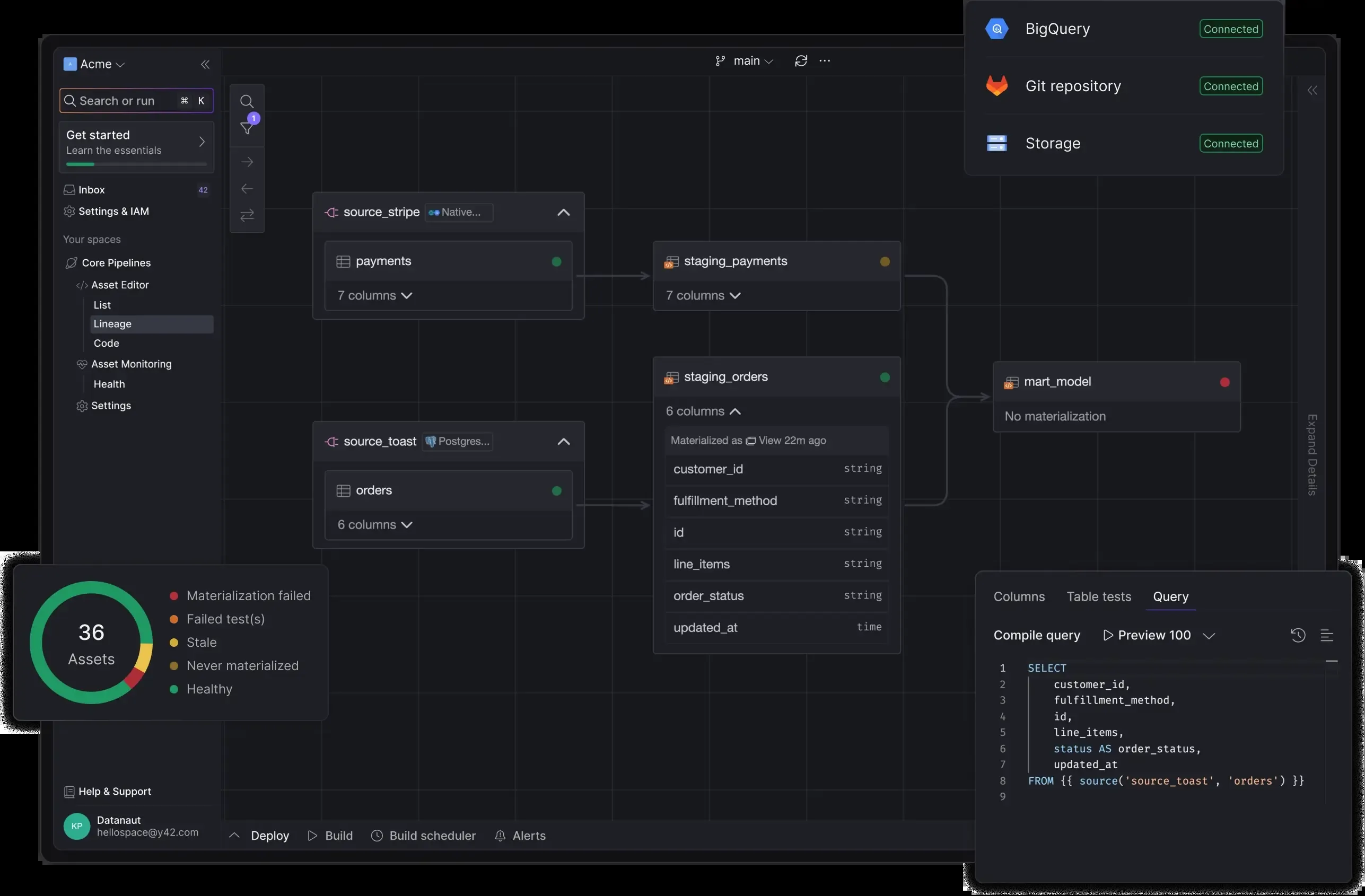
| Code Environment | Python-only; workflows defined as Python scripts in a local or CI/CD environment | Browser-based UI and Code IDE with SQL/dbt Core and Python support |
| Version Control | Git integration through external setup; DAG files managed like standard code repositories | Native Git integration with branch environments and pull requests built for data developers |
| Collaboration | Code-level collaboration via Git; web UI provides shared monitoring but not co-editing | Unified workspace designed for team collaboration with shared spaces and role-based access |
| Data Transformation | ||
| Built-In Transformation | No native transformation engine; orchestrates external tools like dbt, Spark, or custom scripts | Native SQL/dbt Core transformation with Python assets for complex logic |
| Data Warehouse Integration | Connects to warehouses via operators; requires configuration for each provider | Native data warehouse integrations as a core platform capability |
| Data Quality Assurance | No built-in quality checks; relies on external tools like Great Expectations or custom validation tasks | Built-in data quality assurance with observability and time travel for data |
| Operations & Monitoring | ||
| Web Interface | Robust web UI for monitoring DAG runs, task logs, Gantt charts, and pipeline status in real time | Browser-based UI with pipeline monitoring, scheduling management, and cost visibility |
| Observability | Task-level logs, run history, and SLA tracking; advanced monitoring via third-party integrations | Built-in observability for proactive pipeline error prevention and warehouse cost optimization |
| Scalability | Scales to thousands of parallel tasks using CeleryExecutor or KubernetesExecutor across distributed workers | Managed scaling handled by the platform; designed for team-level data operations |
| Ecosystem & Extensibility | ||
| Integration Breadth | Hundreds of plug-and-play operators for AWS, GCP, Azure, databases, SaaS tools, and custom systems | Native connectors for major data warehouses with SQL-based ingestion add-on powered by cData |
| Custom Extensibility | Write custom operators, sensors, and hooks in Python; extend any component of the platform | Python assets for custom logic within the platform; extensibility focused on data transformation |
| Community & Ecosystem | 46,000+ GitHub stars, thousands of contributors, and a sizable data orchestration community | Growing community with Discord presence; focused ecosystem centered on data practitioners |
Pipeline Orchestration
DAG-Based Scheduling
Dynamic Pipeline Generation
Task Retry and Error Handling
Development Experience
Code Environment
Version Control
Collaboration
Data Transformation
Built-In Transformation
Data Warehouse Integration
Data Quality Assurance
Operations & Monitoring
Web Interface
Observability
Scalability
Ecosystem & Extensibility
Integration Breadth
Custom Extensibility
Community & Ecosystem
Which to choose
Apache Airflow and Y42 represent two fundamentally different philosophies for data pipeline management. Airflow is the industry-standard open-source orchestrator that gives data engineers maximum control and flexibility, backed by a massive community and proven at scale by thousands of companies from startups to tech giants. Y42 is a modern turnkey platform that bundles orchestration, transformation, and observability into a managed workspace, eliminating the infrastructure overhead that makes Airflow challenging to operate. The right choice depends on whether your team prioritizes control and extensibility or speed and simplicity.
Best-fit scenarios
Choose Apache Airflow if:
Choose Apache Airflow if your team has strong Python and DevOps expertise and needs a highly customizable orchestration platform. Airflow is the right fit when you orchestrate workflows across multiple systems beyond just a data warehouse, require full control over infrastructure and scaling, or need to integrate with hundreds of services across cloud and on-premise environments. Its open-source model means zero licensing costs, and its community of 46,000+ GitHub stars ensures long-term viability, extensive documentation, and readily available talent.
Choose Y42 if:
Choose Y42 if your team wants to focus on data transformation and analysis rather than infrastructure management. Y42 is the right fit when your workflows are centered on a cloud data warehouse, you want native dbt integration and Git-based version control out of the box, and you prefer a managed platform that handles orchestration infrastructure for you. Its free tier provides a zero-cost entry point, and the Business plan at $500 per month gives small data teams everything they need to build production-grade pipelines without DevOps overhead.
These scenarios reflect the available product evidence. Your requirements, existing stack, and team expertise should guide the final decision.
Frequently Asked Questions
What is the main difference between Apache Airflow and Y42?
Apache Airflow is an open-source workflow orchestration platform that gives data engineers full programmatic control over pipeline scheduling and monitoring using Python DAGs. Y42 is a turnkey data orchestration platform that combines orchestration, transformation, and observability in a single managed workspace. Airflow requires teams to manage their own infrastructure and write Python code, while Y42 provides a browser-based UI and Code IDE, a declarative orchestrator and scheduler, Native Git and Data Warehouse integrations, and SQL/dbt Core and Python assets.
Can Apache Airflow and Y42 be used together?
While both tools handle data orchestration, they serve different layers of the stack. Some teams use Airflow for broader workflow orchestration across their entire infrastructure while using Y42 for warehouse-centric transformation and monitoring. However, most teams choose one or the other since both platforms manage pipeline scheduling and dependency resolution.
Is Apache Airflow really free to use?
Yes. Apache Airflow is fully open-source under the Apache License 2.0 with no licensing fees. However, running Airflow requires infrastructure costs for servers, databases, and worker nodes, plus DevOps time to deploy and maintain the platform. Managed Airflow services like Astronomer and Amazon MWAA handle infrastructure for a fee, which can range from pay-as-you-go to several hundred dollars per month depending on scale.
Which tool is easier to get started with?
Y42 is significantly easier to get started with. Its browser-based interface lets teams connect a data warehouse and begin building pipelines immediately without any infrastructure setup. Apache Airflow has a well-documented steep learning curve that requires Python expertise, infrastructure provisioning, and understanding of concepts like DAGs, operators, and executors before teams can build their first production pipeline.
Which platform scales better for large enterprises?
Apache Airflow has a stronger track record for large-scale enterprise orchestration. Its modular architecture supports distributed execution across thousands of workers using CeleryExecutor or KubernetesExecutor, and it orchestrates workflows across any system or cloud provider. Y42 is designed for data warehouse-centric operations and handles scaling internally, but its focus is on team-level data operations rather than enterprise-wide workflow orchestration across disparate systems.