Decision comparison
BU vs Reverse API Engineer
For repeated tasks on websites without public APIs, the two tools split on one question: does the work have to happen in the UI every time, or can the site's hidden endpoints be captured once? BU fits when tasks vary, involve logins, CAPTCHAs or multi-step UI flows, or need an agent that reasons each run. It costs you per run in model fees (+20%), $0.02/hr browser time and proxy traffic. Reverse API Engineer fits when the same data or action comes back through stable JSON/XHR endpoints. It stops being the right answer when a site has no usable endpoints, uses heavily obfuscated request signing, or changes too often for a generated client to stay valid.
Architecture choice. These take different approaches to the same problem. Read the table as a fit question rather than a feature race.
All 2 are agent tooling.
Quick Comparison
| Decision factor | BU | Reverse API Engineer |
|---|---|---|
| Best For | Changing, multi-step browser tasks such as logins, form flows, monitoring and testing, where an autonomous agent has to work through the live UI on every run | Turning a website's undocumented endpoints into a typed client once, then calling them over and over without running a browser or an LLM |
| Architecture | MIT-licensed Python browser-agent library plus Browser Use Cloud, which provides hosted stealth browsers, a hosted agent API, a terminal, persistent memory and a file system | Local Python CLI: drive a browser (yourself or with an agent), capture HAR traffic, have your own LLM write a typed client, then review and commit it |
| Pricing Model | Browser Use starts free and then bills prepaid credits with no subscription and no expiry, from $5. Browsers are $0.02 per hour. Traffic is billed separately: high-quality residential proxies at $5 per GB, or $0.20 per GB on a direct or bring-your-own proxy. Proxies are on by default. | Open source under the MIT license; source code at https://github.com/kalil0321/reverse-api-engineer. |
| Ease of Use | One prompt or one API call starts an agent. CAPTCHA solving, authentication and proxies are handled for you, and proxies are on by default | Install with `uv tool install reverse-api-engineer`. Works in Claude Code, Codex, Cursor and OpenCode, but you need to be able to review generated client code |
| Scalability | Hosted browsers scale through concurrency limits on the cloud, but every repeat run pays again for model tokens, browser hours and proxy traffic | Once generated, the client makes plain HTTP calls with no per-run browser or LLM cost. Scale is limited by the target site's rate limits and how stable its endpoints are |
| Community/Support | 121,188 GitHub stars, MIT license, latest release 1.0.6 (2026-11-16). Commercial cloud with published enterprise pricing and billing docs | 3,725 GitHub stars, MIT license, latest release v0.16.0 (2026-11-15). Docs, PyPI package and GitHub issues. No commercial support tier mentioned |
BU
- Best For:
- Changing, multi-step browser tasks such as logins, form flows, monitoring and testing, where an autonomous agent has to work through the live UI on every run
- Architecture:
- MIT-licensed Python browser-agent library plus Browser Use Cloud, which provides hosted stealth browsers, a hosted agent API, a terminal, persistent memory and a file system
- Pricing Model:
- Browser Use starts free and then bills prepaid credits with no subscription and no expiry, from $5. Browsers are $0.02 per hour. Traffic is billed separately: high-quality residential proxies at $5 per GB, or $0.20 per GB on a direct or bring-your-own proxy. Proxies are on by default.
- Ease of Use:
- One prompt or one API call starts an agent. CAPTCHA solving, authentication and proxies are handled for you, and proxies are on by default
- Scalability:
- Hosted browsers scale through concurrency limits on the cloud, but every repeat run pays again for model tokens, browser hours and proxy traffic
- Community/Support:
- 121,188 GitHub stars, MIT license, latest release 1.0.6 (2026-11-16). Commercial cloud with published enterprise pricing and billing docs
Reverse API Engineer
- Best For:
- Turning a website's undocumented endpoints into a typed client once, then calling them over and over without running a browser or an LLM
- Architecture:
- Local Python CLI: drive a browser (yourself or with an agent), capture HAR traffic, have your own LLM write a typed client, then review and commit it
- Pricing Model:
- Open source under the MIT license; source code at https://github.com/kalil0321/reverse-api-engineer.
- Ease of Use:
- Install with `uv tool install reverse-api-engineer`. Works in Claude Code, Codex, Cursor and OpenCode, but you need to be able to review generated client code
- Scalability:
- Once generated, the client makes plain HTTP calls with no per-run browser or LLM cost. Scale is limited by the target site's rate limits and how stable its endpoints are
- Community/Support:
- 3,725 GitHub stars, MIT license, latest release v0.16.0 (2026-11-15). Docs, PyPI package and GitHub issues. No commercial support tier mentioned
Public signals
Verified factual signals only. Bars appear only for like-for-like metrics with five weekly assessments for every tool; missing evidence stays explicit. These signals do not establish enterprise adoption, product quality, or total cost.
| Metric | BU | Reverse API Engineer |
|---|---|---|
| GitHub commits, 90d(Developer adoption) | 972 | Not available |
| GitHub stars(Developer adoption) | 121,000+ | Not available |
| Search interest(Market interest) | 0 | Not available |
| Product Hunt comments(Community interest) | 6 | Not available |
| Product Hunt rating(Community interest) | 5.0/5 | Not available |
| Product Hunt reviews(Community interest) | 16 | Not available |
| Product Hunt votes(Community interest) | 138 | Not available |
| PyPI weekly downloads(Developer adoption) | 1.3M | 3.6k |
| GitHub commits, 90d(Product adoption) | Not available | 242 |
| GitHub stars(Product adoption) | Not available | 3,500+ |
As of November 16, 2026 — updated weekly.
Health & risk evidence
Observed public-source checks for mapped package versions and repositories.
BU
November 16, 2026Package vulnerabilities
PyPI · browser-use-sdk@3.12.1
0 vulnerabilities
across 1 package
Repository security score
Not available
Reverse API Engineer
November 16, 2026Package vulnerabilities
PyPI · reverse-api-engineer@0.16.0
0 vulnerabilities
across 1 package
Repository security score
Not available
Interface Preview
BU
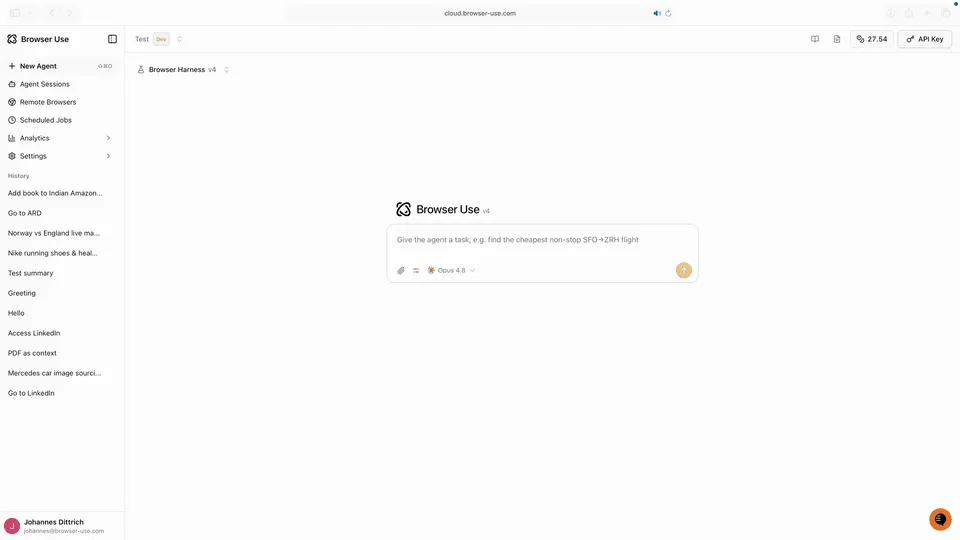
Feature Comparison
| Feature | BU | Reverse API Engineer |
|---|---|---|
| Execution Model | ||
| Per-run behavior | An agent drives a real browser through the task on every invocation | The browser is used once to capture traffic; later runs call the generated client directly |
| Primary output | Task results from an agent that keeps running from a single prompt | A typed API client in one of ten languages, built from HAR captures |
| Repeat-run cost driver | Model cost +20%, browser hours at $0.02/hr, plus proxy traffic | No per-run tool cost; model spend happens only when generating or regenerating a client |
| Browser & Session Handling | ||
| Browser runtime | Hosted remote stealth browsers, also offered as standalone infrastructure for your own agents | A local browser driven by you (manual mode) or by an AI agent (agent mode) |
| Authentication | Managed authentication with integrations for Slack, Gmail, Linear and 100+ more | Chrome MCP provider reuses your existing logged-in browser sessions |
| Anti-bot and network | Built-in CAPTCHA solving; residential proxies on by default at $5/GB | Records every request and response to HAR files for analysis |
| AI & Model Integration | ||
| Model choice | Choice of models with a published price-vs-quality comparison; custom model API available | SDK backends include Claude, OpenCode, Codex, Copilot and Hermes |
| Coding-agent integration | Hermes made Browser Use its default browser tool, reporting 48–66% fewer task tokens | Ships a skill for Claude Code, Codex, Cursor and OpenCode |
| Published performance | 82% success at 17¢ per solved task on a 106-task internal benchmark | Steam demo pulled the top 100 games from two undocumented endpoints in 1m02s |
| Developer Interface & Automation | ||
| Primary interface | Hosted API that goes from prompt to complex workflow, plus the open-source Python library | CLI with agent, manual and engineer modes, installed via uv |
| Scripting | Agents run terminal commands and execute scripts inside their environment | Scriptable subcommands that return JSON output for automation pipelines |
| Maintenance when sites change | The agent re-reads the live page each run, so it adapts to UI changes | Engineer mode regenerates the client from a previous capture |
| Deployment & Licensing | ||
| Hosting | Managed Browser Use Cloud, or self-run open-source library | Runs entirely locally with no account or server |
| License | MIT-licensed Python library; the cloud service is billed by usage | MIT-licensed Python project, free to use and modify |
| State and history | Agents keep persistent memory and a file system across runs | Keeps run history and can resume past runs |
Execution Model
Per-run behavior
Primary output
Repeat-run cost driver
Browser & Session Handling
Browser runtime
Authentication
Anti-bot and network
AI & Model Integration
Model choice
Coding-agent integration
Published performance
Developer Interface & Automation
Primary interface
Scripting
Maintenance when sites change
Deployment & Licensing
Hosting
License
State and history
Which approach fits
For repeated tasks on websites without public APIs, the two tools split on one question: does the work have to happen in the UI every time, or can the site's hidden endpoints be captured once? BU fits when tasks vary, involve logins, CAPTCHAs or multi-step UI flows, or need an agent that reasons each run. It costs you per run in model fees (+20%), $0.02/hr browser time and proxy traffic. Reverse API Engineer fits when the same data or action comes back through stable JSON/XHR endpoints. It stops being the right answer when a site has no usable endpoints, uses heavily obfuscated request signing, or changes too often for a generated client to stay valid.
When each approach fits
Choose BU if:
Choose BU when the task really needs a browser on every run. Examples: logins with CAPTCHAs, multi-page form submissions, visual monitoring or testing, sites that render server-side HTML with no clean API, or open-ended prompts where the steps vary. It also fits when you want hosted infrastructure (stealth browsers, residential proxies, Slack/Gmail/Linear integrations, persistent memory) instead of running anything locally. It becomes a poor fit for high-frequency pulls of the same structured data, because model, browser and proxy costs add up on every run.
Choose Reverse API Engineer if:
Choose Reverse API Engineer when a repeated task maps to the site's own background requests. Examples: pulling charts, event listings or scores on a schedule, or wiring a site into your codebase as a typed client. Capture once with your existing coding agent (Claude Code, Codex, Cursor, OpenCode), review the generated client, commit it, and then make plain HTTP calls with no per-run browser or LLM cost. It stops being the right tool when the site has no reusable endpoints, when requests depend on hard-to-replicate browser tokens, or when you can't review and maintain generated code.
These scenarios reflect the available product evidence. Your requirements, existing stack, and team expertise should guide the final decision.
Frequently Asked Questions
What is the main difference between BU and Reverse API Engineer?
BU (Browser Use) is an agent platform that runs an AI agent inside a real browser on every task. It handles CAPTCHAs, authentication and proxies, and gives the agent a terminal and persistent memory. Reverse API Engineer is a local MIT-licensed CLI that uses a browser only once: it records network traffic to HAR files, then has your chosen LLM write a typed API client in one of ten languages. After that, your code calls the site's undocumented endpoints directly, with no browser or agent involved.
Which is better for small teams?
It depends on the workload, not team size, but both have low entry costs. Reverse API Engineer needs no account or server, installs with `uv tool install reverse-api-engineer`, and works inside Claude Code, Codex, Cursor or OpenCode. A small team that can review generated code gets repeatable scrapers without ongoing tool fees. BU suits small teams that don't want to manage browsers or proxies. New signups get $1 in free credit, then credits start from $5 with no subscription, and top-ups never expire. Pick BU for UI-heavy or changing tasks and Reverse API Engineer for stable data pulls.
Can I migrate from BU to Reverse API Engineer?
Partly, and only for workflows backed by stable network endpoints. There is no automated migration path, because the tools produce different things: BU produces agent runs, and Reverse API Engineer produces typed client code. To move a recurring BU task, run Reverse API Engineer in agent or manual mode against the same site, capture the HAR, generate a client, and replace the BU call with the client call. Workflows that rely on BU's CAPTCHA solving, managed authentication, residential proxies or per-run reasoning usually can't move. Many teams will keep both: BU for UI-bound flows and generated clients for repeat data pulls.
What are the pricing differences?
BU is usage-based. You start free, new signups get $1 in free credit, and credits start at $5 with no subscription; top-ups never expire. Browsers cost $0.02 per hour, agents cost the model cost plus 20%, and traffic is billed separately: $5/GB for residential proxies (on by default) or $0.20/GB direct or bring-your-own proxy. Its open-source Python library is also MIT-licensed. Reverse API Engineer is MIT open source and free, with no account. You pay only your own LLM provider during capture and generation. After that, calls through the generated client carry no tool cost.