Decision comparison
ParadeDB vs Typesense
For in-app product or site search embedded in a PostgreSQL application, ParadeDB is the stronger fit when SQL joins, transactional consistency, and keeping operational data and search together matter. Typesense is the stronger fit when the search experience is a dedicated, low-latency product surface requiring typo tolerance, merchandising, dynamic sorting, and federated search; it stops being the natural choice when relational SQL and Postgres transaction semantics are requirements.
Architecture choice. These take different approaches to the same problem. Read the table as a fit question rather than a feature race.
All 2 are search engines.
Quick Comparison
| Decision factor | ParadeDB | Typesense |
|---|---|---|
| Best For | Postgres-centered product or site search needing SQL JOINs, transactional read-after-write behavior, BM25/vector hybrid retrieval, and aggregations alongside application data. | User-facing product or site search needing instant typo-tolerant results, faceting, dynamic sorting, merchandising, and semantic search in a dedicated engine. |
| Architecture | Pure PostgreSQL pg_search extension with unified columnar indexes; retains application data, full-text search, vector retrieval, and aggregations in Postgres. | Dedicated open-source, in-memory search engine combining keyword, fuzzy, faceted, geo, and vector/semantic search; managed through Typesense Cloud. |
| Pricing Model | Open source under the AGPL-3.0 license; source code at https://github.com/paradedb/paradedb. | Typesense Cloud is priced with a calculator for a dedicated cluster, with no limits on records or operations. The smallest configuration (0.5 GB RAM, 2 vCPUs with 1 hr burst per day, one node) is $0.03 per hour, which the page says works out to $21.60 per month; the first 720 hours are free. Bandwidth out is $0.09 per GB, with the first 10 GB free. Larger RAM, vCPU, GPU, high availability and Search Delivery Network options are priced in the same calculator. Verified 2026-10-05 against https://cloud.typesense.org/pricing/calculator. |
| Ease of Use | Use Postgres and standard SQL instead of a separate search system; setup can run locally, while Cloud remains private preview. | Purpose-built in-memory engine emphasizes quick setup, automatic typo correction, flexible query-time ranking, and managed Typesense Cloud dedicated clusters. |
| Scalability | Postgres replication supports high availability and read replicas; Community is restricted to one node, while Enterprise targets HA deployments. | Replication provides high availability; Cloud calculator offers larger RAM, vCPU, GPU, multi-node high availability, and Search Delivery Network options. |
| Community/Support | GitHub reports 9,498 stars, Rust primary language, and a 2026-11-09 push; Community and Enterprise support options are published. | GitHub reports 27,107 stars, C++ primary language, and a 2026-11-06 push; Typesense offers priority support. |
ParadeDB
- Best For:
- Postgres-centered product or site search needing SQL JOINs, transactional read-after-write behavior, BM25/vector hybrid retrieval, and aggregations alongside application data.
- Architecture:
- Pure PostgreSQL pg_search extension with unified columnar indexes; retains application data, full-text search, vector retrieval, and aggregations in Postgres.
- Pricing Model:
- Open source under the AGPL-3.0 license; source code at https://github.com/paradedb/paradedb.
- Ease of Use:
- Use Postgres and standard SQL instead of a separate search system; setup can run locally, while Cloud remains private preview.
- Scalability:
- Postgres replication supports high availability and read replicas; Community is restricted to one node, while Enterprise targets HA deployments.
- Community/Support:
- GitHub reports 9,498 stars, Rust primary language, and a 2026-11-09 push; Community and Enterprise support options are published.
Typesense
- Best For:
- User-facing product or site search needing instant typo-tolerant results, faceting, dynamic sorting, merchandising, and semantic search in a dedicated engine.
- Architecture:
- Dedicated open-source, in-memory search engine combining keyword, fuzzy, faceted, geo, and vector/semantic search; managed through Typesense Cloud.
- Pricing Model:
- Typesense Cloud is priced with a calculator for a dedicated cluster, with no limits on records or operations. The smallest configuration (0.5 GB RAM, 2 vCPUs with 1 hr burst per day, one node) is $0.03 per hour, which the page says works out to $21.60 per month; the first 720 hours are free. Bandwidth out is $0.09 per GB, with the first 10 GB free. Larger RAM, vCPU, GPU, high availability and Search Delivery Network options are priced in the same calculator. Verified 2026-10-05 against https://cloud.typesense.org/pricing/calculator.
- Ease of Use:
- Purpose-built in-memory engine emphasizes quick setup, automatic typo correction, flexible query-time ranking, and managed Typesense Cloud dedicated clusters.
- Scalability:
- Replication provides high availability; Cloud calculator offers larger RAM, vCPU, GPU, multi-node high availability, and Search Delivery Network options.
- Community/Support:
- GitHub reports 27,107 stars, C++ primary language, and a 2026-11-06 push; Typesense offers priority support.
Public signals
Verified factual signals only. Bars appear only for like-for-like metrics with five weekly assessments for every tool; missing evidence stays explicit. These signals do not establish enterprise adoption, product quality, or total cost.
| Metric | ParadeDB | Typesense |
|---|---|---|
| GitHub commits, 90d(Product adoption) | 680 | 108 |
| GitHub stars(Product adoption) | 9,500+ | 27,000+ |
| Docker Hub pulls(Product adoption) | Not available | 35.1M |
| Search interest(Market interest) | Not available | 0 |
| Hacker News mentions, 90d(Community interest) | Not available | 0 |
| Hugging Face downloads(Product adoption) | Not available | 168 |
| Hugging Face likes(Product adoption) | Not available | 28 |
| npm weekly downloads(Developer adoption) | Not available | 1.2M |
| Product Hunt comments(Community interest) | Not available | 22 |
| Product Hunt rating(Community interest) | Not available | 5.0/5 |
| Product Hunt reviews(Community interest) | Not available | 8 |
| Product Hunt votes(Community interest) | Not available | 213 |
| PyPI weekly downloads(Developer adoption) | Not available | 280.3k |
| Stack Overflow questions(Community interest) | Not available | 70 |
As of November 23, 2026 — updated weekly.
Health & risk evidence
Observed public-source checks for mapped package versions and repositories.
ParadeDB
Package vulnerabilities
Not available
Repository security score
Not available
Typesense
November 23, 2026Package vulnerabilities
npm · typesense@3.2.0 · PyPI · typesense@2.1.1
0 vulnerabilities
across 2 packages
Repository security score
Not available
Interface Preview
Typesense
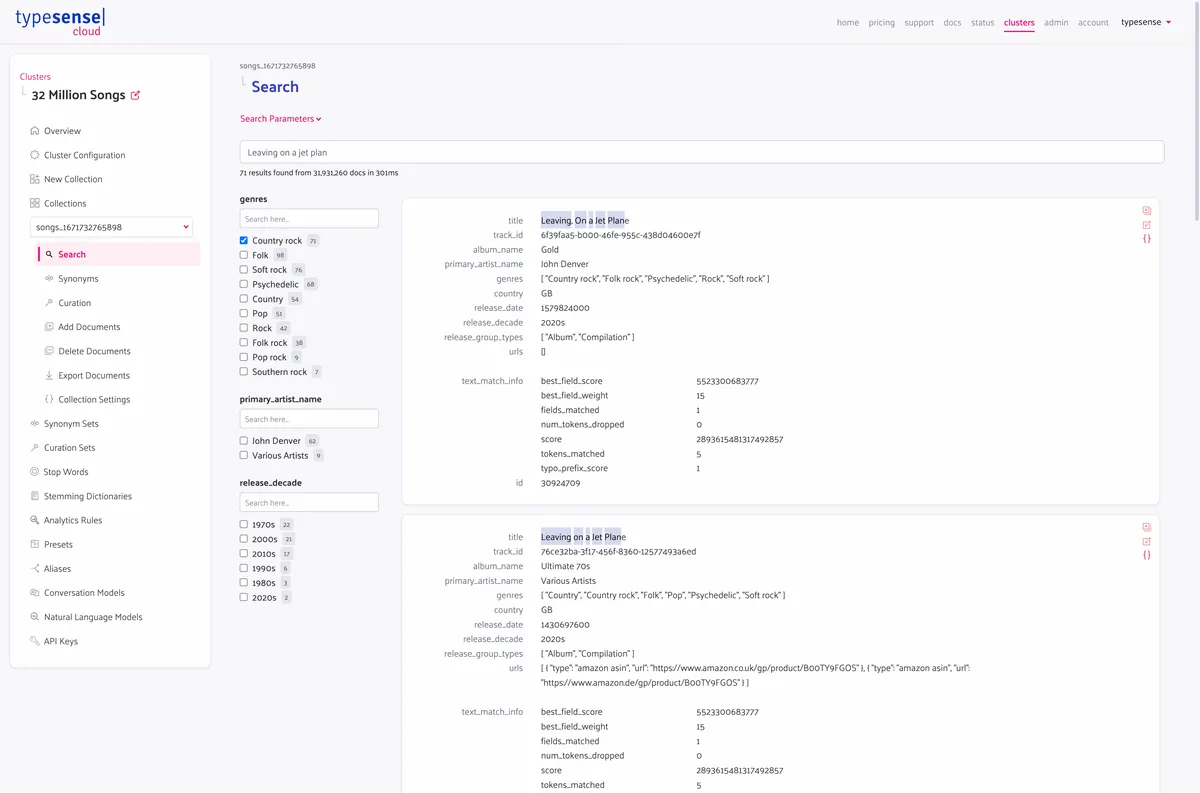
Feature Comparison
| Feature | ParadeDB | Typesense |
|---|---|---|
| Retrieval and Relevance | ||
| Full-text relevance | Tunable BM25 scoring inside PostgreSQL search queries. | Typo-tolerant in-memory fuzzy search with tunable query-time ranking. |
| Vector retrieval | Vector and hybrid search alongside text search in Postgres. | Vector and semantic search combined with keyword retrieval. |
| Typo and fuzzy matching | Fuzzy, phrase, proximity, regex, and typo-tolerant queries. | Automatically corrects likely spelling mistakes during search. |
| Data Access and Analytics | ||
| Relational querying | Uses standard SQL searches with JOINs and CTEs. | Uses federated search to combine multiple search sources. |
| Application-data integration | Keeps application data and search within one PostgreSQL system. | Indexes searchable records into dedicated Typesense collections. |
| Filtering and analysis | Supports filters, facets, and aggregations through Postgres indexes. | Filters and facets records by configured attributes. |
| Indexing and Consistency | ||
| Index storage model | Unified ParadeDB index uses columnar storage. | Purpose-built in-memory search engine indexes searchable data. |
| Text analysis controls | Configures tokenizers and token filters for text indexing. | Applies built-in typo tolerance for user-entered queries. |
| Write consistency | ACID transactions provide read-after-write search guarantees. | No transaction guarantees are stated in the provided material. |
| Search Experience Controls | ||
| Result presentation | Highlights matching text within full-text search results. | Pins records to selected positions for merchandising. |
| Result organization | Uses SQL aggregations for computed result analysis. | Groups similar variants and supports distinct results. |
| Runtime ordering | Uses SQL queries to combine search, filters, and ordering. | Lets users dynamically reorder results at runtime. |
| Operations and Deployment | ||
| High availability | Uses PostgreSQL replication for high availability and read replicas. | Uses replication to keep search available through hardware failures. |
| Managed offering | ParadeDB Cloud is available in private preview. | Typesense Cloud supplies dedicated managed search clusters. |
| Self-managed support | Community is single-node; Enterprise adds dedicated support. | Open source deployment is supplemented by priority support. |
Retrieval and Relevance
Full-text relevance
Vector retrieval
Typo and fuzzy matching
Data Access and Analytics
Relational querying
Application-data integration
Filtering and analysis
Indexing and Consistency
Index storage model
Text analysis controls
Write consistency
Search Experience Controls
Result presentation
Result organization
Runtime ordering
Operations and Deployment
High availability
Managed offering
Self-managed support
Which approach fits
For in-app product or site search embedded in a PostgreSQL application, ParadeDB is the stronger fit when SQL joins, transactional consistency, and keeping operational data and search together matter. Typesense is the stronger fit when the search experience is a dedicated, low-latency product surface requiring typo tolerance, merchandising, dynamic sorting, and federated search; it stops being the natural choice when relational SQL and Postgres transaction semantics are requirements.
When each approach fits
Choose ParadeDB if:
Choose ParadeDB when your catalog, permissions, inventory, or other application data already lives in Postgres and search queries need JOINs, CTEs, filters, facets, BM25/vector hybrid retrieval, and read-after-write guarantees.
Choose Typesense if:
Choose Typesense when building a customer-facing product or site search experience that benefits from typo correction, faceting, result grouping, merchandising, dynamic sorting, federated search, and a dedicated in-memory engine.
These scenarios reflect the available product evidence. Your requirements, existing stack, and team expertise should guide the final decision.
Frequently Asked Questions
What is the main difference between ParadeDB and Typesense?
ParadeDB makes search a PostgreSQL capability through its pg_search extension. It keeps application data, full-text search, vector retrieval, filters, facets, aggregations, SQL JOINs, and ACID transactions in one Postgres system. Typesense is a separate, in-memory search engine designed around fast user-facing search. It combines keyword, typo-tolerant fuzzy, faceted, geo, vector, and semantic search, with product-search controls such as dynamic sorting, merchandising, grouping, and federated search.
Which is better for small teams?
For a small team already operating Postgres, ParadeDB can reduce architectural overhead because it uses Postgres and standard SQL instead of introducing a separate search system. Its Community self-managed offering is free forever but supports a single node. Typesense can be especially approachable for teams focused on a polished search interface, because it provides automatic typo handling, faceting, ranking controls, and managed Cloud clusters. Its first 720 Cloud hours are free, after which the smallest documented cluster is $0.03 per hour.
Can I migrate from ParadeDB to Typesense?
Yes, but this is a search-architecture migration rather than a drop-in database replacement. You would export or stream the documents and searchable fields held in Postgres, define corresponding Typesense collections and field settings, then rebuild filters, facets, ranking behavior, and vector fields in Typesense. SQL JOINs, CTEs, and transactional read-after-write guarantees do not transfer directly because Typesense is a dedicated search engine. Keep Postgres as the system of record and synchronize indexed records during a staged cutover.
What are the pricing differences?
ParadeDB's source code is AGPL-3.0 licensed. Its self-managed Community offering is fully free forever for testing and small projects, with a single-node limit and community support. ParadeDB Cloud is in private preview, while self-managed Enterprise adds high availability, read replicas, and dedicated support; no public Enterprise dollar rate is provided. Typesense Cloud charges for a dedicated cluster with no record or operation limits: the documented smallest one-node configuration is $0.03 per hour, or $21.60 per month, with the first 720 hours free. Outbound bandwidth is $0.09 per GB after the first 10 GB.