Decision comparison
ParadeDB vs Vespa
For hybrid lexical and vector RAG over an existing Postgres application, ParadeDB is the direct fit when transactional data, SQL joins, and retrieval must remain in one database. Vespa is the fit when retrieval quality depends on distributed machine-learned ranking, tensor or multi-vector representations, and operating at billions-of-items scale. ParadeDB stops being the right answer when the workload requires Vespa-style distributed inference and ranking sophistication; Vespa stops being the right answer when a small team primarily needs simple, relationally integrated Postgres search.
Architecture choice. These take different approaches to the same problem. Read the table as a fit question rather than a feature race.
All 2 are search engines.
Quick Comparison
| Decision factor | ParadeDB | Vespa |
|---|---|---|
| Best For | Postgres-centric RAG applications needing hybrid lexical and vector retrieval, SQL joins, transactional application data, filters, facets, and aggregations. | Enterprise-scale RAG and search applications requiring multi-vector retrieval, sophisticated machine-learned ranking, real-time inference, and continuously changing datasets. |
| Architecture | Pure PostgreSQL extension, pg_search, providing unified indexes with columnar storage; uses standard SQL, JOINs, CTEs, and Postgres replication. | Distributed AI search platform handling vectors, tensors, text, and structured data with integrated distributed model inference for relevance. |
| Pricing Model | Open source under the AGPL-3.0 license; source code at https://github.com/paradedb/paradedb. | Community Edition free (self-hosted), Cloud pricing available on cloud.vespa.ai/pricing |
| Ease of Use | Familiar Postgres workflow: search through standard SQL alongside application tables, with ACID transactions and read-after-write guarantees. | Requires designing Vespa schemas, ranking models, tensor representations, and distributed deployment behavior instead of querying application data through SQL. |
| Scalability | Single-node Community deployment; high availability and read replicas use Postgres replication through Enterprise or managed deployment options. | Built for billions of constantly changing items, thousands of queries per second, and stated latencies below 100 milliseconds. |
| Community/Support | AGPL-3.0 Rust project with 9,498 GitHub stars; Community support for free tier and dedicated Enterprise support. | Apache-2.0 Java project with 7,165 GitHub stars; Community Edition is self-hosted, with commercial cloud offering available. |
ParadeDB
- Best For:
- Postgres-centric RAG applications needing hybrid lexical and vector retrieval, SQL joins, transactional application data, filters, facets, and aggregations.
- Architecture:
- Pure PostgreSQL extension, pg_search, providing unified indexes with columnar storage; uses standard SQL, JOINs, CTEs, and Postgres replication.
- Pricing Model:
- Open source under the AGPL-3.0 license; source code at https://github.com/paradedb/paradedb.
- Ease of Use:
- Familiar Postgres workflow: search through standard SQL alongside application tables, with ACID transactions and read-after-write guarantees.
- Scalability:
- Single-node Community deployment; high availability and read replicas use Postgres replication through Enterprise or managed deployment options.
- Community/Support:
- AGPL-3.0 Rust project with 9,498 GitHub stars; Community support for free tier and dedicated Enterprise support.
Vespa
- Best For:
- Enterprise-scale RAG and search applications requiring multi-vector retrieval, sophisticated machine-learned ranking, real-time inference, and continuously changing datasets.
- Architecture:
- Distributed AI search platform handling vectors, tensors, text, and structured data with integrated distributed model inference for relevance.
- Pricing Model:
- Community Edition free (self-hosted), Cloud pricing available on cloud.vespa.ai/pricing
- Ease of Use:
- Requires designing Vespa schemas, ranking models, tensor representations, and distributed deployment behavior instead of querying application data through SQL.
- Scalability:
- Built for billions of constantly changing items, thousands of queries per second, and stated latencies below 100 milliseconds.
- Community/Support:
- Apache-2.0 Java project with 7,165 GitHub stars; Community Edition is self-hosted, with commercial cloud offering available.
Public signals
Verified factual signals only. Bars appear only for like-for-like metrics with five weekly assessments for every tool; missing evidence stays explicit. These signals do not establish enterprise adoption, product quality, or total cost.
| Metric | ParadeDB | Vespa |
|---|---|---|
| GitHub commits, 90d(Product adoption) | 680 | 2.1k |
| GitHub stars(Product adoption) | 9,500+ | 7,000+ |
| Docker Hub pulls(Product adoption) | Not available | 15.7M |
| Hugging Face downloads(Product adoption) | Not available | 421 |
| Hugging Face likes(Product adoption) | Not available | 108 |
| PyPI weekly downloads(Developer adoption) | Not available | 76.5k |
| Stack Overflow questions(Community interest) | Not available | 262 |
As of November 23, 2026 — updated weekly.
Health & risk evidence
Observed public-source checks for mapped package versions and repositories.
ParadeDB
Package vulnerabilities
Not available
Repository security score
Not available
Vespa
November 23, 2026Package vulnerabilities
PyPI · pyvespa@1.2.10
0 vulnerabilities
across 1 package
Repository security score
Not available
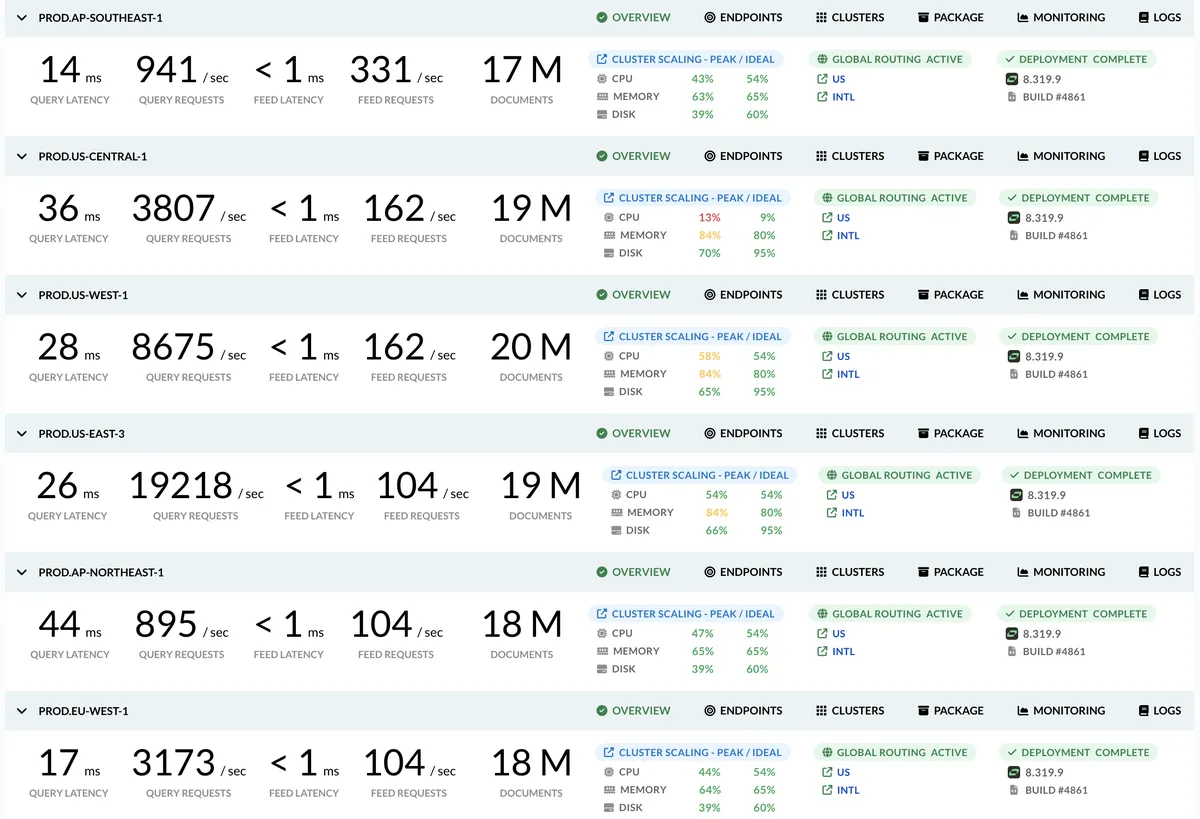
Interface Preview
Vespa
Feature Comparison
| Feature | ParadeDB | Vespa |
|---|---|---|
| Retrieval and relevance | ||
| Hybrid retrieval | Combines tunable BM25 full-text scoring with vector search | Combines vector similarity, hybrid search, and relevance models |
| Ranking approach | Uses tunable BM25 scoring for full-text relevance | Uses machine-learned ranking with native tensor support |
| Vector representation | Searches vectors alongside Postgres text and relational data | Queries vectors and tensors, including multi-vector representations |
| Text search capabilities | ||
| Text index behavior | Provides full-text indexes with configurable tokenizers and filters | Provides true positional text indexes for search applications |
| Advanced query forms | Supports phrase, fuzzy, proximity, regex, and typo-tolerant queries | Uses text, vector, tensor, and structured-data query capabilities |
| Result presentation | Highlights matched content in full-text search results | Optimizes relevance through ranking and model inference |
| Data model and querying | ||
| Application-data integration | Keeps application data and search inside one Postgres system | Organizes searchable vectors, tensors, text, and structured documents |
| Query interface | Uses standard SQL search with JOINs and CTEs | Uses Vespa search application schemas and ranking configuration |
| Analytics within search | Computes filters, facets, and aggregations from unified indexes | Supports structured data alongside search and inference workloads |
| Storage, consistency, and operations | ||
| Index storage | Stores columnar data in a unified ParadeDB index | Distributes searchable data across an AI search platform |
| Write consistency | Uses ACID transactions with read-after-write guarantees | Handles constantly changing data items at large scale |
| High availability model | Uses Postgres replication for high availability and read replicas | Uses distributed architecture for large-scale search applications |
| AI application focus | ||
| Model inference | Provides retrieval capabilities within a Postgres extension | Runs distributed machine-learned model inference for relevance |
| RAG context quality | Combines lexical matching, vectors, filters, and relational joins | Uses hybrid retrieval, relevance models, and multi-vector representations |
| Private or personalized retrieval | Applies SQL filters and joins to application-owned data | Offers streaming search mode for personal and private search |
Retrieval and relevance
Hybrid retrieval
Ranking approach
Vector representation
Text search capabilities
Text index behavior
Advanced query forms
Result presentation
Data model and querying
Application-data integration
Query interface
Analytics within search
Storage, consistency, and operations
Index storage
Write consistency
High availability model
AI application focus
Model inference
RAG context quality
Private or personalized retrieval
Which approach fits
For hybrid lexical and vector RAG over an existing Postgres application, ParadeDB is the direct fit when transactional data, SQL joins, and retrieval must remain in one database. Vespa is the fit when retrieval quality depends on distributed machine-learned ranking, tensor or multi-vector representations, and operating at billions-of-items scale. ParadeDB stops being the right answer when the workload requires Vespa-style distributed inference and ranking sophistication; Vespa stops being the right answer when a small team primarily needs simple, relationally integrated Postgres search.
When each approach fits
Choose ParadeDB if:
Choose ParadeDB when your RAG corpus is closely tied to Postgres application records and you need BM25-plus-vector retrieval, SQL joins, filters, facets, aggregations, and transactional read-after-write behavior.
Choose Vespa if:
Choose Vespa when you operate a large, rapidly changing corpus and need low-latency distributed search, integrated machine-learned inference, complex tensor ranking, or multi-vector RAG retrieval.
These scenarios reflect the available product evidence. Your requirements, existing stack, and team expertise should guide the final decision.
Frequently Asked Questions
What is the main difference between ParadeDB and Vespa?
ParadeDB is a pure PostgreSQL extension centered on bringing full-text search, vector retrieval, aggregations, and columnar indexing into the database that holds application data. It uses standard SQL, including JOINs and CTEs, and provides ACID transactions with read-after-write guarantees. Vespa is a distributed AI search platform for vectors, tensors, text, and structured data. Its distinguishing focus is large-scale search relevance through machine-learned ranking and distributed model inference, rather than embedding search directly in Postgres.
Which is better for small teams?
For a small team already using PostgreSQL, ParadeDB is generally the more natural fit because it is deployed as the pg_search extension and lets developers use ordinary SQL against application data and search indexes together. Its self-managed Community tier is free forever but supports a single node without read replicas, making its operational boundary explicit. Vespa Community Edition is also free to self-host, but its schema, tensor, ranking, and distributed-search concepts are better justified when sophisticated relevance requirements or substantial scale warrant that additional platform complexity.
Can I migrate from ParadeDB to Vespa?
Yes, but it is an application and data-model migration rather than a direct index conversion described by the supplied product information. You would export the records and retrieval fields currently held in Postgres, define Vespa document schemas for text, structured fields, vectors, and potentially tensors, then recreate filtering and ranking behavior in Vespa. SQL JOIN-based retrieval logic must be redesigned because ParadeDB performs it in Postgres, while Vespa is organized as a distributed search application. Validate relevance, freshness, and operational behavior during a staged cutover.
What are the pricing differences?
ParadeDB's source code is AGPL-3.0, and its self-managed Community plan is fully free forever for testing and small projects, with a single-node limit and no read replicas. ParadeDB Cloud is listed as private preview, while self-managed Enterprise adds high availability, read replicas, and dedicated support; no dollar amount is supplied for those offerings. Vespa Community Edition is free to self-host under Apache-2.0. Vespa Cloud pricing is available through its cloud pricing page, but the provided information includes no public dollar rate or usage metric.