Decision comparison
Elasticsearch vs ParadeDB
Choose Elasticsearch when search must operate as an independently scalable distributed platform, especially for cross-datacenter deployments, observability, security analytics, or Elastic Cloud serverless operations. Choose ParadeDB when the workload is full-text search and aggregations over Postgres application data and SQL joins, transactional read-after-write behavior, and avoiding a separate search-data pipeline are decisive.
Direct comparison. These are reviewed substitutes bought for the same job, so the differences below are the ones that decide between them.
All 2 are search engines.
Quick Comparison
| Decision factor | Elasticsearch | ParadeDB |
|---|---|---|
| Best For | Distributed search, hybrid/vector retrieval, observability, and security analytics across large, independently scalable datasets. | Full-text, vector, hybrid search, filters, facets, and aggregations directly over Postgres application data. |
| Architecture | Apache Lucene-based distributed REST engine storing structured, unstructured, and vector data in purpose-built indexes. | Pure Postgres pg_search extension using unified ParadeDB indexes, columnar storage, SQL, joins, CTEs, and ACID transactions. |
| Pricing Model | Self-managed Elasticsearch has a free tier; self-managed Platinum and Enterprise are quoted by sales. Elastic Cloud Hosted, as low as per month: Standard $99, Gold $114, Platinum $131, Enterprise $184, based on a production setup with 120 GB storage in 2 zones. Serverless Elasticsearch bills by use, as low as $0.14 per VCU per hour for ingest, $0.09 for search and $0.047 per GB retained per month. Verified 2026-10-05 against https://www.elastic.co/pricing/cloud-hosted and https://www.elastic.co/pricing/serverless-search. | Open source under the AGPL-3.0 license; source code at https://github.com/paradedb/paradedb. |
| Ease of Use | REST APIs are a reported strength, but users frequently cite setup, configuration, interface, and learning-curve difficulty. | Uses standard SQL and existing Postgres application data, avoiding a separate search datastore and synchronization pipeline. |
| Scalability | Horizontal clusters support automatic rebalancing, node recovery, cross-cluster replication, and cross-datacenter replication. | Community supports one node without read replicas; Enterprise adds high availability and read replicas through Postgres replication. |
| Community/Support | Mature Java project with 78,535 GitHub stars, commercial Elastic tiers, and 8.7/10 user rating across 217 reviews. | Rust project with 9,498 GitHub stars; Community provides community support, while Enterprise includes dedicated support. |
Elasticsearch
- Best For:
- Distributed search, hybrid/vector retrieval, observability, and security analytics across large, independently scalable datasets.
- Architecture:
- Apache Lucene-based distributed REST engine storing structured, unstructured, and vector data in purpose-built indexes.
- Pricing Model:
- Self-managed Elasticsearch has a free tier; self-managed Platinum and Enterprise are quoted by sales. Elastic Cloud Hosted, as low as per month: Standard $99, Gold $114, Platinum $131, Enterprise $184, based on a production setup with 120 GB storage in 2 zones. Serverless Elasticsearch bills by use, as low as $0.14 per VCU per hour for ingest, $0.09 for search and $0.047 per GB retained per month. Verified 2026-10-05 against https://www.elastic.co/pricing/cloud-hosted and https://www.elastic.co/pricing/serverless-search.
- Ease of Use:
- REST APIs are a reported strength, but users frequently cite setup, configuration, interface, and learning-curve difficulty.
- Scalability:
- Horizontal clusters support automatic rebalancing, node recovery, cross-cluster replication, and cross-datacenter replication.
- Community/Support:
- Mature Java project with 78,535 GitHub stars, commercial Elastic tiers, and 8.7/10 user rating across 217 reviews.
ParadeDB
- Best For:
- Full-text, vector, hybrid search, filters, facets, and aggregations directly over Postgres application data.
- Architecture:
- Pure Postgres pg_search extension using unified ParadeDB indexes, columnar storage, SQL, joins, CTEs, and ACID transactions.
- Pricing Model:
- Open source under the AGPL-3.0 license; source code at https://github.com/paradedb/paradedb.
- Ease of Use:
- Uses standard SQL and existing Postgres application data, avoiding a separate search datastore and synchronization pipeline.
- Scalability:
- Community supports one node without read replicas; Enterprise adds high availability and read replicas through Postgres replication.
- Community/Support:
- Rust project with 9,498 GitHub stars; Community provides community support, while Enterprise includes dedicated support.
Public signals
Verified factual signals only. Bars appear only for like-for-like metrics with five weekly assessments for every tool; missing evidence stays explicit. These signals do not establish enterprise adoption, product quality, or total cost.
| Metric | Elasticsearch | ParadeDB |
|---|---|---|
| Docker Hub pulls(Product adoption) | 991.4M | Not available |
| GitHub commits, 90d(Product adoption) | 4.2k | 680 |
| GitHub stars(Product adoption) | 78,000+ | 9,500+ |
| Search interest(Market interest) | 7 | Not available |
| Hacker News mentions, 90d(Community interest) | 11 | Not available |
| npm weekly downloads(Developer adoption) | 3.2M | Not available |
| Product Hunt comments(Community interest) | 1 | Not available |
| Product Hunt rating(Community interest) | 5.0/5 | Not available |
| Product Hunt reviews(Community interest) | 26 | Not available |
| Product Hunt votes(Community interest) | 3 | Not available |
| PyPI weekly downloads(Developer adoption) | 8.2M | Not available |
| Stack Overflow questions(Community interest) | 58.2k | Not available |
As of November 23, 2026 — updated weekly.
Health & risk evidence
Observed public-source checks for mapped package versions and repositories.
Elasticsearch
November 23, 2026Package vulnerabilities
npm · @elastic/elasticsearch@9.5.1 · PyPI · elasticsearch@9.5.1
0 vulnerabilities
across 2 packages
Repository security score
github.com/elastic/elasticsearch
6.0/10
ParadeDB
Package vulnerabilities
Not available
Repository security score
Not available
Interface Preview
Elasticsearch
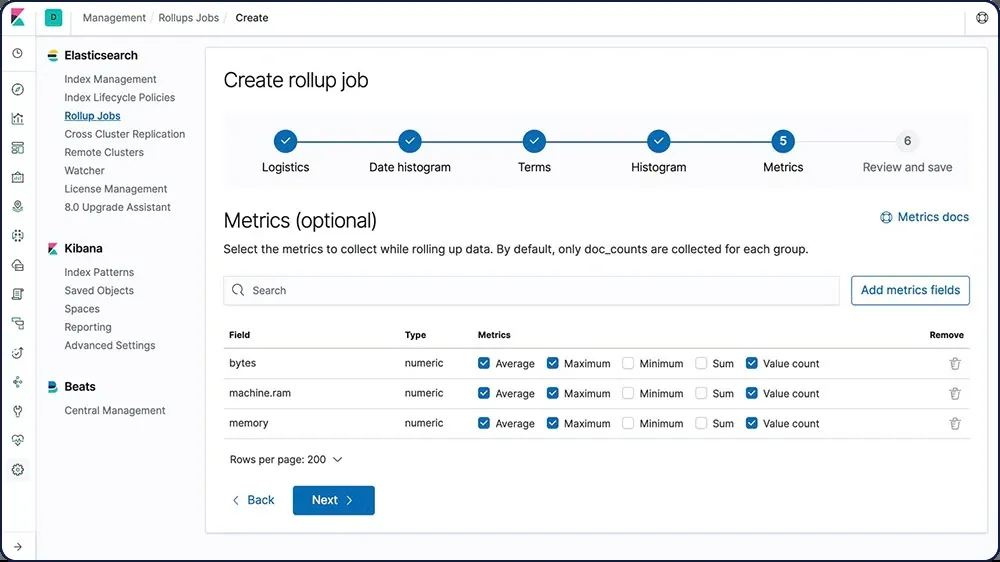
Feature Comparison
| Feature | Elasticsearch | ParadeDB |
|---|---|---|
| Search and Retrieval | ||
| Full-text ranking | Lucene-based full-text search through distributed RESTful indexes | Tunable BM25 scoring exposed through standard SQL queries |
| Vector and hybrid search | Real-time vector and hybrid search alongside structured and unstructured data | Vector retrieval combined with full-text search inside Postgres |
| Advanced text queries | Full-text retrieval capabilities backed by Apache Lucene indexes | Phrase, fuzzy, proximity, regex, highlighting, and typo-tolerant queries |
| Data Model and Querying | ||
| Primary data location | Copies data into dedicated Elasticsearch search and analytics indexes | Keeps application data and search capabilities in one Postgres system |
| Query interface | RESTful APIs query distributed search indexes | Standard SQL queries support joins and common table expressions |
| Index storage | Efficient columnar storage for structured, unstructured, and vector data | Unified ParadeDB indexes include columnar storage for search workloads |
| Analytics and Filtering | ||
| Aggregations | Search and analytics engine supports analytics-oriented indexed data retrieval | Filters, facets, and aggregations execute over Postgres application data |
| Faceted navigation | Search capabilities can combine text retrieval with indexed filtering | Facets and filters are built into PostgreSQL search queries |
| Text analysis controls | Lucene-based text search powers configurable indexed text retrieval | Tokenizers and token filters customize indexing and query analysis |
| Reliability and Scale | ||
| Horizontal scaling | Distributed clusters scale horizontally with automatic data rebalancing | Enterprise scaling relies on Postgres high availability and read replicas |
| Replication | Cross-cluster and cross-datacenter replication copy indexed search data | High availability and read replicas use Postgres replication |
| Recovery and lifecycle operations | Automatic node recovery, snapshots, and index lifecycle management | ACID transactions provide read-after-write guarantees within Postgres |
| Deployment and Commercial Model | ||
| Self-managed deployment | Free self-managed tier with paid Platinum and Enterprise sales quotes | Free AGPL-3.0 Community edition supports a single node |
| Managed deployment | Hosted and serverless Elastic Cloud deployment options | Cloud is available in private preview with fully managed deployments |
| Consumption pricing | Serverless bills $0.14 ingest VCU-hour, $0.09 search VCU-hour, and $0.047 retained GB-month | No public dollar rate card is provided for Enterprise or Cloud |
Search and Retrieval
Full-text ranking
Vector and hybrid search
Advanced text queries
Data Model and Querying
Primary data location
Query interface
Index storage
Analytics and Filtering
Aggregations
Faceted navigation
Text analysis controls
Reliability and Scale
Horizontal scaling
Replication
Recovery and lifecycle operations
Deployment and Commercial Model
Self-managed deployment
Managed deployment
Consumption pricing
Which to choose
Choose Elasticsearch when search must operate as an independently scalable distributed platform, especially for cross-datacenter deployments, observability, security analytics, or Elastic Cloud serverless operations. Choose ParadeDB when the workload is full-text search and aggregations over Postgres application data and SQL joins, transactional read-after-write behavior, and avoiding a separate search-data pipeline are decisive.
Best-fit scenarios
Choose Elasticsearch if:
Choose Elasticsearch for multi-cluster or cross-datacenter search deployments, large independently operated search infrastructure, and workloads that also require Elastic's observability or security analytics capabilities. It is also the clearer fit when a managed hosted or usage-metered serverless price structure is required.
Choose ParadeDB if:
Choose ParadeDB when Postgres is the system of record and your application needs BM25 text search, vector retrieval, filters, facets, aggregations, and SQL joins over the same data. It is particularly compelling for teams that want ACID read-after-write guarantees and do not want to operate a separate Elasticsearch cluster and synchronization process.
These scenarios reflect the available product evidence. Your requirements, existing stack, and team expertise should guide the final decision.
Frequently Asked Questions
What is the main difference between Elasticsearch and ParadeDB?
Elasticsearch is a distributed, Lucene-based search and analytics engine that stores data in dedicated Elasticsearch indexes and exposes a RESTful interface. It is designed for horizontally scalable clusters, automatic rebalancing, snapshots, and cross-cluster or cross-datacenter replication. ParadeDB is a pure Postgres extension: pg_search adds full-text BM25 search, vector and hybrid retrieval, facets, aggregations, and columnar indexing to Postgres. Its central distinction is that search remains with application data and is queried with SQL, including joins and CTEs.
Which is better for small teams?
For a small team already running Postgres, ParadeDB is usually the more direct operational choice for application-data search because it uses standard SQL and avoids introducing a separate search datastore. Its self-managed Community edition is free forever but explicitly supports one node and no read replicas, so it is best when that limit is acceptable. Elasticsearch can also start with a free self-managed tier, but user feedback identifies setup, configuration, interface complexity, and a learning curve as common weaknesses. Elasticsearch becomes more compelling when its distributed architecture or managed Elastic Cloud capabilities are needed from the outset.
Can I migrate from Elasticsearch to ParadeDB?
Yes, but this is a workload and data-model migration rather than a drop-in engine replacement. You would move or reconstruct the indexed documents in Postgres, define ParadeDB indexes, and rewrite Elasticsearch REST or JSON query logic as SQL using pg_search capabilities. ParadeDB can cover full-text search, BM25 ranking, vector retrieval, hybrid search, filters, facets, aggregations, and joins over Postgres data. Validate relevance behavior carefully because analyzers, scoring configuration, mappings, and query semantics do not necessarily translate identically. Also assess whether Elasticsearch-specific requirements such as cross-cluster replication or cross-datacenter replication remain necessary.
What are the pricing differences?
Elasticsearch offers a free self-managed tier, while self-managed Platinum and Enterprise are sales-quoted. Elastic Cloud Hosted starts at $99 per month for Standard, $114 for Gold, $131 for Platinum, and $184 for Enterprise, based on the stated 120 GB, two-zone production setup. Its serverless service meters usage at $0.14 per ingest VCU-hour, $0.09 per search VCU-hour, and $0.047 per retained GB-month. ParadeDB is AGPL-3.0 open source; its Community self-managed tier is free forever for a single node without read replicas. Enterprise and private-preview Cloud are offered, but the provided information lists no public dollar prices.