Decision comparison
Elasticsearch vs Splunk vs Datadog
Elasticsearch, Splunk, and Datadog each dominate different segments of the data analytics and observability landscape. Elasticsearch leads in search capabilities and open-source flexibility, Splunk delivers the strongest enterprise security and SIEM platform, and Datadog provides the most streamlined cloud-native monitoring experience. The right choice depends on whether your primary need is search and analytics, enterprise security, or unified cloud observability.
Category comparison
Three approaches to log analytics: search engine, SIEM, or hosted observability
Elasticsearch is a self-managed search and analytics engine, Splunk an enterprise platform with deep security analytics, and Datadog a hosted observability suite where logs sit alongside metrics and traces. The decision is mostly about operating model and scope rather than query features. If you have already narrowed to Elasticsearch and Splunk, the dedicated head-to-head covers that pair in more depth.
Pick Elasticsearch when
you want to run and tune the platform yourself and control indexing and retention costs directly.
Pick Splunk when
security analytics, compliance reporting, and established enterprise workflows drive the requirement.
Pick Datadog when
logs should live beside metrics and traces in one hosted product with minimal operational work.
These are different kinds of product — Search Engine, Log Management and Observability Platform. Teams do weigh them against each other, but they are not drop-in substitutes, so read the table as a fit question rather than a feature race.
Quick Comparison
| Decision factor | Elasticsearch | Splunk | Datadog |
|---|---|---|---|
| Best For | Teams that need a distributed search and analytics engine for full-text search, log analytics, vector search, and AI-powered retrieval across structured and unstructured data | Enterprise security and IT operations teams that need unified SIEM, threat detection, compliance monitoring, and AI-driven observability at scale | DevOps and SRE teams that need a unified cloud-native monitoring platform covering infrastructure metrics, APM, log management, and real user monitoring in a single SaaS product |
| Architecture | Open-source distributed RESTful engine built on Apache Lucene with horizontal scalability, cross-cluster replication, and support for structured, unstructured, time-series, and vector data | Proprietary data platform that captures, indexes, and correlates machine-generated data in real time with schema-on-read technology and the SPL query language | Cloud-native SaaS platform that aggregates metrics, traces, and logs across the full DevOps stack with 600+ integrations and auto-generated service overviews |
| Pricing Model | $95 / mo, $109 / mo, $125 / mo, $175 / mo | Splunk Free is a perpetual no-cost licence for a single self-hosted instance, capped at 500 MB of daily indexing and without alerting. Splunk Enterprise and Splunk Cloud use workload, ingest, or entity-based pricing that Splunk does not publish. | Free tier for up to 5 hosts with 1-day metric retention. Infrastructure Monitoring starts at $15 per host per month on Pro, billed annually, or $18 on-demand; Enterprise is $23 per host. APM starts at $31 per host, with APM Pro at $35 and APM Enterprise at $40. DevSecOps is $22 per host on Pro and $34 on Enterprise. Logs, custom metrics and other products are billed separately by usage. |
| Ease of Use | REST API-driven with language clients for Java, Python, Go, and more; praised for powerful search capabilities but has a notable learning curve for installation and configuration | Custom dashboards and SPL query language are powerful but carry a steep learning curve; augmented reality and mobile experiences extend data access beyond the desktop | Hundreds of turn-key integrations and auto-instrumentation reduce setup time; praised for responsive customer support but costs can escalate unpredictably at scale |
| Scalability | Automatic node recovery, data rebalancing, and horizontal scaling by adding nodes; cross-datacenter replication and searchable snapshots on object storage for petabyte-scale deployments | SmartStore architecture independently scales compute and storage; supports massive data ingestion volumes with workload management for policy-based resource allocation | Fully managed SaaS that scales automatically; processes trillions of data points daily across 30,500+ customers including over 40% of the Fortune 500 |
| Security & Compliance | Role-based access control, attribute-based access control, field- and document-level security, encrypted communications, encryption at rest, audit logging, IP filtering, and SSO | Named a consecutive leader in SIEM by global analyst firms; unified threat detection and response, compliance automation for PCI, HIPAA, and GDPR, and fraud prevention capabilities | Real-time security monitoring, Cloud SIEM capabilities, cloud security posture management, and threat detection; recognized as a Leader in the Forrester Wave for AIOps Platforms |
Elasticsearch
- Best For:
- Teams that need a distributed search and analytics engine for full-text search, log analytics, vector search, and AI-powered retrieval across structured and unstructured data
- Architecture:
- Open-source distributed RESTful engine built on Apache Lucene with horizontal scalability, cross-cluster replication, and support for structured, unstructured, time-series, and vector data
- Pricing Model:
- $95 / mo, $109 / mo, $125 / mo, $175 / mo
- Ease of Use:
- REST API-driven with language clients for Java, Python, Go, and more; praised for powerful search capabilities but has a notable learning curve for installation and configuration
- Scalability:
- Automatic node recovery, data rebalancing, and horizontal scaling by adding nodes; cross-datacenter replication and searchable snapshots on object storage for petabyte-scale deployments
- Security & Compliance:
- Role-based access control, attribute-based access control, field- and document-level security, encrypted communications, encryption at rest, audit logging, IP filtering, and SSO
Splunk
- Best For:
- Enterprise security and IT operations teams that need unified SIEM, threat detection, compliance monitoring, and AI-driven observability at scale
- Architecture:
- Proprietary data platform that captures, indexes, and correlates machine-generated data in real time with schema-on-read technology and the SPL query language
- Pricing Model:
- Splunk Free is a perpetual no-cost licence for a single self-hosted instance, capped at 500 MB of daily indexing and without alerting. Splunk Enterprise and Splunk Cloud use workload, ingest, or entity-based pricing that Splunk does not publish.
- Ease of Use:
- Custom dashboards and SPL query language are powerful but carry a steep learning curve; augmented reality and mobile experiences extend data access beyond the desktop
- Scalability:
- SmartStore architecture independently scales compute and storage; supports massive data ingestion volumes with workload management for policy-based resource allocation
- Security & Compliance:
- Named a consecutive leader in SIEM by global analyst firms; unified threat detection and response, compliance automation for PCI, HIPAA, and GDPR, and fraud prevention capabilities
Datadog
- Best For:
- DevOps and SRE teams that need a unified cloud-native monitoring platform covering infrastructure metrics, APM, log management, and real user monitoring in a single SaaS product
- Architecture:
- Cloud-native SaaS platform that aggregates metrics, traces, and logs across the full DevOps stack with 600+ integrations and auto-generated service overviews
- Pricing Model:
- Free tier for up to 5 hosts with 1-day metric retention. Infrastructure Monitoring starts at $15 per host per month on Pro, billed annually, or $18 on-demand; Enterprise is $23 per host. APM starts at $31 per host, with APM Pro at $35 and APM Enterprise at $40. DevSecOps is $22 per host on Pro and $34 on Enterprise. Logs, custom metrics and other products are billed separately by usage.
- Ease of Use:
- Hundreds of turn-key integrations and auto-instrumentation reduce setup time; praised for responsive customer support but costs can escalate unpredictably at scale
- Scalability:
- Fully managed SaaS that scales automatically; processes trillions of data points daily across 30,500+ customers including over 40% of the Fortune 500
- Security & Compliance:
- Real-time security monitoring, Cloud SIEM capabilities, cloud security posture management, and threat detection; recognized as a Leader in the Forrester Wave for AIOps Platforms
Public signals
Verified factual signals only. Bars appear only for like-for-like metrics with five weekly assessments for every tool; missing evidence stays explicit. These signals do not establish enterprise adoption, product quality, or total cost.
| Metric | Elasticsearch | Splunk | Datadog |
|---|---|---|---|
| Docker Hub pulls(Product adoption) | 979.2M | 93.3M | Not available |
| GitHub commits, 90d(Product adoption) | 4.4k | Not available | Not available |
| GitHub stars(Product adoption) | 77,000+ | Not available | Not available |
| Search interest(Market interest) | 9 | 15 | 14 |
| Hacker News mentions, 90d(Community interest) | 13 | 1 | 15 |
| npm weekly downloads(Developer adoption) | 2.0M | 27.3k | 6.7M |
| Product Hunt comments(Community interest) | 1 | 0 | 1 |
| Product Hunt rating(Community interest) | 5.0/5 | Unavailable | 5.0/5 |
| Product Hunt reviews(Community interest) | 26 | 0 | 13 |
| Product Hunt votes(Community interest) | 3 | 67 | 75 |
| PyPI weekly downloads(Developer adoption) | 8.4M | 318.5k | 11.2M |
| Stack Overflow questions(Community interest) | 58.2k | 2.3k | 1.1k |
| GitHub commits, 90d(Developer adoption) | Not available | 9 | 2.5k |
| GitHub stars(Developer adoption) | Not available | 743 | 3,500+ |
| Hugging Face downloads(Product adoption) | Not available | Not available | 106.6k |
| Hugging Face likes(Product adoption) | Not available | Not available | 221 |
As of September 21, 2026 — updated weekly.
Health & risk evidence
Observed public-source checks for mapped package versions and repositories.
Elasticsearch
September 21, 2026Package vulnerabilities
npm · @elastic/elasticsearch@9.5.1 · PyPI · elasticsearch@9.5.1
0 vulnerabilities
across 2 packages
Repository security score
github.com/elastic/elasticsearch
6.1/10
Splunk
September 21, 2026Package vulnerabilities
npm · splunk-logging@0.11.1 · PyPI · splunk-sdk@3.0.1
0 vulnerabilities
across 2 packages
Repository security score
github.com/splunk/splunk-sdk-python
6.9/10
Datadog
September 21, 2026Package vulnerabilities
PyPI · datadog@0.53.0 · npm · dd-trace@6.16.0
0 vulnerabilities
across 2 packages
Repository security score
github.com/DataDog/datadog-agent
5.9/10
Interface Preview
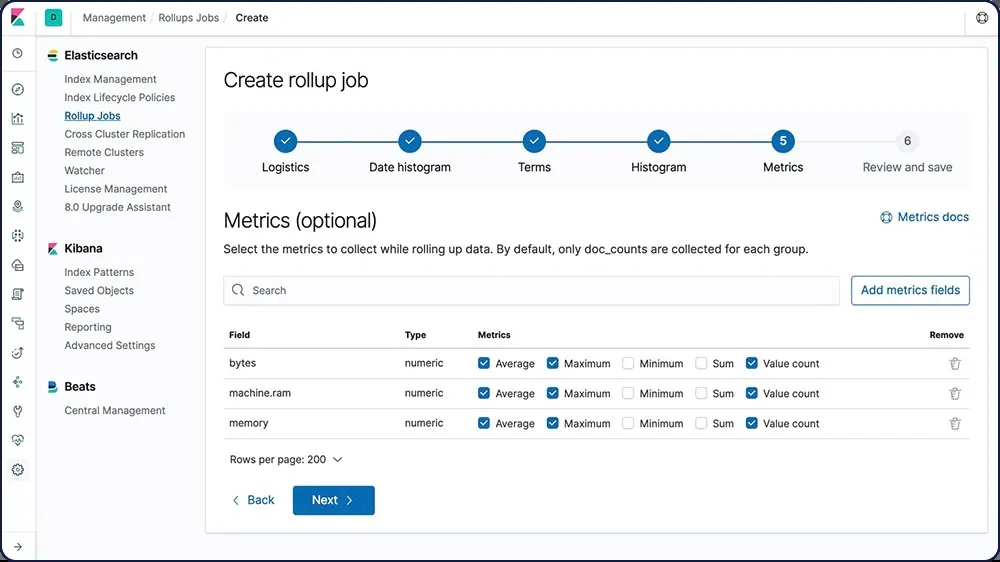
Elasticsearch
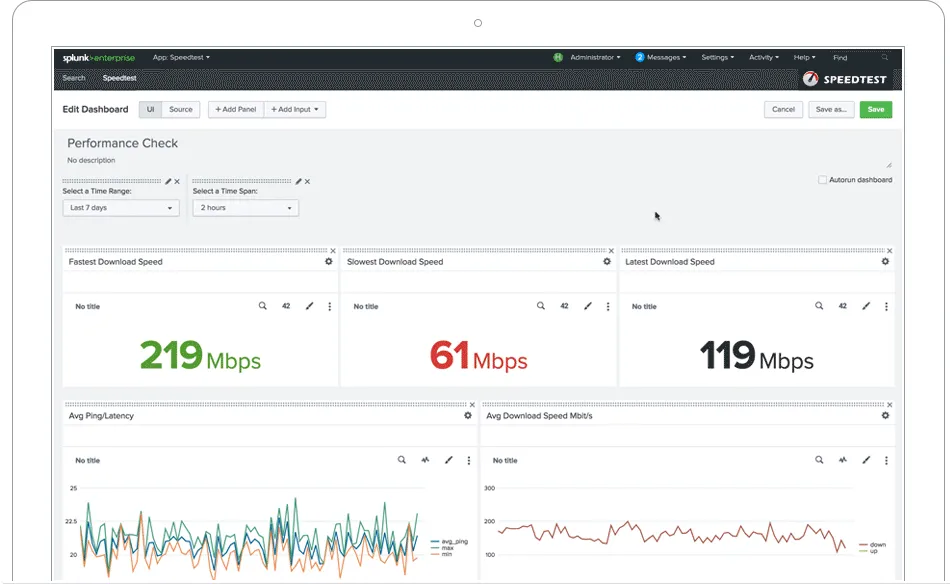
Splunk
Feature Comparison
| Feature | Elasticsearch | Splunk | Datadog |
|---|---|---|---|
| Search & Query Capabilities | |||
| Query Language | Query DSL, ES|QL, and EQL for full-text, structured, and event-based queries with fuzzy matching, relevance scoring, and runtime fields | SPL (Search Processing Language) for searching, filtering, and analyzing machine-generated big data with real-time and scheduled queries | Tag-based filtering and custom query syntax for slicing metrics, logs, and traces by host, device, service, or any custom tag |
| Full-Text Search | Core strength built on Lucene with inverted index, fuzzy search, semantic search via Jina models, hybrid search, and advanced relevance tuning | Schema-on-read technology extracts answers from unstructured data with field extraction and pattern recognition at search time | Log search and filtering with automated tagging and correlation; not purpose-built for full-text search workloads |
| AI & Machine Learning Search | Vector database with dense and sparse vector search, semantic search, reranking, and inference service for running LLMs alongside data | Machine Learning Toolkit with pre-built analytics, custom model development, anomaly detection, and predictive analytics via guided assistants | AI-powered observability with AIOps capabilities recognized in Forrester Wave; automated anomaly detection and root cause analysis |
| Data Ingestion & Storage | |||
| Data Sources & Integrations | 350+ integrations with APIs, language clients, Beats, Logstash, and ingest pipelines; supports structured, unstructured, time-series, geospatial, and vector data | 2,000+ integrations on Splunkbase with built-in OpenTelemetry support, SDKs, and agents for logs, metrics, traces, and events from any source | 600+ turn-key integrations that seamlessly aggregate metrics and events across the full DevOps stack including AWS, Azure, GCP, and Kubernetes |
| Storage Architecture | Hot, warm, cold, and frozen data tiers with index lifecycle management; searchable snapshots on S3, Azure, or GCS reduce storage costs without sacrificing access | SmartStore next-generation architecture with application-aware caching; actively accessed data on local storage, inactive data on lower-cost remote object storage | Fully managed SaaS storage with configurable retention periods; log ingestion separate from indexing with different cost tiers for each |
| Data Retention & Lifecycle | Index lifecycle management automates data movement across hot, warm, cold, and frozen tiers; snapshot lifecycle management for automated backups with configurable retention | Data rollups summarize historical data at a fraction of raw storage cost; data streams for scalable time-series ingestion with configurable retention policies | Retention periods vary by signal type; log retention billed separately from ingestion; custom metrics retention based on plan tier |
| Monitoring & Observability | |||
| Infrastructure Monitoring | Observability solution built on the Elastic Stack for metrics, logs, and traces with OpenTelemetry data ingestion and correlation | Agentic observability across any environment and stack including AI infrastructure; prevents and prioritizes issues based on business impact | Core strength with per-host monitoring, auto-generated service overviews, real-time dashboards, and network visibility across multi-cloud environments |
| APM & Tracing | Application performance monitoring via Elastic APM with distributed tracing, service maps, and integration with logs and metrics | Splunk APM with real-time troubleshooting, AI assistants for faster MTTR, business KPI impact analysis, and SAP system optimization | APM with end-to-end distributed tracing, error rate and latency percentile graphing, and open-source tracing library instrumentation |
| Dashboards & Visualization | Kibana Lens visualization, Elastic Maps, Canvas for visual data representation, and customizable dashboards with drill-down capabilities | Custom dashboards with Dashboard Studio, augmented reality overlays, mobile dashboards, and Splunk TV for NOC and SOC displays | Real-time interactive dashboards with high-resolution metrics; slice data by any tag with rates, ratios, and averages computed on the fly |
| Security & Threat Detection | |||
| SIEM Capabilities | Security analytics with SIEM functionality, detection engine, threat hunting across structured and unstructured data, and AI-powered threat detection | Industry-leading unified SIEM with consecutive leadership recognition from global analyst firms; behavioral analytics, risk scoring, and advanced persistent threat detection | Cloud SIEM with real-time threat detection, security monitoring, and cloud security posture management for identifying system threats |
| Compliance & Audit | Audit logging, field- and document-level security, encryption at rest, and role-based access control for regulated environments | Automated compliance monitoring for PCI, HIPAA, and GDPR; streamlined audits with real-time security visibility and centralized reporting | Cloud security posture management and compliance monitoring; security monitoring integrated with infrastructure and application observability data |
| Incident Response | Alerting via email, webhooks, PagerDuty, Slack, Jira, ServiceNow, and Microsoft Teams with highly available, scalable alerting infrastructure | Custom alert actions with automated remediation scripts; third-party incident response integration; 3x quick threat response times reported by customers | Multi-channel alerting via email, PagerDuty, Slack, and webhooks with complex trigger conditions and one-click maintenance muting |
| Deployment & Operations | |||
| Deployment Options | Self-hosted on bare metal, Elastic Cloud Hosted on AWS/GCP/Azure, Elastic Cloud Serverless, Docker, Kubernetes via Helm Charts, and on-premises | Splunk Enterprise (self-hosted on-premises), Splunk Cloud Platform (managed SaaS), with mobile and augmented reality extensions | Cloud-only SaaS platform with no self-hosted option; supports monitoring across AWS, Azure, GCP, and hybrid environments |
| Open Source & Extensibility | Open source with 77,000+ GitHub stars; Apache Lucene foundation; rich ecosystem of plugins, APIs, and community-built integrations | Proprietary platform with 2,800+ apps on Splunkbase marketplace; SDKs for custom integrations and ODBC support for BI tools | Proprietary SaaS with open-source tracing libraries and full API access; client libraries and REST API for custom instrumentation |
| High Availability & Disaster Recovery | Primary and replica shards with automatic failover; cross-cluster replication for disaster recovery and geo-proximity reads; rack awareness for failure isolation | Clustered indexer architecture with high availability; SmartStore pushes data to remote storage for resilient patching and upgrades without data loss | Fully managed SaaS with built-in redundancy and high availability handled by Datadog; no user-managed disaster recovery configuration needed |
Search & Query Capabilities
Query Language
Full-Text Search
AI & Machine Learning Search
Data Ingestion & Storage
Data Sources & Integrations
Storage Architecture
Data Retention & Lifecycle
Monitoring & Observability
Infrastructure Monitoring
APM & Tracing
Dashboards & Visualization
Security & Threat Detection
SIEM Capabilities
Compliance & Audit
Incident Response
Deployment & Operations
Deployment Options
Open Source & Extensibility
High Availability & Disaster Recovery
What each one does
Elasticsearch, Splunk, and Datadog each dominate different segments of the data analytics and observability landscape. Elasticsearch leads in search capabilities and open-source flexibility, Splunk delivers the strongest enterprise security and SIEM platform, and Datadog provides the most streamlined cloud-native monitoring experience. The right choice depends on whether your primary need is search and analytics, enterprise security, or unified cloud observability.
What each one is for
Choose Elasticsearch if:
We recommend Elasticsearch for teams whose primary workload centers on search, whether that means full-text search for applications, log analytics at scale, or emerging AI-powered retrieval with vector search. Elasticsearch gives you the most deployment flexibility with self-hosted, cloud-hosted, and serverless options, making it the strongest choice when you need to control infrastructure costs and data residency. With 76,550 GitHub stars and an open-source foundation, it also provides the deepest extensibility for engineering teams that want to customize their analytics stack. The tiered Elastic Cloud pricing starting at $95/mo makes it the most accessible entry point among these three tools for small-to-medium teams.
Choose Splunk if:
We recommend Splunk for enterprises that prioritize security operations, compliance automation, and SIEM capabilities above all else. Splunk is the only tool in this comparison recognized as a consecutive leader in both SIEM and observability by global analyst firms, and its unified threat detection, investigation, and response capabilities are unmatched for SOC teams. The SPL query language and 2,000+ Splunkbase integrations provide deep analytical power. Organizations in regulated industries that need automated compliance monitoring for PCI, HIPAA, and GDPR standards will find Splunk delivers the most mature and battle-tested platform for those requirements.
Choose Datadog if:
We recommend Datadog for DevOps and SRE teams running cloud-native infrastructure who want a single pane of glass for metrics, APM, logs, and real user monitoring without managing any observability infrastructure themselves. Datadog's 600+ turn-key integrations and auto-instrumentation capabilities deliver the fastest time-to-value among these three tools, and its recognition as a Leader in both the Forrester Wave for AIOps Platforms and the Gartner Magic Quadrant for Observability Platforms validates its monitoring depth. The usage-based pricing model starting at $15/host/month for infrastructure monitoring keeps entry costs low, but teams should carefully forecast costs as infrastructure grows since charges for hosts, custom metrics, log ingestion, and APM are independent and cumulative.
These scenarios reflect the available product evidence. Your requirements, existing stack, and team expertise should guide the final decision.
Frequently Asked Questions
What is the main difference between Elasticsearch, Splunk, and Datadog?
Elasticsearch is fundamentally a distributed search and analytics engine built on Apache Lucene, designed for full-text search, log analytics, and AI-powered retrieval across structured and unstructured data. Splunk is an enterprise data platform focused on security information and event management (SIEM), machine data analytics, and compliance monitoring with its proprietary SPL query language. Datadog is a cloud-native SaaS observability platform purpose-built for infrastructure monitoring, application performance management, log management, and real user monitoring. While all three can handle log analytics and monitoring, Elasticsearch excels at search workloads, Splunk leads in enterprise security operations, and Datadog provides the most unified cloud monitoring experience.
How do Elasticsearch, Splunk, and Datadog pricing models compare?
Elasticsearch offers the most accessible entry point: a free self-managed tier, with Elastic Cloud billed on consumption-based Elastic Compute Units. Splunk uses custom pricing across its Workload, Ingest and Entity models and publishes no list rate for them, so the annual cost of a Splunk deployment is set in negotiation rather than read off a page. Datadog charges per host for infrastructure monitoring ($15/host/month), and per GB for log ingestion, with independent charges that accumulate across product modules. All three offer free tiers, but Splunk represents the highest total cost of ownership at enterprise scale.
Can Elasticsearch replace Splunk or Datadog for monitoring and observability?
Elasticsearch can serve as a monitoring and observability platform through Elastic Observability, which provides infrastructure monitoring, APM with distributed tracing, log analytics, and uptime monitoring built on the Elastic Stack. For teams already invested in Elasticsearch for search workloads, adding observability capabilities avoids introducing another vendor and keeps all data in one platform. However, Elasticsearch requires more operational expertise to deploy and manage compared to Datadog's fully managed SaaS approach, and its SIEM capabilities, while growing, do not yet match Splunk's depth in enterprise security operations and compliance automation. We find Elasticsearch works best as a monitoring replacement when teams have strong infrastructure engineering capabilities and want to consolidate search and observability on a single open-source platform.
Which tool is best for log management and analysis?
All three tools handle log management, but they approach it differently and excel in different scenarios. Elasticsearch provides the most powerful search capabilities for log data with full-text search, real-time aggregations, and the ability to store logs across hot, warm, cold, and frozen tiers using index lifecycle management and searchable snapshots for cost optimization. Splunk's schema-on-read technology excels at extracting insights from unstructured log data without pre-defining schemas, making it particularly strong for security log analysis and compliance use cases. Datadog offers the most streamlined log management experience with automated tagging, correlation with traces and metrics, and simple filtering, though it can make it expensive at high volumes. For pure log analytics at scale with cost control, we recommend Elasticsearch. For security-focused log analysis, Splunk leads. For correlating logs with APM and infrastructure metrics in a managed platform, Datadog delivers the best integrated experience.
How do these tools compare for enterprise security and SIEM?
Splunk is the clear leader for enterprise security and SIEM among these three tools. It is the only vendor named a consecutive leader in SIEM by global analyst firms, and its unified threat detection, investigation, and response platform provides behavioral analytics, machine learning-based risk scoring, and advanced persistent threat detection. Customers like Carrefour report 3x quick threat response times with Splunk. Elasticsearch offers growing SIEM capabilities through Elastic Security with a detection engine, threat hunting, AI-powered threat detection, and ransomware protection starting at the Platinum tier, but it requires more configuration and tuning than Splunk. Datadog provides Cloud SIEM and security monitoring capabilities that integrate with its observability stack, making it useful for DevSecOps teams that want security signals alongside infrastructure metrics, but it lacks the depth of dedicated SIEM platforms for compliance automation and SOC operations.