Decision comparison
Elasticsearch vs Splunk
Elasticsearch and Splunk serve overlapping but distinct markets. Elasticsearch excels as an open-source, developer-centric search and analytics engine with powerful full-text, vector, and hybrid search capabilities. Splunk is a prominent provider in enterprise security operations and observability with its unified SIEM platform and mature monitoring ecosystem. Your choice depends on whether you prioritize search versatility and cost control or enterprise security and operational visibility.
Architecture choice. These take different approaches to the same problem. Read the table as a fit question rather than a feature race.
These are different kinds of product — Search Engine and Log Management.
Quick Comparison
| Decision factor | Elasticsearch | Splunk |
|---|---|---|
| Best For | Teams needing open-source distributed search and analytics with full-text, vector, and geospatial capabilities | Enterprise teams requiring unified security operations and observability with real-time monitoring |
| Pricing Model | $95 / mo, $109 / mo, $125 / mo, $175 / mo | Splunk Free is a perpetual no-cost licence for a single self-hosted instance, capped at 500 MB of daily indexing and without alerting. Splunk Enterprise and Splunk Cloud use workload, ingest, or entity-based pricing that Splunk does not publish. |
| Ease of Use | Powerful REST API and query DSL with a steeper learning curve for initial setup and configuration | Intuitive web interface with custom dashboards, though SPL query language has a steep learning curve |
| Scalability | Horizontally scalable with automatic data rebalancing, cross-cluster replication, and searchable snapshots | SmartStore architecture scales compute and storage independently with remote object storage support |
| Search Capabilities | Full-text, semantic, hybrid, and vector search with advanced relevance tuning and reranking | Real-time data capture, indexing, and SPL-based querying optimized for machine-generated log data |
| Security Features | Role-based access control, encrypted communications, encryption at rest, field-level security, and SSO | Unified SIEM platform with threat detection, behavioral analytics, compliance monitoring, and fraud prevention |
Elasticsearch
- Best For:
- Teams needing open-source distributed search and analytics with full-text, vector, and geospatial capabilities
- Pricing Model:
- $95 / mo, $109 / mo, $125 / mo, $175 / mo
- Ease of Use:
- Powerful REST API and query DSL with a steeper learning curve for initial setup and configuration
- Scalability:
- Horizontally scalable with automatic data rebalancing, cross-cluster replication, and searchable snapshots
- Search Capabilities:
- Full-text, semantic, hybrid, and vector search with advanced relevance tuning and reranking
- Security Features:
- Role-based access control, encrypted communications, encryption at rest, field-level security, and SSO
Splunk
- Best For:
- Enterprise teams requiring unified security operations and observability with real-time monitoring
- Pricing Model:
- Splunk Free is a perpetual no-cost licence for a single self-hosted instance, capped at 500 MB of daily indexing and without alerting. Splunk Enterprise and Splunk Cloud use workload, ingest, or entity-based pricing that Splunk does not publish.
- Ease of Use:
- Intuitive web interface with custom dashboards, though SPL query language has a steep learning curve
- Scalability:
- SmartStore architecture scales compute and storage independently with remote object storage support
- Search Capabilities:
- Real-time data capture, indexing, and SPL-based querying optimized for machine-generated log data
- Security Features:
- Unified SIEM platform with threat detection, behavioral analytics, compliance monitoring, and fraud prevention
Public signals
Verified factual signals only. Bars appear only for like-for-like metrics with five weekly assessments for every tool; missing evidence stays explicit. These signals do not establish enterprise adoption, product quality, or total cost.
| Metric | Elasticsearch | Splunk |
|---|---|---|
| Docker Hub pulls(Product adoption) | 979.2M | 93.3M |
| GitHub commits, 90d(Product adoption) | 4.4k | Not available |
| GitHub stars(Product adoption) | 77,000+ | Not available |
| Search interest(Market interest) | 9 | 15 |
| Hacker News mentions, 90d(Community interest) | 13 | 1 |
| npm weekly downloads(Developer adoption) | 2.0M | 27.3k |
| Product Hunt comments(Community interest) | 1 | 0 |
| Product Hunt rating(Community interest) | 5.0/5 | Unavailable |
| Product Hunt reviews(Community interest) | 26 | 0 |
| Product Hunt votes(Community interest) | 3 | 67 |
| PyPI weekly downloads(Developer adoption) | 8.4M | 318.5k |
| Stack Overflow questions(Community interest) | 58.2k | 2.3k |
| GitHub commits, 90d(Developer adoption) | Not available | 9 |
| GitHub stars(Developer adoption) | Not available | 743 |
As of September 21, 2026 — updated weekly.
Health & risk evidence
Observed public-source checks for mapped package versions and repositories.
Elasticsearch
September 21, 2026Package vulnerabilities
npm · @elastic/elasticsearch@9.5.1 · PyPI · elasticsearch@9.5.1
0 vulnerabilities
across 2 packages
Repository security score
github.com/elastic/elasticsearch
6.1/10
Splunk
September 21, 2026Package vulnerabilities
npm · splunk-logging@0.11.1 · PyPI · splunk-sdk@3.0.1
0 vulnerabilities
across 2 packages
Repository security score
github.com/splunk/splunk-sdk-python
6.9/10
Interface Preview
Elasticsearch
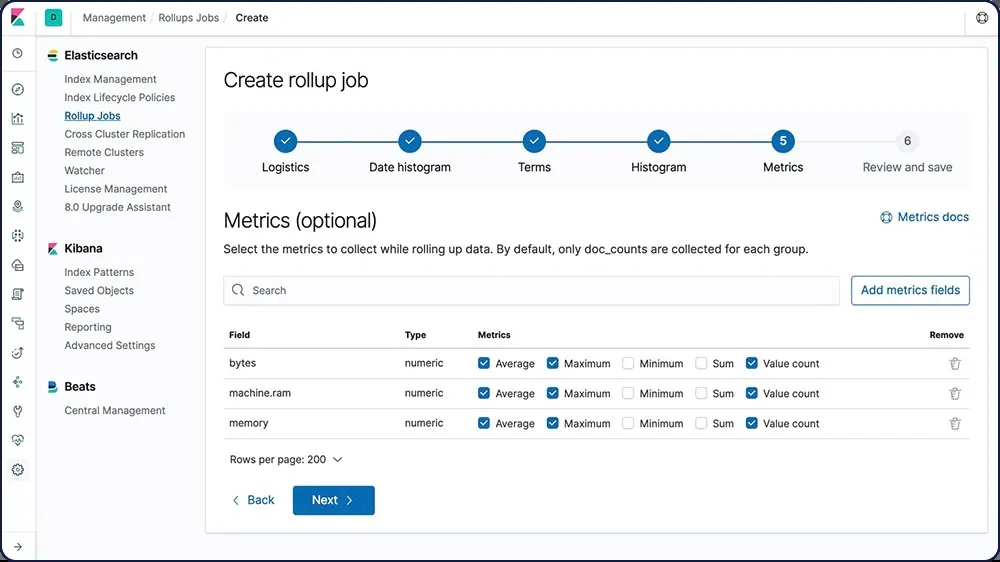
Splunk
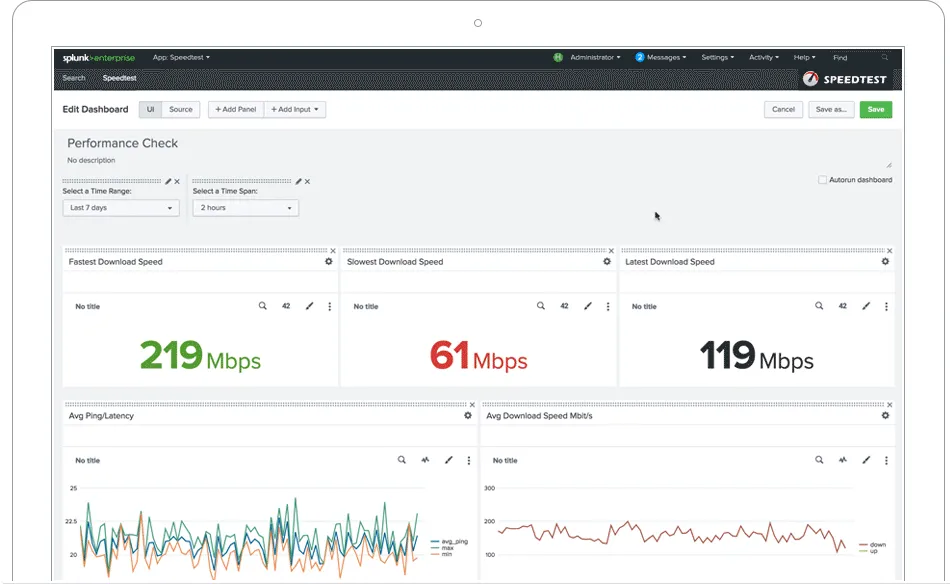
Feature Comparison
| Feature | Elasticsearch | Splunk |
|---|---|---|
| Search and Analytics | ||
| Full-text search | Native inverted index with fuzzy, semantic, and hybrid search modes | SPL-based search across indexed machine-generated data |
| Vector and AI search | Built-in vector database with dense and sparse vector support for AI applications | AI-native platform with GenAI and ML capabilities for data insights |
| Real-time analytics | Real-time aggregations and transforms on high-cardinality data | Real-time data capture, indexing, and continuous monitoring dashboards |
| Data Management | ||
| Index lifecycle management | Hot, warm, cold, and frozen data tiers with automated ILM policies | SmartStore architecture with application-aware caching and remote storage |
| Data ingestion | REST APIs, language clients, Beats, Logstash, and 350+ integrations | Universal Forwarders, 2,000+ Splunkbase integrations, and OpenTelemetry support |
| Snapshot and backup | Searchable snapshots with S3, Azure, and GCS support for cost-effective storage | Built-in data replication with configurable retention policies |
| Security and Compliance | ||
| Access control | RBAC, ABAC, field-level and document-level security with SSO support | Role-based access with SOC2 Type 2 and ISO 27001 certified Spacebridge |
| Threat detection | SIEM functionality available in Platinum tier with anomaly detection | Unified SIEM platform with behavioral analytics and risk scoring |
| Compliance monitoring | Audit logging and encrypted communications for compliance requirements | Automated compliance monitoring for PCI, HIPAA, GDPR standards |
| Deployment and Scalability | ||
| Deployment options | On-premises, Elastic Cloud hosted, and serverless on AWS, Azure, and GCP | Self-hosted Enterprise, Splunk Cloud Platform, or hybrid deployments |
| Horizontal scaling | Automatic shard rebalancing and node recovery with cross-cluster search | Workload Management for policy-based CPU and memory resource allocation |
| High availability | Primary and replica shards with automatic failover and cross-datacenter replication | Clustering with indexer and search head replication for enterprise resilience |
| Visualization and Reporting | ||
| Dashboards | Kibana Lens visualizations, Canvas, and Elastic Maps for data exploration | Custom dashboards with Dashboard Studio, Splunk TV, and mobile support |
| Machine learning | Anomaly detection, forecasting, and inference service for AI model deployment | Machine Learning Toolkit with pre-built analytics and custom model development |
| Reporting | Alerting, notifications via email, Slack, PagerDuty, and other integrations | Scheduled reports, real-time alerts, and custom alert actions with ODBC export |
Search and Analytics
Full-text search
Vector and AI search
Real-time analytics
Data Management
Index lifecycle management
Data ingestion
Snapshot and backup
Security and Compliance
Access control
Threat detection
Compliance monitoring
Deployment and Scalability
Deployment options
Horizontal scaling
High availability
Visualization and Reporting
Dashboards
Machine learning
Reporting
Which approach fits
Elasticsearch and Splunk serve overlapping but distinct markets. Elasticsearch excels as an open-source, developer-centric search and analytics engine with powerful full-text, vector, and hybrid search capabilities. Splunk is a prominent provider in enterprise security operations and observability with its unified SIEM platform and mature monitoring ecosystem. Your choice depends on whether you prioritize search versatility and cost control or enterprise security and operational visibility.
When each approach fits
Choose Elasticsearch if:
We recommend Elasticsearch for teams that need a versatile, open-source search and analytics platform with strong developer tooling. It is the stronger choice when your primary workloads involve full-text search, semantic or vector search for AI applications, geospatial analytics, or log analytics where cost control matters. With Elastic Cloud plans starting at $95 / mo and a free self-managed option, Elasticsearch offers significantly different commercial starting points than Splunk. The 76,000+ GitHub stars and active open-source community also mean extensive documentation and community support for troubleshooting.
Choose Splunk if:
We recommend Splunk for enterprise organizations where security operations and observability are the primary use cases. Splunk is the stronger choice when you need a unified SIEM platform with advanced threat detection, behavioral analytics, compliance automation for standards like PCI and HIPAA, and real-time incident response workflows. Its 2,000+ Splunkbase integrations and mature Machine Learning Toolkit provide enterprise-grade capabilities out of the box. Be prepared for commercial terms that can be higher for some deployments, making Splunk a better fit for organizations with dedicated security and IT operations budgets.
These scenarios reflect the available product evidence. Your requirements, existing stack, and team expertise should guide the final decision.
Frequently Asked Questions
What are the main differences between Elasticsearch and Splunk for log analytics?
Both Elasticsearch and Splunk handle log analytics, but they approach it differently. Elasticsearch uses a distributed architecture built on Apache Lucene with inverted indices that deliver millisecond-latency search across structured, unstructured, and time-series data. It supports ES|QL for querying and pairs with Kibana for visualization. Splunk uses its proprietary SPL query language and indexes machine-generated data with real-time capture capabilities. Splunk provides more turnkey log analytics with pre-built dashboards and monitoring templates through Splunkbase, while Elasticsearch offers more flexibility for custom search applications. For pure log analytics, Splunk provides a faster time to value with less configuration, while Elasticsearch gives teams more control over their search architecture and significantly lower per-GB storage costs.
How do Elasticsearch and Splunk compare on pricing for small and medium teams?
Pricing is one of the biggest differentiators between these two platforms. Elasticsearch offers a free self-managed Community Edition and Elastic Cloud plans starting at $95/mo for Standard, $109/mo for Gold, $125/mo for Platinum, and $175/mo for Enterprise tier. The consumption-based model uses Elastic Consumption Units where one ECU equals one dollar. Splunk Free is a perpetual no-cost licence for a single self-hosted instance, capped at 500 MB of daily indexing and without alerting; Splunk Enterprise and Splunk Cloud use workload, ingest, or entity-based pricing that Splunk does not publish. For small and medium teams processing moderate data volumes, Elasticsearch states its entry tiers publicly, so a budget can be set without a quote, provided the team can manage the initial setup.
Can Elasticsearch replace Splunk as a SIEM solution?
Elasticsearch can function as a SIEM through its Security solution available in the Platinum tier and above, offering threat detection, anomaly detection with machine learning, and security analytics. However, Splunk Enterprise Security is the more mature and feature-complete SIEM platform, named a consecutive leader in SIEM reports by global analyst firms. Splunk provides behavioral analytics, risk scoring, advanced threat detection for insider threats and lateral movement, compliance automation for PCI, HIPAA, and GDPR, and fraud prevention capabilities out of the box. Organizations with dedicated security operations centers generally find Splunk delivers faster time to value for SIEM use cases, while teams already running Elasticsearch for search or observability can leverage its security features as an integrated add-on rather than deploying a separate SIEM tool.
Which platform is better for AI and machine learning use cases?
Both platforms invest heavily in AI and ML, but their approaches differ. Elasticsearch positions itself as a retrieval platform for AI applications, with native vector database capabilities supporting dense and sparse vectors, semantic search with models from providers like Jina AI, hybrid search combining lexical and vector retrieval, and an inference service for running ML models alongside your data. Splunk takes an agentic AI approach focused on security and observability, with its Machine Learning Toolkit providing pre-built analytics for anomaly detection, predictive analytics, and clustering, plus GenAI capabilities for natural language data exploration. If you are building AI-powered search applications or RAG pipelines, Elasticsearch is the stronger platform. If your AI needs center on security threat detection, AIOps, and operational intelligence, Splunk has a mature ML ecosystem for those specific domains.
How do Elasticsearch and Splunk handle scalability for large data volumes?
Both platforms scale to petabyte-level data volumes but use different architectures. Elasticsearch distributes data across clusters using shards with automatic rebalancing, node recovery, and cross-cluster replication. Adding capacity means adding nodes, and the system handles shard allocation automatically. Searchable snapshots let you store cold data on object storage like S3 while keeping it searchable. Splunk uses its SmartStore architecture that separates compute from storage, placing active data in local storage and inactive data in lower-cost remote storage automatically based on access patterns. Splunk Workload Management allocates CPU and memory based on organizational priorities. For very large deployments at the 500GB per day level, Elasticsearch offers more granular scaling options with its tiered cloud pricing and a free self-hosted option for organizations that prefer to manage their own infrastructure and optimize costs directly.