Decision comparison
Grafana vs Splunk
Grafana and Splunk serve overlapping but fundamentally different audiences in the observability space. Grafana is the flexible, open-source visualization layer that connects to virtually any data source and provides teams with full control over their dashboards and monitoring setup. Splunk is the enterprise powerhouse that combines observability with security operations, compliance automation, and AI-driven analytics in a single platform. The choice comes down to whether you need an open, cost-effective visualization and monitoring platform or a comprehensive enterprise security and observability suite with SIEM capabilities.
Used together. These are normally used together rather than chosen between. The comparison explains what each one does in the stack.
These are different kinds of product — Metrics & Dashboards and Log Management.
Quick Comparison
| Decision factor | Grafana | Splunk |
|---|---|---|
| Primary Focus | Open-source data visualization and observability across metrics, logs, and traces | Enterprise security and observability with SIEM, compliance, and AI-driven analytics |
| Deployment Model | Self-hosted open source, Grafana Cloud (managed SaaS), or Enterprise on-prem | Self-hosted Enterprise, Splunk Cloud Platform (SaaS), or hybrid deployments |
| Pricing Approach | Grafana Cloud Free is $0/month and includes 10k active metrics series, 50 GB of logs, traces and profiles, and 3 active users. Pro is from $19/month plus usage: metrics at $6.50 per 1k series, logs, traces and profiles at $0.400/GB write and $0.100/GB retain, and Grafana visualization at $8 per active user. Enterprise starts at a $25,000/year minimum commit and is quote-based. | Splunk Free is a perpetual no-cost licence for a single self-hosted instance, capped at 500 MB of daily indexing and without alerting. Splunk Enterprise and Splunk Cloud use workload, ingest, or entity-based pricing that Splunk does not publish. |
| Data Sources | Pluggable model with native support for Prometheus, Graphite, InfluxDB, Elasticsearch, MySQL, Postgres, and cloud providers | 2,000+ integrations via Splunkbase with universal forwarders and OpenTelemetry support |
| Security Capabilities | Focused on observability alerting; not a SIEM platform | Full SIEM with threat detection, fraud prevention, compliance automation, and security analytics |
| Best For | Engineering teams building custom observability dashboards across diverse data sources | Large enterprises needing unified security operations, compliance, and observability at scale |
Grafana
- Primary Focus:
- Open-source data visualization and observability across metrics, logs, and traces
- Deployment Model:
- Self-hosted open source, Grafana Cloud (managed SaaS), or Enterprise on-prem
- Pricing Approach:
- Grafana Cloud Free is $0/month and includes 10k active metrics series, 50 GB of logs, traces and profiles, and 3 active users. Pro is from $19/month plus usage: metrics at $6.50 per 1k series, logs, traces and profiles at $0.400/GB write and $0.100/GB retain, and Grafana visualization at $8 per active user. Enterprise starts at a $25,000/year minimum commit and is quote-based.
- Data Sources:
- Pluggable model with native support for Prometheus, Graphite, InfluxDB, Elasticsearch, MySQL, Postgres, and cloud providers
- Security Capabilities:
- Focused on observability alerting; not a SIEM platform
- Best For:
- Engineering teams building custom observability dashboards across diverse data sources
Splunk
- Primary Focus:
- Enterprise security and observability with SIEM, compliance, and AI-driven analytics
- Deployment Model:
- Self-hosted Enterprise, Splunk Cloud Platform (SaaS), or hybrid deployments
- Pricing Approach:
- Splunk Free is a perpetual no-cost licence for a single self-hosted instance, capped at 500 MB of daily indexing and without alerting. Splunk Enterprise and Splunk Cloud use workload, ingest, or entity-based pricing that Splunk does not publish.
- Data Sources:
- 2,000+ integrations via Splunkbase with universal forwarders and OpenTelemetry support
- Security Capabilities:
- Full SIEM with threat detection, fraud prevention, compliance automation, and security analytics
- Best For:
- Large enterprises needing unified security operations, compliance, and observability at scale
Public signals
Verified factual signals only. Bars appear only for like-for-like metrics with five weekly assessments for every tool; missing evidence stays explicit. These signals do not establish enterprise adoption, product quality, or total cost.
| Metric | Grafana | Splunk |
|---|---|---|
| Docker Hub pulls(Product adoption) | 5.3B | 93.2M |
| GitHub commits, 90d(Product adoption) | 3.1k | Not available |
| GitHub stars(Product adoption) | 76,000+ | Not available |
| Search interest(Market interest) | 22 | 15 |
| Hacker News mentions, 90d(Community interest) | 31 | 2 |
| npm weekly downloads(Developer adoption) | 76.4k | 34.0k |
| Product Hunt comments(Community interest) | 0 | 0 |
| Product Hunt rating(Community interest) | 5.0/5 | Unavailable |
| Product Hunt reviews(Community interest) | 1 | 0 |
| Product Hunt votes(Community interest) | 5 | 67 |
| PyPI weekly downloads(Ecosystem adoption) | 48.7k | Not available |
| Stack Overflow questions(Community interest) | 5.8k | 2.3k |
| GitHub commits, 90d(Developer adoption) | Not available | 13 |
| GitHub stars(Developer adoption) | Not available | 741 |
| PyPI weekly downloads(Developer adoption) | Not available | 285.4k |
As of September 14, 2026 — updated weekly.
Health & risk evidence
Observed public-source checks for mapped package versions and repositories.
Grafana
September 14, 2026Package vulnerabilities
npm · @grafana/data@13.2.1 · PyPI · grafana-client@5.1.2
0 vulnerabilities
across 2 packages
Repository security score
github.com/grafana/grafana
6.9/10
Splunk
September 14, 2026Package vulnerabilities
npm · splunk-logging@0.11.1 · PyPI · splunk-sdk@3.0.1
0 vulnerabilities
across 2 packages
Repository security score
github.com/splunk/splunk-sdk-python
6.9/10
Interface Preview
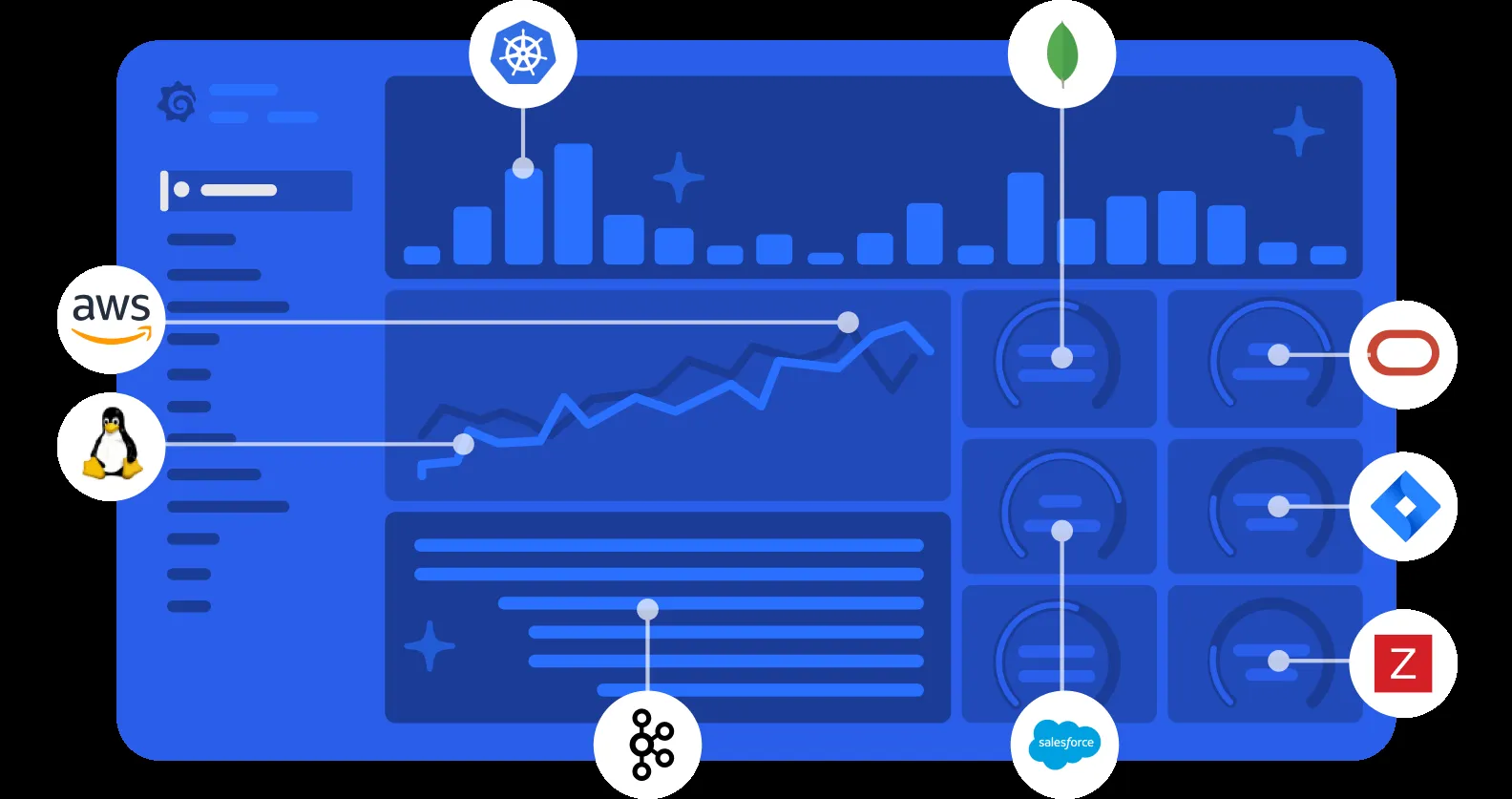
Grafana
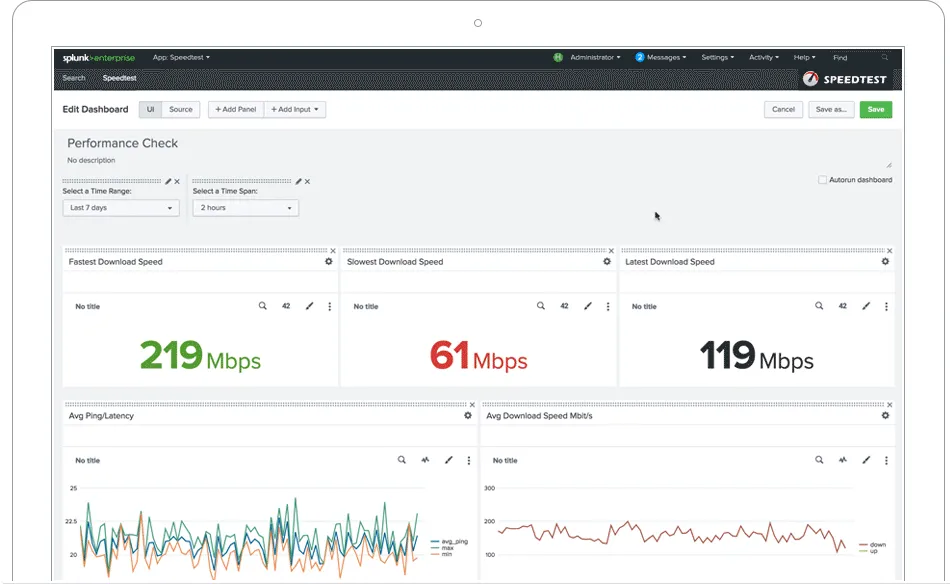
Splunk
Feature Comparison
| Feature | Grafana | Splunk |
|---|---|---|
| Data Visualization & Dashboards | ||
| Custom Dashboards | Dynamic dashboards with template variables, mixed data sources, and fast client-side rendering | Custom dashboards with Dashboard Studio, Splunk TV displays, and mobile-friendly views |
| Visualization Library | Extensive panel plugin ecosystem with community-contributed visualizations | Built-in chart types with Analytics Workspace for visual-friendly metric analysis |
| Mobile Access | Responsive web interface accessible from mobile browsers | Dedicated Splunk Mobile app, Splunk for iPad, and Splunk TV for large displays |
| Data Collection & Integration | ||
| Data Source Connectors | Pluggable data source model with native support for Prometheus, Graphite, InfluxDB, Elasticsearch, MySQL, Postgres, and cloud monitoring vendors | 2,000+ integrations on Splunkbase with universal forwarders, OpenTelemetry support, and SDKs |
| Cloud Provider Support | Built-in support for Amazon CloudWatch, Microsoft Azure, and Google Cloud monitoring | Enterprise integrations with ODBC, REST APIs, and SDKs for embedding in any application |
| Log Management | Loki for log aggregation with 50 GB free ingestion per month in Grafana Cloud | Core platform capability with real-time indexing, SPL query language, and SmartStore architecture |
| Monitoring & Alerting | ||
| Alerting System | Visual alert rule builder with notifications to external systems like Slack, PagerDuty, and email | Custom alert actions with automated remediation scripts, granular triggers, and real-time alerts |
| Infrastructure Monitoring | Kubernetes monitoring with 2,232 free host hours; application and database observability included | Full infrastructure monitoring with Splunk Observability Cloud and business impact prioritization |
| Performance Testing | Built-in performance testing with 500 free virtual user hours in Grafana Cloud | APM with real-time troubleshooting from third-party APIs to code level, plus AI assistants |
| AI & Machine Learning | ||
| AI Capabilities | Grafana Assistant with 3 free active AI users; AI insights for root cause analysis | Native agentic, GenAI, and ML capabilities with natural language insights and AI model deployment |
| Machine Learning | Focused on visualization and alerting; ML capabilities through data source integrations | Machine Learning Toolkit (MLTK) with pre-built analytics, outlier detection, predictive analytics, and clustering |
| AIOps | SLO management and contextualized root cause analysis in Grafana Cloud | IT Service Intelligence (ITSI) with AI-driven anomaly identification, alert correlation, and proactive outage prevention |
| Security & Compliance | ||
| SIEM Capabilities | Not a SIEM platform; focused on observability and visualization | Full SIEM with Enterprise Security for threat detection, investigation, and automated response |
| Compliance Monitoring | Not a core capability; relies on observability data for operational compliance | Automated compliance monitoring for PCI, HIPAA, GDPR with audit-ready reporting |
| Threat Detection | Not offered; security use cases handled by integrated data sources | Behavioral analytics, ML-powered risk scoring, APT detection, and fraud prevention |
Data Visualization & Dashboards
Custom Dashboards
Visualization Library
Mobile Access
Data Collection & Integration
Data Source Connectors
Cloud Provider Support
Log Management
Monitoring & Alerting
Alerting System
Infrastructure Monitoring
Performance Testing
AI & Machine Learning
AI Capabilities
Machine Learning
AIOps
Security & Compliance
SIEM Capabilities
Compliance Monitoring
Threat Detection
How they fit together
Grafana and Splunk serve overlapping but fundamentally different audiences in the observability space. Grafana is the flexible, open-source visualization layer that connects to virtually any data source and provides teams with full control over their dashboards and monitoring setup. Splunk is the enterprise powerhouse that combines observability with security operations, compliance automation, and AI-driven analytics in a single platform. The choice comes down to whether you need an open, cost-effective visualization and monitoring platform or a comprehensive enterprise security and observability suite with SIEM capabilities.
What each one handles
Use Grafana for:
Choose Grafana if you want an open-source, cost-effective observability platform with maximum flexibility. Grafana's pluggable data source model connects to Prometheus, InfluxDB, Elasticsearch, MySQL, Postgres, and dozens of other backends without vendor lock-in. The generous Grafana Cloud free tier covers 10,000 metric series, 50 GB of logs and traces, and 3 users at no cost. With over 73,000 GitHub stars and the full LGTM stack (Loki, Grafana, Tempo, Mimir), it delivers enterprise-grade observability at a fraction of Splunk's cost. Engineering teams that value customization, open standards, and community-driven development will find Grafana the stronger foundation for their monitoring infrastructure.
Use Splunk for:
Choose Splunk if your organization needs a unified security and observability platform that goes beyond monitoring into threat detection, compliance, and enterprise resilience. Splunk is the only vendor named a consecutive leader in both SIEM and observability analyst reports. Its 2,000+ Splunkbase integrations, Machine Learning Toolkit, and SmartStore architecture handle massive data volumes that enterprise security operations demand. Organizations in regulated industries that need automated compliance monitoring for PCI, HIPAA, and GDPR, along with AI-driven threat detection and incident response, will find Splunk's comprehensive platform justifies its higher price point.
These roles reflect the available product evidence. Most teams run both; which one owns a given job depends on your stack and team.
Frequently Asked Questions
What is the main difference between Grafana and Splunk?
Grafana is an open-source data visualization and observability platform that excels at building custom dashboards across diverse data sources like Prometheus, InfluxDB, and Elasticsearch. Splunk is an enterprise-grade security and observability platform that combines SIEM capabilities, log analytics, compliance automation, and AI-driven threat detection. Grafana focuses on flexible visualization, while Splunk provides a broader unified security and operations platform.
Is Grafana really free to use?
Grafana's core platform is open source under the AGPL-3.0 license and free to self-host. Grafana Cloud also offers a generous free tier that includes 10,000 billable metric series, 50 GB of logs, traces, and profiles each, 100,000 frontend sessions, and 3 active Grafana users. Beyond these free limits, Grafana Cloud Pro starts at $19 per month and charges $8 per active Grafana user with usage-based rates for additional consumption.
How much does Splunk cost compared to Grafana?
Splunk costs significantly more than Grafana for most deployments. Splunk's free tier is limited to 500MB per day with no authentication or alerting. Grafana Cloud's free tier covers substantially more usage, and paid plans start at $19 per month plus $8 per active user, making it far more accessible for small to mid-size teams.
Can Grafana replace Splunk for log management?
Grafana with Loki can handle log aggregation and visualization effectively, especially for teams already using the Prometheus ecosystem. However, Splunk provides more advanced log analytics capabilities including its proprietary SPL query language, real-time indexing at massive scale, SmartStore architecture for cost-efficient storage, and the Machine Learning Toolkit for anomaly detection. For pure log visualization, Grafana plus Loki is a strong open-source alternative. For enterprise-scale log analytics with built-in security and compliance, Splunk remains the more complete solution.
Which platform has better community support?
Grafana has a stronger open-source community with over 75,000 GitHub stars, an active contributor ecosystem, and a plugin marketplace. Its codebase is publicly available and written primarily in TypeScript and Go. Splunk has a large enterprise user base with 542 reviews on third-party platforms compared to Grafana's 157, plus the Splunkbase marketplace with 2,000+ integrations. Grafana wins on open-source community engagement; Splunk wins on enterprise ecosystem breadth.