Grafana: product and architecture
Grafana is the open-source observability and data visualization platform used by millions of developers to create dashboards for metrics, logs, and traces from 150+ data sources. In this Grafana review, we examine how the platform has become the de facto standard for infrastructure monitoring and operational dashboards.
Overview
Grafana (grafana.com) is an open-source platform for monitoring and observability, originally created by Torkel Ödegaard in 2014. Grafana Labs, the company behind it, raised $240M at a $6B valuation and employs 800+ people. The platform is used by thousands of organizations including Bloomberg, JP Morgan, eBay, PayPal, and Sony for operational dashboards and monitoring.
The core product is a visualization layer that connects to time-series databases (Prometheus, InfluxDB, Graphite), log aggregation systems (Loki, Elasticsearch), tracing backends (Tempo, Jaeger), and traditional databases (PostgreSQL, MySQL, BigQuery). Grafana doesn't store data itself — it queries data where it lives and renders it in customizable dashboards.
The Grafana ecosystem includes Grafana Loki (log aggregation), Grafana Tempo (distributed tracing), Grafana Mimir (long-term metrics storage), and Grafana OnCall (incident management) — forming a complete observability stack that competes with Datadog and Splunk at a fraction of the cost.
Key Features and Architecture
150+ Data Source Plugins
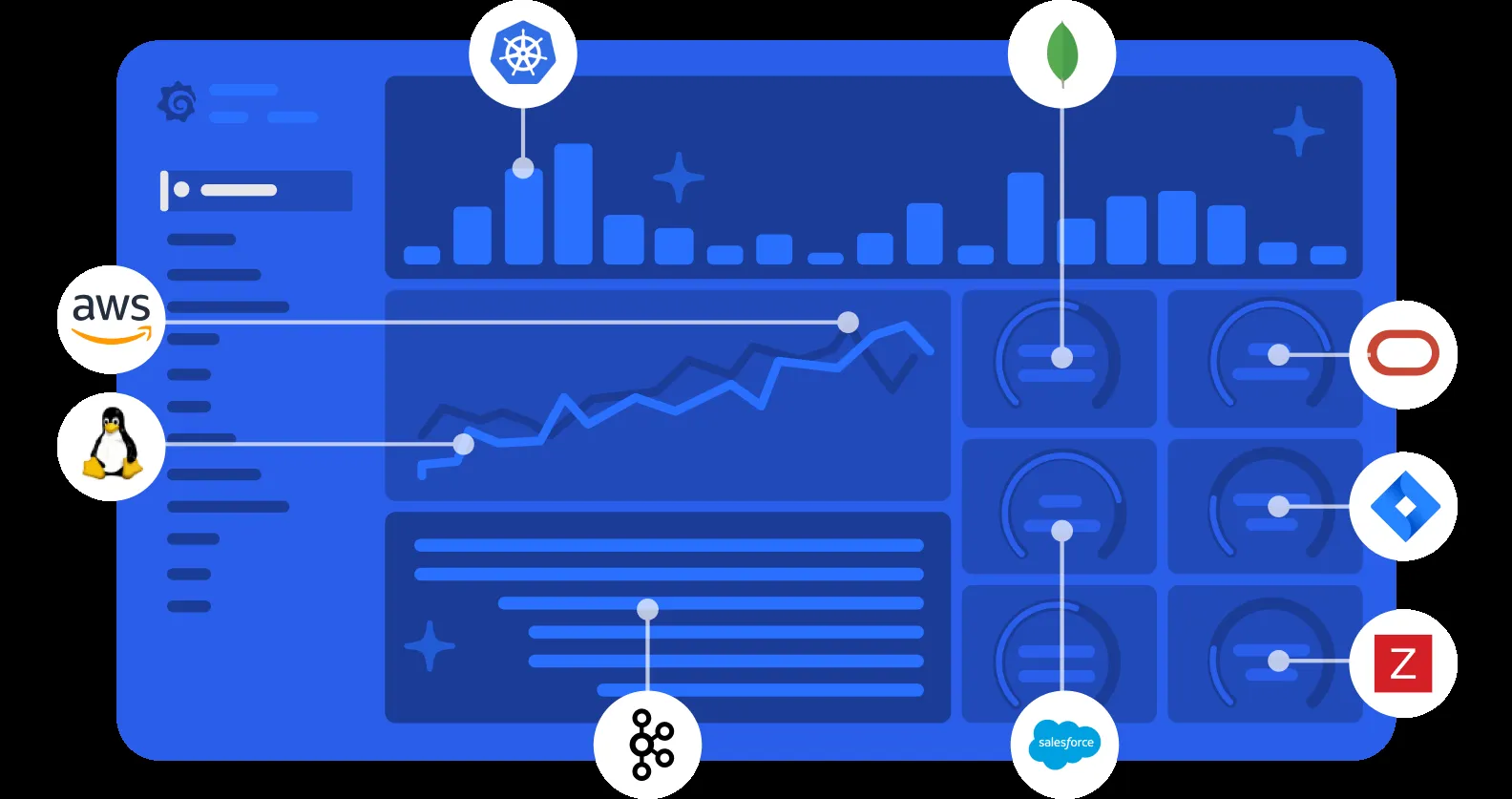
Grafana connects to virtually any data source through its plugin architecture. Core integrations include Prometheus, InfluxDB, Elasticsearch, CloudWatch, Azure Monitor, Google Cloud Monitoring, PostgreSQL, MySQL, and BigQuery. Community plugins extend this to 150+ sources, meaning Grafana can visualize data from any system in your stack.
Dashboard Builder
A drag-and-drop dashboard editor with 15+ visualization types: time series graphs, stat panels, gauges, bar charts, heatmaps, geomap, logs panels, trace views, and more. Dashboards support template variables for dynamic filtering, annotations for event correlation, and auto-refresh for real-time monitoring.
Alerting Engine
Grafana's unified alerting system evaluates queries across any data source and triggers notifications via email, Slack, PagerDuty, OpsGenie, and 20+ notification channels. Alert rules support multi-dimensional evaluation, meaning a single rule can monitor thousands of time series and fire alerts for specific label combinations.
Grafana Loki (Log Aggregation)
A horizontally-scalable log aggregation system inspired by Prometheus. Loki indexes only metadata (labels) rather than full-text indexing like Elasticsearch, making it 10-100x more cost-effective to operate. It integrates natively with Grafana for log exploration alongside metrics.
Grafana Tempo (Distributed Tracing)
A high-scale distributed tracing backend that requires only object storage (S3, GCS). Tempo integrates with OpenTelemetry, Jaeger, and Zipkin, providing trace visualization directly in Grafana dashboards alongside metrics and logs.
Explore and Ad-Hoc Queries
Beyond pre-built dashboards, Grafana's Explore mode allows ad-hoc querying of any connected data source. Engineers can investigate incidents by querying metrics, searching logs, and tracing requests in a single interface without building dashboards first.
Ideal Use Cases
Infrastructure and Application Monitoring
The primary use case: DevOps and SRE teams monitoring server metrics (CPU, memory, disk, network), application metrics (request rate, error rate, latency), and infrastructure health. Grafana + Prometheus is a prominent open-source monitoring stack, used by the majority of Kubernetes deployments.
Observability (Metrics + Logs + Traces)
Teams implementing full observability use Grafana as the unified visualization layer for metrics (Prometheus/Mimir), logs (Loki), and traces (Tempo). Correlating across all three signal types in a single dashboard accelerates incident investigation.
IoT and Sensor Data Visualization
Organizations monitoring IoT devices, industrial sensors, or environmental data use Grafana with time-series databases (InfluxDB, TimescaleDB) to visualize sensor readings, detect anomalies, and track trends across thousands of devices.
Business Operations Dashboards
While not a traditional BI tool, Grafana is used for operational business dashboards — order volumes, payment processing rates, API usage metrics, and SLA compliance. These dashboards serve operations teams rather than business analysts.
Strengths & Trade-offs
Pros
- Open-source and free — the full platform is available under AGPL-3.0 with no feature restrictions; most teams never need paid tiers
- 150+ data source plugins — connects to virtually any metrics, logs, or database system; no vendor lock-in
- Industry standard for DevOps — a widely used monitoring dashboard; a massive community, thousands of shared dashboards, extensive documentation
- Complete observability stack — Loki (logs), Tempo (traces), Mimir (metrics), OnCall (incidents) form a full alternative to Datadog/Splunk
- Generous free cloud tier — 10K metrics, 50GB logs, 50GB traces free; sufficient for small teams and startups
- Active development — regular releases, 60K+ GitHub stars, 3,000+ contributors
Cons
- Not a BI tool — designed for operational dashboards, not business analytics; lacks the data modeling, semantic layer, and self-service exploration that Looker or Tableau provide
- Steep learning curve for complex dashboards — PromQL, LogQL, and other query languages require technical expertise; not accessible to non-technical users
- Self-hosted complexity — running Grafana + Prometheus + Loki + Tempo requires significant infrastructure and operational knowledge
- Dashboard sprawl — organizations often end up with hundreds of dashboards that become unmaintained; no built-in governance or lifecycle management
- Limited data transformation — Grafana visualizes data as-is; complex transformations require upstream processing in the data source