Decision comparison
Grafana vs Datadog vs New Relic
Grafana delivers the strongest value for teams that prioritize open-source flexibility, data sovereignty, and visualization customization. Datadog provides the most polished all-in-one SaaS experience with deep integrations and AI-powered security. New Relic offers the best per-GB pricing model and AI-driven observability for teams wanting predictable costs at scale.
These are different kinds of product — Metrics & Dashboards and Observability Platform. Teams do weigh them against each other, but they are not drop-in substitutes, so read the table as a fit question rather than a feature race.
Quick Comparison
| Decision factor | Grafana | Datadog | New Relic |
|---|---|---|---|
| Best For | Teams wanting open-source observability with self-hosting and full data sovereignty | Organizations needing a fully managed all-in-one observability and security platform | Teams wanting predictable per-GB pricing with AI-powered intelligent observability |
| Pricing Model | Grafana Cloud Free is $0/month and includes 10k active metrics series, 50 GB of logs, traces and profiles, and 3 active users. Pro is from $19/month plus usage: metrics at $6.50 per 1k series, logs, traces and profiles at $0.400/GB write and $0.100/GB retain, and Grafana visualization at $8 per active user. Enterprise starts at a $25,000/year minimum commit and is quote-based. | Free tier for up to 5 hosts with 1-day metric retention. Infrastructure Monitoring starts at $15 per host per month on Pro, billed annually, or $18 on-demand; Enterprise is $23 per host. APM starts at $31 per host, with APM Pro at $35 and APM Enterprise at $40. DevSecOps is $22 per host on Pro and $34 on Enterprise. Logs, custom metrics and other products are billed separately by usage. | Free tier available, paid plans start at $19/mo per host, additional costs based on usage and features |
| Deployment Options | Self-hosted open-source, Grafana Cloud managed, or Enterprise edition | Cloud-only SaaS with no self-hosted option | SaaS-only with Data Plus option for enhanced data residency controls |
| Core Strength | Industry-leading dashboards with pluggable data source model and LGTM stack | Unified observability and security monitoring in a single managed platform | Intelligent Observability with AI and agentic monitoring across 50+ capabilities |
| Integration Count | Native support for Prometheus, Elasticsearch, InfluxDB, Postgres, MySQL, and cloud providers | Turn-key integrations across SaaS providers, automation tools, and databases | 780+ quickstart integrations with native OpenTelemetry support |
Grafana
- Best For:
- Teams wanting open-source observability with self-hosting and full data sovereignty
- Pricing Model:
- Grafana Cloud Free is $0/month and includes 10k active metrics series, 50 GB of logs, traces and profiles, and 3 active users. Pro is from $19/month plus usage: metrics at $6.50 per 1k series, logs, traces and profiles at $0.400/GB write and $0.100/GB retain, and Grafana visualization at $8 per active user. Enterprise starts at a $25,000/year minimum commit and is quote-based.
- Deployment Options:
- Self-hosted open-source, Grafana Cloud managed, or Enterprise edition
- Core Strength:
- Industry-leading dashboards with pluggable data source model and LGTM stack
- Integration Count:
- Native support for Prometheus, Elasticsearch, InfluxDB, Postgres, MySQL, and cloud providers
Datadog
- Best For:
- Organizations needing a fully managed all-in-one observability and security platform
- Pricing Model:
- Free tier for up to 5 hosts with 1-day metric retention. Infrastructure Monitoring starts at $15 per host per month on Pro, billed annually, or $18 on-demand; Enterprise is $23 per host. APM starts at $31 per host, with APM Pro at $35 and APM Enterprise at $40. DevSecOps is $22 per host on Pro and $34 on Enterprise. Logs, custom metrics and other products are billed separately by usage.
- Deployment Options:
- Cloud-only SaaS with no self-hosted option
- Core Strength:
- Unified observability and security monitoring in a single managed platform
- Integration Count:
- Turn-key integrations across SaaS providers, automation tools, and databases
New Relic
- Best For:
- Teams wanting predictable per-GB pricing with AI-powered intelligent observability
- Pricing Model:
- Free tier available, paid plans start at $19/mo per host, additional costs based on usage and features
- Deployment Options:
- SaaS-only with Data Plus option for enhanced data residency controls
- Core Strength:
- Intelligent Observability with AI and agentic monitoring across 50+ capabilities
- Integration Count:
- 780+ quickstart integrations with native OpenTelemetry support
Public signals
Verified factual signals only. Bars appear only for like-for-like metrics with five weekly assessments for every tool; missing evidence stays explicit. These signals do not establish enterprise adoption, product quality, or total cost.
| Metric | Grafana | Datadog | New Relic |
|---|---|---|---|
| Docker Hub pulls(Product adoption) | 5.3B | Not available | Not available |
| GitHub commits, 90d(Product adoption) | 3.2k | Not available | Not available |
| GitHub stars(Product adoption) | 76,000+ | Not available | Not available |
| Search interest(Market interest) | 21 | 14 | 4 |
| Hacker News mentions, 90d(Community interest) | 33 | 15 | 1 |
| npm weekly downloads(Developer adoption) | 80.4k | 6.7M | 847.6k |
| Product Hunt comments(Community interest) | 0 | 1 | 1 |
| Product Hunt rating(Community interest) | 5.0/5 | 5.0/5 | Unavailable |
| Product Hunt reviews(Community interest) | 1 | 13 | 0 |
| Product Hunt votes(Community interest) | 5 | 75 | 16 |
| PyPI weekly downloads(Ecosystem adoption) | 45.6k | Not available | Not available |
| Stack Overflow questions(Community interest) | 5.8k | 1.1k | 1.5k |
| GitHub commits, 90d(Developer adoption) | Not available | 2.5k | 352 |
| GitHub stars(Developer adoption) | Not available | 3,500+ | 10 |
| Hugging Face downloads(Product adoption) | Not available | 106.6k | Not available |
| Hugging Face likes(Product adoption) | Not available | 221 | Not available |
| PyPI weekly downloads(Developer adoption) | Not available | 11.2M | 929.1k |
As of September 21, 2026 — updated weekly.
Health & risk evidence
Observed public-source checks for mapped package versions and repositories.
Grafana
September 21, 2026Package vulnerabilities
npm · @grafana/data@13.2.2 · PyPI · grafana-client@5.1.2
0 vulnerabilities
across 2 packages
Repository security score
github.com/grafana/grafana
6.8/10
Datadog
September 21, 2026Package vulnerabilities
PyPI · datadog@0.53.0 · npm · dd-trace@6.16.0
0 vulnerabilities
across 2 packages
Repository security score
github.com/DataDog/datadog-agent
5.9/10
New Relic
September 21, 2026Package vulnerabilities
npm · newrelic@14.5.0 · PyPI · newrelic@13.5.0
0 vulnerabilities
across 2 packages
Repository security score
Not available
Interface Preview
Grafana
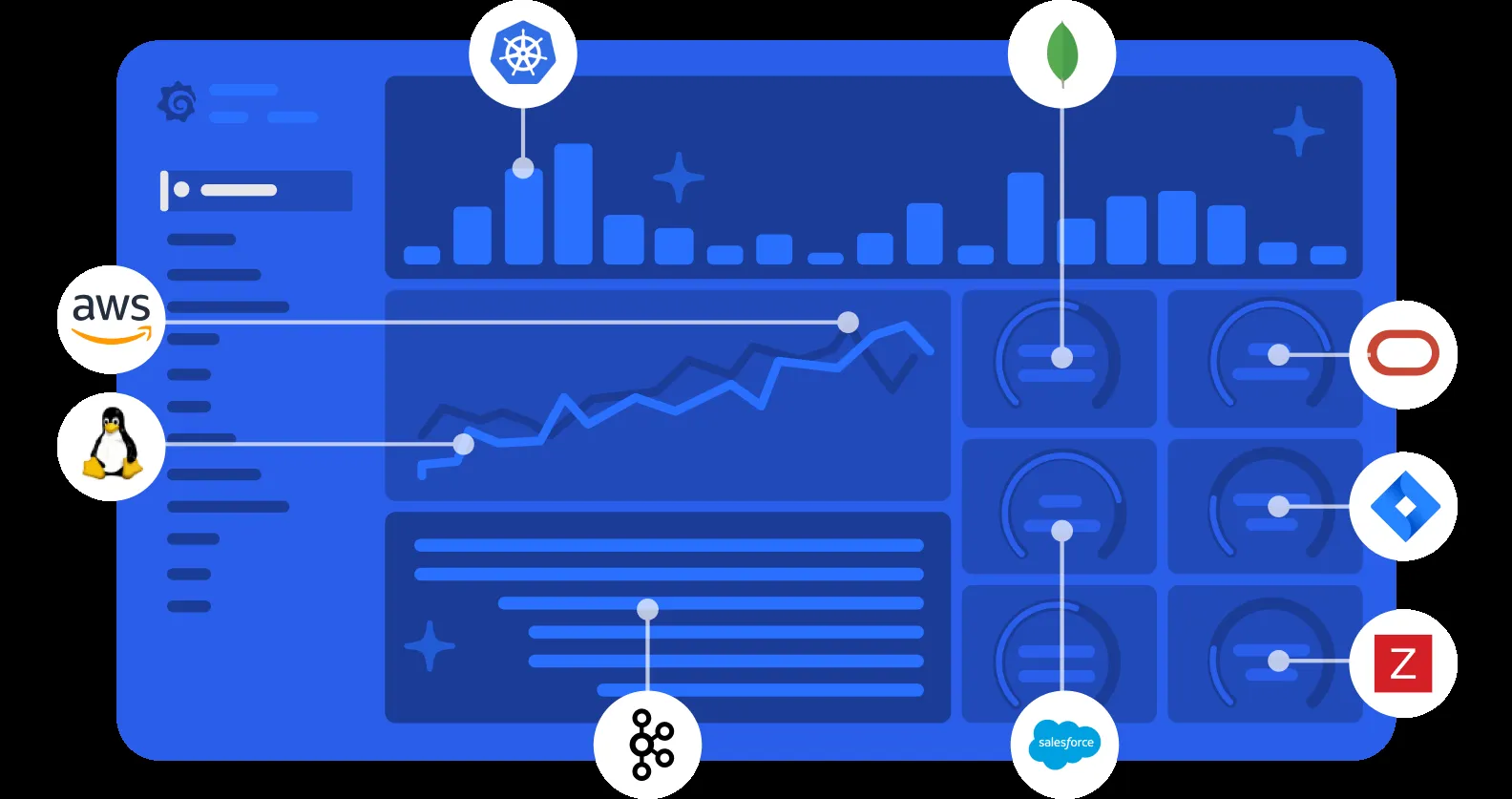
Feature Comparison
| Feature | Grafana | Datadog | New Relic |
|---|---|---|---|
| Core Monitoring | |||
| Infrastructure Monitoring | Monitors infrastructure through Grafana Cloud with host-level metrics, Kubernetes monitoring, and database observability included in free and pro tiers. | Comprehensive infrastructure monitoring with auto-generated service overviews, host-level metrics, and real-time dashboards across cloud and on-premises environments. | Full hybrid visibility across cloud-native and Kubernetes environments, tying infrastructure health directly to application performance context. |
| Application Performance Monitoring | Application observability through Grafana Cloud with support for distributed tracing via Tempo and metrics via Mimir, included in the free tier with 2232 host hours. | Full APM with auto-generated service overviews, error rate and latency percentile graphing, and open-source tracing library support for end-to-end request tracing. | APM 360 with code-level diagnostics, distributed tracing, error tracking, and code profiling to connect application performance directly to customer experience. |
| Log Management | Log aggregation and exploration powered by Loki, with 50 GB of free log ingestion per month and seamless correlation with metrics and traces. | Automated log collection with tagging and correlation, real-time search and filtering, and visualization and alerting on log data patterns. | Logs in context with instant data search, compliance support, and contextual log viewing alongside APM, infrastructure monitoring, and distributed tracing. |
| Visualization and Dashboards | |||
| Dashboard Capabilities | Industry-leading dashboard system with dynamic template variables, mixed data source support, and fast client-side rendering for flexible visualizations. | Real-time interactive dashboards with high-resolution metrics, data slicing by host or tag, rate and ratio computations, and code-based customization options. | Customizable dashboards that display data across 50+ capabilities with pre-built observability resources from 780+ quickstart integrations. |
| Data Source Integration | Pluggable data source model supporting Prometheus, Loki, Elasticsearch, InfluxDB, Postgres, MySQL, Amazon CloudWatch, and Microsoft Azure natively. | Turn-key integrations that aggregate metrics and events across SaaS providers, automation tools, databases, source control systems, and monitoring instrumentation. | 780+ quickstart integrations covering AWS, Azure, GCP, databases, Kubernetes, serverless, and OpenTelemetry for pre-built observability across any stack. |
| Alerting System | Visual alert rule definition with notification routing to multiple systems, supported by on-call management and incident management workflows in Grafana Cloud. | Complex alerting logic with multiple trigger conditions, notifications via email, PagerDuty, Slack, and one-click mute during maintenance and upgrades. | AIOps-powered alerting with automated detection, correlation, and resolution that ties multiple incidents to single issues to reduce alert fatigue. |
| Advanced Observability | |||
| Distributed Tracing | Distributed tracing through Grafana Tempo with 50 GB of free trace ingestion, integrated into the LGTM stack for correlation with logs and metrics. | End-to-end request tracing across distributed systems with automatic tagging, latency percentile tracking, and open-source tracing library instrumentation. | Native distributed tracing with automatic telemetry analysis in context, requiring no extra setup, and OpenTelemetry support as a first-class protocol. |
| Synthetic Monitoring | Synthetic monitoring included in Grafana Cloud with 100k API test executions and 10k browser test executions per month in the free tier. | Proactive AI-driven synthetic monitoring that simulates critical application features, with web recorder for user journey capture and SLA management. | Global traffic simulation through synthetic monitoring to proactively identify and fix performance issues before they reach end users. |
| AI and Machine Learning | Grafana Assistant AI with 3 free active AI users, contextualized root cause analysis, and AI-powered insights for faster troubleshooting workflows. | AI-powered observability recognized as a Leader in the Forrester Wave for AIOps Platforms, with automated anomaly detection and intelligent alerting. | Intelligent Observability with AI and agentic monitoring that controls agent behavior, tracks token usage, monitors model interactions, and predicts issues autonomously. |
| Security and Compliance | |||
| Security Monitoring | Security and governance features available in Grafana Cloud for controlling access, managing data policies, and securing observability infrastructure. | Real-time security monitoring that identifies potential threats across systems, with Cloud SIEM and compliance tools integrated into the observability platform. | Unified vulnerability management with production-impact prioritization, guided remediation, and AI-powered reasoning to secure investments. |
| Compliance Support | Enterprise edition provides enhanced security features with configuration-as-code support for audit trails and reproducible governance setups. | Compliance support through log archiving, data retention policies, and integration with security monitoring tools for regulated industry requirements. | FedRAMP Moderate and HIPAA eligibility with Data Plus, enterprise-grade security and governance, and priority support with 1-hour critical response SLA. |
| Data Privacy Controls | Open-source deployment option provides full data sovereignty, with self-hosted instances keeping all telemetry data within your own infrastructure. | Cloud-only SaaS architecture with data residing on Datadog infrastructure, subject to their retention policies and regional data processing options. | SaaS-based platform with Data Plus option for enhanced data residency controls, encryption standards, and compliance-ready data handling. |
| Developer Experience | |||
| Open-Source Ecosystem | Fully open-source under AGPL-3.0 with 75,000+ GitHub stars, active community contributions, and the complete LGTM stack available for self-hosting. | Proprietary platform with open-source tracing libraries supported, but core product uses proprietary agents, query languages, and data formats. | Extensive open-source ecosystem support among SaaS providers with native OpenTelemetry ingestion for metrics, traces, and logs to avoid vendor lock-in. |
| API and Extensibility | Configuration-as-code support with extensive plugin ecosystem, REST API access, and TypeScript-based architecture for custom plugin development. | Full RESTful HTTP API with client libraries for custom instrumentation, command-line tools for server tagging, and JSON-formatted dashboard generation. | Full API access with CodeStream IDE integration, NRQL query language for data exploration, and notification workflow integration with Slack and other tools. |
| Performance Testing | Built-in performance testing through Grafana Cloud with 500 virtual user hours included in the free tier for load testing scenarios. | Performance monitoring through APM with latency tracking, error rate analysis, and infrastructure correlation for identifying performance bottlenecks. | Website performance tracking with free continuous dashboards, browser monitoring for frontend performance, and mobile monitoring for app performance. |
Core Monitoring
Infrastructure Monitoring
Application Performance Monitoring
Log Management
Visualization and Dashboards
Dashboard Capabilities
Data Source Integration
Alerting System
Advanced Observability
Distributed Tracing
Synthetic Monitoring
AI and Machine Learning
Security and Compliance
Security Monitoring
Compliance Support
Data Privacy Controls
Developer Experience
Open-Source Ecosystem
API and Extensibility
Performance Testing
What each one does
Grafana delivers the strongest value for teams that prioritize open-source flexibility, data sovereignty, and visualization customization. Datadog provides the most polished all-in-one SaaS experience with deep integrations and AI-powered security. New Relic offers the best per-GB pricing model and AI-driven observability for teams wanting predictable costs at scale.
What each one is for
Choose Grafana if:
Grafana is the strongest choice for engineering teams that value open-source principles and want full control over their observability stack. With 73,311 GitHub stars and the complete LGTM stack (Loki, Grafana, Tempo, Mimir), organizations can self-host their entire monitoring infrastructure and retain complete data sovereignty. The generous free tier includes 10k metrics series, 50 GB each for logs, traces, and profiles, and built-in performance testing. Teams already invested in Prometheus, InfluxDB, or Elasticsearch will find Grafana integrates seamlessly with their existing data sources without requiring migration.
Choose Datadog if:
Datadog is the top pick for organizations that need a fully managed, all-in-one observability and security platform without the operational overhead of self-hosting. Its strength lies in unified monitoring across infrastructure, APM, logs, network, synthetic monitoring, and real-time security in a single SaaS product. Datadog has earned Leader recognition in both the Gartner Magic Quadrant for Observability Platforms and the Forrester Wave for AIOps Platforms. Teams that need deep integration across cloud providers (AWS, Azure, GCP), turn-key setup, and AI-powered threat detection will find Datadog delivers the most comprehensive managed experience.
Choose New Relic if:
New Relic is the best fit for teams that want predictable, usage-based pricing at scale with strong AI capabilities built in. Its per-GB pricing model with 100 GB of free data ingest per month eliminates the per-host cost surprises that frustrate teams using other platforms. New Relic provides 50+ capabilities and 780+ integrations in a unified platform, with native OpenTelemetry support protecting against vendor lock-in. The Intelligent Observability features, including AI and agentic monitoring, SRE Agent for automated remediation, and session replay with AI-powered friction detection, make it particularly strong for organizations investing in AI-driven operations.
These scenarios reflect the available product evidence. Your requirements, existing stack, and team expertise should guide the final decision.
Frequently Asked Questions
How do Grafana, Datadog, and New Relic compare on pricing for a growing team?
Grafana Cloud offers the most accessible entry point with a generous free tier including 10k metrics series, 50 GB each for logs, traces, and profiles, and 3 active users at no cost. Grafana Cloud Pro starts at $19 per month, with Grafana visualization at $8 per active user per month. Datadog uses multi-dimensional pricing that charges separately per host, per metric, per log GB, and per APM trace, with paid plans starting from a per-host fee and additional costs per feature module. New Relic takes a fundamentally different approach with per-GB data pricing, offering 100 GB of free ingest per month, unlimited free basic users, and full platform user seats at $49 per user per month. For growing teams, New Relic and Grafana typically provide more predictable billing than Datadog.
Which platform is best for teams that use OpenTelemetry?
New Relic provides the strongest OpenTelemetry support among these three platforms, treating it as a first-class protocol for ingesting metrics, traces, and logs. New Relic positions itself as a prominent open-source ecosystem within SaaS observability providers. Grafana also has strong OpenTelemetry compatibility through the LGTM stack, with Tempo and Mimir natively accepting OTel data, and the open-source nature means teams have full control over their ingestion pipeline. Datadog supports OpenTelemetry ingestion but also promotes its own proprietary agents and SDKs, which can create a dependency on Datadog-specific tooling. Teams committed to OpenTelemetry as their instrumentation standard should prioritize New Relic or Grafana for the most frictionless experience.
Can I self-host any of these platforms?
Grafana is the only platform among the three that offers a full self-hosted option. The entire LGTM stack (Loki for logs, Grafana for visualization, Tempo for traces, Mimir for metrics) is open-source under the AGPL-3.0 license with 73,311 GitHub stars. Organizations can deploy Grafana entirely within their own infrastructure, retaining complete data sovereignty and eliminating any SaaS dependency. Datadog is exclusively a cloud-hosted SaaS product with no self-hosted deployment option. New Relic is also SaaS-only, though it offers a Data Plus option for enhanced data residency controls and FedRAMP Moderate eligibility. Teams with strict data sovereignty or compliance requirements that mandate on-premises deployment should choose Grafana.
How do the AI and machine learning capabilities compare across these platforms?
New Relic leads in AI-driven observability with its Intelligent Observability platform, featuring AI and agentic monitoring that automatically controls agent behavior, tracks token usage, and monitors model interactions. The SRE Agent provides automated remediation beyond simple assistance, and session replay uses AI to identify friction points. Datadog has earned Leader recognition in the Forrester Wave for AIOps Platforms with strong anomaly detection, intelligent alerting, and AI-powered security monitoring. Grafana offers the Grafana Assistant AI feature (3 free active AI users) with contextualized root cause analysis. For teams building AI applications specifically, New Relic provides dedicated APM for AI apps to control speed, quality, and cost. All three platforms are investing heavily in AI, but New Relic and Datadog currently offer the most mature AI-driven capabilities.