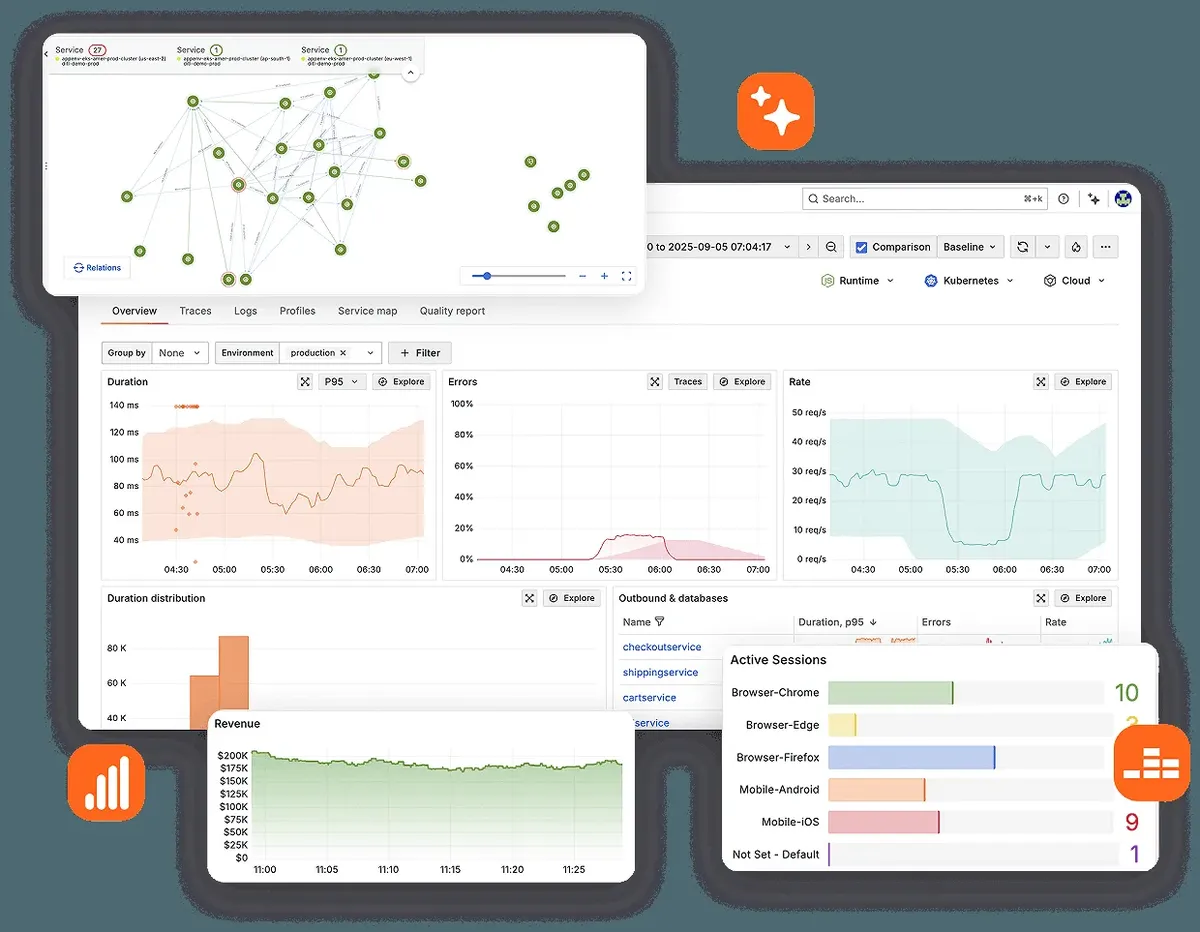
Grafana Cloud: product and architecture
Grafana Cloud is a strong choice for teams that want managed, open-source-rooted observability without committing to a closed proprietary data model; this Grafana Cloud review recommends it most clearly for data and platform teams already comfortable with Grafana’s dashboard-centric workflow. It brings metrics, logs, traces, and profiles into one managed observability platform, while preserving the flexibility associated with Grafana’s pluggable data-source approach. The trade-off is that flexibility: teams that need highly polished log analysis, a simpler console, or minimal configuration work should evaluate alternatives carefully.
Overview
Grafana Cloud is the managed offering from Grafana Labs, the New York-based company behind Grafana. The product positions itself as an AI-powered, fully managed observability platform for monitoring metrics, logs, traces, and profiles, built on leading open-source tools. In practical terms, it is designed to give engineering and data teams a common view across operational signals instead of forcing dashboards to live separately from logging, tracing, or profiling workflows.
The central value proposition is unified visibility. Grafana can combine data from many locations into a single dashboard, and its data-source model supports time-series systems such as Graphite, cloud monitoring services including Amazon CloudWatch and Microsoft Azure, and SQL databases such as MySQL. That breadth is valuable for organizations that have accumulated heterogeneous infrastructure and want to standardize how people inspect operational data without first replacing every underlying system.
Grafana Cloud’s website emphasizes AI-assisted onboarding, out-of-the-box monitoring, Adaptive Telemetry, predictable cost management, and freedom from vendor lock-in. Those claims describe a compelling direction, but the supplied material does not provide independent implementation detail or outcome metrics for every claim. We would treat the platform’s open and multi-source positioning as the clearest reason to shortlist it, rather than assuming AI assistance alone will solve observability design problems.
The product is positioned from startups through Fortune 500 organizations and is described as a leader in the Gartner Magic Quadrant for Observability Platforms. That is useful market context, not proof that Grafana Cloud will fit a particular operating model. The deciding question is whether your team values a flexible, dashboard-led observability layer enough to accept a more hands-on experience in configuration, console use, and log-analysis workflows.
Key Features and Architecture
Grafana Cloud’s architecture centers on collecting and presenting four major signal types: metrics, logs, traces, and profiles. Bringing those signals into one platform matters because an incident investigation often starts with a metric change, moves to logs for context, and then needs trace or profile evidence to isolate a service-level issue. The provided material establishes that Grafana Cloud covers all four categories, but it does not specify retention defaults, ingestion limits, query languages, or performance benchmarks; teams should obtain those details before committing to a production design.
A key technical capability is Grafana’s pluggable data-source model. Rather than requiring every operational dataset to originate in one proprietary repository, Grafana can connect to multiple sources and combine their results within a dashboard. The documented examples include Graphite for time-series data, Amazon CloudWatch and Microsoft Azure for cloud monitoring, and MySQL for SQL-backed data; this is especially useful when data engineering, application, and infrastructure teams already own different systems.
Specific capabilities supported by the provided product material include:
- Multi-signal monitoring: Grafana Cloud is described as monitoring metrics, logs, traces, and profiles through a fully managed platform.
- Cross-source dashboards: Grafana can consolidate data from Graphite, Amazon CloudWatch, Microsoft Azure, MySQL, and other supported sources into a single dashboard view.
- Synthetic monitoring: The official feature material includes tutorials for simple synthetic monitoring of applications, including an introduction connected to Grafana Labs’ iteration on worldPing.
- AI-assisted onboarding and workflows: The website states that users can start with AI-assisted onboarding and workflows to reach initial insights more quickly.
- Out-of-the-box monitoring: The product description promises instant visibility through out-of-the-box monitoring, reducing the amount of initial dashboard assembly required.
- Adaptive Telemetry: Grafana Cloud presents Adaptive Telemetry as a cost-management capability that keeps important signals while reducing noise.
- Managed deployment model: Unlike self-managed open-source Grafana, Grafana Cloud is the managed edition, shifting platform operation to the vendor.
This design favors composability over a narrowly prescriptive workflow. It is a meaningful advantage when a team needs dashboards spanning cloud monitoring and database data, but it also means the quality of the final observability experience depends on data-source setup, dashboard design, alerts, and governance. User feedback specifically identifies configuration files and command-line work as weaknesses, so the platform should not be treated as configuration-free simply because it is managed.
Ideal Use Cases
Grafana Cloud is best for a data platform or SRE-oriented team that needs one operational interface across mixed systems. A team of 5 to 20 engineers running workloads in Amazon infrastructure, using MySQL for operational data, and retaining existing Graphite-based metrics can use Grafana Cloud to bring those distinct sources into common dashboards. The practical benefit is less context switching during incident response and capacity reviews; the cost is that someone still needs to own conventions for data sources, dashboards, and alert configuration.
It is also a sensible fit for an analytics engineering or data engineering group supporting a shared data platform. For example, a team responsible for database services, cloud resources, and application pipelines can use the platform’s metrics, logs, traces, and profiles scope to create an operating view that is broader than a single database-monitoring product. The official material supports multi-source monitoring and dashboard consolidation, but it does not provide evidence for specialized data-pipeline lineage, warehouse-cost optimization, or data-quality monitoring, so do not procure Grafana Cloud expecting those capabilities by default.
A third fit is an organization that wants to start with a free entry point and expand into managed observability as needs mature. Grafana Cloud uses a freemium model and offers tiers described as serving small teams through global enterprises, making it appropriate for a startup proving its monitoring patterns before standardizing more widely. Public user feedback is also favorable overall: the product has an 8.6/10 user rating from 157 reviews, with recurring praise for predefined templates, data sources, alerting, open-source roots, Box integration, and Azure integration.
Do not use Grafana Cloud if your primary requirement is a highly refined log-analysis experience with little configuration. Users explicitly call out log analysis, the web console, user experience, text editors, configuration files, and the command line as weak points. We recommend Grafana Cloud for teams prepared to invest in observability practices and dashboard ownership; choose a more opinionated alternative if the organization cannot support that operational discipline.
Pros and Cons
Grafana Cloud has real strengths, particularly for organizations that want an open-source-aligned managed observability experience rather than an all-in-one proprietary replacement for every data source. The 8.6/10 rating across 157 user reviews is positive evidence, although it should be interpreted as user sentiment rather than a universal fit. The same feedback also makes the limitations unusually clear: the product’s flexibility does not automatically produce the cleanest authoring or investigation experience.
Pros
- Connects diverse operational data in one dashboard. Grafana’s pluggable data-source model and documented support for Graphite, Amazon CloudWatch, Microsoft Azure, and MySQL make it practical to unify data that already lives in separate systems.
- Covers four core observability signal types. Metrics, logs, traces, and profiles are included in Grafana Cloud’s stated scope, which supports broader incident investigation than a metrics-only dashboard tool.
- Offers managed delivery without abandoning open-source roots. Teams can use Grafana Cloud instead of operating Grafana themselves while retaining the ecosystem orientation users associate with Grafana.
- Supports quicker initial adoption. The product describes AI-assisted onboarding, out-of-the-box monitoring, and predefined templates; reviewers specifically cite predefined templates and data sources as strengths.
- Has operational alerting support. Users explicitly identify that it sends alerts, making the platform more useful for active reliability workflows than passive reporting alone.
- Provides a freemium entry model. This lowers the barrier for teams to validate a monitoring design before committing to an enterprise-scale rollout.
Cons
- Log analysis is a documented user pain point. Review feedback specifically names log analysis as a weakness, so log-centric investigation teams should test their real searches and incident workflows before standardizing.
- The web console and user experience receive criticism. Users identify both the web console and user experience as weaknesses, which can slow adoption among occasional users and stakeholders who do not work in Grafana daily.
- Configuration can be demanding. Configuration files and command-line work are both called out negatively, undercutting the assumption that a managed offering eliminates operational complexity.
- Text editing and visualization tooling have reported limitations. Users cite text editors and visualization tools as weaknesses; teams with demanding dashboard-authoring requirements should run hands-on evaluations.
- Current paid pricing is not disclosed in the supplied data. Contact-for-pricing procurement requires a direct vendor conversation and makes early cost comparison less transparent than published-rate alternatives.