Decision comparison
Uptrace vs Grafana Cloud
Choose Uptrace when OpenTelemetry-first telemetry economics, ClickHouse architecture, self-hosting, EU-based infrastructure, and enforceable monthly spend caps are priorities. Choose Grafana Cloud when a managed platform, broad dashboard and data-source flexibility, Kubernetes integrations, AI-assisted workflows, and extensive enterprise compliance coverage matter more.
Direct comparison. These are reviewed substitutes bought for the same job, so the differences below are the ones that decide between them.
All 2 are observability platforms.
Quick Comparison
| Decision factor | Uptrace | Grafana Cloud |
|---|---|---|
| Best For | OpenTelemetry-centric teams seeking cost-controlled tracing, metrics, and logs with ClickHouse-backed analytics and EU-based managed or self-hosted deployment. | Teams wanting managed full-stack observability, broad data-source dashboards, Kubernetes integrations, AI-assisted onboarding, and enterprise compliance controls. |
| Architecture | OpenTelemetry and ClickHouse platform unifying traces, metrics, and logs; accepts Prometheus, Vector, Fluent Bit, CloudWatch, and other sources. | Managed open observability platform with OpenTelemetry-native integrations, knowledge-graph-enriched alerts, flexible data sources, and Bring Your Own Cloud support. |
| Pricing Model | Uptrace Cloud includes 50 GB free every month, then starts from $0.075/GB. Volume discounts apply automatically, with unlimited users, services, and hosts. Metrics are billed per million ingested datapoints. The supplied evidence does not list a public monthly starting price or per-seat price; buyers should evaluate expected data volume, retention, and metrics usage. | Grafana Cloud Free is $0/month and includes 10k active metrics series, 50 GB of logs, traces and profiles, and 3 active users. Pro is from $19/month plus usage: metrics at $6.50 per 1k series, logs, traces and profiles at $0.400/GB write and $0.100/GB retain, and Grafana visualization at $8 per active user. Enterprise starts at a $25,000/year minimum commit and is quote-based. |
| Ease of Use | Provides a unified application-health dashboard, service graph, RED metrics, latency percentiles, error patterns, and slow-endpoint visibility in one interface. | AI-assisted onboarding, out-of-the-box monitoring, templates, and broad integrations accelerate setup, though users report configuration and console usability concerns. |
| Scalability | Processes billions of spans using ClickHouse; volume discounts, OTel Arrow compression, predictable usage caps, and unlimited users, services, and hosts support growth. | Tiered volume pricing and Adaptive Telemetry prioritize critical signals, with claimed 35-50% savings across metrics, logs, and traces as environments grow. |
| Community/Support | AGPL-3.0 open-source project with 4,280 GitHub stars; offers managed cloud, self-hosting, free trials, demos, and commercial support paths. | Enterprise-grade managed service with SOC 2, GDPR, PCI, FedRAMP High, and DoD IL5 support; associated CLI repository has 571 GitHub stars. |
Uptrace
- Best For:
- OpenTelemetry-centric teams seeking cost-controlled tracing, metrics, and logs with ClickHouse-backed analytics and EU-based managed or self-hosted deployment.
- Architecture:
- OpenTelemetry and ClickHouse platform unifying traces, metrics, and logs; accepts Prometheus, Vector, Fluent Bit, CloudWatch, and other sources.
- Pricing Model:
- Uptrace Cloud includes 50 GB free every month, then starts from $0.075/GB. Volume discounts apply automatically, with unlimited users, services, and hosts. Metrics are billed per million ingested datapoints. The supplied evidence does not list a public monthly starting price or per-seat price; buyers should evaluate expected data volume, retention, and metrics usage.
- Ease of Use:
- Provides a unified application-health dashboard, service graph, RED metrics, latency percentiles, error patterns, and slow-endpoint visibility in one interface.
- Scalability:
- Processes billions of spans using ClickHouse; volume discounts, OTel Arrow compression, predictable usage caps, and unlimited users, services, and hosts support growth.
- Community/Support:
- AGPL-3.0 open-source project with 4,280 GitHub stars; offers managed cloud, self-hosting, free trials, demos, and commercial support paths.
Grafana Cloud
- Best For:
- Teams wanting managed full-stack observability, broad data-source dashboards, Kubernetes integrations, AI-assisted onboarding, and enterprise compliance controls.
- Architecture:
- Managed open observability platform with OpenTelemetry-native integrations, knowledge-graph-enriched alerts, flexible data sources, and Bring Your Own Cloud support.
- Pricing Model:
- Grafana Cloud Free is $0/month and includes 10k active metrics series, 50 GB of logs, traces and profiles, and 3 active users. Pro is from $19/month plus usage: metrics at $6.50 per 1k series, logs, traces and profiles at $0.400/GB write and $0.100/GB retain, and Grafana visualization at $8 per active user. Enterprise starts at a $25,000/year minimum commit and is quote-based.
- Ease of Use:
- AI-assisted onboarding, out-of-the-box monitoring, templates, and broad integrations accelerate setup, though users report configuration and console usability concerns.
- Scalability:
- Tiered volume pricing and Adaptive Telemetry prioritize critical signals, with claimed 35-50% savings across metrics, logs, and traces as environments grow.
- Community/Support:
- Enterprise-grade managed service with SOC 2, GDPR, PCI, FedRAMP High, and DoD IL5 support; associated CLI repository has 571 GitHub stars.
Public signals
Verified factual signals only. Bars appear only for like-for-like metrics with five weekly assessments for every tool; missing evidence stays explicit. These signals do not establish enterprise adoption, product quality, or total cost.
| Metric | Uptrace | Grafana Cloud |
|---|---|---|
| Docker Hub pulls(Product adoption) | 430.5k | Not available |
| GitHub commits, 90d(Product adoption) | 0 | Not available |
| GitHub stars(Product adoption) | 4,000+ | Not available |
| Search interest(Market interest) | 0 | 1 |
| Hacker News mentions, 90d(Community interest) | 0 | 0 |
| npm weekly downloads(Developer adoption) | 2.6k | Not available |
| PyPI weekly downloads(Developer adoption) | 17.6k | Not available |
| GitHub commits, 90d(Developer adoption) | Not available | 244 |
| GitHub stars(Developer adoption) | Not available | 571 |
As of September 14, 2026 — updated weekly.
Health & risk evidence
Observed public-source checks for mapped package versions and repositories.
Uptrace
September 14, 2026Package vulnerabilities
npm · @uptrace/node@2.3.0 · PyPI · uptrace@1.41.0
0 vulnerabilities
across 2 packages
Repository security score
Not available
Grafana Cloud
Package vulnerabilities
Not available
Repository security score
Not available
Interface Preview
Grafana Cloud
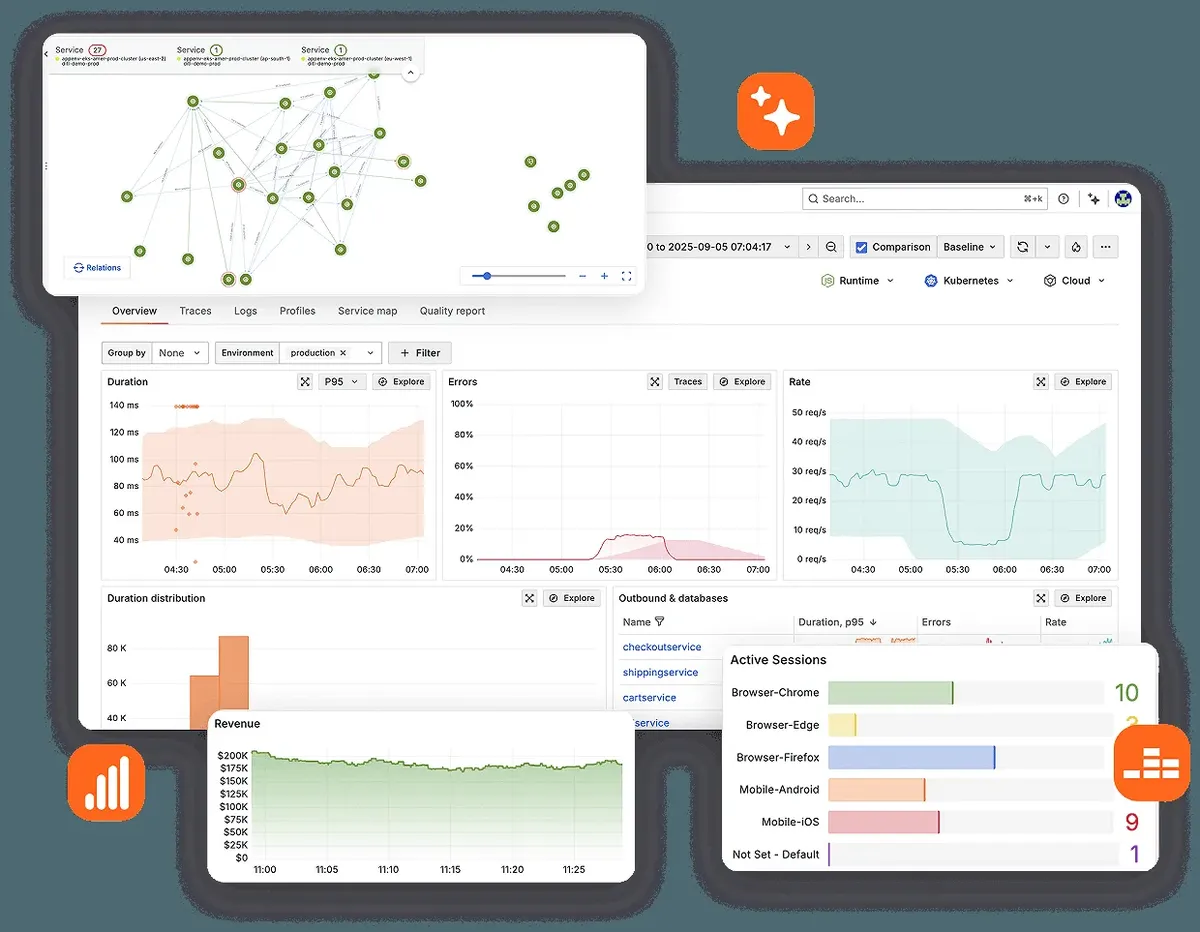
Feature Comparison
| Feature | Uptrace | Grafana Cloud |
|---|---|---|
| Telemetry architecture | ||
| Core observability data | Unifies OpenTelemetry traces, metrics, and logs in one platform | Provides full-stack observability through an open managed platform |
| Telemetry ingestion | Ingests OpenTelemetry, Prometheus, Vector, Fluent Bit, and CloudWatch | Uses OpenTelemetry-native observability and integrated Kubernetes monitoring |
| Data platform approach | Stores and analyzes telemetry with ClickHouse-backed architecture | Connects flexible data sources through Grafana's open platform |
| Application performance monitoring | ||
| Service dependency analysis | Service graph exposes dependencies and bottlenecks across services | System knowledge graphs enrich operational context for incidents |
| Request health metrics | Displays RED metrics for request rate, errors, and latency | Provides out-of-the-box monitoring for rapid system visibility |
| Latency investigation | Shows p50, p90, p99, maximum latency, and slow endpoints | Uses application observability integrations for operational investigation |
| Alerting and incident response | ||
| Alerting | Includes alerting alongside APM, metrics, errors, and logs | Creates context-rich alerts enhanced by system knowledge graphs |
| Error analysis | Surfaces top errors and frequent log patterns in dashboards | Applies Grafana Assistant workflows for intelligent filtering and alerts |
| Synthetic monitoring | Not available in the supplied product data | Offers tutorials and capabilities for application synthetic monitoring |
| Cost management | ||
| Primary billing meter | Bills traces and logs by ingested GB and metrics by datapoints | Uses volume-based, tiered pricing calculated for deployment scale |
| Cost controls | Monthly budget cap guarantees charges never exceed the set budget | Adaptive Telemetry automatically prioritizes critical telemetry signals |
| Efficiency mechanisms | OTel Arrow provides 15-30× compression to reduce egress costs | Adaptive Telemetry claims 35-50% savings across telemetry types |
| Deployment, governance, and ecosystem | ||
| Deployment choices | Available as managed cloud service or self-hosted deployment | Managed cloud platform with Bring Your Own Cloud support |
| Security and compliance | Uses EU-based infrastructure with GDPR compliance by design | Supports SOC 2, GDPR, PCI, FedRAMP High, and DoD IL5 |
| Open-source licensing | Open-source APM distributed under the AGPL-3.0 license | Associated Grafana Cloud management CLI uses Apache-2.0 licensing |
Telemetry architecture
Core observability data
Telemetry ingestion
Data platform approach
Application performance monitoring
Service dependency analysis
Request health metrics
Latency investigation
Alerting and incident response
Alerting
Error analysis
Synthetic monitoring
Cost management
Primary billing meter
Cost controls
Efficiency mechanisms
Deployment, governance, and ecosystem
Deployment choices
Security and compliance
Open-source licensing
Which to choose
Choose Uptrace when OpenTelemetry-first telemetry economics, ClickHouse architecture, self-hosting, EU-based infrastructure, and enforceable monthly spend caps are priorities. Choose Grafana Cloud when a managed platform, broad dashboard and data-source flexibility, Kubernetes integrations, AI-assisted workflows, and extensive enterprise compliance coverage matter more.
Best-fit scenarios
Choose Uptrace if:
Choose Uptrace for high-volume tracing and log workloads where ingestion-based pricing, OTel Arrow compression, ClickHouse analytics, self-hosting, or a hard monthly budget cap are important.
Choose Grafana Cloud if:
Choose Grafana Cloud for teams that need managed full-stack observability, rapid onboarding, flexible multi-source dashboards, Kubernetes monitoring, AI-assisted alert workflows, and regulated-enterprise compliance.
These scenarios reflect the available product evidence. Your requirements, existing stack, and team expertise should guide the final decision.
Frequently Asked Questions
What is the main difference between Uptrace and Grafana Cloud?
Uptrace is an OpenTelemetry and ClickHouse-based observability platform focused on unifying traces, metrics, and logs with explicit ingestion-based cost controls. It supports managed and self-hosted deployments, provides service graphs and RED metrics, and offers a monthly budget cap. Grafana Cloud is a managed full-stack observability platform emphasizing flexible dashboards and data sources, AI-assisted onboarding, Adaptive Telemetry, Kubernetes integrations, and enterprise compliance capabilities.
Which is better for small teams?
For a small team with predictable telemetry needs and a strong focus on cost visibility, Uptrace is compelling because it includes 50 GB free each month, starts at $0.075 per GB after that, supports unlimited users, services, and hosts, and allows a hard monthly spending cap. Grafana Cloud can be attractive when the team values quick onboarding, templates, broad integrations, and managed dashboards, but its paid rates must be estimated through its calculator because no public dollar rate was supplied.
Can I migrate from Uptrace to Grafana Cloud?
A migration is feasible in principle because both products support OpenTelemetry-oriented observability workflows. Uptrace explicitly ingests OpenTelemetry data, while Grafana Cloud is described as OpenTelemetry-native. The practical work is to redirect collectors or exporters, recreate dashboards and alerts, validate metric naming and label conventions, and plan historical-data retention separately. The supplied information does not establish a one-click migration tool or direct historical-data import path between the two services.
What are the pricing differences?
Uptrace publishes concrete consumption pricing: 50 GB is free every month, then traces and logs start at $0.075 per ingested GB, while metrics are billed per million ingested datapoints. It offers automatic volume discounts, a free trial with 1 TB storage and 100,000 timeseries, billing at month-end or every $400, and a configurable monthly cap. Grafana Cloud uses volume-based, tiered pricing with lower effective rates at higher scale and a calculator for estimates, but the supplied data provides no public dollar amount.