Decision comparison
Better Stack vs Grafana Cloud
Choose Better Stack when an operations-focused team wants concrete low-cost entry plans, eBPF service mapping, SQL logs, and AI-driven incident handling in Slack or Teams. Choose Grafana Cloud when open multi-source dashboards, Kubernetes-focused observability, enterprise compliance, BYOC flexibility, and volume-based scaling are the primary requirements.
Direct comparison. These are reviewed substitutes bought for the same job, so the differences below are the ones that decide between them.
Applies to: Choosing the observability backend that will receive OpenTelemetry data and carry on-call.
All 2 are observability platforms.
Quick Comparison
| Decision factor | Better Stack | Grafana Cloud |
|---|---|---|
| Best For | Teams prioritizing AI-assisted incident response, uptime monitoring, eBPF visibility, and predictable entry pricing for an integrated observability stack. | Organizations needing open, multi-source observability, customizable dashboards, Kubernetes integrations, and enterprise compliance across growing telemetry volumes. |
| Architecture | Integrated AI SRE platform combining eBPF service mapping, OpenTelemetry collection, SQL log management, tracing, monitoring, incidents, and status pages. | Managed open observability platform using pluggable data sources, OpenTelemetry-native integrations, Kubernetes Monitoring, Application Observability, and unified Grafana dashboards. |
| Pricing Model | Free tier: 10 monitors, 3-minute checks, 1 phone call alert. Uptime: from $29/month (50 monitors, 30-second checks). Logs (Logtail): from $24/month (30-day retention, 10GB/month). Incidents: from $29/month. Dashboards: from $24/month. Enterprise: custom pricing. | Grafana Cloud Free is $0/month and includes 10k active metrics series, 50 GB of logs, traces and profiles, and 3 active users. Pro is from $19/month plus usage: metrics at $6.50 per 1k series, logs, traces and profiles at $0.400/GB write and $0.100/GB retain, and Grafana visualization at $8 per active user. Enterprise starts at a $25,000/year minimum commit and is quote-based. |
| Ease of Use | Designed for rapid operations workflows: Slack incident response, smart incident merging, AI explanations, automated post-mortems, and visual bubble-up investigations. | AI-assisted onboarding, workflows, out-of-the-box monitoring, templates, and Grafana Assistant help teams start quickly, though users report configuration usability concerns. |
| Scalability | Supports high-volume telemetry through eBPF and OpenTelemetry, with claims of ingesting up to 80x more data under the same budget. | Tiered volume pricing, Adaptive Telemetry prioritization, Bring Your Own Cloud support, and enterprise-oriented observability support growth from small teams to global enterprises. |
| Community/Support | Apache-2.0 Go repository has 73 stars; Better Stack emphasizes bespoke onboarding, migration assistance, and exceptional customer support. | Apache-2.0 Go CLI repository has 571 stars; the managed platform supports enterprise compliance including SOC 2, GDPR, PCI, and FedRAMP High. |
Better Stack
- Best For:
- Teams prioritizing AI-assisted incident response, uptime monitoring, eBPF visibility, and predictable entry pricing for an integrated observability stack.
- Architecture:
- Integrated AI SRE platform combining eBPF service mapping, OpenTelemetry collection, SQL log management, tracing, monitoring, incidents, and status pages.
- Pricing Model:
- Free tier: 10 monitors, 3-minute checks, 1 phone call alert. Uptime: from $29/month (50 monitors, 30-second checks). Logs (Logtail): from $24/month (30-day retention, 10GB/month). Incidents: from $29/month. Dashboards: from $24/month. Enterprise: custom pricing.
- Ease of Use:
- Designed for rapid operations workflows: Slack incident response, smart incident merging, AI explanations, automated post-mortems, and visual bubble-up investigations.
- Scalability:
- Supports high-volume telemetry through eBPF and OpenTelemetry, with claims of ingesting up to 80x more data under the same budget.
- Community/Support:
- Apache-2.0 Go repository has 73 stars; Better Stack emphasizes bespoke onboarding, migration assistance, and exceptional customer support.
Grafana Cloud
- Best For:
- Organizations needing open, multi-source observability, customizable dashboards, Kubernetes integrations, and enterprise compliance across growing telemetry volumes.
- Architecture:
- Managed open observability platform using pluggable data sources, OpenTelemetry-native integrations, Kubernetes Monitoring, Application Observability, and unified Grafana dashboards.
- Pricing Model:
- Grafana Cloud Free is $0/month and includes 10k active metrics series, 50 GB of logs, traces and profiles, and 3 active users. Pro is from $19/month plus usage: metrics at $6.50 per 1k series, logs, traces and profiles at $0.400/GB write and $0.100/GB retain, and Grafana visualization at $8 per active user. Enterprise starts at a $25,000/year minimum commit and is quote-based.
- Ease of Use:
- AI-assisted onboarding, workflows, out-of-the-box monitoring, templates, and Grafana Assistant help teams start quickly, though users report configuration usability concerns.
- Scalability:
- Tiered volume pricing, Adaptive Telemetry prioritization, Bring Your Own Cloud support, and enterprise-oriented observability support growth from small teams to global enterprises.
- Community/Support:
- Apache-2.0 Go CLI repository has 571 stars; the managed platform supports enterprise compliance including SOC 2, GDPR, PCI, and FedRAMP High.
Public signals
Verified factual signals only. Bars appear only for like-for-like metrics with five weekly assessments for every tool; missing evidence stays explicit. These signals do not establish enterprise adoption, product quality, or total cost.
| Metric | Better Stack | Grafana Cloud |
|---|---|---|
| GitHub commits, 90d(Developer adoption) | 31 | 244 |
| GitHub stars(Developer adoption) | 73 | 571 |
| Search interest(Market interest) | Unavailable | 1 |
| Hacker News mentions, 90d(Community interest) | 0 | 0 |
| npm weekly downloads(Developer adoption) | 225.1k | Not available |
| PyPI weekly downloads(Developer adoption) | 124.6k | Not available |
As of September 14, 2026 — updated weekly.
Health & risk evidence
Observed public-source checks for mapped package versions and repositories.
Better Stack
September 14, 2026Package vulnerabilities
npm · @logtail/node@0.5.8 · PyPI · logtail-python@0.4.0
0 vulnerabilities
across 2 packages
Repository security score
Not available
Grafana Cloud
Package vulnerabilities
Not available
Repository security score
Not available
Interface Preview
Better Stack

Grafana Cloud
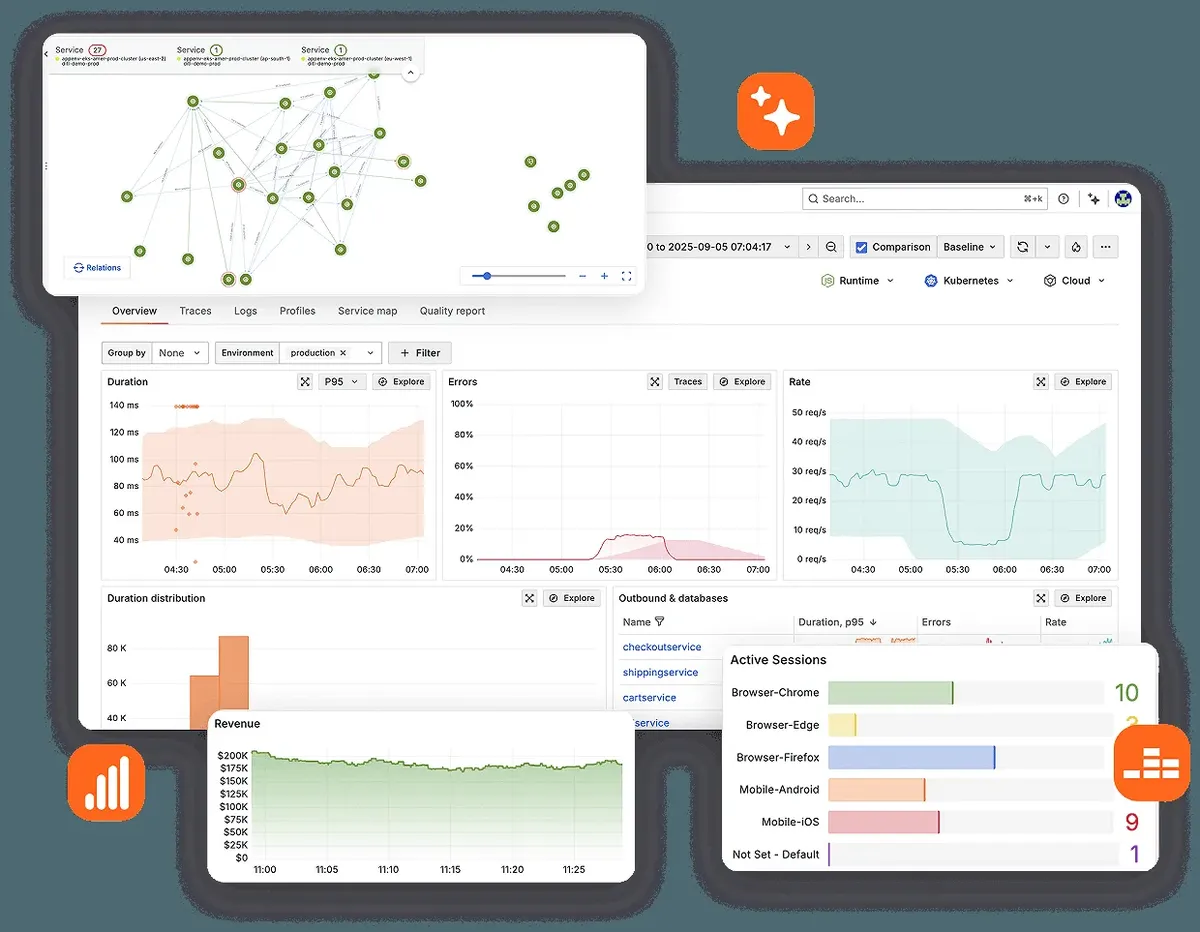
Feature Comparison
| Feature | Better Stack | Grafana Cloud |
|---|---|---|
| Telemetry collection and infrastructure visibility | ||
| OpenTelemetry instrumentation | Collects traces, logs, and metrics through eBPF and OpenTelemetry. | Provides OpenTelemetry-native observability with Kubernetes and application integrations. |
| Service and workload visibility | Maps network flows, databases, and SLOs using eBPF-based service mapping. | Uses Kubernetes Monitoring and Application Observability for workload visibility. |
| Trace investigation | Uses drag-and-drop bubble-up analysis to investigate slow requests visually. | Combines telemetry into full-stack views for faster operational answers. |
| Incident response and alerting | ||
| Incident coordination | Manages incidents in Slack or Teams with smart incident merging. | Enriches alerts with system knowledge graphs for incident context. |
| Post-incident analysis | Generates AI post-mortems from incident timelines and Slack activity. | Supports customized alerts and intelligent filtering through Grafana Assistant workflows. |
| Synthetic and transaction monitoring | Runs Playwright-based transaction checks alongside uptime monitoring. | Provides simple synthetic-monitoring tutorials for application monitoring workflows. |
| AI-assisted operations | ||
| AI operations interface | Offers a Claude Code-like AI SRE interface informed by infrastructure. | Uses Grafana Assistant for agentic workflows, filtering, and customized alerts. |
| AI diagnostics | Explains MTR, traceroute, SSL certificate, and connection-error results. | Uses AI-assisted onboarding and workflows for rapid setup and learning. |
| LLM workflow integration | Exposes logs, metrics, traces, and errors through an MCP server. | Provides agentic workflows through Grafana Assistant within the managed platform. |
| Data exploration and platform openness | ||
| Log analysis | Queries centralized log data using SQL query support. | Aggregates data from pluggable sources into Grafana dashboards. |
| Dashboard and data-source model | Provides observability dashboards alongside logs, traces, metrics, and incidents. | Combines Graphite, cloud-monitoring vendors, SQL databases, and other sources. |
| Vendor flexibility | Uses OpenTelemetry-native tracing and an MCP integration for telemetry workflows. | Offers an open platform with no vendor lock-in and Bring Your Own Cloud. |
| Cost controls and commercial structure | ||
| Free and entry-level monitoring | Includes 10 free monitors, three-minute checks, and one phone alert. | Offers a free-account entry path; provided data does not specify limits. |
| Cost optimization approach | Claims up to 80x more ingestion per budget or 98% savings. | Adaptive Telemetry prioritizes important data and targets 35-50% savings. |
| Paid pricing mechanics | Uptime starts $29/month; logs and dashboards start $24/month. | Uses tiered volume pricing with automatically declining effective rates. |
Telemetry collection and infrastructure visibility
OpenTelemetry instrumentation
Service and workload visibility
Trace investigation
Incident response and alerting
Incident coordination
Post-incident analysis
Synthetic and transaction monitoring
AI-assisted operations
AI operations interface
AI diagnostics
LLM workflow integration
Data exploration and platform openness
Log analysis
Dashboard and data-source model
Vendor flexibility
Cost controls and commercial structure
Free and entry-level monitoring
Cost optimization approach
Paid pricing mechanics
Which to choose
Choose Better Stack when an operations-focused team wants concrete low-cost entry plans, eBPF service mapping, SQL logs, and AI-driven incident handling in Slack or Teams. Choose Grafana Cloud when open multi-source dashboards, Kubernetes-focused observability, enterprise compliance, BYOC flexibility, and volume-based scaling are the primary requirements.
Best-fit scenarios
Choose Better Stack if:
Choose Better Stack for teams that want a tightly integrated AI SRE workflow, Playwright transaction checks, eBPF-based discovery, automatic incident merging, and published starting prices such as $29/month uptime monitoring.
Choose Grafana Cloud if:
Choose Grafana Cloud for organizations standardizing on Grafana dashboards and diverse data sources, requiring Kubernetes and OpenTelemetry integrations, or needing compliance capabilities and flexible Bring Your Own Cloud deployment.
These scenarios reflect the available product evidence. Your requirements, existing stack, and team expertise should guide the final decision.
Frequently Asked Questions
What is the main difference between Better Stack and Grafana Cloud?
Better Stack is positioned as an integrated AI SRE observability stack with eBPF service mapping, OpenTelemetry telemetry, SQL-based log management, uptime checks, status pages, and Slack or Teams incident workflows. Grafana Cloud is a managed open observability platform centered on Grafana’s flexible multi-source dashboard model, OpenTelemetry-native integrations, Kubernetes Monitoring, Application Observability, and enterprise-oriented openness and compliance.
Which is better for small teams?
Better Stack is often the clearer fit for a small operations team that wants specific published starting points and a consolidated workflow. Its free tier includes 10 monitors, three-minute checks, and one phone-call alert; paid uptime starts at $29/month. Its AI incident merging, Slack-based response, AI explanations, and automatic post-mortems can reduce manual operational work. Grafana Cloud can also suit small teams through AI-assisted onboarding and a free-account entry path, but the provided information does not specify free-tier limits or public dollar rates.
Can I migrate from Better Stack to Grafana Cloud?
A migration is feasible in principle because both products support OpenTelemetry-oriented observability workflows, allowing teams to standardize telemetry collection while changing their managed backend. However, the provided information does not document a dedicated Better Stack-to-Grafana Cloud migration tool or compatibility guarantee. Plan to recreate dashboards, alerts, incident processes, retention policies, synthetic checks, and data-source configuration in Grafana Cloud. Better Stack explicitly advertises migration assistance, but its stated offer is directed at customers migrating from Datadog.
What are the pricing differences?
Better Stack publishes several concrete starting prices: uptime monitoring starts at $29/month for 50 monitors and 30-second checks; logs start at $24/month for 30-day retention and 10GB/month; incidents start at $29/month; dashboards start at $24/month. Its free tier includes 10 monitors, three-minute checks, and one phone-call alert. Grafana Cloud uses volume-based, tiered pricing, where effective rates drop as usage grows, and promotes Adaptive Telemetry savings of 35-50% across metrics, logs, and traces. The provided data contains no Grafana Cloud public dollar amount.