Decision comparison
Grafana Cloud vs New Relic
Grafana Cloud excels as an open, composable observability platform for teams that value data source flexibility and cost optimization through Adaptive Telemetry. New Relic delivers a more comprehensive all-in-one APM experience with 780+ integrations and deeper code-level diagnostics out of the box.
Architecture choice. These take different approaches to the same problem. Read the table as a fit question rather than a feature race.
All 2 are observability platforms.
Quick Comparison
| Decision factor | Grafana Cloud | New Relic |
|---|---|---|
| Best For | Teams wanting open-source flexibility, custom dashboards, and multi-source data visualization with no vendor lock-in | Organizations needing full-stack APM with code-level diagnostics, session replay, and 780+ pre-built integrations |
| Pricing Model | Grafana Cloud Free is $0/month and includes 10k active metrics series, 50 GB of logs, traces and profiles, and 3 active users. Pro is from $19/month plus usage: metrics at $6.50 per 1k series, logs, traces and profiles at $0.400/GB write and $0.100/GB retain, and Grafana visualization at $8 per active user. Enterprise starts at a $25,000/year minimum commit and is quote-based. | Free tier available, paid plans start at $19/mo per host, additional costs based on usage and features |
| Core Strength | Unified visualization across multiple data sources with Adaptive Telemetry saving 35-50% on observability costs | End-to-end application performance monitoring with AI-powered insights and 50+ built-in capabilities |
| AI Capabilities | Grafana Assistant powers agentic workflows, intelligent filters, prebuilt dashboards, and customized alert creation | AI and agentic monitoring for LLM and agent oversight, plus SRE Agent for automated incident remediation |
| Integrations | OpenTelemetry-native with pluggable data source model supporting Graphite, CloudWatch, Azure, MySQL, and growing plugin ecosystem | 780+ quickstart integrations covering AWS, Azure, GCP, Kubernetes, databases, and serverless environments out of the box |
| Compliance | SOC 2, GDPR, PCI DSS, FedRAMP High, and DoD IL5 authorization via Grafana Federal Cloud | FedRAMP Moderate and HIPAA eligibility with Data Plus, enterprise-grade security and governance controls |
Grafana Cloud
- Best For:
- Teams wanting open-source flexibility, custom dashboards, and multi-source data visualization with no vendor lock-in
- Pricing Model:
- Grafana Cloud Free is $0/month and includes 10k active metrics series, 50 GB of logs, traces and profiles, and 3 active users. Pro is from $19/month plus usage: metrics at $6.50 per 1k series, logs, traces and profiles at $0.400/GB write and $0.100/GB retain, and Grafana visualization at $8 per active user. Enterprise starts at a $25,000/year minimum commit and is quote-based.
- Core Strength:
- Unified visualization across multiple data sources with Adaptive Telemetry saving 35-50% on observability costs
- AI Capabilities:
- Grafana Assistant powers agentic workflows, intelligent filters, prebuilt dashboards, and customized alert creation
- Integrations:
- OpenTelemetry-native with pluggable data source model supporting Graphite, CloudWatch, Azure, MySQL, and growing plugin ecosystem
- Compliance:
- SOC 2, GDPR, PCI DSS, FedRAMP High, and DoD IL5 authorization via Grafana Federal Cloud
New Relic
- Best For:
- Organizations needing full-stack APM with code-level diagnostics, session replay, and 780+ pre-built integrations
- Pricing Model:
- Free tier available, paid plans start at $19/mo per host, additional costs based on usage and features
- Core Strength:
- End-to-end application performance monitoring with AI-powered insights and 50+ built-in capabilities
- AI Capabilities:
- AI and agentic monitoring for LLM and agent oversight, plus SRE Agent for automated incident remediation
- Integrations:
- 780+ quickstart integrations covering AWS, Azure, GCP, Kubernetes, databases, and serverless environments out of the box
- Compliance:
- FedRAMP Moderate and HIPAA eligibility with Data Plus, enterprise-grade security and governance controls
Public signals
Verified factual signals only. Bars appear only for like-for-like metrics with five weekly assessments for every tool; missing evidence stays explicit. These signals do not establish enterprise adoption, product quality, or total cost.
| Metric | Grafana Cloud | New Relic |
|---|---|---|
| GitHub commits, 90d(Developer adoption) | 244 | 303 |
| GitHub stars(Developer adoption) | 571 | 9 |
| Search interest(Market interest) | 1 | 4 |
| Hacker News mentions, 90d(Community interest) | 0 | 1 |
| npm weekly downloads(Developer adoption) | Not available | 894.3k |
| Product Hunt comments(Community interest) | Not available | 1 |
| Product Hunt reviews(Community interest) | Not available | 0 |
| Product Hunt votes(Community interest) | Not available | 16 |
| PyPI weekly downloads(Developer adoption) | Not available | 817.2k |
| Stack Overflow questions(Community interest) | Not available | 1.5k |
As of September 14, 2026 — updated weekly.
Health & risk evidence
Observed public-source checks for mapped package versions and repositories.
Grafana Cloud
Package vulnerabilities
Not available
Repository security score
Not available
New Relic
September 14, 2026Package vulnerabilities
npm · newrelic@14.4.0 · PyPI · newrelic@13.5.0
0 vulnerabilities
across 2 packages
Repository security score
Not available
Interface Preview
Grafana Cloud
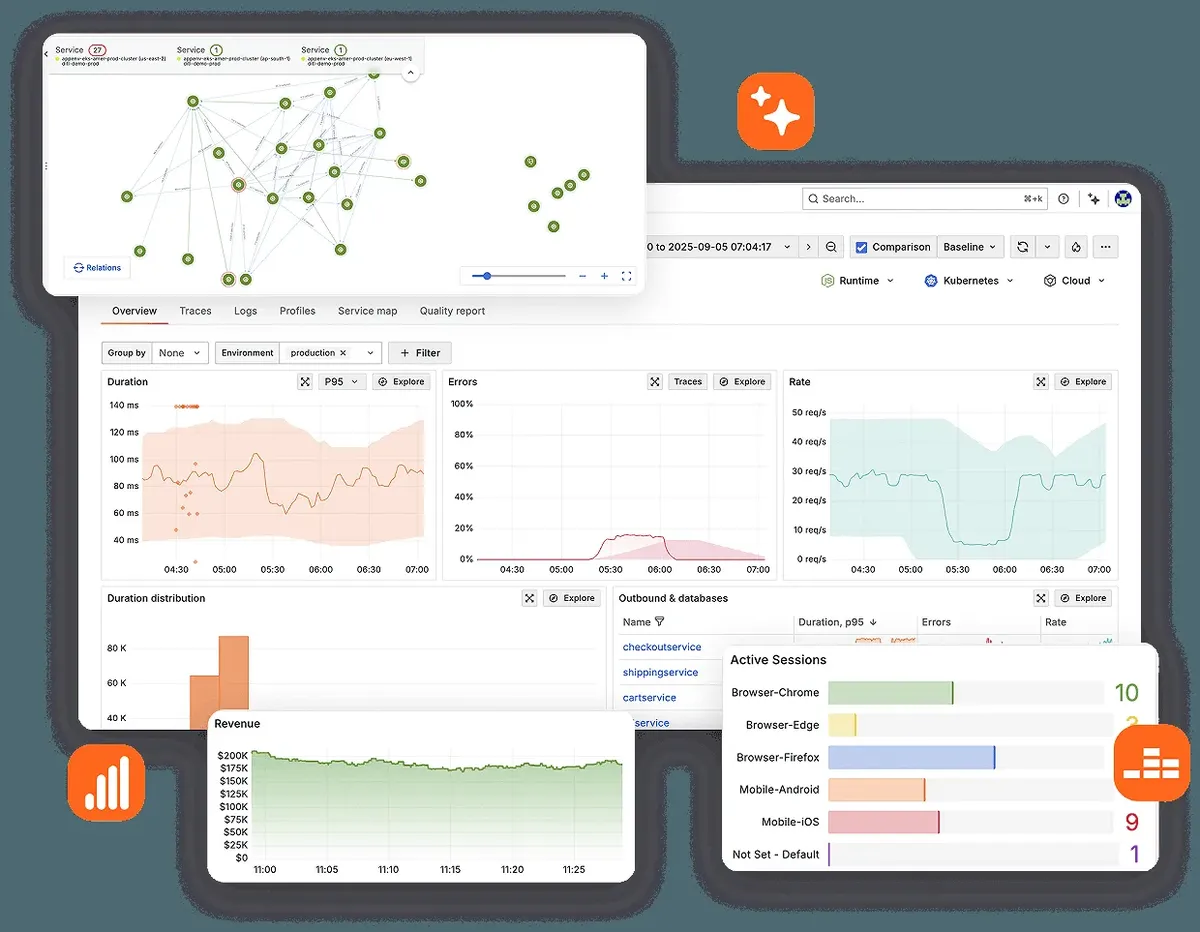
Feature Comparison
| Feature | Grafana Cloud | New Relic |
|---|---|---|
| Monitoring & Observability | ||
| Full-Stack APM | Via Application Observability integration | Native APM 360 with code-level diagnostics |
| Infrastructure Monitoring | Cloud metrics with multi-source dashboards | Full hybrid visibility across cloud and on-premises |
| Log Management | Cloud logs with 14-day free retention | Logs in Context linked to APM and distributed tracing |
| AI & Automation | ||
| AI Assistant | Grafana Assistant for agentic workflows and intelligent filtering | AI-powered insights with automated alerting and correlation |
| Agentic Monitoring | AI-assisted onboarding and context-rich alert enrichment | Dedicated AI and Agentic Monitoring for LLM and agent tracking |
| Automated Remediation | Knowledge-graph enriched alerts for faster incident resolution | SRE Agent for automated remediation beyond assistance |
| Data & Integrations | ||
| OpenTelemetry Support | OpenTelemetry-native observability built into the platform | Full OpenTelemetry ingest for metrics, traces, and logs |
| Pre-Built Integrations | Growing plugin ecosystem with pluggable data source model | 780+ quickstart integrations for instant setup |
| Custom Dashboards | Industry-leading dashboard builder with pre-defined templates | Customizable dashboards with data visualization tools |
| Security & Compliance | ||
| FedRAMP | FedRAMP High and DoD IL5 via Federal Cloud | FedRAMP Moderate eligibility with Data Plus |
| SOC 2 & GDPR | SOC 2 Type II verified and GDPR compliant | Enterprise-grade security and governance |
| Vulnerability Management | Not a core focus area | Built-in vulnerability management with guided remediation |
| Developer Experience | ||
| Onboarding | AI-assisted onboarding with guided workflows for rapid setup | Quickstart integrations and pre-built observability resources |
| Query Language | Supports multiple query languages per data source | NRQL proprietary query language praised for power and flexibility |
| Session Replay | Not available natively | Session replay with AI-identified friction points |
Monitoring & Observability
Full-Stack APM
Infrastructure Monitoring
Log Management
AI & Automation
AI Assistant
Agentic Monitoring
Automated Remediation
Data & Integrations
OpenTelemetry Support
Pre-Built Integrations
Custom Dashboards
Security & Compliance
FedRAMP
SOC 2 & GDPR
Vulnerability Management
Developer Experience
Onboarding
Query Language
Session Replay
Which approach fits
Grafana Cloud excels as an open, composable observability platform for teams that value data source flexibility and cost optimization through Adaptive Telemetry. New Relic delivers a more comprehensive all-in-one APM experience with 780+ integrations and deeper code-level diagnostics out of the box.
When each approach fits
Choose Grafana Cloud if:
Choose Grafana Cloud if your team values open-source foundations, needs to unify multiple existing data sources into custom dashboards, and wants to reduce observability costs with Adaptive Telemetry that saves 35-50% across metrics, logs, and traces. It is ideal for organizations already invested in the Grafana ecosystem or those requiring FedRAMP High and DoD IL5 compliance through its Federal Cloud offering.
Choose New Relic if:
Choose New Relic if you need a full-stack observability platform with 50+ built-in capabilities, native APM with code-level diagnostics, and 780+ quickstart integrations for instant setup. It suits teams that want AI and agentic monitoring for LLM oversight, session replay for digital experience insights, and usage-based pricing with 100 GB of free data ingest per month to get started without upfront commitment.
These scenarios reflect the available product evidence. Your requirements, existing stack, and team expertise should guide the final decision.
Frequently Asked Questions
How do Grafana Cloud and New Relic differ in their approach to observability?
Grafana Cloud takes an open, composable approach built on open-source tools like Grafana, Loki, Tempo, and Mimir. It lets you connect multiple data sources and build unified dashboards without vendor lock-in. New Relic offers a more integrated all-in-one platform with 50+ capabilities built into a single experience, including native APM, infrastructure monitoring, log management, and digital experience monitoring. Grafana Cloud focuses on flexibility and data source aggregation, while New Relic emphasizes a cohesive, full-stack monitoring experience with deep code-level diagnostics and 780+ quickstart integrations.
Which platform offers better pricing for growing teams?
Grafana Cloud provides a free-forever tier with access to all services (with usage limits), 14-day retention for metrics, logs, and traces, and AI Assistant access. Its Pro plan adds usage-based pricing with extended retention and email support. New Relic offers 100 GB of free data ingest per month with unlimited free basic users. Core users cost $49/user per month and Full Platform users cost $349/user per month. Grafana Cloud also features Adaptive Telemetry that can save 35-50% on observability costs by automatically prioritizing critical data. The best choice depends on your data volume and user count, as Grafana Cloud charges primarily by usage while New Relic adds per-user fees for full platform access.
How do the AI capabilities compare between Grafana Cloud and New Relic?
Both platforms invest heavily in AI-powered observability. Grafana Cloud offers the Grafana Assistant for agentic AI workflows, intelligent filtering, prebuilt dashboards, and customized alerts, along with context-rich alerts enriched by a knowledge graph of your systems. New Relic provides dedicated AI and Agentic Monitoring for tracking LLM and AI agent behavior, an SRE Agent for automated incident remediation, and AI-powered session replay that automatically identifies friction points. New Relic edges ahead for teams monitoring AI applications specifically, while Grafana Cloud focuses AI on operational efficiency and alert quality.
Which platform has better compliance and security certifications?
Both platforms meet enterprise-grade security requirements, but with different strengths. Grafana Cloud holds SOC 2 Type II, GDPR, PCI DSS, and NATSEC100 certifications, and offers FedRAMP High and DoD IL5 authorization through its dedicated Grafana Federal Cloud offering. New Relic provides FedRAMP Moderate eligibility and HIPAA eligibility through its Data Plus tier, with enterprise-grade security and governance controls and priority ticket routing. For federal and defense workloads requiring the highest compliance levels, Grafana Cloud has the edge with FedRAMP High authorization compared to New Relic's FedRAMP Moderate level.