Decision comparison
Elastic Observability vs New Relic
Elastic Observability excels for organizations wanting open-source flexibility, self-managed deployment options, and cost-efficient petabyte-scale data retention, while New Relic offers a more turnkey SaaS experience with a generous free tier and broader out-of-the-box integrations.
Architecture choice. These take different approaches to the same problem. Read the table as a fit question rather than a feature race.
All 2 are observability platforms.
Quick Comparison
| Decision factor | Elastic Observability | New Relic |
|---|---|---|
| Pricing | Standard: As low as $95/month, Platinum: As low as $125/month, Enterprise: As low as $175/month | Free tier available, paid plans start at $19/mo per host, additional costs based on usage and features |
| Ease of Use | Rated 9/10 by users but noted as complex for beginners, requiring experienced operators for advanced configuration and query language | Rated 7.9/10 with easy initial setup praised by users, though dashboards and advanced features have a steep learning curve |
| Integrations | 450+ OpenTelemetry-compliant integrations covering cloud providers, databases, Kubernetes, CI/CD, and serverless environments | 780+ quickstart integrations with pre-built dashboards spanning AWS, Azure, GCP, databases, Kubernetes, and SAP monitoring |
| AI Capabilities | AI Assistant with natural language root cause analysis, zero-config ML anomaly detection, and agentic AI workflows built-in | AI-powered intelligent observability with SRE Agent for automated remediation, session replay analysis, and agentic monitoring |
| Data Management | Search AI Lake supports petabytes of data with 65% footprint reduction via logsdb index mode and cost-efficient long-term storage | Usage-based data ingest pricing at $0.40/GB beyond 100 GB of free data ingest per month, with unlimited scalability and logs-in-context for efficient data querying |
| Open Source | Built on open-source Elastic Stack (ELK), fully standardized on OpenTelemetry with no proprietary extensions required | Strong open-source ecosystem support with native OpenTelemetry ingestion, but the core platform itself is proprietary SaaS |
Elastic Observability
- Pricing:
- Standard: As low as $95/month, Platinum: As low as $125/month, Enterprise: As low as $175/month
- Ease of Use:
- Rated 9/10 by users but noted as complex for beginners, requiring experienced operators for advanced configuration and query language
- Integrations:
- 450+ OpenTelemetry-compliant integrations covering cloud providers, databases, Kubernetes, CI/CD, and serverless environments
- AI Capabilities:
- AI Assistant with natural language root cause analysis, zero-config ML anomaly detection, and agentic AI workflows built-in
- Data Management:
- Search AI Lake supports petabytes of data with 65% footprint reduction via logsdb index mode and cost-efficient long-term storage
- Open Source:
- Built on open-source Elastic Stack (ELK), fully standardized on OpenTelemetry with no proprietary extensions required
New Relic
- Pricing:
- Free tier available, paid plans start at $19/mo per host, additional costs based on usage and features
- Ease of Use:
- Rated 7.9/10 with easy initial setup praised by users, though dashboards and advanced features have a steep learning curve
- Integrations:
- 780+ quickstart integrations with pre-built dashboards spanning AWS, Azure, GCP, databases, Kubernetes, and SAP monitoring
- AI Capabilities:
- AI-powered intelligent observability with SRE Agent for automated remediation, session replay analysis, and agentic monitoring
- Data Management:
- Usage-based data ingest pricing at $0.40/GB beyond 100 GB of free data ingest per month, with unlimited scalability and logs-in-context for efficient data querying
- Open Source:
- Strong open-source ecosystem support with native OpenTelemetry ingestion, but the core platform itself is proprietary SaaS
Public signals
Verified factual signals only. Bars appear only for like-for-like metrics with five weekly assessments for every tool; missing evidence stays explicit. These signals do not establish enterprise adoption, product quality, or total cost.
| Metric | Elastic Observability | New Relic |
|---|---|---|
| GitHub commits, 90d(Developer adoption) | 423 | 303 |
| GitHub stars(Developer adoption) | 271 | 9 |
| Search interest(Market interest) | 0 | 4 |
| Hacker News mentions, 90d(Community interest) | 0 | 1 |
| Stack Overflow questions(Community interest) | 3.7k | 1.5k |
| npm weekly downloads(Developer adoption) | Not available | 894.3k |
| Product Hunt comments(Community interest) | Not available | 1 |
| Product Hunt reviews(Community interest) | Not available | 0 |
| Product Hunt votes(Community interest) | Not available | 16 |
| PyPI weekly downloads(Developer adoption) | Not available | 817.2k |
As of September 14, 2026 — updated weekly.
Health & risk evidence
Observed public-source checks for mapped package versions and repositories.
Elastic Observability
Package vulnerabilities
Not available
Repository security score
Not available
New Relic
September 14, 2026Package vulnerabilities
npm · newrelic@14.4.0 · PyPI · newrelic@13.5.0
0 vulnerabilities
across 2 packages
Repository security score
Not available
Interface Preview
Elastic Observability
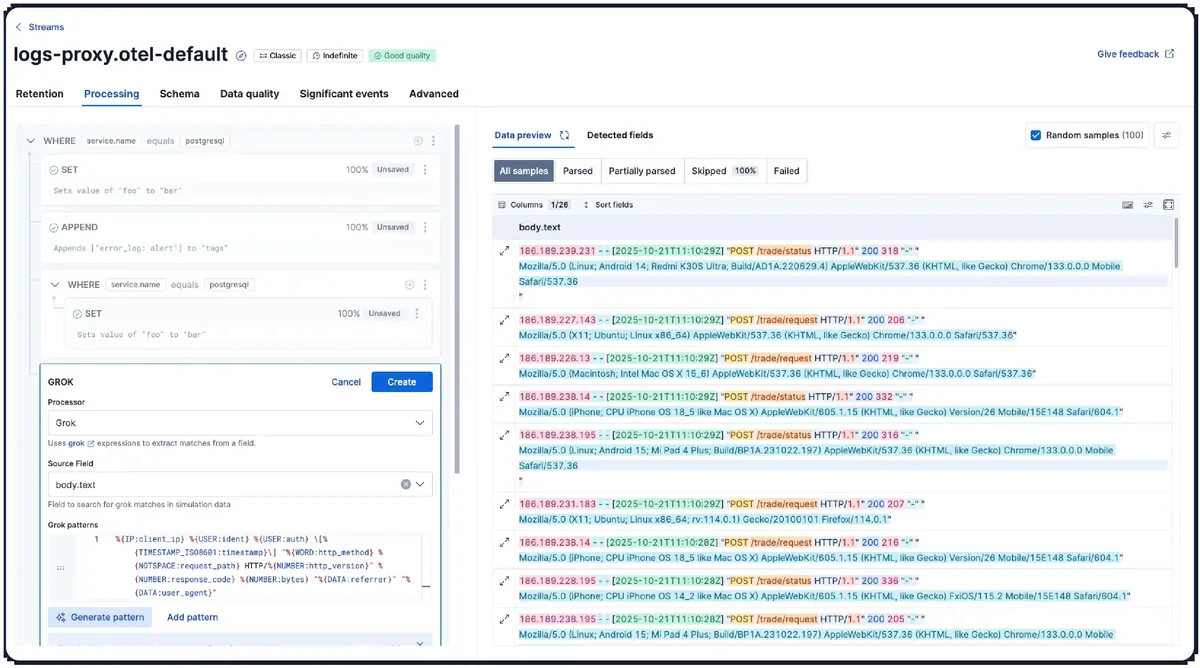
Feature Comparison
| Feature | Elastic Observability | New Relic |
|---|---|---|
| Core Monitoring | ||
| Application Performance Monitoring | Production-grade pure OTel APM with broad language support and native streaming without proprietary agents | APM 360 with distributed tracing, code profiling, error tracking, and direct business impact correlation |
| Infrastructure Monitoring | 400+ out-of-the-box integrations across cloud, on-premises, Kubernetes, serverless, and bare metal hosts | Full hybrid visibility covering AWS, Azure, GCP, Kubernetes, host, network, serverless, and database monitoring |
| Log Management | Petabyte-scale log analytics with Discover, prebuilt dashboards, ES|QL queries, and AI-driven Streams processing | Scalable log management with logs-in-context linking to APM, infrastructure, distributed tracing, and errors inbox |
| AI and Analytics | ||
| AIOps | Zero-config always-on anomaly detection, pattern analysis, correlation, and root cause identification using proven ML | Automated alerting, incident detection, correlation, and resolution with change tracking and notification workflows |
| AI Assistant | Natural language AI Assistant connected to enterprise knowledge for context-aware root cause analysis and troubleshooting | SRE Agent providing automated remediation beyond assistance, moving from insights to autonomous incident resolution |
| LLM and AI App Monitoring | Dedicated LLM observability tracking latency, errors, prompts, responses, usage, and costs for major LLM services | AI and agentic monitoring to control behavior, token usage, speed, quality, and cost across AI stacks automatically |
| User Experience | ||
| Digital Experience Monitoring | Real user monitoring, synthetic testing, and uptime monitoring to track every click and user path proactively | Browser monitoring, session replay with AI friction detection, synthetic monitoring, and mobile app crash tracking |
| Custom Dashboards | Prebuilt dashboards with ES|QL-based ad hoc analysis and custom chart building from logs, metrics, and traces | Fully customizable dashboards displaying data flexibly with 780+ integration quickstarts providing pre-built views |
| Alerting and Notifications | Proactive notifications for anomalies and significant events with Significant Events feature for automatic highlighting | Multi-channel alerting integrated with Slack and communication tools with notification workflows and service levels |
| Platform and Architecture | ||
| OpenTelemetry Support | Fully standardized on OTel with EDOT distributions providing production-ready, OTel-native ecosystem without extensions | Native OpenTelemetry ingestion for metrics, traces, and logs with open-source instrumentation support across services |
| Deployment Options | Hosted cloud, serverless with auto-scaling, and self-managed on-premises options with full configuration control | SaaS-only cloud platform with FedRAMP Moderate and HIPAA eligibility available through the Data Plus add-on tier |
| Security Monitoring | Elastic Security available as a separate solution on the same Elastic Stack platform for unified security operations | Built-in vulnerability management to monitor and control risks from third-party components within the observability platform |
| Data and Storage | ||
| Data Retention and Storage | Search AI Lake with searchable snapshots ensuring historical data never goes dark and 65% footprint reduction available | Usage-based data ingest with 100GB free per month, query-in-place capabilities to reduce data storage and movement costs |
| Scalability | Supports petabytes of structured and unstructured data with Elasticsearch's scalable storage and search capabilities | Unlimited data ingest from all telemetry sources with automatic scaling designed for 16,000+ enterprise customer workloads |
Core Monitoring
Application Performance Monitoring
Infrastructure Monitoring
Log Management
AI and Analytics
AIOps
AI Assistant
LLM and AI App Monitoring
User Experience
Digital Experience Monitoring
Custom Dashboards
Alerting and Notifications
Platform and Architecture
OpenTelemetry Support
Deployment Options
Security Monitoring
Data and Storage
Data Retention and Storage
Scalability
Which approach fits
Elastic Observability excels for organizations wanting open-source flexibility, self-managed deployment options, and cost-efficient petabyte-scale data retention, while New Relic offers a more turnkey SaaS experience with a generous free tier and broader out-of-the-box integrations.
When each approach fits
Choose Elastic Observability if:
Choose Elastic Observability if your organization values open-source foundations and wants full control over deployment, whether cloud-hosted, serverless, or self-managed on-premises. It is particularly strong for teams managing petabytes of log and telemetry data who need cost-efficient long-term storage with the 65% footprint reduction via logsdb index mode. Engineering teams already familiar with the Elastic Stack or those standardizing on OpenTelemetry without proprietary vendor extensions will find Elastic Observability aligns well with their architecture. The platform's AI-driven log processing with Streams and zero-config ML anomaly detection make it a compelling choice for mature SRE organizations.
Choose New Relic if:
Choose New Relic if you want a fully managed SaaS observability platform that is quick to deploy and offers a generous free tier with 100GB of monthly data ingest. Its 780+ pre-built quickstart integrations and intuitive onboarding make it ideal for teams that want immediate visibility without extensive configuration. New Relic's usage-based pricing model at $0.40 per GB can be more predictable for organizations with moderate data volumes. The SRE Agent for automated remediation, session replay with AI-powered friction detection, and built-in vulnerability management make it a strong fit for teams seeking a comprehensive, all-in-one observability platform that ties application performance directly to business outcomes.
These scenarios reflect the available product evidence. Your requirements, existing stack, and team expertise should guide the final decision.
Frequently Asked Questions
What are the main pricing differences between Elastic Observability and New Relic?
Elastic Observability uses a resource-based pricing model starting at $95 per month for the Standard tier, with Platinum at $125 per month and Enterprise at $175 per month. It also offers serverless usage-based pricing and self-managed license-based options. New Relic takes a different approach with a freemium model that includes 100GB of free data ingest monthly and unlimited free basic users. Paid plans start at $49 per user per month for the Pro tier, with data ingest charged at $0.40/GB beyond the 100 GB free monthly allowance. New Relic's model tends to favor organizations with moderate data volumes, while Elastic's approach can be more cost-effective for teams with very large data retention requirements due to its storage optimization capabilities.
Which platform is better for organizations already using open-source tools?
Elastic Observability has a stronger open-source foundation, being built entirely on the Elastic Stack (Elasticsearch, Kibana, Logstash, and Beats). It is fully standardized on OpenTelemetry with Elastic Distributions of OpenTelemetry (EDOT) providing production-ready, OTel-native tooling without proprietary extensions. Organizations can self-host and customize the entire stack. New Relic supports OpenTelemetry ingestion for metrics, traces, and logs and promotes itself as a prominent open-source ecosystem with 780+ integrations, but its core platform is proprietary SaaS. For teams deeply invested in open-source observability stacks or requiring on-premises deployment, Elastic Observability offers significant flexibility and community-driven extensibility.
How do the AI capabilities compare between Elastic Observability and New Relic?
Both platforms have invested heavily in AI-driven observability features. Elastic Observability provides an AI Assistant that uses natural language for root cause analysis and connects to enterprise knowledge bases for contextual troubleshooting. It includes zero-config machine learning refined over a decade for anomaly detection, pattern analysis, and correlation, plus dedicated LLM observability for monitoring GenAI applications. New Relic offers its SRE Agent, which goes beyond assistance to provide automated remediation of incidents. It features AI-powered session replay that automatically identifies user friction points and agentic monitoring to control AI agent behavior and token usage. New Relic's approach focuses more on autonomous action, while Elastic emphasizes AI-augmented investigation with deep analytical capabilities.
Can I deploy Elastic Observability on-premises, and does New Relic offer a similar option?
Yes, Elastic Observability offers three deployment models: hosted cloud with fully managed infrastructure, serverless with automatic scaling and no operational overhead, and self-managed on-premises deployment with complete control over hardware configuration, cluster sizing, node count, and software versions. This makes Elastic particularly attractive for organizations in regulated industries or those with strict data sovereignty requirements. New Relic, by contrast, is exclusively a SaaS-based cloud platform. While it offers FedRAMP Moderate and HIPAA eligibility through its Data Plus tier for compliance-sensitive workloads, there is no self-hosted or on-premises option available. Organizations requiring full infrastructure control and data locality should consider Elastic Observability as the better fit.