Decision comparison
Cribl vs Elastic Observability
Cribl and Elastic Observability are complementary tools occupying different layers of the observability stack. Cribl controls data flow and cost; Elastic provides analytics and visualization. Large-scale environments benefit most from deploying both together.
Used together. These are normally used together rather than chosen between. The comparison explains what each one does in the stack.
These are different kinds of product — Telemetry Pipeline and Observability Platform.
Quick Comparison
| Decision factor | Cribl | Elastic Observability |
|---|---|---|
| Primary Focus | Observability data pipeline — routes, reduces, enriches, and transforms logs, metrics, and traces in transit between sources and destinations | Full observability platform built on ELK stack — ingests, stores, searches, and visualizes logs, metrics, traces, and security events |
| Deployment Model | SaaS (Cribl Cloud), self-hosted via Docker or Kubernetes, or hybrid deployment | Elastic Cloud (managed SaaS) or self-hosted via Docker, Kubernetes, or bare metal |
| AI Capabilities | Rule-based processing and data transformation; no native machine learning or AI analytics | Machine learning anomaly detection, AI Assistant for log pattern analysis and alert correlation |
| Best For | Teams needing vendor-neutral telemetry routing, data reduction, and multi-destination pipeline management to control observability costs | Teams needing an all-in-one observability destination with APM, log analytics, metrics, SIEM, and ML anomaly detection in a single platform |
| Pricing Model | Cribl offers a free tier and paid plans. Free ($0): up to 1 TB/day ingestion, 1 worker group, 10 worker processes, 100 Edge nodes, 50 GB Lake, community support. Standard (contact sales): up to 5 TB/day, 50 workers, unlimited Edge nodes, 8x5 support, git backup. Enterprise (contact sales): unlimited data volume, unlimited workers/fleets/workspaces, RBAC, federated auth, dedicated 24x7 support. Consumption-based credit model for paid tiers. No published per-GB rates. | Standard: As low as $95/month, Platinum: As low as $125/month, Enterprise: As low as $175/month |
| OpenTelemetry Support | Full OTel-compatible as both source and destination; can transform between OTel and vendor-specific formats | Fully OTel-compliant ingestion destination; native support for OTel Collector and SDKs |
Cribl
- Primary Focus:
- Observability data pipeline — routes, reduces, enriches, and transforms logs, metrics, and traces in transit between sources and destinations
- Deployment Model:
- SaaS (Cribl Cloud), self-hosted via Docker or Kubernetes, or hybrid deployment
- AI Capabilities:
- Rule-based processing and data transformation; no native machine learning or AI analytics
- Best For:
- Teams needing vendor-neutral telemetry routing, data reduction, and multi-destination pipeline management to control observability costs
- Pricing Model:
- Cribl offers a free tier and paid plans. Free ($0): up to 1 TB/day ingestion, 1 worker group, 10 worker processes, 100 Edge nodes, 50 GB Lake, community support. Standard (contact sales): up to 5 TB/day, 50 workers, unlimited Edge nodes, 8x5 support, git backup. Enterprise (contact sales): unlimited data volume, unlimited workers/fleets/workspaces, RBAC, federated auth, dedicated 24x7 support. Consumption-based credit model for paid tiers. No published per-GB rates.
- OpenTelemetry Support:
- Full OTel-compatible as both source and destination; can transform between OTel and vendor-specific formats
Elastic Observability
- Primary Focus:
- Full observability platform built on ELK stack — ingests, stores, searches, and visualizes logs, metrics, traces, and security events
- Deployment Model:
- Elastic Cloud (managed SaaS) or self-hosted via Docker, Kubernetes, or bare metal
- AI Capabilities:
- Machine learning anomaly detection, AI Assistant for log pattern analysis and alert correlation
- Best For:
- Teams needing an all-in-one observability destination with APM, log analytics, metrics, SIEM, and ML anomaly detection in a single platform
- Pricing Model:
- Standard: As low as $95/month, Platinum: As low as $125/month, Enterprise: As low as $175/month
- OpenTelemetry Support:
- Fully OTel-compliant ingestion destination; native support for OTel Collector and SDKs
Public signals
Verified factual signals only. Bars appear only for like-for-like metrics with five weekly assessments for every tool; missing evidence stays explicit. These signals do not establish enterprise adoption, product quality, or total cost.
| Metric | Cribl | Elastic Observability |
|---|---|---|
| Docker Hub pulls(Product adoption) | 16.1M | Not available |
| GitHub commits, 90d(Developer adoption) | 47 | 423 |
| GitHub stars(Developer adoption) | 3 | 271 |
| Search interest(Market interest) | 0 | 0 |
| Hacker News mentions, 90d(Community interest) | 2 | 0 |
| Stack Overflow questions(Community interest) | Not available | 3.7k |
As of September 14, 2026 — updated weekly.
Interface Preview
Cribl

Elastic Observability
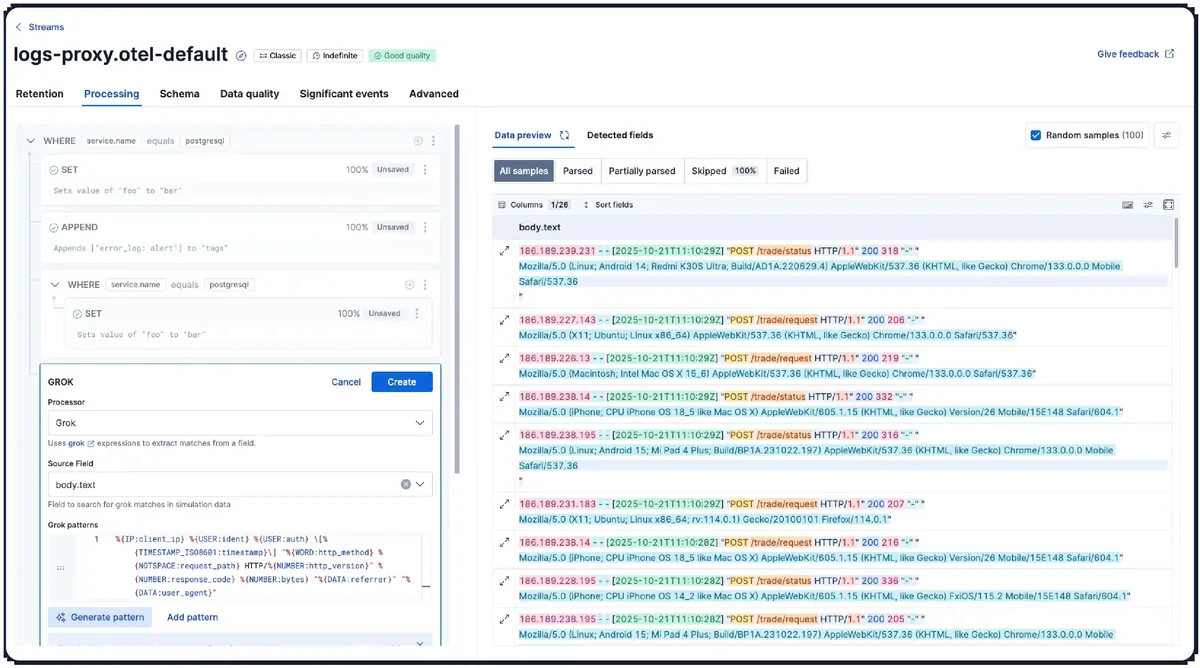
Feature Comparison
| Feature | Cribl | Elastic Observability |
|---|---|---|
| Core Capabilities | ||
| Primary Function | Observability data pipeline — routes, reduces, and enriches telemetry in transit | Full observability platform — ingests, stores, searches, and visualizes telemetry |
| Log Management | Routes and transforms logs; Cribl Lake for cold storage, no native hot search | Full log ingestion, indexing, full-text search, and Kibana visualization |
| APM / Distributed Tracing | Passes through and enriches trace data; no native APM analysis | Built-in APM with distributed tracing, service maps, and transaction latency analysis |
| Metrics Monitoring | Transforms and routes metrics to downstream tools; no native dashboarding | Native metrics visualization with Kibana dashboards, anomaly detection, and alerting |
| Data Management & Routing | ||
| Data Reduction | Core strength — filter, sample, aggregate, and drop fields to reduce volume by 30-60% | Limited — index lifecycle management and data tiers (hot/warm/cold/frozen) post-ingestion |
| Multi-Destination Routing | Routes to 50+ destinations simultaneously (Splunk, Elastic, Datadog, S3, Kafka) | Single destination — data goes into Elasticsearch; export requires additional tooling |
| Vendor Lock-in Risk | Low — vendor-neutral pipeline; swap destinations without changing collection | Medium — data stored in Elasticsearch proprietary format; migration requires re-indexing |
| Security & Compliance | ||
| SIEM / Security Analytics | Routes security events to SIEM destinations; no native security analytics | Built-in Elastic Security with SIEM, threat detection rules, and case management |
| Data Masking / PII Redaction | Native pipeline functions for field masking, PII redaction, and data obfuscation in transit | Ingest pipeline processors for field removal; limited real-time redaction |
| Infrastructure & Integration | ||
| Data Collection Agents | Cribl Edge lightweight agent; accepts Fluent Bit, syslog, HTTP, Kafka, and OpenTelemetry inputs | Elastic Agent, Beats family (Filebeat, Metricbeat), and OpenTelemetry Collector |
| Query & Search | Cribl Search for federated queries across connected destinations and Cribl Lake | ES|QL, KQL, and Lucene query languages with full-text search across indexed data |
| Deployment Options | SaaS (Cribl Cloud), self-hosted (Docker, Kubernetes), hybrid | Elastic Cloud (SaaS), self-hosted (Docker, Kubernetes, bare metal) |
| AI / ML Capabilities | Rule-based processing; no native machine learning | Machine learning anomaly detection, AI Assistant for log pattern analysis |
Core Capabilities
Primary Function
Log Management
APM / Distributed Tracing
Metrics Monitoring
Data Management & Routing
Data Reduction
Multi-Destination Routing
Vendor Lock-in Risk
Security & Compliance
SIEM / Security Analytics
Data Masking / PII Redaction
Infrastructure & Integration
Data Collection Agents
Query & Search
Deployment Options
AI / ML Capabilities
How they fit together
Cribl and Elastic Observability are complementary tools occupying different layers of the observability stack. Cribl controls data flow and cost; Elastic provides analytics and visualization. Large-scale environments benefit most from deploying both together.
What each one handles
Use Cribl for:
Choose Cribl for telemetry data management and cost control — when you process over 1 TB/day, need multi-destination routing to tools like Splunk, Elastic, Datadog, and S3 simultaneously, or want to reduce observability ingestion costs by 30-60% through pipeline-level data reduction. Essential for organizations with complex multi-backend observability architectures.
Use Elastic Observability for:
Choose Elastic Observability for an integrated observability destination with built-in APM, log analytics, metrics dashboards, SIEM, and ML anomaly detection starting at $95/month. Best for teams needing a single-platform approach to infrastructure monitoring, application tracing, and security analytics without managing a multi-tool stack.
These roles reflect the available product evidence. Most teams run both; which one owns a given job depends on your stack and team.
Frequently Asked Questions
Can Cribl and Elastic Observability be used together?
Yes, and this is one of the most common deployment patterns. Cribl sits in front of Elastic as a pipeline layer, routing and reducing data before it reaches Elasticsearch. This combination lets you use Cribl's data reduction to lower Elastic ingestion costs by 30-60% while retaining full analytical capabilities in Kibana.
Is Cribl a replacement for Elastic Observability?
No. Cribl is a data pipeline that processes, routes, and reduces telemetry data in transit but does not provide long-term storage, search, visualization, APM, or SIEM capabilities. Elastic Observability is a destination platform that stores data and provides analytics. They serve fundamentally different functions.
Which tool is better for organizations just starting with observability?
For teams building their first observability practice, Elastic Observability is the more practical starting point at $95/month with logs, metrics, APM, and dashboards in a single platform. Cribl becomes valuable once data volumes exceed 1 TB/day and cost optimization justifies an additional infrastructure layer.
How do the two tools compare on OpenTelemetry support?
Both have strong OpenTelemetry support. Elastic is fully OTel-compliant as an ingestion destination. Cribl supports OTel as both source and destination, adding value through format translation between OTel and vendor-specific formats during transit.