Decision comparison
Elastic Observability vs Datadog
Elastic Observability and Datadog are both Leaders in the 2025 Gartner Magic Quadrant for Observability Platforms, but they serve different organizational needs. Elastic delivers open-source flexibility with self-hosted deployment, OTel-native instrumentation, and petabyte-scale log analytics at predictable costs. Datadog delivers a fully managed SaaS experience with the broadest product portfolio, 600+ integrations, and a unified platform spanning observability and security. The choice depends on whether you prioritize data ownership, deployment flexibility, and cost control at scale, or a managed platform with maximal product breadth and minimal operational overhead.
Architecture choice. These take different approaches to the same problem. Read the table as a fit question rather than a feature race.
Applies to: for teams that want an observability platform explicitly built on open source and value control over their data approach.
All 2 are observability platforms.
Quick Comparison
| Decision factor | Elastic Observability | Datadog |
|---|---|---|
| Deployment Model | Hosted cloud, serverless, and self-managed on-premises deployment options | Fully managed cloud SaaS with no self-hosted or on-premises deployment option |
| Pricing Structure | Standard: As low as $95/month, Platinum: As low as $125/month, Enterprise: As low as $175/month | Free tier available, paid plans start at $0.75 per host per month, additional costs based on usage and features |
| OpenTelemetry Support | Fully standardized on OTel with EDOT distributions and no proprietary agents required | Supports OTel ingestion but promotes proprietary agents and SDK instrumentation |
| Log Analytics Approach | Petabyte-scale log search with ES|QL, logsdb index mode reducing footprint by 65% | Real-time log search with automated tagging and correlation across infrastructure |
| AI Capabilities | AI Assistant with natural language root cause analysis and zero-config ML anomaly detection | AI-powered observability with AIOps recognized as Leader in Forrester Wave AIOps Q2 2025 |
| Best For | Teams needing open-source flexibility, self-hosted options, and cost-efficient petabyte-scale retention | Teams wanting a fully managed SaaS platform with 600+ integrations and unified product suite |
Elastic Observability
- Deployment Model:
- Hosted cloud, serverless, and self-managed on-premises deployment options
- Pricing Structure:
- Standard: As low as $95/month, Platinum: As low as $125/month, Enterprise: As low as $175/month
- OpenTelemetry Support:
- Fully standardized on OTel with EDOT distributions and no proprietary agents required
- Log Analytics Approach:
- Petabyte-scale log search with ES|QL, logsdb index mode reducing footprint by 65%
- AI Capabilities:
- AI Assistant with natural language root cause analysis and zero-config ML anomaly detection
- Best For:
- Teams needing open-source flexibility, self-hosted options, and cost-efficient petabyte-scale retention
Datadog
- Deployment Model:
- Fully managed cloud SaaS with no self-hosted or on-premises deployment option
- Pricing Structure:
- Free tier available, paid plans start at $0.75 per host per month, additional costs based on usage and features
- OpenTelemetry Support:
- Supports OTel ingestion but promotes proprietary agents and SDK instrumentation
- Log Analytics Approach:
- Real-time log search with automated tagging and correlation across infrastructure
- AI Capabilities:
- AI-powered observability with AIOps recognized as Leader in Forrester Wave AIOps Q2 2025
- Best For:
- Teams wanting a fully managed SaaS platform with 600+ integrations and unified product suite
Public signals
Verified factual signals only. Bars appear only for like-for-like metrics with five weekly assessments for every tool; missing evidence stays explicit. These signals do not establish enterprise adoption, product quality, or total cost.
| Metric | Elastic Observability | Datadog |
|---|---|---|
| GitHub commits, 90d(Developer adoption) | 423 | 2.4k |
| GitHub stars(Developer adoption) | 271 | 3,500+ |
| Search interest(Market interest) | 0 | 14 |
| Hacker News mentions, 90d(Community interest) | 0 | 16 |
| Stack Overflow questions(Community interest) | 3.7k | 1.1k |
| Hugging Face downloads(Product adoption) | Not available | 96.6k |
| Hugging Face likes(Product adoption) | Not available | 220 |
| npm weekly downloads(Developer adoption) | Not available | 7.3M |
| Product Hunt comments(Community interest) | Not available | 1 |
| Product Hunt rating(Community interest) | Not available | 5.0/5 |
| Product Hunt reviews(Community interest) | Not available | 13 |
| Product Hunt votes(Community interest) | Not available | 75 |
| PyPI weekly downloads(Developer adoption) | Not available | 11.0M |
As of September 14, 2026 — updated weekly.
Health & risk evidence
Observed public-source checks for mapped package versions and repositories.
Elastic Observability
Package vulnerabilities
Not available
Repository security score
Not available
Datadog
September 14, 2026Package vulnerabilities
PyPI · datadog@0.53.0 · npm · dd-trace@6.16.0
0 vulnerabilities
across 2 packages
Repository security score
github.com/DataDog/datadog-agent
5.9/10
Interface Preview
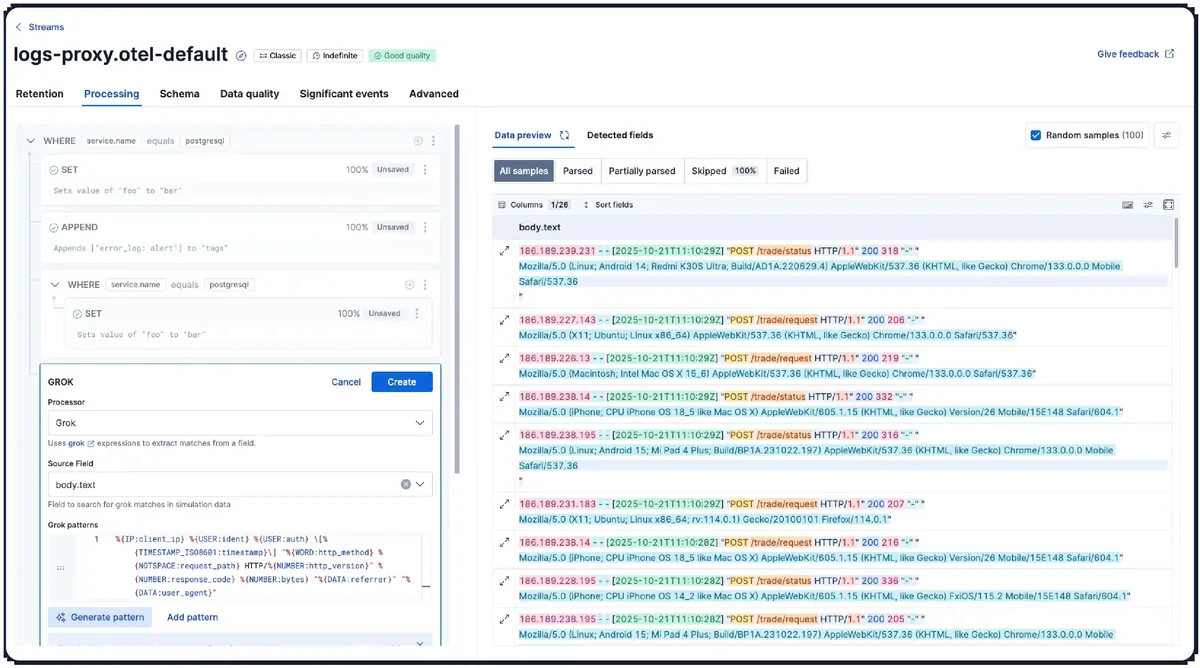
Elastic Observability
Feature Comparison
| Feature | Elastic Observability | Datadog |
|---|---|---|
| Log Management & Analytics | ||
| Log Ingestion | AI-driven auto-import with 450+ integrations and OTel-compliant ingestion from any source | Automated collection from services, applications, and platforms with real-time processing |
| Log Search & Query | ES|QL ad hoc queries with Discover and prebuilt dashboards across petabytes of data | Real-time search, filter, and analysis with automated tagging and correlation |
| Log Storage Optimization | Logsdb index mode reducing data footprint by up to 65% with searchable snapshots | Usage-based log pricing with separate ingestion and indexing charges |
| Application Performance Monitoring | ||
| Distributed Tracing | Production-grade pure OTel tracing without proprietary agents and broad language support | End-to-end request tracing with auto-generated service overviews across distributed systems |
| Error & Latency Monitoring | Always-on anomaly detection with pattern analysis and root cause correlation via ML | Graph and alert on error rates or latency percentiles including p95 and p99 |
| LLM Observability | Dedicated LLM monitoring tracking latency, errors, prompts, responses, usage, and costs | AI-powered observability capabilities for monitoring AI application performance |
| Infrastructure Monitoring | ||
| Cloud & On-Prem Coverage | 400+ OOTB integrations across cloud, on-prem, Kubernetes, and serverless environments | 600+ integrations spanning AWS, Azure, GCP, Kubernetes, and Docker environments |
| Network Monitoring | Infrastructure-level network visibility through Elastic integrations | Dedicated network monitoring unifying visibility across clouds, applications, and devices |
| Real-Time Dashboards | Instant prebuilt dashboards with customizable visualizations and ES|QL analysis | Interactive dashboards with high-resolution metrics, real-time graphing, and custom views |
| Digital Experience & Synthetic Monitoring | ||
| Real User Monitoring | RUM with Core Web Vitals, synthetic testing, and uptime monitoring | Frontend performance with session replays, user journey tracking, and Core Web Vitals |
| Synthetic Testing | Synthetic monitoring integrated with GitOps for simulating user journeys | AI-driven self-maintaining synthetic tests with multi-location monitoring |
| SLA & SLO Management | SLA monitoring available through Elastic alerting and ML-based anomaly tracking | Built-in SLA and SLO management with proactive alerting and custom thresholds |
| Deployment & Data Management | ||
| Deployment Options | Hosted cloud, serverless with auto-scaling, and full self-managed on-premises deployment | Cloud SaaS only with no self-hosted or on-premises deployment available |
| Data Retention & Sovereignty | Searchable snapshots with long-term retention and full data ownership in self-managed mode | Data stored on Datadog infrastructure with retention policies tied to pricing tier |
| Open Source Foundation | Built on the open-source Elastic Stack with community contributions and extensibility | Proprietary platform with proprietary agents, query languages, and data formats |
Log Management & Analytics
Log Ingestion
Log Search & Query
Log Storage Optimization
Application Performance Monitoring
Distributed Tracing
Error & Latency Monitoring
LLM Observability
Infrastructure Monitoring
Cloud & On-Prem Coverage
Network Monitoring
Real-Time Dashboards
Digital Experience & Synthetic Monitoring
Real User Monitoring
Synthetic Testing
SLA & SLO Management
Deployment & Data Management
Deployment Options
Data Retention & Sovereignty
Open Source Foundation
Which approach fits
Elastic Observability and Datadog are both Leaders in the 2025 Gartner Magic Quadrant for Observability Platforms, but they serve different organizational needs. Elastic delivers open-source flexibility with self-hosted deployment, OTel-native instrumentation, and petabyte-scale log analytics at predictable costs. Datadog delivers a fully managed SaaS experience with the broadest product portfolio, 600+ integrations, and a unified platform spanning observability and security. The choice depends on whether you prioritize data ownership, deployment flexibility, and cost control at scale, or a managed platform with maximal product breadth and minimal operational overhead.
When each approach fits
Choose Elastic Observability if:
Choose Elastic Observability if you need deployment flexibility, data sovereignty, or cost-efficient log management at scale. Its open-source foundation, full OpenTelemetry standardization with EDOT, and self-managed deployment option make it the stronger choice for regulated industries, teams with strict data residency requirements, and organizations ingesting petabytes of telemetry data. The logsdb index mode cutting storage by 65% and searchable snapshots for historical data deliver meaningful cost savings as data volumes grow.
Choose Datadog if:
Choose Datadog if you want a fully managed observability platform with minimal operational overhead and the broadest integration ecosystem. Its 600+ integrations, unified product suite spanning infrastructure through security monitoring, and proven scale serving 30,500+ customers including over 40% of the Fortune 500 make it the safer choice for teams that prefer SaaS convenience over self-managed control. Datadog is the better fit when rapid time-to-value and a single vendor for observability and security are the priority.
These scenarios reflect the available product evidence. Your requirements, existing stack, and team expertise should guide the final decision.
Frequently Asked Questions
What is the main difference between Elastic Observability and Datadog?
Elastic Observability is an open-source observability platform built on the Elastic Stack that offers self-managed, hosted, and serverless deployment options with OpenTelemetry as a first-class protocol. Datadog is a fully managed SaaS observability platform with proprietary agents and a broader product portfolio spanning infrastructure, APM, logs, security, and network monitoring. The fundamental difference is deployment flexibility and data ownership: Elastic gives you the option to self-host and retain full control over your telemetry data, while Datadog manages everything in their cloud.
Which platform is more cost-effective for large-scale log management?
Elastic Observability is generally more cost-effective for high-volume log management. Its logsdb index mode reduces the data footprint by up to 65%, and searchable snapshots keep historical data accessible without paying premium storage rates. Elastic's tier-based pricing starts at a vendor-specific amount/month for Standard. Datadog charges separately for log ingestion and log indexing, and those costs compound as data volumes grow. Teams ingesting petabytes of log data regularly cite cost as the primary reason for evaluating Datadog alternatives.
How do Elastic Observability and Datadog compare on OpenTelemetry support?
Elastic Observability is fully standardized on OpenTelemetry and offers Elastic Distributions of OpenTelemetry (EDOT), a production-ready OTel-native ecosystem with no proprietary extensions required. You can stream native OTel data without installing proprietary agents. Datadog supports OpenTelemetry ingestion but continues to promote its own proprietary agents and SDKs alongside OTel. For teams committed to an open-standards instrumentation strategy that avoids vendor lock-in, Elastic provides a more native OTel experience.
Can Elastic Observability be deployed on-premises?
Yes. Elastic Observability offers three deployment models: hosted cloud with resource-based pricing, serverless with usage-based pricing and automatic scaling, and self-managed with license-based pricing. The self-managed option gives teams full control over deployment location, hardware setup, cluster sizing, and data residency. This is a significant differentiator for regulated industries like healthcare, finance, and government that cannot send telemetry data to a third-party SaaS provider. Datadog is cloud-only with no self-hosted deployment option available.
Which platform has better AI and machine learning capabilities?
Both platforms invest heavily in AI. Elastic Observability offers an AI Assistant for natural language root cause analysis, zero-config ML refined over a decade for anomaly detection and pattern analysis, and dedicated LLM observability for monitoring GenAI applications. Datadog has been recognized as a Leader in the Forrester Wave for AIOps Platforms in Q2 2025 and brands itself as AI-Powered Observability and Security. Elastic's advantage is that its ML models run on your infrastructure in self-managed deployments, while Datadog's AI capabilities are tightly integrated into its managed SaaS platform.