Decision comparison
Grafana Cloud vs Splunk
Grafana Cloud delivers open, cost-efficient observability with Adaptive Telemetry and no vendor lock-in, while Splunk provides enterprise-grade combined security and observability with extensive SIEM capabilities and a broad integration ecosystem.
Direct comparison. These are reviewed substitutes bought for the same job, so the differences below are the ones that decide between them.
Applies to: Choosing where logs and monitoring data are stored, searched and alerted on.
These are different kinds of product — Observability Platform and Log Management.
Quick Comparison
| Decision factor | Grafana Cloud | Splunk |
|---|---|---|
| Best For | Teams seeking an open, unified observability platform with OpenTelemetry-native support and cost-efficient scaling | Large enterprises requiring a combined security and observability platform with advanced SIEM capabilities |
| Pricing Model | Grafana Cloud Free is $0/month and includes 10k active metrics series, 50 GB of logs, traces and profiles, and 3 active users. Pro is from $19/month plus usage: metrics at $6.50 per 1k series, logs, traces and profiles at $0.400/GB write and $0.100/GB retain, and Grafana visualization at $8 per active user. Enterprise starts at a $25,000/year minimum commit and is quote-based. | Splunk Free is a perpetual no-cost licence for a single self-hosted instance, capped at 500 MB of daily indexing and without alerting. Splunk Enterprise and Splunk Cloud use workload, ingest, or entity-based pricing that Splunk does not publish. |
| Core Strength | Full-stack observability with Adaptive Telemetry that automatically prioritizes critical data and saves 35-50% on costs | Enterprise-grade machine data analytics with powerful SPL query language and deep security threat detection capabilities |
| Ease of Use | AI-assisted onboarding and workflows enable quick setup with pre-built dashboards and intuitive data source integrations | Powerful but known for a steep learning curve requiring dedicated training for SPL queries and dashboard creation |
| Integrations | OpenTelemetry-native with a growing ecosystem of plugins, data source connectors, and cloud monitoring integrations | Over 2,000 integrations on Splunkbase with built-in OpenTelemetry support, SDKs, agents, and enterprise connectors |
| Security & Compliance | SOC 2, GDPR, PCI, and FedRAMP High/DoD IL5 compliance with enterprise-grade security and guaranteed SLAs | Industry-certified with SOC 2, HIPAA, PCI-DSS compliance plus unified SIEM for threat detection and investigation |
Grafana Cloud
- Best For:
- Teams seeking an open, unified observability platform with OpenTelemetry-native support and cost-efficient scaling
- Pricing Model:
- Grafana Cloud Free is $0/month and includes 10k active metrics series, 50 GB of logs, traces and profiles, and 3 active users. Pro is from $19/month plus usage: metrics at $6.50 per 1k series, logs, traces and profiles at $0.400/GB write and $0.100/GB retain, and Grafana visualization at $8 per active user. Enterprise starts at a $25,000/year minimum commit and is quote-based.
- Core Strength:
- Full-stack observability with Adaptive Telemetry that automatically prioritizes critical data and saves 35-50% on costs
- Ease of Use:
- AI-assisted onboarding and workflows enable quick setup with pre-built dashboards and intuitive data source integrations
- Integrations:
- OpenTelemetry-native with a growing ecosystem of plugins, data source connectors, and cloud monitoring integrations
- Security & Compliance:
- SOC 2, GDPR, PCI, and FedRAMP High/DoD IL5 compliance with enterprise-grade security and guaranteed SLAs
Splunk
- Best For:
- Large enterprises requiring a combined security and observability platform with advanced SIEM capabilities
- Pricing Model:
- Splunk Free is a perpetual no-cost licence for a single self-hosted instance, capped at 500 MB of daily indexing and without alerting. Splunk Enterprise and Splunk Cloud use workload, ingest, or entity-based pricing that Splunk does not publish.
- Core Strength:
- Enterprise-grade machine data analytics with powerful SPL query language and deep security threat detection capabilities
- Ease of Use:
- Powerful but known for a steep learning curve requiring dedicated training for SPL queries and dashboard creation
- Integrations:
- Over 2,000 integrations on Splunkbase with built-in OpenTelemetry support, SDKs, agents, and enterprise connectors
- Security & Compliance:
- Industry-certified with SOC 2, HIPAA, PCI-DSS compliance plus unified SIEM for threat detection and investigation
Public signals
Verified factual signals only. Bars appear only for like-for-like metrics with five weekly assessments for every tool; missing evidence stays explicit. These signals do not establish enterprise adoption, product quality, or total cost.
| Metric | Grafana Cloud | Splunk |
|---|---|---|
| GitHub commits, 90d(Developer adoption) | 244 | 13 |
| GitHub stars(Developer adoption) | 571 | 741 |
| Search interest(Market interest) | 1 | 15 |
| Hacker News mentions, 90d(Community interest) | 0 | 2 |
| Docker Hub pulls(Product adoption) | Not available | 93.2M |
| npm weekly downloads(Developer adoption) | Not available | 34.0k |
| Product Hunt comments(Community interest) | Not available | 0 |
| Product Hunt reviews(Community interest) | Not available | 0 |
| Product Hunt votes(Community interest) | Not available | 67 |
| PyPI weekly downloads(Developer adoption) | Not available | 285.4k |
| Stack Overflow questions(Community interest) | Not available | 2.3k |
As of September 14, 2026 — updated weekly.
Health & risk evidence
Observed public-source checks for mapped package versions and repositories.
Grafana Cloud
Package vulnerabilities
Not available
Repository security score
Not available
Splunk
September 14, 2026Package vulnerabilities
npm · splunk-logging@0.11.1 · PyPI · splunk-sdk@3.0.1
0 vulnerabilities
across 2 packages
Repository security score
github.com/splunk/splunk-sdk-python
6.9/10
Interface Preview
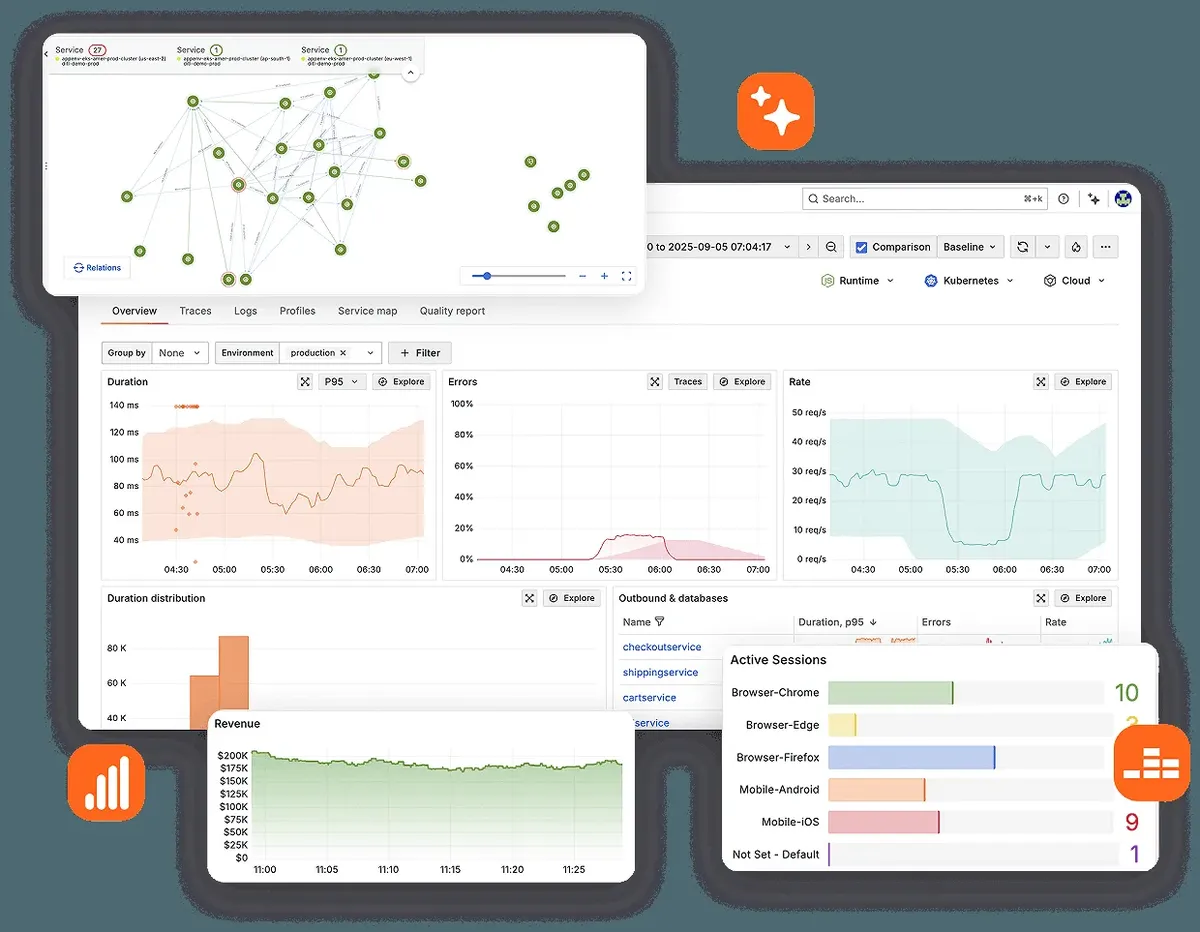
Grafana Cloud
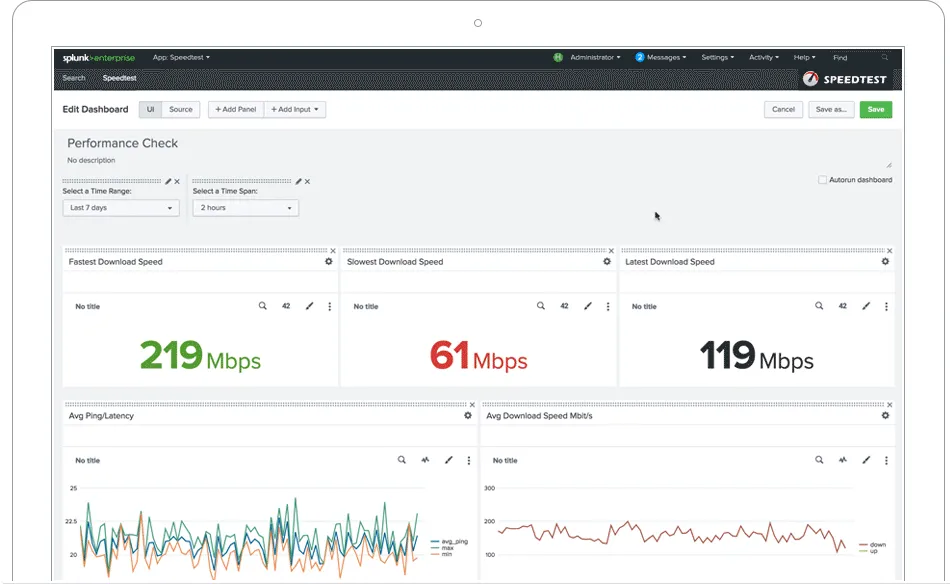
Splunk
Feature Comparison
| Feature | Grafana Cloud | Splunk |
|---|---|---|
| Data Collection & Ingestion | ||
| OpenTelemetry Support | Native OpenTelemetry observability with built-in Kubernetes and Application Observability integrations | Built-in OpenTelemetry support with SDKs and agents for flexible instrumentation |
| Data Source Integrations | Pluggable data source model with cloud monitoring, time series databases, and SQL database connectors | Over 2,000 integrations on Splunkbase for logs, metrics, traces, and events from any source or format |
| Adaptive Data Management | Adaptive Telemetry automatically prioritizes critical data and filters unused signals to save 35-50% on costs | SmartStore architecture with application-aware cache for managing active vs. inactive data storage tiers |
| Visualization & Dashboards | ||
| Dashboard Capabilities | Combine data from multiple sources into unified dashboards with pre-defined templates and custom panels | Customized dashboards with personalized views for different audiences including management and security teams |
| Data Exploration | Interactive visualization with Grafana's open-source charting engine and dashboard studio | Analytics Workspace for visual metrics analysis with charts, scatter plots, and reference lines without requiring SPL |
| Mobile & Multi-Platform Access | Web-based dashboard access across devices with cloud-hosted management | Splunk Mobile for mobile dashboards, Splunk AR for augmented reality, plus Apple TV and iPad apps |
| Alerting & Incident Response | ||
| Alert Intelligence | Context-rich alerts enriched by system knowledge graphs with smarter routing to filter noise and false positives | Custom alert actions with granular conditions including thresholds, trend-based triggers, and behavioral patterns |
| Incident Resolution | AI-powered agents and Grafana Assistant for faster incident response with intelligent filtering | Automated event correlation with predictive performance dashboards and IT service management integration |
| On-Call Management | Grafana OnCall included as part of the Cloud observability platform for integrated on-call workflows | Integration with external ticketing and task assignment systems through alerts and enterprise integrations |
| AI & Machine Learning | ||
| AI Capabilities | Grafana Assistant with agentic AI workflows for intelligent filtering, customized alerts, and observability insights | Native agentic, GenAI, and ML capabilities for deep data insights with natural language and automated workflows |
| Machine Learning | Grafana Machine Learning for anomaly detection and forecasting within the Cloud platform | Machine Learning Toolkit with pre-built analytics, custom model development, and guided assistants for ML ops |
| Predictive Analytics | AI-assisted onboarding and proactive reliability recommendations through the observability platform | ITSI with AI-driven incident prediction, anomaly correlation, and proactive outage prevention using AIOps |
| Scalability & Deployment | ||
| Deployment Flexibility | Fully managed cloud with Public Cloud, Federal Cloud, and Bring Your Own Cloud deployment options | Self-hosted Enterprise, managed Splunk Cloud Platform, or hybrid deployments for full infrastructure control |
| Cost Scaling | Tiers designed for small teams to global enterprises with predictable usage-based pricing and free tier | Volume-based licensing with multiple models including workload, ingest, and entity pricing for enterprise scale |
| Vendor Lock-In | No vendor lock-in with flexible open platform, open standards, and open ecosystem approach | Proprietary platform with SPL query language and Splunkbase ecosystem with a distinct platform integration model |
Data Collection & Ingestion
OpenTelemetry Support
Data Source Integrations
Adaptive Data Management
Visualization & Dashboards
Dashboard Capabilities
Data Exploration
Mobile & Multi-Platform Access
Alerting & Incident Response
Alert Intelligence
Incident Resolution
On-Call Management
AI & Machine Learning
AI Capabilities
Machine Learning
Predictive Analytics
Scalability & Deployment
Deployment Flexibility
Cost Scaling
Vendor Lock-In
Which to choose
Grafana Cloud delivers open, cost-efficient observability with Adaptive Telemetry and no vendor lock-in, while Splunk provides enterprise-grade combined security and observability with extensive SIEM capabilities and a broad integration ecosystem.
Best-fit scenarios
Choose Grafana Cloud if:
We recommend Grafana Cloud for teams that prioritize cost efficiency, open standards, and unified observability without vendor lock-in. Its Adaptive Telemetry saves 35-50% on metrics, logs, and traces, making it ideal for organizations scaling their monitoring stack. The forever-free tier and AI-assisted onboarding lower the barrier to entry significantly, and the OpenTelemetry-native approach ensures flexibility across your infrastructure.
Choose Splunk if:
We recommend Splunk for large enterprises that need a unified security and observability platform with advanced SIEM functionality. Its SPL query language enables deep machine data analysis, and the 2,000+ integrations on Splunkbase cover virtually any data source. Organizations with dedicated security operations centers and compliance requirements for threat detection, fraud prevention, and incident investigation will benefit most from Splunk's comprehensive platform.
These scenarios reflect the available product evidence. Your requirements, existing stack, and team expertise should guide the final decision.
Frequently Asked Questions
How do Grafana Cloud and Splunk compare on pricing for small to mid-size teams?
Grafana Cloud offers a forever-free tier at a current vendor-published rate that includes all core services with usage limits, Adaptive Telemetry, and AI Assistant access. The Pro plan starts at a current vendor-published rate plus usage-based charges, making it accessible for growing teams. Splunk's free tier is limited to 500MB/day with no authentication, alerting, or clustering. Splunk Enterprise paid plans start around a current vendor-published rate for 1GB/day, and the median enterprise customer pays approximately a current vendor-published rate-a current vendor-published rate. For small to mid-size teams with moderate data volumes, Grafana Cloud typically provides a more cost-effective entry point with more features available at lower tiers.
Which platform is better for security monitoring and SIEM use cases?
Splunk is the stronger choice for dedicated security operations. It offers unified threat detection, investigation, and response through Splunk Enterprise Security, with capabilities for compliance monitoring (PCI, HIPAA, GDPR), advanced persistent threat detection, fraud prevention, and AI-driven security analytics. Splunk is recognized as a consecutive leader in SIEM by global analyst firms. Grafana Cloud focuses primarily on observability rather than security operations. While it provides enterprise-grade compliance certifications including SOC 2, GDPR, PCI, and FedRAMP High, its core strength is infrastructure and application monitoring rather than dedicated SIEM functionality.
Can Grafana Cloud and Splunk integrate with OpenTelemetry?
Both platforms support OpenTelemetry, but their approaches differ. Grafana Cloud is OpenTelemetry-native, building its observability stack around open standards with built-in Kubernetes Monitoring and Application Observability integrations that leverage OpenTelemetry natively. Splunk provides OpenTelemetry support through its built-in agents, SDKs, and the Splunk OpenTelemetry Collector. Both platforms can ingest logs, metrics, and traces from OpenTelemetry-instrumented applications, but Grafana Cloud's open-source foundation and no-vendor-lock-in philosophy make it a more natural fit for organizations deeply committed to the OpenTelemetry ecosystem.
What are the main differences in ease of use and learning curve?
Grafana Cloud emphasizes rapid time-to-value with AI-assisted onboarding, pre-built dashboards, and out-of-the-box monitoring that lets teams see insights within minutes. Users frequently praise its data source integrations, alert capabilities, and open-source community support. Splunk is powerful but has a well-documented steep learning curve, particularly around its proprietary SPL query language. Users note that training is often required for teams to create effective dashboards and queries. Splunk has added features like Analytics Workspace to reduce the SPL dependency, but mastering the platform still requires more investment in learning compared to Grafana Cloud.