Decision comparison
Splunk vs Datadog
Splunk and Datadog are both powerful observability platforms, but they serve different organizational profiles and priorities. Splunk is the enterprise heavyweight, built for organizations that need deep log analytics, industry-leading security operations, and the flexibility to deploy on-premises, in the cloud, or in hybrid configurations. Datadog is the cloud-native leader, designed for engineering teams running modern distributed applications entirely on public cloud infrastructure who need unified monitoring across infrastructure, applications, logs, and user experience in a single SaaS platform. The choice between them often comes down to whether security and compliance or cloud-native application monitoring is the primary driver.
Direct comparison. These are reviewed substitutes bought for the same job, so the differences below are the ones that decide between them.
These are different kinds of product — Log Management and Observability Platform.
Quick Comparison
| Decision factor | Splunk | Datadog |
|---|---|---|
| Primary Strength | Deep log analytics and enterprise security (SIEM) with AI-powered threat detection and compliance | Unified cloud-native observability across infrastructure, APM, logs, and user experience monitoring |
| Deployment Model | Self-hosted (Splunk Enterprise), managed cloud (Splunk Cloud Platform), or hybrid deployments | Fully managed SaaS platform with no self-hosted option |
| Log Analytics | Schema-on-read technology for searching unstructured data at massive scale with SPL query language | Automated log collection, tagging, and correlation with seamless navigation between logs, metrics, and traces |
| Security Capabilities | Full SIEM platform with behavioral analytics, risk scoring, threat intelligence, and compliance automation | Cloud SIEM and security monitoring available as add-on modules |
| Pricing Approach | Splunk Free is a perpetual no-cost licence for a single self-hosted instance, capped at 500 MB of daily indexing and without alerting. Splunk Enterprise and Splunk Cloud use workload, ingest, or entity-based pricing that Splunk does not publish. | Free tier for up to 5 hosts with 1-day metric retention. Infrastructure Monitoring starts at $15 per host per month on Pro, billed annually, or $18 on-demand; Enterprise is $23 per host. APM starts at $31 per host, with APM Pro at $35 and APM Enterprise at $40. DevSecOps is $22 per host on Pro and $34 on Enterprise. Logs, custom metrics and other products are billed separately by usage. |
| Best For | Large enterprises with complex hybrid environments, heavy security/compliance needs, and massive log volumes | Cloud-native DevOps and SRE teams running modern distributed applications across public cloud infrastructure |
Splunk
- Primary Strength:
- Deep log analytics and enterprise security (SIEM) with AI-powered threat detection and compliance
- Deployment Model:
- Self-hosted (Splunk Enterprise), managed cloud (Splunk Cloud Platform), or hybrid deployments
- Log Analytics:
- Schema-on-read technology for searching unstructured data at massive scale with SPL query language
- Security Capabilities:
- Full SIEM platform with behavioral analytics, risk scoring, threat intelligence, and compliance automation
- Pricing Approach:
- Splunk Free is a perpetual no-cost licence for a single self-hosted instance, capped at 500 MB of daily indexing and without alerting. Splunk Enterprise and Splunk Cloud use workload, ingest, or entity-based pricing that Splunk does not publish.
- Best For:
- Large enterprises with complex hybrid environments, heavy security/compliance needs, and massive log volumes
Datadog
- Primary Strength:
- Unified cloud-native observability across infrastructure, APM, logs, and user experience monitoring
- Deployment Model:
- Fully managed SaaS platform with no self-hosted option
- Log Analytics:
- Automated log collection, tagging, and correlation with seamless navigation between logs, metrics, and traces
- Security Capabilities:
- Cloud SIEM and security monitoring available as add-on modules
- Pricing Approach:
- Free tier for up to 5 hosts with 1-day metric retention. Infrastructure Monitoring starts at $15 per host per month on Pro, billed annually, or $18 on-demand; Enterprise is $23 per host. APM starts at $31 per host, with APM Pro at $35 and APM Enterprise at $40. DevSecOps is $22 per host on Pro and $34 on Enterprise. Logs, custom metrics and other products are billed separately by usage.
- Best For:
- Cloud-native DevOps and SRE teams running modern distributed applications across public cloud infrastructure
Public signals
Verified factual signals only. Bars appear only for like-for-like metrics with five weekly assessments for every tool; missing evidence stays explicit. These signals do not establish enterprise adoption, product quality, or total cost.
| Metric | Splunk | Datadog |
|---|---|---|
| Docker Hub pulls(Product adoption) | 93.3M | Not available |
| GitHub commits, 90d(Developer adoption) | 9 | 2.5k |
| GitHub stars(Developer adoption) | 743 | 3,500+ |
| Search interest(Market interest) | 15 | 14 |
| Hacker News mentions, 90d(Community interest) | 1 | 15 |
| npm weekly downloads(Developer adoption) | 27.3k | 6.7M |
| Product Hunt comments(Community interest) | 0 | 1 |
| Product Hunt rating(Community interest) | Unavailable | 5.0/5 |
| Product Hunt reviews(Community interest) | 0 | 13 |
| Product Hunt votes(Community interest) | 67 | 75 |
| PyPI weekly downloads(Developer adoption) | 318.5k | 11.2M |
| Stack Overflow questions(Community interest) | 2.3k | 1.1k |
| Hugging Face downloads(Product adoption) | Not available | 106.6k |
| Hugging Face likes(Product adoption) | Not available | 221 |
As of September 21, 2026 — updated weekly.
Health & risk evidence
Observed public-source checks for mapped package versions and repositories.
Splunk
September 21, 2026Package vulnerabilities
npm · splunk-logging@0.11.1 · PyPI · splunk-sdk@3.0.1
0 vulnerabilities
across 2 packages
Repository security score
github.com/splunk/splunk-sdk-python
6.9/10
Datadog
September 21, 2026Package vulnerabilities
PyPI · datadog@0.53.0 · npm · dd-trace@6.16.0
0 vulnerabilities
across 2 packages
Repository security score
github.com/DataDog/datadog-agent
5.9/10
Interface Preview
Splunk
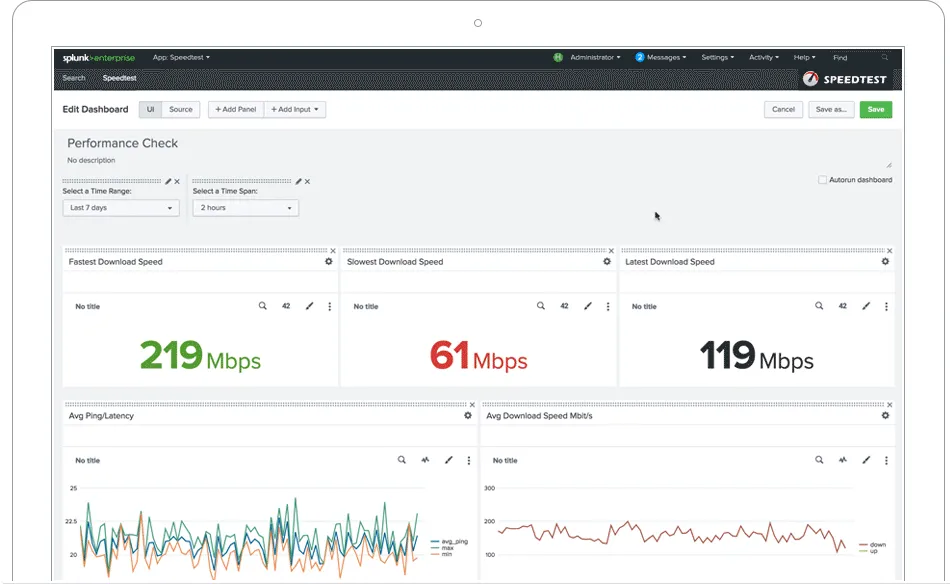
Feature Comparison
| Feature | Splunk | Datadog |
|---|---|---|
| Log Management & Analytics | ||
| Log Ingestion & Indexing | Real-time data capture and indexing from any source with schema-on-read for unstructured data | Automated log collection from services, applications, and platforms with auto-tagging and correlation |
| Query Language | SPL (Search Processing Language) for complex queries across massive datasets with statistical analysis | Proprietary query syntax with filtering, faceting, and seamless log-to-trace correlation |
| Log Retention & Storage | SmartStore architecture with tiered storage; active data in local cache, inactive in lower-cost remote storage | Cloud-managed retention with separate charges for ingestion and indexing; configurable retention periods |
| Application Performance Monitoring | ||
| Distributed Tracing | APM with full-fidelity trace capture; available as part of Splunk Observability Cloud | End-to-end request tracing across distributed systems with auto-generated service overviews |
| Error & Latency Monitoring | Application performance monitoring with AI assistants and business KPI impact analysis | Graph and alert on error rates or latency percentiles (p95, p99) with open-source tracing libraries |
| Real User Monitoring | Available through Splunk Observability Cloud as a separate product module | Built-in RUM with session replays, Core Web Vitals tracking, and frontend-backend correlation |
| Infrastructure Monitoring | ||
| Cloud Infrastructure | Monitors hybrid and multi-cloud environments with 2,000+ Splunkbase integrations | 600+ integrations with native support for AWS, Azure, GCP, Kubernetes, and Docker |
| Network Monitoring | Network visibility through integrations and custom dashboards | Dedicated Network Monitoring product unifying visibility across clouds, applications, and devices |
| Dashboards & Visualization | Custom dashboards with Dashboard Studio, AR visualization, mobile access, and Splunk TV | Real-time interactive dashboards with high-resolution metrics, custom views, and code-based configuration |
| Security & Compliance | ||
| SIEM Capabilities | Industry-leading SIEM with behavioral analytics, machine learning risk scoring, and threat intelligence | Cloud SIEM available as an add-on; real-time threat detection across cloud environments |
| Compliance Automation | Automated compliance monitoring and audit streamlining for PCI, HIPAA, GDPR, and more | Security monitoring with compliance-focused dashboards; fewer native compliance workflows |
| Threat Response | Unified threat detection, investigation, and response with automated alert actions and remediation scripts | Security monitoring with alert-driven incident workflows and integration with external SOAR tools |
| AI & Automation | ||
| AI/ML Capabilities | Machine Learning Toolkit with custom model development, anomaly detection, predictive analytics, and clustering | AI-powered AIOps recognized as Leader in Forrester Wave; automated anomaly detection and alerting |
| AIOps & Incident Management | IT Service Intelligence (ITSI) with AI-driven anomaly correlation, alert noise reduction, and proactive outage prevention | Automated event correlation with multi-channel notifications via email, PagerDuty, Slack, and webhooks |
| Synthetic Monitoring | Available through Splunk Observability Cloud with Synthetic Monitoring capabilities | Proactive, AI-driven synthetic monitoring of critical application features with web recorder |
Log Management & Analytics
Log Ingestion & Indexing
Query Language
Log Retention & Storage
Application Performance Monitoring
Distributed Tracing
Error & Latency Monitoring
Real User Monitoring
Infrastructure Monitoring
Cloud Infrastructure
Network Monitoring
Dashboards & Visualization
Security & Compliance
SIEM Capabilities
Compliance Automation
Threat Response
AI & Automation
AI/ML Capabilities
AIOps & Incident Management
Synthetic Monitoring
Which to choose
Splunk and Datadog are both powerful observability platforms, but they serve different organizational profiles and priorities. Splunk is the enterprise heavyweight, built for organizations that need deep log analytics, industry-leading security operations, and the flexibility to deploy on-premises, in the cloud, or in hybrid configurations. Datadog is the cloud-native leader, designed for engineering teams running modern distributed applications entirely on public cloud infrastructure who need unified monitoring across infrastructure, applications, logs, and user experience in a single SaaS platform. The choice between them often comes down to whether security and compliance or cloud-native application monitoring is the primary driver.
Best-fit scenarios
Choose Splunk if:
Choose Splunk if your organization prioritizes security operations, compliance automation, and deep log analytics at enterprise scale. Splunk is the right platform for teams that need a full SIEM with behavioral analytics and threat intelligence, must support hybrid or on-premises deployments, or process massive volumes of unstructured machine data. Its acquisition by Cisco strengthens its position for enterprises that need unified security and observability. Organizations in regulated industries like finance, healthcare, and government where compliance requirements are non-negotiable will find Splunk's audit streamlining and real-time security visibility indispensable. The platform's 2,000+ Splunkbase integrations and Machine Learning Toolkit make it highly extensible for custom enterprise use cases.
Choose Datadog if:
Choose Datadog if your team runs cloud-native applications and needs unified observability across infrastructure, APM, logs, and real user experience in a single managed platform. Datadog is the stronger choice for DevOps and SRE teams that want tighter correlation between metrics, traces, and logs without managing any observability infrastructure. Its 600+ integrations, built-in synthetic monitoring, and real user monitoring provide comprehensive visibility into application performance and user experience. Datadog is recognized as a Leader in both the Gartner Magic Quadrant for Observability Platforms and Digital Experience Monitoring, and its AI-powered AIOps capabilities were named a Leader in the Forrester Wave. Teams that value rapid deployment, a fully managed SaaS experience, and modern cloud-first workflows will find Datadog the more natural fit.
These scenarios reflect the available product evidence. Your requirements, existing stack, and team expertise should guide the final decision.
Frequently Asked Questions
What is the main difference between Splunk and Datadog?
Splunk is an enterprise-scale platform built around deep log analytics and security (SIEM), with strong capabilities for hybrid and on-premises environments. Datadog is a cloud-native SaaS observability platform designed for modern distributed applications running on public cloud infrastructure. Splunk excels at searching and analyzing massive volumes of unstructured machine data with its SPL query language and offers industry-leading security capabilities. Datadog excels at unified cloud monitoring with tighter APM, infrastructure, and user experience integration in a single SaaS interface.
How does Splunk pricing compare to Datadog pricing?
Both platforms use consumption-based pricing but measure differently. Splunk primarily charges based on daily data ingest volume (GB/day), with the median enterprise paying around $60,000-$75,000 per year according to third-party buyer data. Datadog charges per host, per GB of logs, per APM host, and per feature module, with costs that compound across infrastructure monitoring, APM, log management, and security. Splunk offers a free tier at 500MB/day, while Datadog also offers a free tier. Both require Contact Sales for enterprise pricing and offer multi-year discounts.
Can Splunk and Datadog be used together?
Yes. Some organizations run both platforms for different purposes. A common pattern is using Splunk for security operations (SIEM, compliance, threat detection) and Datadog for application performance monitoring and cloud infrastructure observability. Both platforms support OpenTelemetry and offer extensive APIs, making data sharing and integration feasible. However, running both increases overall tool costs and operational complexity.
Which platform is better for security and compliance?
Splunk is the stronger choice for security and compliance. It is the only vendor named a consecutive leader in SIEM by global analyst firms and offers comprehensive threat detection, investigation, and response capabilities. Splunk automates compliance monitoring for standards like PCI, HIPAA, and GDPR, and its behavioral analytics with machine learning risk scoring provide advanced threat detection. Datadog offers Cloud SIEM as an add-on module, but it does not match Splunk's depth in security operations, compliance automation, or enterprise SIEM functionality.
Which platform has a steeper learning curve?
Splunk has a steeper learning curve according to user reviews. Users consistently cite the complexity of SPL (Search Processing Language) and the time required to master dashboard creation and advanced analytics. Datadog also has a learning curve, particularly around its multi-dimensional pricing model and initial setup, but users generally find its cloud-native interface more approachable for DevOps and SRE workflows. Both platforms offer training and certification programs to help teams get up to speed.