Decision comparison
Splunk vs Prometheus
Splunk and Prometheus represent two fundamentally different approaches to observability. Splunk is a comprehensive commercial platform that unifies log management, security operations, and observability under a single enterprise umbrella, backed by AI-powered analytics and 2,000+ integrations. Prometheus is purpose-built for cloud-native metrics monitoring, offering a dimensional data model and PromQL that have become the standard for Kubernetes environments. The right choice depends on whether you need a full-stack enterprise platform with security capabilities or a focused, cost-free metrics solution for cloud-native infrastructure. Organizations handling security compliance and complex log analysis will find Splunk indispensable, while teams running Kubernetes-native workloads get more value from Prometheus.
Architecture choice. These take different approaches to the same problem. Read the table as a fit question rather than a feature race.
These are different kinds of product — Log Management and Metrics & Dashboards.
Quick Comparison
| Decision factor | Splunk | Prometheus |
|---|---|---|
| Primary Focus | Unified security and observability platform for log management, SIEM, and machine data analytics | Cloud-native metrics monitoring with dimensional data model and pull-based collection architecture |
| Query Language | SPL (Search Processing Language) for searching and analyzing machine-generated big data across sources | PromQL for querying and transforming dimensional time series data with label-based filtering |
| Deployment Model | Commercial SaaS and self-hosted Enterprise editions with managed infrastructure and support | Self-hosted open-source servers that operate independently using local storage, written in Go |
| Pricing Approach | Splunk Free is a perpetual no-cost licence for a single self-hosted instance, capped at 500 MB of daily indexing and without alerting. Splunk Enterprise and Splunk Cloud use workload, ingest, or entity-based pricing that Splunk does not publish. | Free and open source |
| Community & Ecosystem | 2,000+ integrations in the Splunkbase marketplace with certified enterprise support and professional services | 65,000+ GitHub stars, CNCF graduated project, hundreds of community-contributed exporters and integrations |
| Best For | Enterprise security teams and operations centers needing unified SIEM, compliance, and observability | Cloud-native teams running Kubernetes that need metrics-focused monitoring with service discovery |
Splunk
- Primary Focus:
- Unified security and observability platform for log management, SIEM, and machine data analytics
- Query Language:
- SPL (Search Processing Language) for searching and analyzing machine-generated big data across sources
- Deployment Model:
- Commercial SaaS and self-hosted Enterprise editions with managed infrastructure and support
- Pricing Approach:
- Splunk Free is a perpetual no-cost licence for a single self-hosted instance, capped at 500 MB of daily indexing and without alerting. Splunk Enterprise and Splunk Cloud use workload, ingest, or entity-based pricing that Splunk does not publish.
- Community & Ecosystem:
- 2,000+ integrations in the Splunkbase marketplace with certified enterprise support and professional services
- Best For:
- Enterprise security teams and operations centers needing unified SIEM, compliance, and observability
Prometheus
- Primary Focus:
- Cloud-native metrics monitoring with dimensional data model and pull-based collection architecture
- Query Language:
- PromQL for querying and transforming dimensional time series data with label-based filtering
- Deployment Model:
- Self-hosted open-source servers that operate independently using local storage, written in Go
- Pricing Approach:
- Free and open source
- Community & Ecosystem:
- 65,000+ GitHub stars, CNCF graduated project, hundreds of community-contributed exporters and integrations
- Best For:
- Cloud-native teams running Kubernetes that need metrics-focused monitoring with service discovery
Public signals
Verified factual signals only. Bars appear only for like-for-like metrics with five weekly assessments for every tool; missing evidence stays explicit. These signals do not establish enterprise adoption, product quality, or total cost.
| Metric | Splunk | Prometheus |
|---|---|---|
| Docker Hub pulls(Product adoption) | 93.2M | 2.0B |
| GitHub commits, 90d(Developer adoption) | 13 | Not available |
| GitHub stars(Developer adoption) | 741 | Not available |
| Search interest(Market interest) | 15 | 1 |
| Hacker News mentions, 90d(Community interest) | 2 | 0 |
| npm weekly downloads(Developer adoption) | 34.0k | Not available |
| Product Hunt comments(Community interest) | 0 | 1 |
| Product Hunt reviews(Community interest) | 0 | 0 |
| Product Hunt votes(Community interest) | 67 | 9 |
| PyPI weekly downloads(Developer adoption) | 285.4k | 30.7M |
| Stack Overflow questions(Community interest) | 2.3k | 7.0k |
| GitHub commits, 90d(Product adoption) | Not available | 794 |
| GitHub stars(Product adoption) | Not available | 66,000+ |
| npm weekly downloads(Ecosystem adoption) | Not available | 6.6M |
As of September 14, 2026 — updated weekly.
Health & risk evidence
Observed public-source checks for mapped package versions and repositories.
Splunk
September 14, 2026Package vulnerabilities
npm · splunk-logging@0.11.1 · PyPI · splunk-sdk@3.0.1
0 vulnerabilities
across 2 packages
Repository security score
github.com/splunk/splunk-sdk-python
6.9/10
Prometheus
September 14, 2026Package vulnerabilities
npm · prom-client@15.1.3 · PyPI · prometheus-client@0.26.0
0 vulnerabilities
across 2 packages
Repository security score
Not available
Interface Preview
Splunk
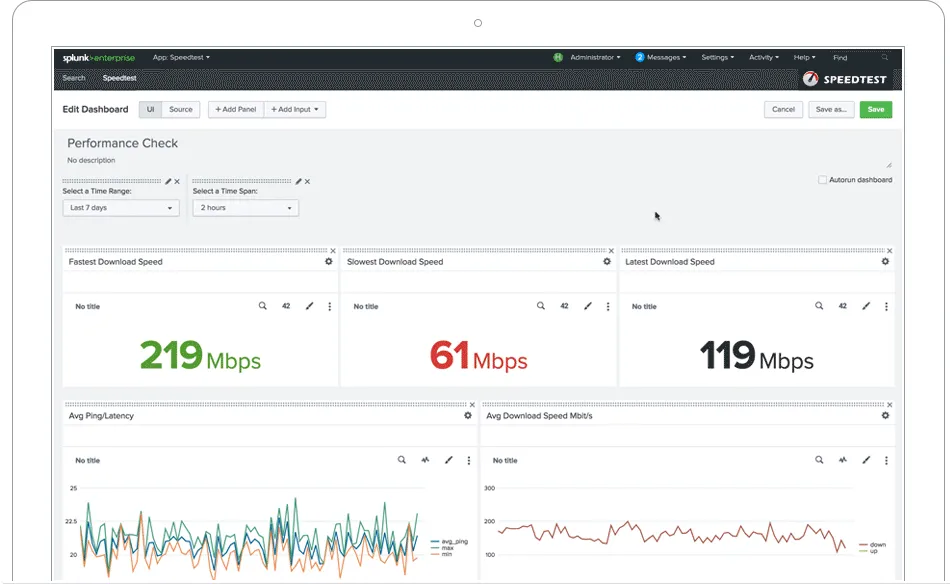
Feature Comparison
| Feature | Splunk | Prometheus |
|---|---|---|
| Data Collection & Ingestion | ||
| Metrics Collection | Agent-based and agentless collection supporting 2,000+ data sources including logs, metrics, and traces | HTTP pull model scraping metrics endpoints at configured intervals; push supported via Pushgateway |
| Log Management | Core platform capability with real-time indexing, search, and analysis of log data from any source | Not designed for log management; focused exclusively on numeric time series metrics data |
| Service Discovery | Supports data inputs configuration and forwarder management for dynamic infrastructure | Native Kubernetes service discovery with support for Consul, EC2, Azure, and static configuration |
| Querying & Analysis | ||
| Query Language Power | SPL provides full-text search, statistical commands, and transformations across structured and unstructured data | PromQL delivers powerful dimensional queries with aggregation, rate functions, and label-based filtering |
| Dashboarding | Built-in custom dashboards with drag-and-drop creation, Splunk Mobile, and augmented reality visualization | Basic built-in expression browser; typically paired with Grafana for production dashboard needs |
| AI & Machine Learning | AI-native data platform with built-in ML toolkit for anomaly detection, forecasting, and pattern recognition | No built-in ML capabilities; relies on external tools or custom recording rules for advanced analysis |
| Alerting & Response | ||
| Alerting System | Configurable alerts with real-time triggers, scheduled searches, and integration with ticketing systems | Separate Alertmanager component with grouping, inhibition, silencing, and notification routing |
| Security Operations | Full SIEM platform with unified threat detection, investigation, response, and compliance reporting | Not designed for security use cases; focused on infrastructure and application metrics monitoring |
| Incident Response | Integrated incident management with automated playbooks and SOAR capabilities for security teams | Alertmanager routes notifications to PagerDuty, Slack, and email; no built-in incident workflows |
| Scalability & Architecture | ||
| Horizontal Scaling | SmartStore architecture with indexer clustering and search head clustering for enterprise-scale deployments | Federation with hierarchical and horizontal modes; single server has no native clustering |
| Data Retention | Configurable retention policies with SmartStore offloading cold data to object storage for cost efficiency | Local TSDB storage with configurable retention; long-term storage requires Thanos or Cortex |
| High Availability | Built-in replication with indexer clustering ensuring data redundancy and search continuity | Independent server design; HA achieved by running duplicate servers with identical configurations |
| Ecosystem & Integration | ||
| Third-Party Integrations | 2,000+ apps and add-ons in Splunkbase marketplace covering cloud, security, and infrastructure sources | Hundreds of official and community-contributed exporters for databases, hardware, messaging, and more |
| Kubernetes Support | Splunk Observability Cloud provides Kubernetes monitoring with OpenTelemetry-based collection | Native Kubernetes integration as a CNCF graduated project with built-in service discovery |
| API & Extensibility | REST API, SDKs, and custom app framework for building integrations and extending platform capabilities | HTTP API for queries and metadata; Go client libraries for custom instrumentation across languages |
Data Collection & Ingestion
Metrics Collection
Log Management
Service Discovery
Querying & Analysis
Query Language Power
Dashboarding
AI & Machine Learning
Alerting & Response
Alerting System
Security Operations
Incident Response
Scalability & Architecture
Horizontal Scaling
Data Retention
High Availability
Ecosystem & Integration
Third-Party Integrations
Kubernetes Support
API & Extensibility
Which approach fits
Splunk and Prometheus represent two fundamentally different approaches to observability. Splunk is a comprehensive commercial platform that unifies log management, security operations, and observability under a single enterprise umbrella, backed by AI-powered analytics and 2,000+ integrations. Prometheus is purpose-built for cloud-native metrics monitoring, offering a dimensional data model and PromQL that have become the standard for Kubernetes environments. The right choice depends on whether you need a full-stack enterprise platform with security capabilities or a focused, cost-free metrics solution for cloud-native infrastructure. Organizations handling security compliance and complex log analysis will find Splunk indispensable, while teams running Kubernetes-native workloads get more value from Prometheus.
When each approach fits
Choose Splunk if:
Choose Splunk if your organization needs a unified platform covering security operations, log management, and observability in a single solution. Splunk excels when you need to ingest and analyze diverse data types beyond metrics, including logs, traces, and security events. Its AI-native analytics, SIEM capabilities, and compliance reporting make it the right fit for enterprises in regulated industries like banking and healthcare. The platform justifies its higher cost when you need threat detection, incident response, and data analytics consolidated under one roof with enterprise support and SLAs.
Choose Prometheus if:
Choose Prometheus if you are running Kubernetes-native infrastructure and need a focused, reliable metrics monitoring solution with zero licensing cost. With 63,600+ GitHub stars and CNCF graduated status, Prometheus has the strongest community support in the cloud-native ecosystem. PromQL provides powerful dimensional querying that integrates seamlessly with Grafana for dashboarding and Alertmanager for notification routing. Teams that prioritize operational simplicity, infrastructure-as-code deployment, and avoiding vendor lock-in will find Prometheus the more practical and cost-effective choice for metrics-focused monitoring.
These scenarios reflect the available product evidence. Your requirements, existing stack, and team expertise should guide the final decision.
Frequently Asked Questions
What is the main difference between Splunk and Prometheus?
Splunk is a comprehensive commercial platform that handles logs, metrics, traces, and security events in a unified interface with AI-powered analytics and 2,000+ integrations. Prometheus is a focused open-source metrics monitoring system built specifically for cloud-native environments with a pull-based collection model and the PromQL query language. Splunk serves as an enterprise-wide data analytics and security platform, while Prometheus concentrates exclusively on time series metrics collection and alerting for infrastructure monitoring.
Is Prometheus really free compared to Splunk?
Prometheus is completely free and open source under the Apache 2.0 license with no licensing costs at any scale. Splunk offers the perpetual Splunk Free licence for self-hosted single-instance use, but production Enterprise deployments use workload, ingest, or entity-based pricing that requires contacting sales. External pricing data shows Splunk annual costs ranging from $1,800 for small deployments ingesting 1-10 GB/day to $400,000-$800,000 for large deployments exceeding 500+ GB/day. Infrastructure and implementation costs typically add 30-50% on top of the base Splunk license. Prometheus still requires infrastructure costs for hosting, but eliminates all software licensing fees.
Can Splunk and Prometheus be used together?
Many organizations run both tools in complementary roles. Prometheus handles metrics collection for Kubernetes workloads and cloud-native services where its pull-based model and service discovery excel. Splunk ingests logs, security events, and broader machine data for enterprise-wide analytics and SIEM operations. Splunk can ingest Prometheus metrics through OpenTelemetry or its own integrations, allowing teams to use PromQL for real-time operational monitoring while leveraging Splunk for long-term analytics, compliance reporting, and security investigations across the full data estate.
Which tool has better community support and ecosystem?
Both tools have strong but different ecosystems. Prometheus has 65,000+ GitHub stars, is a CNCF graduated project, and benefits from hundreds of community-contributed exporters and integrations tightly coupled with the Kubernetes ecosystem. Its open governance model means the community drives development priorities. Splunk has 2,000+ apps and add-ons in the Splunkbase marketplace, certified enterprise support with SLAs, professional services, and a network of implementation partners. Splunk's ecosystem is extensive in scope, covering security, compliance, and business analytics, while Prometheus is prominent in cloud-native metrics monitoring.
Which is better for Kubernetes monitoring, Splunk or Prometheus?
Prometheus is the stronger choice for Kubernetes monitoring. As a CNCF graduated project, it integrates natively with Kubernetes service discovery to automatically detect and monitor new pods, services, and nodes. The dimensional data model maps naturally to Kubernetes labels and annotations. Splunk provides Kubernetes monitoring through its Observability Cloud using OpenTelemetry-based collection, which works well but adds an additional layer. For pure Kubernetes metrics monitoring, Prometheus is the community standard that most Kubernetes distributions and managed services support out of the box.