Decision comparison
Grafana vs Datadog
Grafana and Datadog serve overlapping but distinct needs in the observability space. Grafana excels as a vendor-neutral, open-source visualization layer that gives teams full control over their data and infrastructure, while Datadog delivers a turnkey, fully managed SaaS experience with broader out-of-the-box coverage for security and network monitoring. The right choice depends on whether your team prioritizes openness and cost control or prefers a single-vendor, batteries-included platform.
Architecture choice. These take different approaches to the same problem. Read the table as a fit question rather than a feature race.
These are different kinds of product — Metrics & Dashboards and Observability Platform.
Quick Comparison
| Decision factor | Grafana | Datadog |
|---|---|---|
| Best For | Teams that want open-source, vendor-neutral visualization across multiple data sources | Teams seeking a fully managed, all-in-one observability SaaS with deep integrations |
| Architecture | Open-source platform with pluggable data source model; self-hosted or managed via Grafana Cloud | Proprietary SaaS platform with agent-based data collection across infrastructure and applications |
| Pricing Model | Grafana Cloud Free is $0/month and includes 10k active metrics series, 50 GB of logs, traces and profiles, and 3 active users. Pro is from $19/month plus usage: metrics at $6.50 per 1k series, logs, traces and profiles at $0.400/GB write and $0.100/GB retain, and Grafana visualization at $8 per active user. Enterprise starts at a $25,000/year minimum commit and is quote-based. | Free tier for up to 5 hosts with 1-day metric retention. Infrastructure Monitoring starts at $15 per host per month on Pro, billed annually, or $18 on-demand; Enterprise is $23 per host. APM starts at $31 per host, with APM Pro at $35 and APM Enterprise at $40. DevSecOps is $22 per host on Pro and $34 on Enterprise. Logs, custom metrics and other products are billed separately by usage. |
| Ease of Use | Moderate learning curve; requires familiarity with data source configuration and query languages | Steep initial learning curve but polished UI with auto-generated dashboards and service maps |
| Scalability | Scales horizontally with backend data sources; Grafana Cloud handles infrastructure scaling automatically | Cloud-native SaaS that scales automatically; processes trillions of data points daily |
| Community/Support | 75,000+ GitHub stars; AGPL-3.0 licensed; active open-source community and commercial support tiers | 346 TrustRadius reviews at 8.6/10; 600+ integrations; recognized Leader in Gartner Magic Quadrant |
Grafana
- Best For:
- Teams that want open-source, vendor-neutral visualization across multiple data sources
- Architecture:
- Open-source platform with pluggable data source model; self-hosted or managed via Grafana Cloud
- Pricing Model:
- Grafana Cloud Free is $0/month and includes 10k active metrics series, 50 GB of logs, traces and profiles, and 3 active users. Pro is from $19/month plus usage: metrics at $6.50 per 1k series, logs, traces and profiles at $0.400/GB write and $0.100/GB retain, and Grafana visualization at $8 per active user. Enterprise starts at a $25,000/year minimum commit and is quote-based.
- Ease of Use:
- Moderate learning curve; requires familiarity with data source configuration and query languages
- Scalability:
- Scales horizontally with backend data sources; Grafana Cloud handles infrastructure scaling automatically
- Community/Support:
- 75,000+ GitHub stars; AGPL-3.0 licensed; active open-source community and commercial support tiers
Datadog
- Best For:
- Teams seeking a fully managed, all-in-one observability SaaS with deep integrations
- Architecture:
- Proprietary SaaS platform with agent-based data collection across infrastructure and applications
- Pricing Model:
- Free tier for up to 5 hosts with 1-day metric retention. Infrastructure Monitoring starts at $15 per host per month on Pro, billed annually, or $18 on-demand; Enterprise is $23 per host. APM starts at $31 per host, with APM Pro at $35 and APM Enterprise at $40. DevSecOps is $22 per host on Pro and $34 on Enterprise. Logs, custom metrics and other products are billed separately by usage.
- Ease of Use:
- Steep initial learning curve but polished UI with auto-generated dashboards and service maps
- Scalability:
- Cloud-native SaaS that scales automatically; processes trillions of data points daily
- Community/Support:
- 346 TrustRadius reviews at 8.6/10; 600+ integrations; recognized Leader in Gartner Magic Quadrant
Public signals
Verified factual signals only. Bars appear only for like-for-like metrics with five weekly assessments for every tool; missing evidence stays explicit. These signals do not establish enterprise adoption, product quality, or total cost.
| Metric | Grafana | Datadog |
|---|---|---|
| Docker Hub pulls(Product adoption) | 5.3B | Not available |
| GitHub commits, 90d(Product adoption) | 3.2k | Not available |
| GitHub stars(Product adoption) | 76,000+ | Not available |
| Search interest(Market interest) | 21 | 14 |
| Hacker News mentions, 90d(Community interest) | 33 | 15 |
| npm weekly downloads(Developer adoption) | 80.4k | 6.7M |
| Product Hunt comments(Community interest) | 0 | 1 |
| Product Hunt rating(Community interest) | 5.0/5 | 5.0/5 |
| Product Hunt reviews(Community interest) | 1 | 13 |
| Product Hunt votes(Community interest) | 5 | 75 |
| PyPI weekly downloads(Ecosystem adoption) | 45.6k | Not available |
| Stack Overflow questions(Community interest) | 5.8k | 1.1k |
| GitHub commits, 90d(Developer adoption) | Not available | 2.5k |
| GitHub stars(Developer adoption) | Not available | 3,500+ |
| Hugging Face downloads(Product adoption) | Not available | 106.6k |
| Hugging Face likes(Product adoption) | Not available | 221 |
| PyPI weekly downloads(Developer adoption) | Not available | 11.2M |
As of September 21, 2026 — updated weekly.
Health & risk evidence
Observed public-source checks for mapped package versions and repositories.
Grafana
September 21, 2026Package vulnerabilities
npm · @grafana/data@13.2.2 · PyPI · grafana-client@5.1.2
0 vulnerabilities
across 2 packages
Repository security score
github.com/grafana/grafana
6.8/10
Datadog
September 21, 2026Package vulnerabilities
PyPI · datadog@0.53.0 · npm · dd-trace@6.16.0
0 vulnerabilities
across 2 packages
Repository security score
github.com/DataDog/datadog-agent
5.9/10
Interface Preview
Grafana
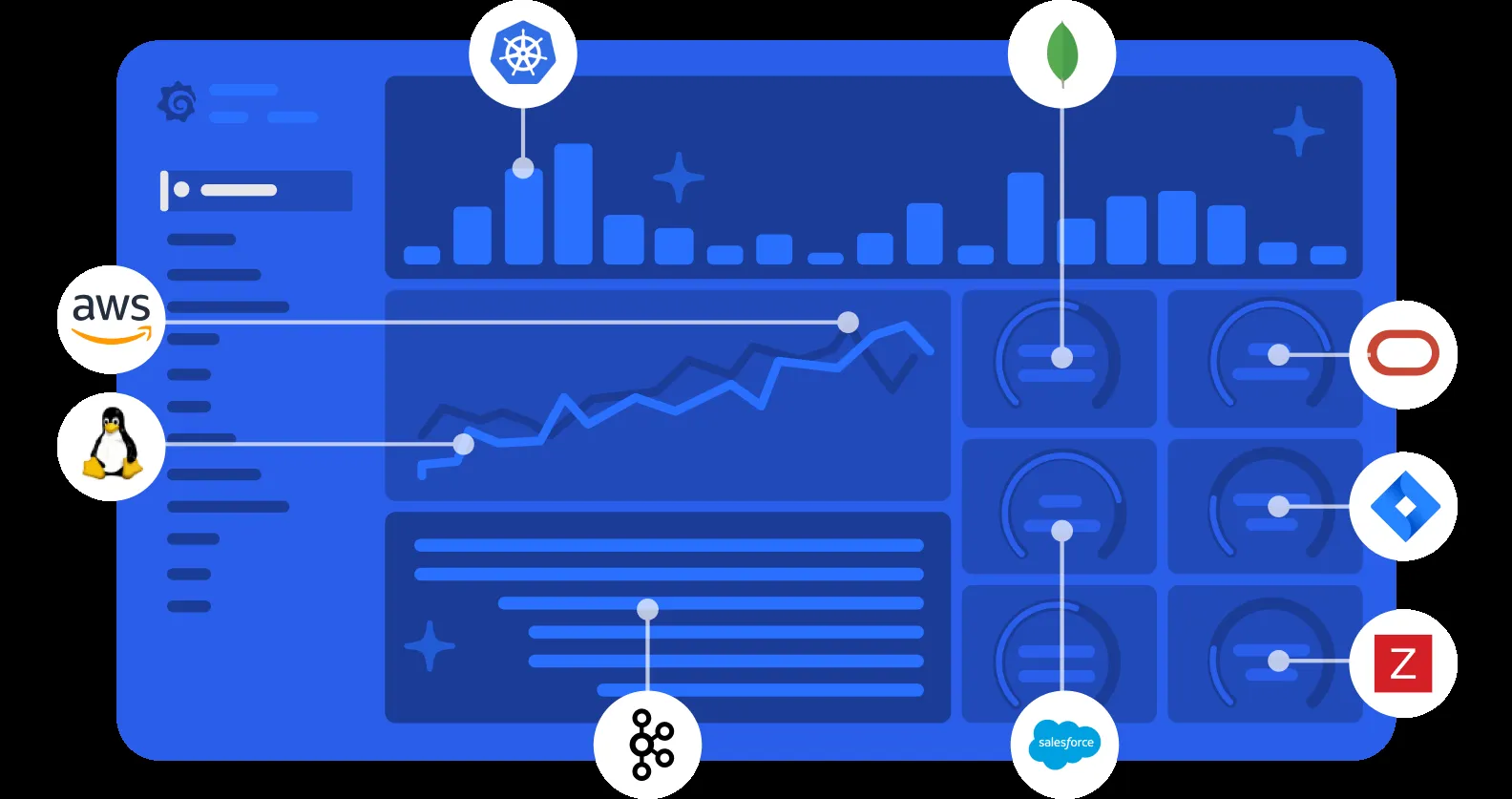
Feature Comparison
| Feature | Grafana | Datadog |
|---|---|---|
| Data Visualization & Dashboards | ||
| Custom Dashboards | Dynamic dashboards with template variables and mixed data sources | Real-time interactive dashboards with high-resolution metrics and graphing |
| Data Source Flexibility | Pluggable model supporting Prometheus, InfluxDB, Elasticsearch, Postgres, and more | 600+ turn-key integrations aggregating metrics across the full DevOps stack |
| Mixed Data Sources in Single View | Combine different data sources in the same graph natively | Graphs across sources in real-time with slicing by host, device, or tag |
| Monitoring & Alerting | ||
| Alerting System | Visual alert rule builder with notifications to multiple systems | Complex alerting logic with multi-trigger conditions and one-click muting |
| Application Performance Monitoring | Application Observability with host-hour-based tracking | Full APM with auto-generated service overviews and latency percentile tracking |
| Synthetic Monitoring | Included in Grafana Cloud with 100k API and 10k browser test executions free | AI-driven proactive monitoring of critical application user journeys |
| Logs & Traces | ||
| Log Management | Loki-based log aggregation with 50 GB free ingestion per month | Automated tagging, correlation, and real-time log collection without indexing delay |
| Distributed Tracing | Tempo-based tracing with 50 GB free ingestion per month | End-to-end request tracing with open-source tracing library instrumentation |
| Continuous Profiling | Pyroscope-based profiling included in Grafana Cloud | Continuous Profiler ships as a documented product with per-language SDKs. |
| Infrastructure & Network | ||
| Kubernetes Monitoring | Dedicated Kubernetes Monitoring with 2,232 host hours free monthly | Container and orchestrator monitoring with auto-discovery and tagging |
| Network Monitoring | Not verified | Unified visibility across multi-cloud, hybrid, and on-premises network environments |
| Database Observability | Database Observability with 2,232 database host hours free monthly | Not available as a standalone product module |
| User Experience & Security | ||
| Frontend / Real User Monitoring | Frontend Observability with 100k sessions included free monthly | Real User Monitoring with session replays and frontend performance tracking |
| Security Monitoring | Not verified | Real-time threat detection and security monitoring across systems |
| Incident & On-Call Management | Built-in incident management and on-call management in Grafana Cloud | Alert-based incident workflows with team notification and resolution tracking |
Data Visualization & Dashboards
Custom Dashboards
Data Source Flexibility
Mixed Data Sources in Single View
Monitoring & Alerting
Alerting System
Application Performance Monitoring
Synthetic Monitoring
Logs & Traces
Log Management
Distributed Tracing
Continuous Profiling
Infrastructure & Network
Kubernetes Monitoring
Network Monitoring
Database Observability
User Experience & Security
Frontend / Real User Monitoring
Security Monitoring
Incident & On-Call Management
Which approach fits
Grafana and Datadog serve overlapping but distinct needs in the observability space. Grafana excels as a vendor-neutral, open-source visualization layer that gives teams full control over their data and infrastructure, while Datadog delivers a turnkey, fully managed SaaS experience with broader out-of-the-box coverage for security and network monitoring. The right choice depends on whether your team prioritizes openness and cost control or prefers a single-vendor, batteries-included platform.
When each approach fits
Choose Grafana if:
Choose Grafana when you want open-source flexibility, vendor-neutral data source support, self-hosted deployment options, or predictable pricing with generous free tiers. It is ideal for teams already invested in the Prometheus/Loki/Tempo ecosystem or those who need to combine data from many heterogeneous sources into unified dashboards.
Choose Datadog if:
Choose Datadog when you need a fully managed, all-in-one observability platform with minimal operational overhead. It is the stronger pick for teams requiring built-in security monitoring, network visibility, deep APM with auto-instrumentation, and 600+ pre-built integrations without managing any backend infrastructure.
These scenarios reflect the available product evidence. Your requirements, existing stack, and team expertise should guide the final decision.
Frequently Asked Questions
Can Grafana replace Datadog entirely?
Grafana Cloud with the full LGTM stack (Loki, Grafana, Tempo, Mimir) covers metrics, logs, traces, and visualization. However, Datadog offers built-in security monitoring and network monitoring that Grafana does not provide natively. For pure observability and visualization, Grafana can replace Datadog; for security-integrated monitoring, Datadog remains more comprehensive.
Which platform is more cost-effective at scale?
Grafana is generally more cost-effective, especially for large deployments. Its open-source core eliminates licensing fees for self-hosted setups, and Grafana Cloud offers generous free tiers with predictable per-user pricing. Datadog's usage-based model with per-host, per-metric, and per-log charges can escalate quickly in Kubernetes-heavy or microservices environments.
Does Datadog support open-source data collection standards like OpenTelemetry?
Datadog supports OpenTelemetry ingestion, but it also promotes its proprietary agents and SDKs. Grafana is built around open standards from the ground up, with native support for Prometheus, OpenTelemetry, and other open-source protocols, making it easier to avoid vendor lock-in.
Which tool is better for teams new to observability?
Datadog provides a smoother onboarding experience with auto-generated service maps, pre-built dashboards, and guided setup flows. Grafana requires more upfront configuration knowledge, particularly around data source setup and query languages like PromQL. Teams with limited observability experience often find Datadog's managed approach faster to adopt initially.