Decision comparison
Metabase vs Grafana
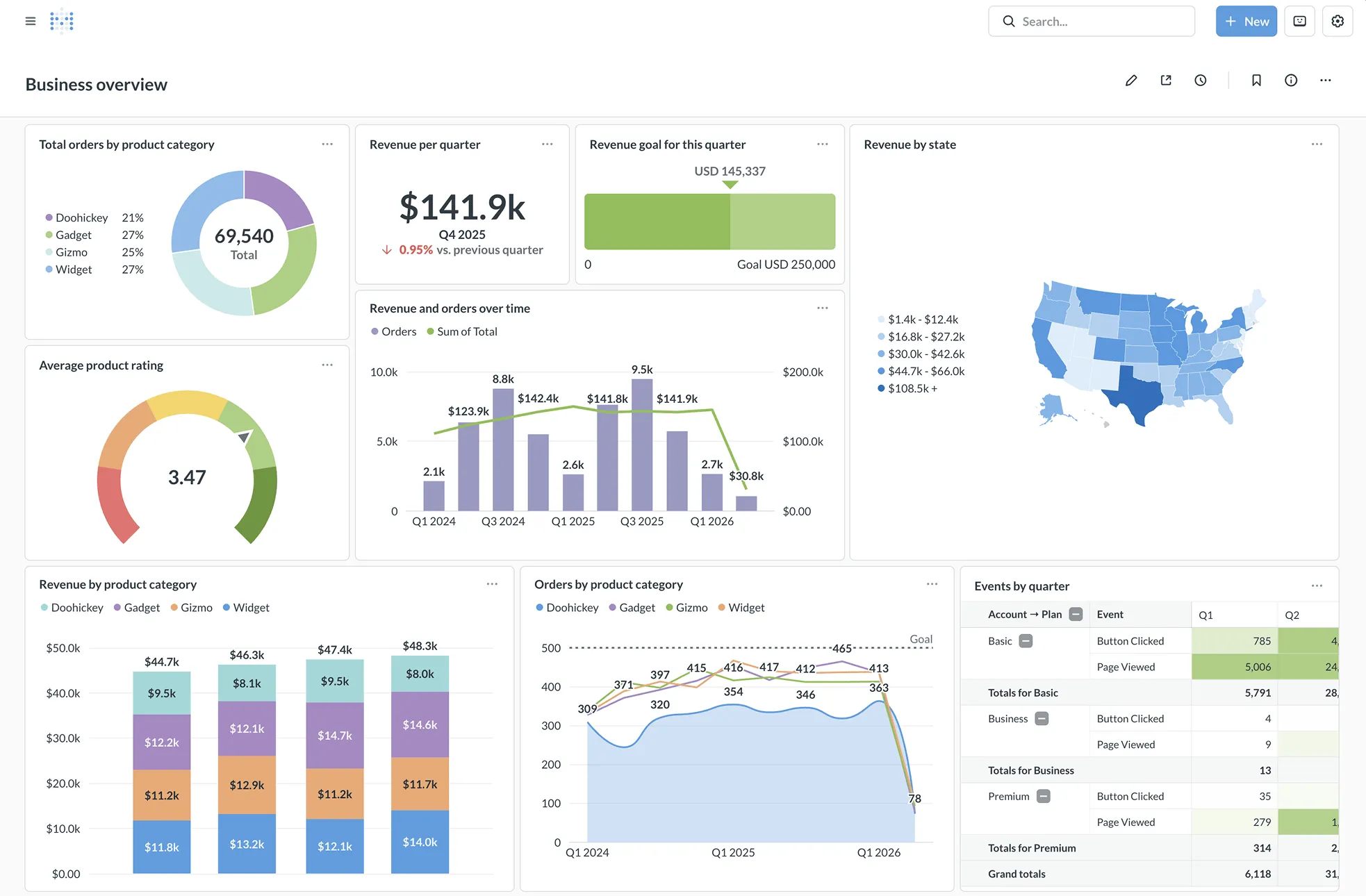
Metabase and Grafana excel in fundamentally different domains. Metabase is a business intelligence platform that makes data exploration accessible to everyone on the team, from marketing managers to executives, through its no-code query builder, embedded analytics, and curated dashboard collections. Grafana is an observability powerhouse built for engineering teams that need to monitor infrastructure health, correlate metrics with logs and traces, and respond to incidents through real-time alerting. The choice comes down to audience and use case: business analytics versus operational monitoring. Organizations often run both tools side by side, each serving its core strength.
Architecture choice. These take different approaches to the same problem. Read the table as a fit question rather than a feature race.
These are different kinds of product — BI Platform and Metrics & Dashboards.
Quick Comparison
| Decision factor | Metabase | Grafana |
|---|---|---|
| Best For | Self-service business analytics and embedded reporting | Infrastructure monitoring, observability, and incident response |
| Primary Users | Business analysts, product managers, non-technical teams | DevOps engineers, SREs, platform engineering teams |
| Pricing Model | Community Edition is free, open-source and self-hosted, with unlimited users. Paid Metabase Cloud plans start with Starter at $100/month, or $90/month billed annually, including the first 5 users, then $6 per user/month. Pro is $575/month, or $517.50/month annually, including the first 10 users, then $12 per user/month. Enterprise is custom pricing starting at $20,000/year. Both paid plans offer a 14 days free trial. | Grafana Cloud Free is $0/month and includes 10k active metrics series, 50 GB of logs, traces and profiles, and 3 active users. Pro is from $19/month plus usage: metrics at $6.50 per 1k series, logs, traces and profiles at $0.400/GB write and $0.100/GB retain, and Grafana visualization at $8 per active user. Enterprise starts at a $25,000/year minimum commit and is quote-based. |
| Data Sources | 20+ relational databases and data warehouses | 100+ plugins for time-series, logs, traces, and SQL databases |
| Deployment | Cloud (Metabase Cloud) or self-hosted (Docker, JAR) | Cloud (Grafana Cloud) or self-hosted (Docker, binary) |
| Community | 49,000+ GitHub stars, active discussion forum | 76,000+ GitHub stars, large plugin ecosystem |
Metabase
- Best For:
- Self-service business analytics and embedded reporting
- Primary Users:
- Business analysts, product managers, non-technical teams
- Pricing Model:
- Community Edition is free, open-source and self-hosted, with unlimited users. Paid Metabase Cloud plans start with Starter at $100/month, or $90/month billed annually, including the first 5 users, then $6 per user/month. Pro is $575/month, or $517.50/month annually, including the first 10 users, then $12 per user/month. Enterprise is custom pricing starting at $20,000/year. Both paid plans offer a 14 days free trial.
- Data Sources:
- 20+ relational databases and data warehouses
- Deployment:
- Cloud (Metabase Cloud) or self-hosted (Docker, JAR)
- Community:
- 49,000+ GitHub stars, active discussion forum
Grafana
- Best For:
- Infrastructure monitoring, observability, and incident response
- Primary Users:
- DevOps engineers, SREs, platform engineering teams
- Pricing Model:
- Grafana Cloud Free is $0/month and includes 10k active metrics series, 50 GB of logs, traces and profiles, and 3 active users. Pro is from $19/month plus usage: metrics at $6.50 per 1k series, logs, traces and profiles at $0.400/GB write and $0.100/GB retain, and Grafana visualization at $8 per active user. Enterprise starts at a $25,000/year minimum commit and is quote-based.
- Data Sources:
- 100+ plugins for time-series, logs, traces, and SQL databases
- Deployment:
- Cloud (Grafana Cloud) or self-hosted (Docker, binary)
- Community:
- 76,000+ GitHub stars, large plugin ecosystem
Public signals
Verified factual signals only. Bars appear only for like-for-like metrics with five weekly assessments for every tool; missing evidence stays explicit. These signals do not establish enterprise adoption, product quality, or total cost.
| Metric | Metabase | Grafana |
|---|---|---|
| Docker Hub pulls(Product adoption) | 272.7M | 5.3B |
| GitHub commits, 90d(Product adoption) | 2.0k | 3.2k |
| GitHub stars(Product adoption) | 49,000+ | 76,000+ |
| Search interest(Market interest) | Not available | 21 |
| Hacker News mentions, 90d(Community interest) | 12 | 33 |
| npm weekly downloads(Developer adoption) | 36.8k | 80.4k |
| Product Hunt comments(Community interest) | 30 | 0 |
| Product Hunt rating(Community interest) | 4.9/5 | 5.0/5 |
| Product Hunt reviews(Community interest) | 24 | 1 |
| Product Hunt votes(Community interest) | 310 | 5 |
| Stack Overflow questions(Community interest) | 374 | 5.8k |
| PyPI weekly downloads(Ecosystem adoption) | Not available | 45.6k |
As of September 21, 2026 — updated weekly.
Health & risk evidence
Observed public-source checks for mapped package versions and repositories.
Metabase
September 21, 2026Package vulnerabilities
npm · @metabase/embedding-sdk-react@0.63.1
0 vulnerabilities
across 1 package
Repository security score
github.com/metabase/metabase
7.1/10
Grafana
September 21, 2026Package vulnerabilities
npm · @grafana/data@13.2.2 · PyPI · grafana-client@5.1.2
0 vulnerabilities
across 2 packages
Repository security score
github.com/grafana/grafana
6.8/10
Interface Preview
Metabase
Grafana
Feature Comparison
| Feature | Metabase | Grafana |
|---|---|---|
| Business Intelligence & Reporting | ||
| Visual Query Builder | Full support | Not verified |
| Scheduled Report Delivery | Full support | Partial support |
| PDF Export & Downloads | Full support | Partial support |
| Embedded Analytics SDK | Full support | Partial support |
| Natural Language Querying | Full support | Not verified |
| Observability & Monitoring | ||
| Metrics Monitoring | Not verified | Full support |
| Log Aggregation | Not verified | Full support |
| Distributed Tracing | Not verified | Full support |
| Kubernetes Monitoring | Not verified | Full support |
| Synthetic Monitoring | Not verified | Full support |
| Data Connectivity | ||
| Relational Database Support | Full support | Full support |
| Time-Series Database Support | Not verified | Full support |
| Cloud Monitoring Sources | Not verified | Full support |
| Data Warehouse Connectors | Full support | Partial support |
| Plugin Ecosystem | Partial support | Full support |
| Alerting & Collaboration | ||
| Alert Rule Builder | Partial support | Full support |
| On-Call Management | Not verified | Full support |
| Incident Management | Not verified | Full support |
| Slack & Email Notifications | Full support | Full support |
| Dashboard Subscriptions | Full support | Partial support |
| Access Control & Governance | ||
| Row-Level Permissions | Full support | Partial support |
| Column-Level Permissions | Full support | Not verified |
| SSO Integration | Full support | Full support |
| Multi-Tenant Segregation | Full support | Partial support |
| Content Curation & Verification | Full support | Not verified |
Business Intelligence & Reporting
Visual Query Builder
Scheduled Report Delivery
PDF Export & Downloads
Embedded Analytics SDK
Natural Language Querying
Observability & Monitoring
Metrics Monitoring
Log Aggregation
Distributed Tracing
Kubernetes Monitoring
Synthetic Monitoring
Data Connectivity
Relational Database Support
Time-Series Database Support
Cloud Monitoring Sources
Data Warehouse Connectors
Plugin Ecosystem
Alerting & Collaboration
Alert Rule Builder
On-Call Management
Incident Management
Slack & Email Notifications
Dashboard Subscriptions
Access Control & Governance
Row-Level Permissions
Column-Level Permissions
SSO Integration
Multi-Tenant Segregation
Content Curation & Verification
Which approach fits
Metabase and Grafana excel in fundamentally different domains. Metabase is a business intelligence platform that makes data exploration accessible to everyone on the team, from marketing managers to executives, through its no-code query builder, embedded analytics, and curated dashboard collections. Grafana is an observability powerhouse built for engineering teams that need to monitor infrastructure health, correlate metrics with logs and traces, and respond to incidents through real-time alerting. The choice comes down to audience and use case: business analytics versus operational monitoring. Organizations often run both tools side by side, each serving its core strength.
When each approach fits
Choose Metabase if:
Choose Metabase when your primary goal is empowering non-technical team members to explore business data independently. Its visual query builder, Metabot AI, and embedded analytics make it the right fit for startups needing fast time-to-dashboard, SaaS companies embedding analytics in their products, and data teams that want to reduce ad-hoc reporting requests. With 20+ database connectors and granular permissions, Metabase scales from a startup's single PostgreSQL instance to enterprise multi-tenant deployments.
Choose Grafana if:
Choose Grafana when you need real-time infrastructure monitoring, log aggregation, distributed tracing, and operational alerting. Its full observability stack (Loki, Tempo, Mimir, Pyroscope) and 100+ data source plugins make it essential for DevOps, SRE, and platform engineering teams. Grafana Cloud's free tier covers small environments, and its per-user pricing scales predictably. If your primary users are engineers tracking system performance, Grafana is the clear choice.
These scenarios reflect the available product evidence. Your requirements, existing stack, and team expertise should guide the final decision.
Frequently Asked Questions
What is the main difference between Metabase and Grafana?
Metabase is a business intelligence tool built for exploring and visualizing data stored in relational databases and warehouses. It focuses on making analytics accessible to non-technical users through a visual query builder and embedded dashboards. Grafana is an observability platform designed for monitoring infrastructure, applications, and services through metrics, logs, and traces. Metabase answers business questions; Grafana monitors operational health.
Can Metabase and Grafana be used together?
Yes, and many organizations do exactly that. Grafana handles real-time infrastructure monitoring, alerting, and operational observability, while Metabase serves as the self-service analytics layer for business teams querying production databases and warehouses. The two tools address different audiences and use cases with minimal overlap.
Which tool is easier for non-technical users?
Metabase is significantly easier for non-technical users. Its visual query builder lets anyone explore data without writing SQL, and Metabot AI allows natural language questions. Grafana expects users to understand query languages like PromQL for Prometheus or LogQL for Loki, making it better suited for engineers and DevOps teams.
How do Metabase and Grafana compare on pricing?
Both offer free open-source self-hosted editions. Metabase cloud starts at $100/mo for Starter and $575/mo for Pro. Grafana Cloud offers a free tier with generous included usage (10k metrics series, 50 GB logs) and Pro starts at $19 per month plus usage-based rates for additional consumption. Grafana's free tier is more generous for small teams, while Metabase's pricing is simpler for business analytics use cases.
Which tool has a stronger open-source community?
Both projects have strong open-source communities. Grafana has over 76,000+ GitHub stars and a large plugin ecosystem. Metabase has over 48,000 GitHub stars and an active discussion forum. Grafana's community skews toward DevOps and platform engineers, while Metabase's community centers on data analysts and business users. Both tools are actively maintained with frequent releases.