Decision comparison
Tableau vs Metabase
Tableau and Metabase serve fundamentally different segments of the business intelligence market. Tableau delivers enterprise-grade visual analytics with deep Salesforce integration and advanced visualization capabilities, while Metabase provides an open-source, developer-friendly analytics platform that prioritizes speed of deployment and ease of use for teams without dedicated BI professionals.
Business Intelligence
Last Updated:
Quick Comparison
| Decision factor | Tableau | Metabase |
|---|---|---|
| Pricing Model | Tableau Cloud Standard Edition: Viewer $15/user/month, Explorer $42/user/month, Creator $75/user/month; Enterprise Edition: Viewer $35/user/month, Explorer $70/user/month, Creator $115/user/month; Tableau+ Bundle requires contact sales for pricing details. | Starter $100/mo, Pro $575/mo, Enterprise $20. Free trial available. |
| Deployment Options | Cloud (SaaS), Server (self-hosted), Desktop (local) | Cloud (SaaS), self-hosted, air-gapped deployments |
| Learning Curve | Steep — budget 40+ hours and $1,200-$2,000 per analyst for training | Minimal — teams report querying within 5 minutes of setup |
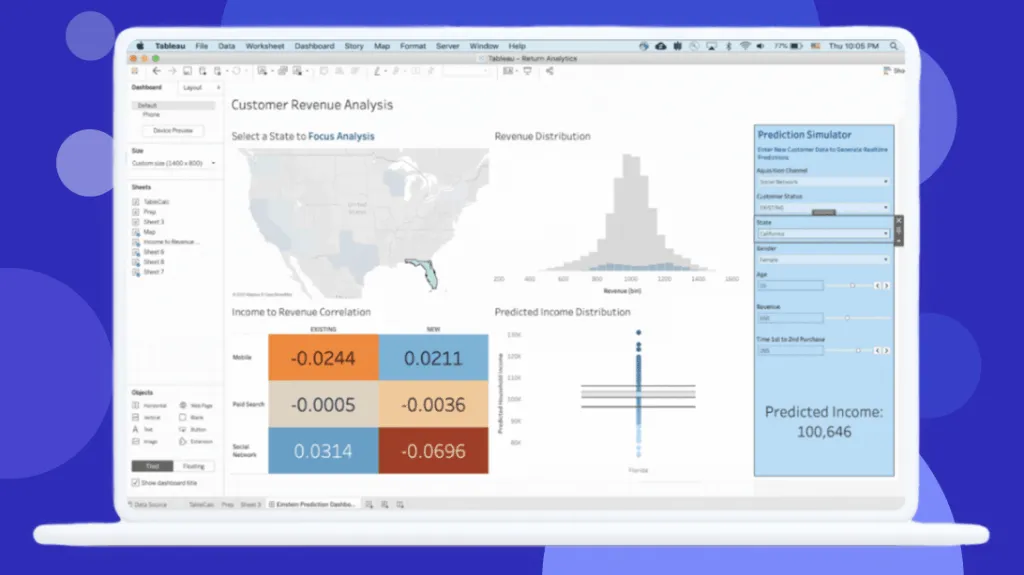
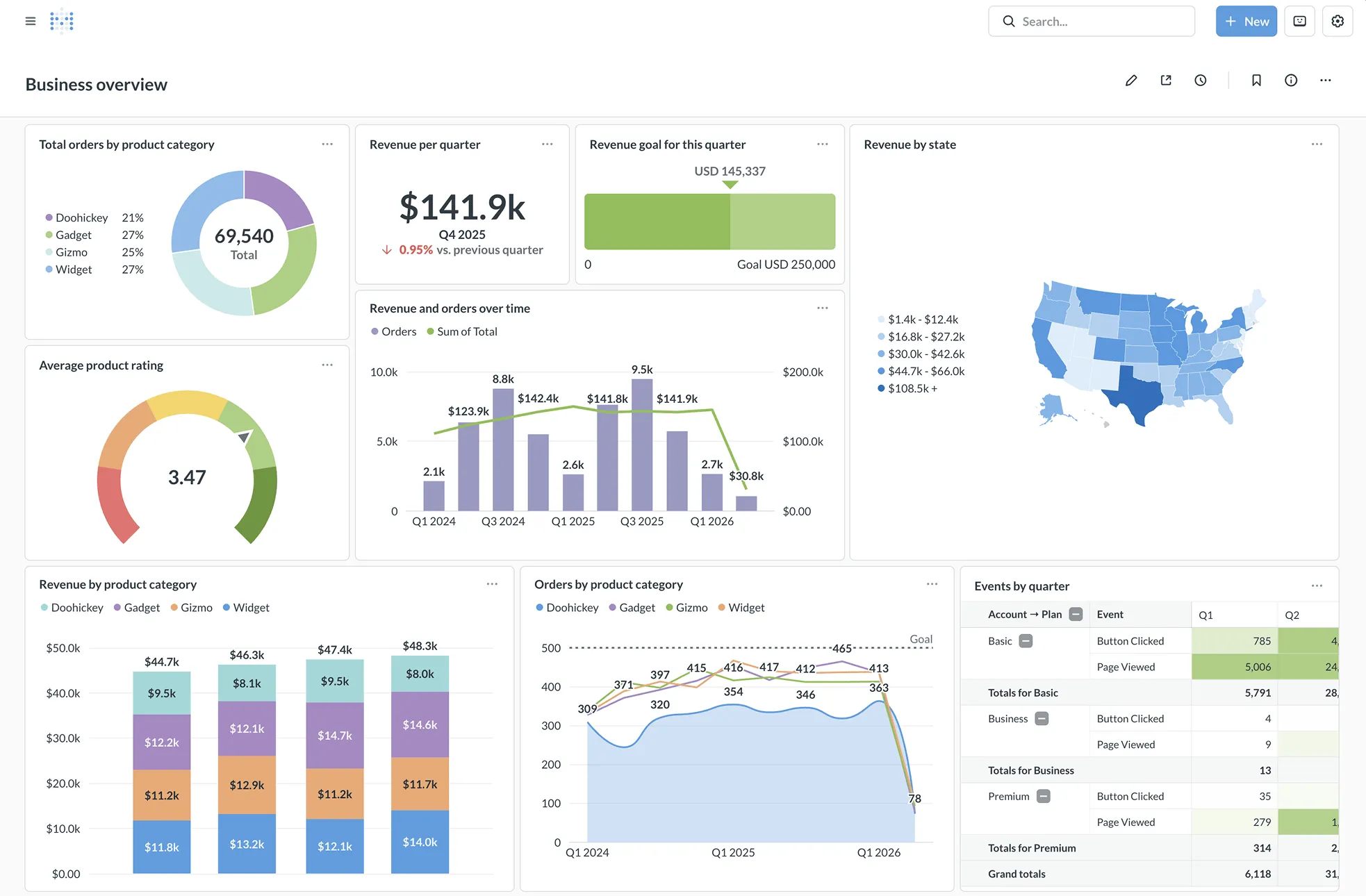
| Data Visualization | Industry-leading drag-and-drop visual analytics with interactive drill-down dashboards | Clean dashboard and chart UI with automatic x-ray reports and drill-through menus |
| Query Interface | Drag-and-drop visual query builder; no native SQL editor for end users | Visual no-code query builder plus full SQL editor for power users |
| Open Source | No — proprietary, closed-source platform owned by Salesforce | Yes — open-source core with 46,900+ GitHub stars, written in Clojure |
| Embedded Analytics | Requires Enterprise edition ($35-$115/user/mo) plus additional licensing fees | Built-in via iframes or React SDK with white-labeling on all paid plans |
| User Rating | 8.4/10 based on 2,320 reviews | 8.4/10 based on 66 reviews |
| Best For | Large enterprises with dedicated analytics teams and complex visualization needs | Startups and mid-size teams needing fast, self-service analytics without a dedicated BI team |
| Data Connectors | Broad native connectors plus Salesforce CRM integration via Data 360 unified data layer | 20+ database connectors including PostgreSQL, MySQL, BigQuery, Snowflake, and more |
Tableau
- Pricing Model:
- Tableau Cloud Standard Edition: Viewer $15/user/month, Explorer $42/user/month, Creator $75/user/month; Enterprise Edition: Viewer $35/user/month, Explorer $70/user/month, Creator $115/user/month; Tableau+ Bundle requires contact sales for pricing details.
- Deployment Options:
- Cloud (SaaS), Server (self-hosted), Desktop (local)
- Learning Curve:
- Steep — budget 40+ hours and $1,200-$2,000 per analyst for training
- Data Visualization:
- Industry-leading drag-and-drop visual analytics with interactive drill-down dashboards
- Query Interface:
- Drag-and-drop visual query builder; no native SQL editor for end users
- Open Source:
- No — proprietary, closed-source platform owned by Salesforce
- Embedded Analytics:
- Requires Enterprise edition ($35-$115/user/mo) plus additional licensing fees
- User Rating:
- 8.4/10 based on 2,320 reviews
- Best For:
- Large enterprises with dedicated analytics teams and complex visualization needs
- Data Connectors:
- Broad native connectors plus Salesforce CRM integration via Data 360 unified data layer
Metabase
- Pricing Model:
- Starter $100/mo, Pro $575/mo, Enterprise $20. Free trial available.
- Deployment Options:
- Cloud (SaaS), self-hosted, air-gapped deployments
- Learning Curve:
- Minimal — teams report querying within 5 minutes of setup
- Data Visualization:
- Clean dashboard and chart UI with automatic x-ray reports and drill-through menus
- Query Interface:
- Visual no-code query builder plus full SQL editor for power users
- Open Source:
- Yes — open-source core with 46,900+ GitHub stars, written in Clojure
- Embedded Analytics:
- Built-in via iframes or React SDK with white-labeling on all paid plans
- User Rating:
- 8.4/10 based on 66 reviews
- Best For:
- Startups and mid-size teams needing fast, self-service analytics without a dedicated BI team
- Data Connectors:
- 20+ database connectors including PostgreSQL, MySQL, BigQuery, Snowflake, and more
Public signals
Verified factual signals only. Bars appear only for like-for-like metrics with five weekly assessments for every tool; missing evidence stays explicit. These signals do not establish enterprise adoption, product quality, or total cost.
| Metric | Tableau | Metabase |
|---|---|---|
| Stack Overflow questions(Community interest) | 5.4k | 374 |
| Docker Hub pulls(Product adoption) | Not available | 268.6M |
| GitHub commits, 90d(Product adoption) | Not available | 2.0k |
| GitHub stars(Product adoption) | Not available | 48,000+ |
As of August 24, 2026 — updated weekly.
Health & risk evidence
Observed public-source checks for mapped package versions and repositories.
Tableau
August 24, 2026Package vulnerabilities
PyPI · tableauserverclient@0.41
0 vulnerabilities
across 1 package
Repository security score
Not available
Metabase
August 24, 2026Package vulnerabilities
Not available
Repository security score
github.com/metabase/metabase
5.9/10
Interface Preview
Tableau
Metabase
Feature Comparison
| Feature | Tableau | Metabase |
|---|---|---|
| Data Exploration | ||
| Visual Query Builder | Drag-and-drop interface in Desktop and web authoring for Creators and Explorers | No-code query builder available to all users; templates recurring questions with models and metrics |
| SQL Editor | Not exposed to end users; relies on visual interface and calculated fields | Built-in SQL editor lets power users write raw queries, tweak logic, and join tables directly |
| Drill-Through Analysis | Interactive drill-down on dashboard visuals with filtering and parameter actions | Auto-configured drill-through menus on charts that preempt follow-up questions without new queries |
| Deployment & Architecture | ||
| Self-Hosted Option | Tableau Server runs on-premises or private cloud; requires dedicated infrastructure and 0.5-1 FTE DBA | Single Docker command deployment; runs on any server with a JVM; supports air-gapped environments |
| Cloud Hosting | Tableau Cloud is a fully managed SaaS platform with automatic updates and infrastructure included | Metabase Cloud handles hosting and updates; Starter plan at $100/mo includes managed deployment |
| API & Extensibility | API-first composable architecture with Tableau Next; integrates with Agentforce and Slack | REST API for programmatic access; React SDK for embedded analytics; YAML-based configuration export |
| Security & Governance | ||
| Row-Level Security | Available in Enterprise edition with advanced data management and governance controls | Row-level and column-level permissions on all plans; native support for one-database-per-tenant segregation |
| SSO Integration | SSO available in Enterprise edition; integrates with SAML and Salesforce identity | SSO via SAML, LDAP, JWT, and Google authentication with automatic group mapping on paid plans |
| Usage Analytics | Admin views track content usage and license utilization across the deployment | Built-in usage analytics dashboard tracks user behavior across content, data access, and downloads |
| Collaboration & Sharing | ||
| Scheduled Reports | Email subscriptions and alerts for dashboard consumers across all license types | Scheduled delivery and alerts via email and Slack; supports custom filters and PDF/CSV/XLSX export |
| Embedded Analytics | Requires Enterprise edition plus additional licensing for external user embedding | Built-in embedding via iframes or React SDK with white-labeling; available on Starter plan at $100/mo |
| Content Curation | Tableau Public for sharing public visualizations; governed publishing from Creators to Viewers | Collections with verified items and official badges; moderated questions and automatic dependency checks |
| AI & Automation | ||
| AI-Powered Analytics | Agentforce Tableau delivers agentic AI with proactive insights and natural language data questions | Metabot AI provides single-shot SQL generation from natural language; available as add-on across plans |
| Semantic Layer | Tableau Semantics is an AI-infused semantic layer integrated with Data 360 for unified business data | Data Studio provides analyst workbench with measures, segments, SQL transforms, and dependency graphing |
| Automatic Discovery | AI-assisted semantic model creation accelerates time to insight for Creators | Automatic data model discovery with x-ray reports that generate dashboards from database tables on setup |
Data Exploration
Visual Query Builder
TableauDrag-and-drop interface in Desktop and web authoring for Creators and Explorers
MetabaseNo-code query builder available to all users; templates recurring questions with models and metrics
SQL Editor
TableauNot exposed to end users; relies on visual interface and calculated fields
MetabaseBuilt-in SQL editor lets power users write raw queries, tweak logic, and join tables directly
Drill-Through Analysis
TableauInteractive drill-down on dashboard visuals with filtering and parameter actions
MetabaseAuto-configured drill-through menus on charts that preempt follow-up questions without new queries
Deployment & Architecture
Self-Hosted Option
TableauTableau Server runs on-premises or private cloud; requires dedicated infrastructure and 0.5-1 FTE DBA
MetabaseSingle Docker command deployment; runs on any server with a JVM; supports air-gapped environments
Cloud Hosting
TableauTableau Cloud is a fully managed SaaS platform with automatic updates and infrastructure included
MetabaseMetabase Cloud handles hosting and updates; Starter plan at $100/mo includes managed deployment
API & Extensibility
TableauAPI-first composable architecture with Tableau Next; integrates with Agentforce and Slack
MetabaseREST API for programmatic access; React SDK for embedded analytics; YAML-based configuration export
Security & Governance
Row-Level Security
TableauAvailable in Enterprise edition with advanced data management and governance controls
MetabaseRow-level and column-level permissions on all plans; native support for one-database-per-tenant segregation
SSO Integration
TableauSSO available in Enterprise edition; integrates with SAML and Salesforce identity
MetabaseSSO via SAML, LDAP, JWT, and Google authentication with automatic group mapping on paid plans
Usage Analytics
TableauAdmin views track content usage and license utilization across the deployment
MetabaseBuilt-in usage analytics dashboard tracks user behavior across content, data access, and downloads
Collaboration & Sharing
Scheduled Reports
TableauEmail subscriptions and alerts for dashboard consumers across all license types
MetabaseScheduled delivery and alerts via email and Slack; supports custom filters and PDF/CSV/XLSX export
Embedded Analytics
TableauRequires Enterprise edition plus additional licensing for external user embedding
MetabaseBuilt-in embedding via iframes or React SDK with white-labeling; available on Starter plan at $100/mo
Content Curation
TableauTableau Public for sharing public visualizations; governed publishing from Creators to Viewers
MetabaseCollections with verified items and official badges; moderated questions and automatic dependency checks
AI & Automation
AI-Powered Analytics
TableauAgentforce Tableau delivers agentic AI with proactive insights and natural language data questions
MetabaseMetabot AI provides single-shot SQL generation from natural language; available as add-on across plans
Semantic Layer
TableauTableau Semantics is an AI-infused semantic layer integrated with Data 360 for unified business data
MetabaseData Studio provides analyst workbench with measures, segments, SQL transforms, and dependency graphing
Automatic Discovery
TableauAI-assisted semantic model creation accelerates time to insight for Creators
MetabaseAutomatic data model discovery with x-ray reports that generate dashboards from database tables on setup
Decision Summary
Tableau and Metabase serve fundamentally different segments of the business intelligence market. Tableau delivers enterprise-grade visual analytics with deep Salesforce integration and advanced visualization capabilities, while Metabase provides an open-source, developer-friendly analytics platform that prioritizes speed of deployment and ease of use for teams without dedicated BI professionals.
Best-fit scenarios
Choose Tableau if:
Tableau is the stronger choice for organizations that employ trained data analysts and need advanced interactive dashboards with drill-down capabilities across large, governed data environments. Its Creator-Explorer-Viewer licensing model works well when a small team of analysts builds dashboards consumed by hundreds of stakeholders. The platform's Agentforce integration and Tableau Semantics layer provide enterprise AI capabilities that Metabase does not match. However, teams should budget for the full cost of ownership: Creator licenses run $75/user/month, Explorer at $42/user/month, and Viewer at $15/user/month on the Standard Cloud edition, with Enterprise pricing nearly doubling those rates to $115, $70, and $35 per user/month respectively.
Choose Metabase if:
Metabase is the stronger choice for teams that want to go from database to dashboards in minutes rather than weeks. Its open-source core with 46,900+ GitHub stars means you can self-host for free with a single Docker command, and the visual query builder lets non-technical teammates explore data without learning SQL. For SaaS companies, the built-in embedded analytics with white-labeling via iframes or React SDK starts at $100/mo on the Starter plan, compared to Tableau's Enterprise-only embedding that requires the upper-tier licensing. The trade-off is that Metabase lacks Tableau's depth in complex visualizations and enterprise governance, but its 20+ database connectors and live query architecture eliminate the extract refresh limitations that constrain Tableau Cloud deployments.
These scenarios reflect the available product evidence. Your requirements, existing stack, and team expertise should guide the final decision.
Frequently Asked Questions
Can Metabase replace Tableau for enterprise analytics?
Metabase handles many standard BI use cases that Tableau covers, including dashboards, scheduled reports, drill-through analysis, and role-based permissions with row-level security. However, Tableau provides extensive capabilities in complex multi-dimensional visualizations, Salesforce ecosystem integration via Agentforce, and enterprise governance features that Metabase does not replicate. Organizations with dedicated analytics teams building sophisticated visual analyses will find Tableau's Creator tools more capable. Teams that primarily need self-service dashboards, embedded analytics in their product, or a lightweight BI layer on top of their database can use Metabase as a full replacement at a fraction of the cost. The decision depends on whether your use case demands Tableau's visualization depth or Metabase's deployment simplicity and open-source flexibility.
How do the total costs compare for a team of 20 users?
For a 20-person team, the cost difference is substantial. A typical Tableau Cloud Standard deployment with 2 Creators at $75/user/month, 8 Explorers at $42/user/month, and 10 Viewers at $15/user/month costs $636/month in license fees alone. Metabase's self-hosted open-source edition has no license fees for unlimited users; you only pay for server infrastructure. Metabase Cloud Starter runs $100/mo flat, and Pro at $575/mo includes self-hosted deployment options. The Enterprise tier at $20/user/month for 20 users totals $400/month. At every tier, Metabase delivers lower per-user costs, with the open-source option eliminating license fees entirely for teams willing to manage their own infrastructure.
Which tool is better for embedded analytics in a SaaS product?
Metabase is purpose-built for embedded analytics and provides this capability across all paid plans. The platform offers iframe embedding for quick integration and a React SDK for deeper customization and control, both with white-labeling support. Non-developer teammates can manage permissions, iterate on dashboards, and refine reports without engineering involvement. Tableau requires the Enterprise edition for embedded analytics, which prices Viewers at $35/month and Creators at $115/month, plus additional licensing fees depending on external user count. For SaaS companies embedding analytics into their product, the source snapshot lists Metabase's Starter plan at $100/month with embedding capabilities that scale as user counts grow. Verify current plan terms and usage limits before buying.
How do deployment and setup times compare between Tableau and Metabase?
Metabase is designed for rapid deployment. The open-source version starts with a single Docker command and teams report querying their data within 5 minutes. Automatic data model discovery generates initial dashboards from your database schema without manual configuration. Tableau requires more setup time and infrastructure planning. Tableau Cloud eliminates server management but still requires Creator licenses at $75/user/month for anyone building dashboards, and analysts typically need 40+ hours of training to reach proficiency with the Desktop application. Tableau Server deployments add additional infrastructure and administration overhead beyond license costs. Organizations that prioritize time-to-value and minimal operational overhead will find Metabase significantly faster to deploy, while teams that need Tableau's advanced visualization capabilities should plan for a longer onboarding period.