Decision comparison
pgvector vs Qdrant
pgvector is the pragmatic choice for teams that already depend on PostgreSQL and want vector search without adding infrastructure complexity. Qdrant is the stronger option for teams building dedicated AI retrieval systems that need advanced hybrid search, real-time indexing at massive scale, and purpose-built vector search performance.
Direct comparison. These are reviewed substitutes bought for the same job, so the differences below are the ones that decide between them.
All 2 are vector databases.
Quick Comparison
| Decision factor | pgvector | Qdrant |
|---|---|---|
| Best For | Teams already running PostgreSQL that need vector search alongside relational data | Teams building dedicated AI retrieval systems requiring advanced search capabilities |
| Architecture | PostgreSQL extension written in C that adds vector columns and similarity operators | Standalone vector search engine written in Rust with custom storage engine (Gridstore) |
| Pricing | Open-source (self-hosted), no paid tiers mentioned | Qdrant Cloud lists no dollar prices on its pricing page. The Free Tier is free forever: a single-node cluster with 0.5 vCPU, 1GB RAM and 4GB disk. The Standard Tier has usage-based pricing, billed hourly for vCPU, memory, storage, backup storage and paid inference tokens; the page points to a pricing calculator instead of listing rates. The Premium Tier requires a minimum spend. Hybrid Cloud and Private Cloud are priced through Qdrant's team. Verified 2026-10-05 against https://qdrant.tech/pricing/. |
| Search Capabilities | Exact and approximate nearest neighbor search with HNSW and IVFFlat index types | Native hybrid search combining dense and sparse vectors with full-spectrum reranking |
| Scalability | Sweet spot of 1 million to 50 million vectors with sub-second latency on PostgreSQL | Designed for billions of vectors with auto-sharding, distributed deployment, and edge support |
| Ease of Setup | Single CREATE EXTENSION command on any PostgreSQL 13+ instance; uses familiar SQL syntax | Standalone service with REST and gRPC APIs; Docker deployment or fully managed cloud option |
pgvector
- Best For:
- Teams already running PostgreSQL that need vector search alongside relational data
- Architecture:
- PostgreSQL extension written in C that adds vector columns and similarity operators
- Pricing:
- Open-source (self-hosted), no paid tiers mentioned
- Search Capabilities:
- Exact and approximate nearest neighbor search with HNSW and IVFFlat index types
- Scalability:
- Sweet spot of 1 million to 50 million vectors with sub-second latency on PostgreSQL
- Ease of Setup:
- Single CREATE EXTENSION command on any PostgreSQL 13+ instance; uses familiar SQL syntax
Qdrant
- Best For:
- Teams building dedicated AI retrieval systems requiring advanced search capabilities
- Architecture:
- Standalone vector search engine written in Rust with custom storage engine (Gridstore)
- Pricing:
- Qdrant Cloud lists no dollar prices on its pricing page. The Free Tier is free forever: a single-node cluster with 0.5 vCPU, 1GB RAM and 4GB disk. The Standard Tier has usage-based pricing, billed hourly for vCPU, memory, storage, backup storage and paid inference tokens; the page points to a pricing calculator instead of listing rates. The Premium Tier requires a minimum spend. Hybrid Cloud and Private Cloud are priced through Qdrant's team. Verified 2026-10-05 against https://qdrant.tech/pricing/.
- Search Capabilities:
- Native hybrid search combining dense and sparse vectors with full-spectrum reranking
- Scalability:
- Designed for billions of vectors with auto-sharding, distributed deployment, and edge support
- Ease of Setup:
- Standalone service with REST and gRPC APIs; Docker deployment or fully managed cloud option
Public signals
Verified factual signals only. Bars appear only for like-for-like metrics with five weekly assessments for every tool; missing evidence stays explicit. These signals do not establish enterprise adoption, product quality, or total cost.
| Metric | pgvector | Qdrant |
|---|---|---|
| Docker Hub pulls(Product adoption) | 236.6M | 50.3M |
| GitHub commits, 90d(Product adoption) | 118 | 972 |
| GitHub stars(Product adoption) | 23,000+ | 35,000+ |
| Search interest(Market interest) | 1 | 1 |
| Hacker News mentions, 90d(Community interest) | 5 | 6 |
| npm weekly downloads(Developer adoption) | 608.0k | 892.1k |
| PyPI weekly downloads(Developer adoption) | 8.6M | 3.2M |
| Stack Overflow questions(Community interest) | 91 | 60 |
| Hugging Face downloads(Product adoption) | Not available | 5.1M |
| Hugging Face likes(Product adoption) | Not available | 84 |
As of October 12, 2026 — updated weekly.
Health & risk evidence
Observed public-source checks for mapped package versions and repositories.
pgvector
October 12, 2026Package vulnerabilities
npm · pgvector@0.3.0 · PyPI · pgvector@0.5.1
0 vulnerabilities
across 2 packages
Repository security score
Not available
Qdrant
October 12, 2026Package vulnerabilities
npm · @qdrant/js-client-rest@1.19.0 · PyPI · qdrant-client@1.19.1
0 vulnerabilities
across 2 packages
Repository security score
Not available
Interface Preview
Qdrant
Feature Comparison
| Feature | pgvector | Qdrant |
|---|---|---|
| Indexing & Search | ||
| HNSW Indexing | Supported with configurable m and ef_construction parameters for speed-recall tradeoff | GPU-accelerated HNSW with filterable traversal applied during search, not as post-filter |
| IVFFlat Indexing | Supported with parallel worker builds and configurable list/probe parameters | Not available; Qdrant focuses exclusively on HNSW-based indexing architecture |
| Hybrid Search | Supported via sparse vectors and combining multiple distance operators in queries | Native dense plus sparse vector search in one query with BM25, SPLADE++, and miniCOIL support |
| Vector Types & Distance Metrics | ||
| Supported Vector Types | Single-precision, half-precision (up to 4000 dims), binary, and sparse vector types | Dense vectors, sparse vectors, and built-in multivector for multi-modal representations |
| Distance Metrics | L2, inner product, cosine, L1, Hamming, and Jaccard distance functions | Cosine, dot product, Euclidean, and Manhattan distance metrics optimized per use case |
| Quantization | Binary quantization available for reducing storage footprint of vector data | Asymmetric, scalar, and binary quantization reducing memory usage by up to 64x |
| Filtering & Querying | ||
| Metadata Filtering | Full SQL WHERE clause filtering using standard PostgreSQL indexes and query planner | JSON payload filters with nested, text, geo, and has_vector conditions during HNSW traversal |
| Iterative Scanning | Iterative index scans prevent overfiltering with configurable max_scan_tuples threshold | Efficient one-stage filtering applied during graph traversal eliminates need for iterative scans |
| Reranking | Manual reranking via SQL ORDER BY clauses and custom scoring expressions | Built-in score boosting, late interaction models like ColBERT, and Maximum Marginal Relevance |
| Deployment & Operations | ||
| Deployment Model | Self-hosted PostgreSQL extension; available on major managed PostgreSQL providers | Self-hosted, Docker, Kubernetes, managed cloud, hybrid cloud, private cloud, and edge deployment |
| Real-Time Indexing | Standard PostgreSQL insert and update operations; index builds recommended after bulk loads | Vectors are searchable the moment they are added without requiring index rebuilds |
| Compliance & Security | Inherits PostgreSQL ACID compliance, point-in-time recovery, and role-based access controls | SOC 2 and HIPAA compliant with SSO, multitenancy, granular RBAC, and vector-scoped API keys |
| Developer Experience | ||
| API & Language Support | Any language with a PostgreSQL client driver; familiar SQL syntax for all vector operations | REST and gRPC APIs with official Python, JavaScript, Rust, and Go client libraries |
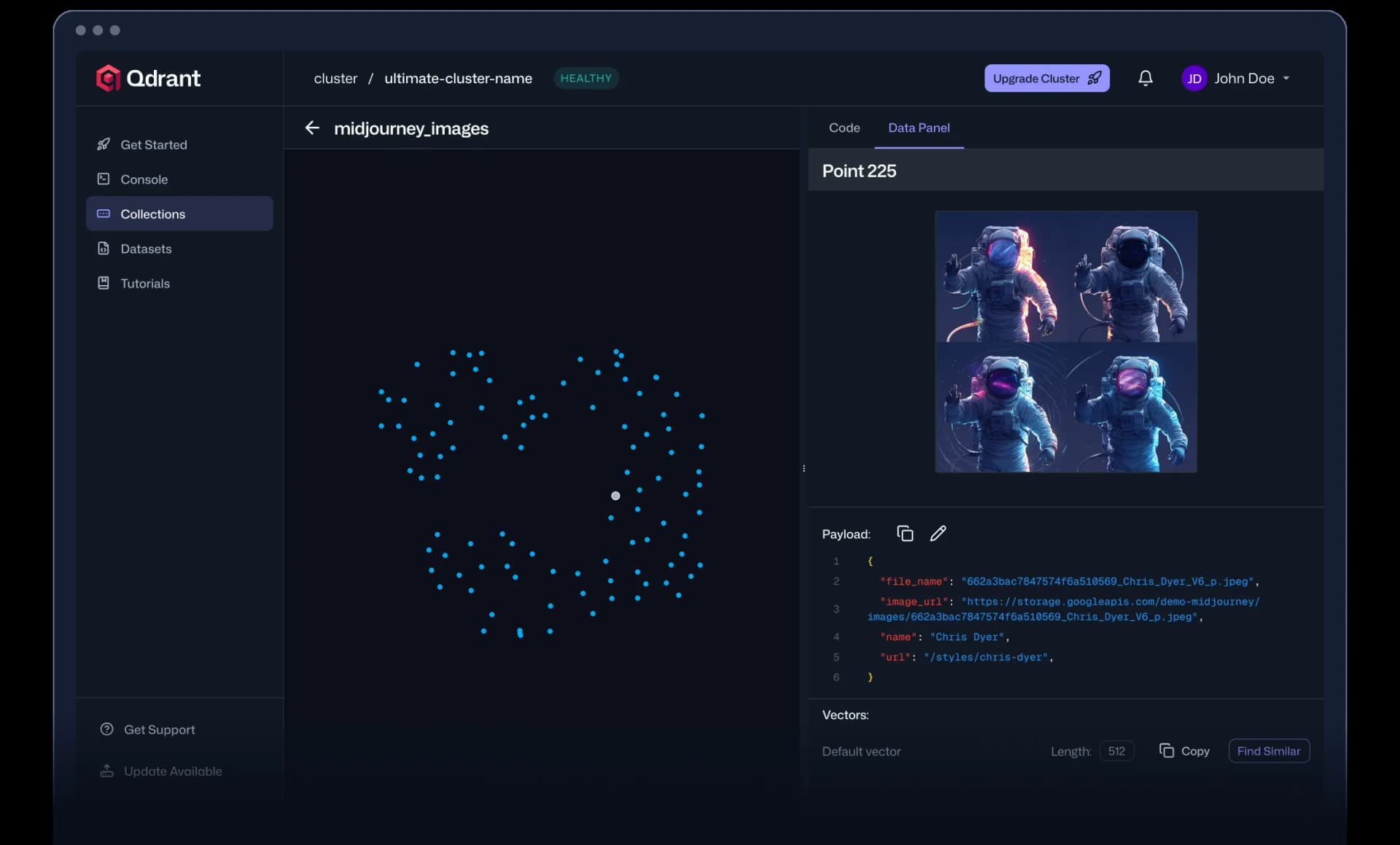
| Tooling | Standard PostgreSQL tooling including pg_stat for monitoring and EXPLAIN for query analysis | Built-in web UI for collection exploration, query testing, and result visualization |
| Ecosystem Integration | Works with LangChain, pgvector Python bindings, and any PostgreSQL ORM or framework | Integrations with LangChain, LlamaIndex, and native cloud inference for embedding generation |
Indexing & Search
HNSW Indexing
IVFFlat Indexing
Hybrid Search
Vector Types & Distance Metrics
Supported Vector Types
Distance Metrics
Quantization
Filtering & Querying
Metadata Filtering
Iterative Scanning
Reranking
Deployment & Operations
Deployment Model
Real-Time Indexing
Compliance & Security
Developer Experience
API & Language Support
Tooling
Ecosystem Integration
Which to choose
pgvector is the pragmatic choice for teams that already depend on PostgreSQL and want vector search without adding infrastructure complexity. Qdrant is the stronger option for teams building dedicated AI retrieval systems that need advanced hybrid search, real-time indexing at massive scale, and purpose-built vector search performance.
Best-fit scenarios
Choose pgvector if:
We recommend pgvector for teams that already run PostgreSQL in production and want to add vector similarity search without introducing a separate database. It shines when you need to combine vector search with relational queries using JOINs and SQL aggregations, and when your dataset stays within the 1 to 50 million vector range. The zero additional infrastructure cost and familiar SQL interface make it the fastest path to production-ready vector search.
Choose Qdrant if:
We recommend Qdrant for teams building dedicated AI search and retrieval applications that demand high vector search performance. Its native hybrid search combining dense and sparse vectors, GPU-accelerated HNSW, and real-time indexing make it the better fit when you need to scale to billions of vectors. The managed cloud offering with SOC 2 and HIPAA compliance, combined with flexible deployment options from edge to enterprise, gives teams a clear production path.
These scenarios reflect the available product evidence. Your requirements, existing stack, and team expertise should guide the final decision.
Frequently Asked Questions
Can pgvector handle the same scale as Qdrant for vector search workloads?
pgvector works well for datasets between 1 million and 50 million vectors with sub-second search latency. For workloads beyond that range, particularly those requiring millisecond latency on billions of vectors, Qdrant is purpose-built to handle that scale. Qdrant uses a custom Rust-based storage engine (Gridstore) with SIMD optimizations and supports auto-sharding across distributed nodes, while pgvector inherits PostgreSQL scaling constraints.
Is pgvector truly free compared to Qdrant's pricing model?
pgvector is fully open-source with no paid tiers. You install it as a PostgreSQL extension on your existing infrastructure at no additional software cost. Qdrant offers a free cloud tier with 1GB of storage, but production deployments on Qdrant Cloud require paid plans. Qdrant is also open-source under the Apache 2.0 license for self-hosted deployments, so both tools can be run at zero software cost if you manage your own infrastructure.
Which tool has better hybrid search capabilities for RAG applications?
Qdrant has a clear advantage for hybrid search in RAG applications. It natively combines dense and sparse vector search in a single query and supports retrieval models like BM25, SPLADE++, and miniCOIL out of the box. pgvector supports sparse vectors and you can combine multiple distance operators, but building a full hybrid search pipeline requires more manual SQL engineering. Qdrant also includes built-in reranking with ColBERT and Maximum Marginal Relevance, which pgvector does not offer natively.
What are the key differences in filtering between pgvector and Qdrant?
pgvector leverages the full power of PostgreSQL's WHERE clause, standard B-tree indexes, and the query planner for filtering. This means you can use any SQL expression alongside vector search. Qdrant applies metadata filters during HNSW graph traversal in a single stage, avoiding the performance penalty of pre-filtering or post-filtering. Qdrant supports specialized filter types including nested JSON, geo-spatial, and has_vector conditions. pgvector introduced iterative index scans in version 0.8.0 to prevent overfiltering, which helps close the gap.