Decision comparison
Milvus vs Qdrant
Milvus and Qdrant are both production-ready open-source vector databases, but they serve different operational priorities. Milvus is built for teams that need to scale vector search to tens of billions of vectors with a flexible deployment ladder from a pip-installable library to fully distributed enterprise clusters. Qdrant is built for teams that need maximum search precision and developer ergonomics, with native hybrid retrieval, one-stage filtering, advanced quantization, and a Rust-powered engine that prioritizes speed and memory efficiency. The choice depends on whether your primary constraint is scale and deployment flexibility or search quality and real-time performance.
Direct comparison. These are reviewed substitutes bought for the same job, so the differences below are the ones that decide between them.
All 2 are vector databases.
Quick Comparison
| Decision factor | Milvus | Qdrant |
|---|---|---|
| Core Language | Go/C++ with Python SDK | Rust with Python, JavaScript, and gRPC clients |
| Deployment Model | Lite, Standalone, Distributed, Zilliz Cloud (managed) | Cloud, Hybrid Cloud, Private Cloud, Edge (Beta) |
| Hybrid Search | Metadata filtering and hybrid search supported | Native dense + sparse vector blending with BM25 and SPLADE++ |
| Quantization | Supports vector compression for large-scale deployments | Asymmetric, scalar, and binary quantization (up to 64x memory reduction) |
| Pricing Model | Milvus is free and open source, and free to self-host. Fully managed Milvus is a separate product, Zilliz Cloud, which publishes its own serverless and dedicated tiers and quotes enterprise deployments. | Free Tier free, $1 (no specific tier mentioned) |
| GitHub Stars | Not publicly listed on context data | 33,000+ stars on GitHub |
| Best For | Massive-scale GenAI apps needing tens of billions of vectors | Production AI search with real-time indexing and advanced filtering |
Milvus
- Core Language:
- Go/C++ with Python SDK
- Deployment Model:
- Lite, Standalone, Distributed, Zilliz Cloud (managed)
- Hybrid Search:
- Metadata filtering and hybrid search supported
- Quantization:
- Supports vector compression for large-scale deployments
- Pricing Model:
- Milvus is free and open source, and free to self-host. Fully managed Milvus is a separate product, Zilliz Cloud, which publishes its own serverless and dedicated tiers and quotes enterprise deployments.
- GitHub Stars:
- Not publicly listed on context data
- Best For:
- Massive-scale GenAI apps needing tens of billions of vectors
Qdrant
- Core Language:
- Rust with Python, JavaScript, and gRPC clients
- Deployment Model:
- Cloud, Hybrid Cloud, Private Cloud, Edge (Beta)
- Hybrid Search:
- Native dense + sparse vector blending with BM25 and SPLADE++
- Quantization:
- Asymmetric, scalar, and binary quantization (up to 64x memory reduction)
- Pricing Model:
- Free Tier free, $1 (no specific tier mentioned)
- GitHub Stars:
- 33,000+ stars on GitHub
- Best For:
- Production AI search with real-time indexing and advanced filtering
Public signals
Verified factual signals only. Bars appear only for like-for-like metrics with five weekly assessments for every tool; missing evidence stays explicit. These signals do not establish enterprise adoption, product quality, or total cost.
| Metric | Milvus | Qdrant |
|---|---|---|
| Docker Hub pulls(Product adoption) | 78.9M | 46.6M |
| GitHub commits, 90d(Product adoption) | 718 | 754 |
| GitHub stars(Product adoption) | 46,000+ | 34,000+ |
| Search interest(Market interest) | 2 | 3 |
| Hacker News mentions, 90d(Community interest) | 0 | 8 |
| npm weekly downloads(Developer adoption) | 133.5k | 601.6k |
| PyPI weekly downloads(Developer adoption) | 883.0k | 2.7M |
| Stack Overflow questions(Community interest) | 209 | 60 |
| Hugging Face downloads(Product adoption) | Not available | 3.9M |
| Hugging Face likes(Product adoption) | Not available | 69 |
As of September 21, 2026 — updated weekly.
Health & risk evidence
Observed public-source checks for mapped package versions and repositories.
Milvus
September 21, 2026Package vulnerabilities
npm · @zilliz/milvus2-sdk-node@3.0.6 · PyPI · pymilvus@3.0.2
0 vulnerabilities
across 2 packages
Repository security score
Not available
Qdrant
September 21, 2026Package vulnerabilities
npm · @qdrant/js-client-rest@1.19.0 · PyPI · qdrant-client@1.19.1
0 vulnerabilities
across 2 packages
Repository security score
Not available
Interface Preview
Milvus
Qdrant
Feature Comparison
| Feature | Milvus | Qdrant |
|---|---|---|
| Search Capabilities | ||
| Vector Similarity Search | Global Index for high-speed search across tens of billions of vectors with minimal performance loss | HNSW-based search built in Rust with SIMD optimizations and custom Gridstore engine |
| Hybrid Search | Metadata filtering and hybrid search capabilities with multi-vector support | Native dense + sparse vector blending in one query with BM25, SPLADE++, and miniCOIL support |
| Filtering | Metadata filtering on vector attributes during search | One-stage filtering applied during HNSW traversal with no pre- or post-filtering overhead |
| Performance & Storage | ||
| Quantization | Vector compression supported for large-scale deployments | Asymmetric, scalar, and binary quantization reducing memory by up to 64x while maintaining search quality |
| Real-Time Indexing | Batch and streaming insertion supported with indexing optimized for large datasets | Real-time indexing with vectors searchable the instant they are added |
| Memory Efficiency | Cloud-native stateless components designed for elastic scaling across large vector sets | Memory-efficient storage architecture supporting billions of vectors with minimal memory footprint |
| Deployment & Scalability | ||
| Deployment Options | Milvus Lite (pip install), Standalone (single machine), Distributed (enterprise), Zilliz Cloud (managed) | Qdrant Cloud (managed), Hybrid Cloud (BYOK), Private Cloud (air-gapped), Edge (Beta) |
| Scaling Architecture | Distributed architecture with separated storage and computation; horizontal scaling to billions of vectors | Auto-sharding and high availability on AWS, GCP, or Azure with decoupled control and data planes |
| Enterprise Security | Role-based access control with enterprise-grade security in distributed deployments | SOC 2 and HIPAA compliant with SSO, RBAC, private networking, and vector-scoped API keys |
| Developer Experience | ||
| API & SDKs | Python SDK with pip install; write once and deploy with one line of code | REST, gRPC, and official clients for Python and JavaScript with advanced HNSW control |
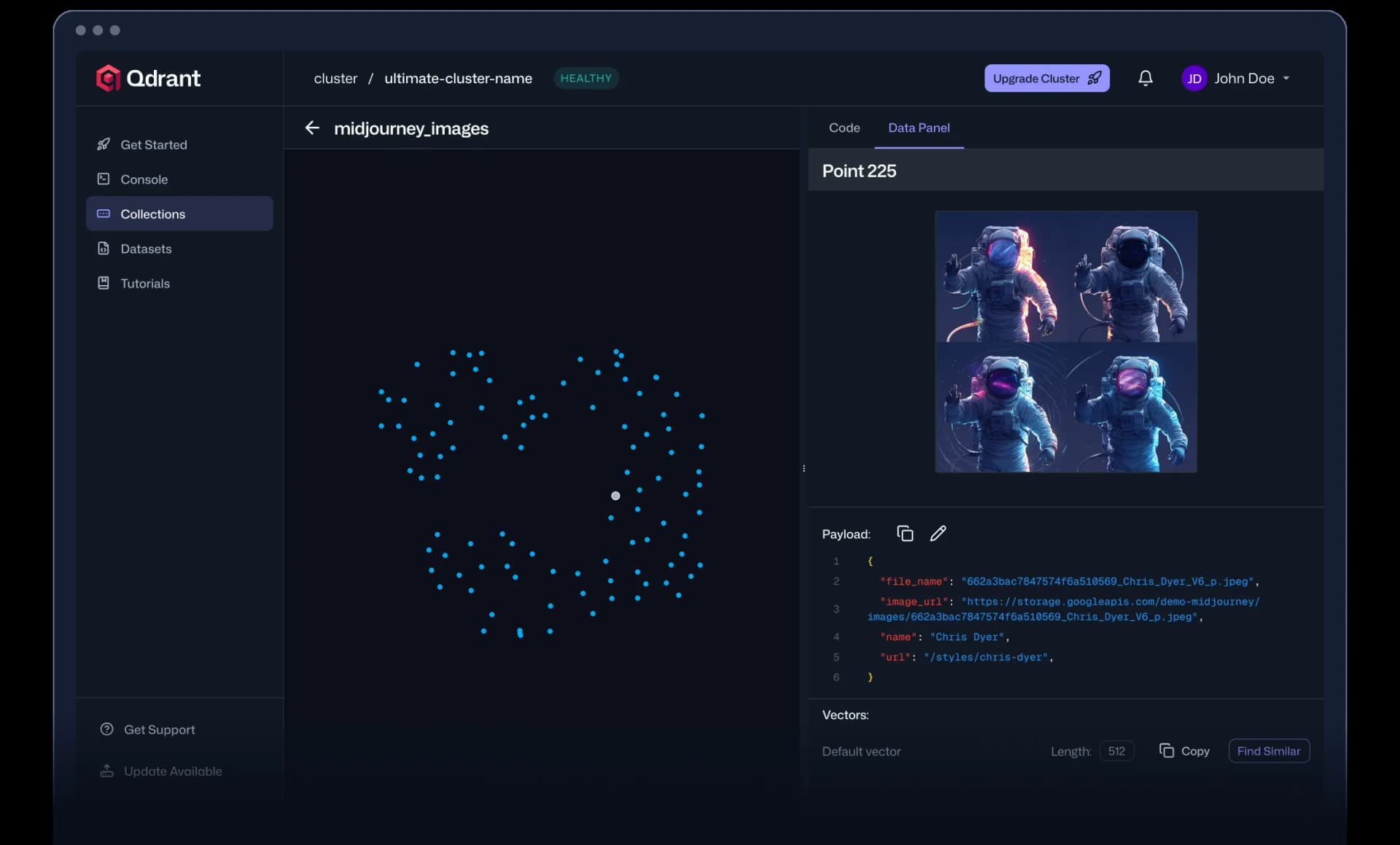
| Built-in Tooling | Integration with popular AI dev tools; guided notebooks for RAG, image search, and multimodal search | Built-in Web UI for exploring collections, testing queries, and inspecting results; native cloud inference |
| Reranking & Relevance | Multi-vector support for improved relevance across different embedding types | Full-spectrum reranking with score boosting, ColBERT late interaction, and MMR diversification |
| Use Cases | ||
| Primary Use Cases | RAG, image search, multimodal search, hybrid search, and Graph RAG applications | RAG, AI agents, semantic search, recommendation systems, and anomaly detection |
| Multivector Support | Multi-vector capabilities for cross-modal similarity matching | Built-in multivector for expressive, flexible, and multimodal retrieval per object |
| Community & Ecosystem | Large supportive community with extensive resources and regular Unstructured Data Meetups | 33,000+ GitHub stars, 60,000+ community members, Apache-2.0 licensed, active development |
Search Capabilities
Vector Similarity Search
Hybrid Search
Filtering
Performance & Storage
Quantization
Real-Time Indexing
Memory Efficiency
Deployment & Scalability
Deployment Options
Scaling Architecture
Enterprise Security
Developer Experience
API & SDKs
Built-in Tooling
Reranking & Relevance
Use Cases
Primary Use Cases
Multivector Support
Community & Ecosystem
Which to choose
Milvus and Qdrant are both production-ready open-source vector databases, but they serve different operational priorities. Milvus is built for teams that need to scale vector search to tens of billions of vectors with a flexible deployment ladder from a pip-installable library to fully distributed enterprise clusters. Qdrant is built for teams that need maximum search precision and developer ergonomics, with native hybrid retrieval, one-stage filtering, advanced quantization, and a Rust-powered engine that prioritizes speed and memory efficiency. The choice depends on whether your primary constraint is scale and deployment flexibility or search quality and real-time performance.
Best-fit scenarios
Choose Milvus if:
Choose Milvus if your application needs to scale to tens of billions of vectors and you want a graduated deployment path. Start with Milvus Lite for prototyping in notebooks, move to Standalone for production datasets up to millions of vectors, and scale to Milvus Distributed for enterprise workloads. Zilliz Cloud provides a fully managed option with both serverless and dedicated clusters. Milvus is the stronger choice for teams building GenAI applications that expect rapid data growth and need elastic horizontal scaling across complex infrastructure.
Choose Qdrant if:
Choose Qdrant if search precision and developer experience are your top priorities. Its native hybrid search blending dense and sparse vectors, one-stage filtering during HNSW traversal, full-spectrum reranking, and up to 64x memory reduction through quantization make it the more feature-rich engine for sophisticated retrieval patterns. Qdrant's free cloud tier, built-in Web UI, and native cloud inference lower the barrier to production deployment. Teams building AI agents, recommendation systems, or real-time search applications will benefit from Qdrant's real-time indexing and Rust-powered performance.
These scenarios reflect the available product evidence. Your requirements, existing stack, and team expertise should guide the final decision.
Frequently Asked Questions
What is the main difference between Milvus and Qdrant?
Milvus is a Go/C++ vector database focused on massive-scale deployments that can handle tens of billions of vectors through its distributed architecture with separated storage and computation. Qdrant is a Rust-based vector search engine optimized for production-grade AI search with native hybrid retrieval, one-stage filtering during HNSW traversal, and advanced quantization that reduces memory usage by up to 64x. Milvus emphasizes flexible deployment tiers from lightweight prototyping to enterprise clusters, while Qdrant emphasizes search precision with features like full-spectrum reranking and built-in multivector support.
Which vector database is better for RAG applications?
Both platforms support RAG workloads effectively, but they approach the problem differently. Milvus offers guided notebooks specifically for RAG, hybrid search, and Graph RAG patterns, making it straightforward to prototype and deploy retrieval pipelines. Qdrant provides native hybrid search that blends dense and sparse vectors in a single query with BM25 and SPLADE++ support, plus full-spectrum reranking with ColBERT late interaction models. For teams that need token-level precision in retrieval, Qdrant's native hybrid capabilities give it an edge. For teams scaling RAG across massive vector collections, Milvus's distributed architecture is a strong fit.
How do Milvus and Qdrant compare on pricing?
Milvus is open-source and free to self-host, with Zilliz Cloud offering a fully managed option in both serverless and dedicated cluster configurations. Qdrant is also open-source under the Apache-2.0 license, with Qdrant Cloud providing a free tier for getting started and usage-based pricing that scales with production workloads. Qdrant's free-forever 1GB cluster on Qdrant Cloud gives teams a risk-free starting point. Both vendors offer enterprise plans through direct sales for organizations with advanced security and compliance requirements.
Can Milvus and Qdrant handle real-time data ingestion?
Qdrant explicitly supports real-time indexing where vectors become searchable the moment they are added, with no need to rebuild the entire index. Milvus supports both batch and streaming insertion optimized for large-scale datasets, with its cloud-native stateless architecture designed for continuous data ingestion. For use cases where sub-second search availability after insertion is critical, such as real-time recommendation engines or live anomaly detection, Qdrant's real-time indexing architecture is purpose-built for that pattern.
Which vector database has better community support?
Both platforms have strong open-source communities. Qdrant is an Apache-2.0-licensed project with public documentation and release information. Confirm the current release and support options before deployment. Milvus has a large developer community with regular Unstructured Data Meetups and extensive documentation resources. Both projects maintain active GitHub repositories, comprehensive documentation, and responsive community channels. Qdrant's GitHub metrics are publicly stronger, while Milvus leverages its Zilliz-backed ecosystem for enterprise support.