Decision comparison
LanceDB vs Milvus
LanceDB and Milvus both serve as capable open-source vector databases, but they target different segments of the AI infrastructure stack. LanceDB positions itself as a multimodal lakehouse that unifies storage, search, feature engineering, and model training in one platform. Milvus focuses on delivering high-performance vector similarity search with a battle-tested distributed architecture that scales to tens of billions of vectors.
Direct comparison. These are reviewed substitutes bought for the same job, so the differences below are the ones that decide between them.
All 2 are vector databases.
Quick Comparison
| Decision factor | LanceDB | Milvus |
|---|---|---|
| Best For | Multimodal AI workloads combining vectors, text, images, and training pipelines in a unified lakehouse | High-performance GenAI applications requiring similarity search across tens of billions of vectors |
| Architecture | Embedded database with columnar storage, compute-storage separation, and zero-copy versioning | Cloud-native distributed system with stateless components and separated storage and computation |
| Deployment Model | Runs in-process via pip install or as a cloud service with S3, GCS, and Azure support | Four tiers from Milvus Lite in notebooks to Milvus Distributed and fully managed Zilliz Cloud |
| Scalability | Petabyte-scale tables with automatic compression and compute-storage separation for up to 100x cost savings | Scales elastically to tens of billions of vectors with horizontal scaling and minimal performance loss |
| Search Capabilities | Hybrid search over vectors and multimodal data with SQL queries, filtering, and cross-encoder reranking | Global Index for blazing-fast vector similarity search with metadata filtering and multi-vector support |
| Pricing Model | Open-source (self-hosted), cloud pricing available upon contact | Milvus is free and open source, and free to self-host. Fully managed Milvus is a separate product, Zilliz Cloud, which publishes its own serverless and dedicated tiers and quotes enterprise deployments. |
LanceDB
- Best For:
- Multimodal AI workloads combining vectors, text, images, and training pipelines in a unified lakehouse
- Architecture:
- Embedded database with columnar storage, compute-storage separation, and zero-copy versioning
- Deployment Model:
- Runs in-process via pip install or as a cloud service with S3, GCS, and Azure support
- Scalability:
- Petabyte-scale tables with automatic compression and compute-storage separation for up to 100x cost savings
- Search Capabilities:
- Hybrid search over vectors and multimodal data with SQL queries, filtering, and cross-encoder reranking
- Pricing Model:
- Open-source (self-hosted), cloud pricing available upon contact
Milvus
- Best For:
- High-performance GenAI applications requiring similarity search across tens of billions of vectors
- Architecture:
- Cloud-native distributed system with stateless components and separated storage and computation
- Deployment Model:
- Four tiers from Milvus Lite in notebooks to Milvus Distributed and fully managed Zilliz Cloud
- Scalability:
- Scales elastically to tens of billions of vectors with horizontal scaling and minimal performance loss
- Search Capabilities:
- Global Index for blazing-fast vector similarity search with metadata filtering and multi-vector support
- Pricing Model:
- Milvus is free and open source, and free to self-host. Fully managed Milvus is a separate product, Zilliz Cloud, which publishes its own serverless and dedicated tiers and quotes enterprise deployments.
Public signals
Verified factual signals only. Bars appear only for like-for-like metrics with five weekly assessments for every tool; missing evidence stays explicit. These signals do not establish enterprise adoption, product quality, or total cost.
| Metric | LanceDB | Milvus |
|---|---|---|
| GitHub commits, 90d(Product adoption) | 471 | 653 |
| GitHub stars(Product adoption) | 11,000+ | 46,000+ |
| Search interest(Market interest) | 0 | 1 |
| Hacker News mentions, 90d(Community interest) | 8 | 0 |
| npm weekly downloads(Developer adoption) | 472.3k | 147.3k |
| PyPI weekly downloads(Product adoption) | 1.8M | Not available |
| Stack Overflow questions(Community interest) | 1 | 208 |
| Docker Hub pulls(Product adoption) | Not available | 79.4M |
| PyPI weekly downloads(Developer adoption) | Not available | 759.1k |
As of October 12, 2026 — updated weekly.
Health & risk evidence
Observed public-source checks for mapped package versions and repositories.
LanceDB
October 12, 2026Package vulnerabilities
npm · @lancedb/lancedb@0.40.0 · PyPI · lancedb@0.40.0
0 vulnerabilities
across 2 packages
Repository security score
Not available
Milvus
October 12, 2026Package vulnerabilities
npm · @zilliz/milvus2-sdk-node@3.0.6 · PyPI · pymilvus@3.0.2
0 vulnerabilities
across 2 packages
Repository security score
Not available
Interface Preview
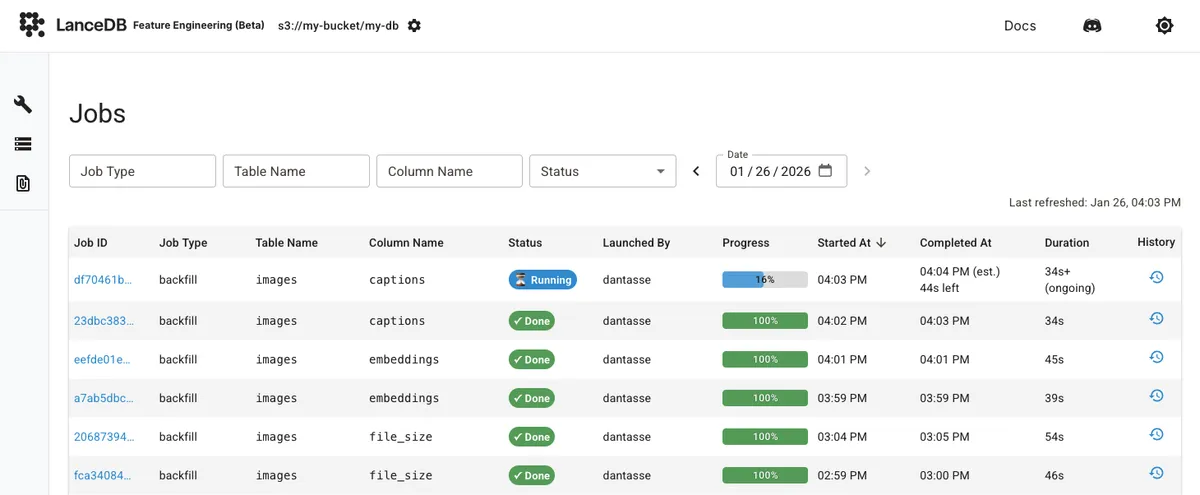
LanceDB
Milvus
Feature Comparison
| Feature | LanceDB | Milvus |
|---|---|---|
| Core Database Architecture | ||
| Storage Format | Columnar Lance format with automatic compression, zero-copy versioning, and native multimodal blob storage | Cloud-native architecture with stateless components and fully separated storage and computation layers |
| Deployment Options | Embedded in-process database via pip install, self-hosted on local storage or cloud object stores (S3, GCS, Azure) | Four-tier deployment: Milvus Lite for notebooks, Standalone for single-machine, Distributed for enterprise, Zilliz Cloud for managed |
| Scalability | Petabyte-scale single tables with compute-storage separation delivering up to 100x cost savings over traditional databases | Horizontal elastic scaling to support tens of billions of vectors with minimal performance degradation |
| Search and Retrieval | ||
| Vector Search | IVF-PQ vector indexing with automatic index creation based on column data types and GPU-accelerated index building | Global Index technology for blazing-fast vector similarity search with consistent speed regardless of dataset scale |
| Hybrid Search | Combined vector similarity and full-text search with SQL filtering, cross-encoder reranking, and multimodal data queries | Metadata filtering and hybrid search with multi-vector support for combining different embedding types |
| Query Language | High-performance SQL for multimodal data with support for decoding audio, video, and image data types directly in queries | Purpose-built API with collection-based queries, filtering expressions, and similarity search with relevance scoring |
| Data Management | ||
| Versioning | Zero-copy automatic versioning with fine-grained data evolution, enabling column additions without full dataset rewrites | Collection-based data management with create, insert, search, and delete operations through a straightforward API |
| Multimodal Support | Native storage and querying of text, images, videos, point clouds, and audio within a single unified lakehouse | Primarily vector-focused with multimodal search capabilities through embedding-based approaches and metadata |
| Data Processing | Declarative, distributed batch UDFs with native LLM-as-UDF support for automated feature engineering at scale | Reusable code deployment with one line of code to move from development to production environments |
| Integrations and SDKs | ||
| Language Support | Native SDKs for Rust, Python, and JavaScript/TypeScript with zero-copy interoperability via Apache Arrow | Python SDK with pip install, plus client libraries and extensive community-contributed integrations |
| AI Framework Integration | Direct integrations with LangChain, LlamaIndex, Pandas, Polars, DuckDB, and PyTorch/JAX training pipelines | Broad ecosystem of AI development tool integrations with notebook-based quickstart guides for RAG and search |
| Cloud Storage | S3-compatible object storage, Google Cloud Storage, Azure Blob Storage, Alibaba Cloud OSS, and HuggingFace Hub | Cloud-native deployment with Zilliz Cloud offering serverless and dedicated clusters with SaaS and BYOC options |
| Enterprise and Compliance | ||
| Security Compliance | Enterprise-grade with SOC2 Type II, GDPR, and HIPAA compliance certifications for regulated industries | Enterprise-grade solution through Zilliz Cloud with SaaS and BYOC options for security and compliance requirements |
| Production Readiness | Used in production by companies including Harvey (legal AI) and Runway (generative AI) for mission-critical workloads | Trusted for production workloads across organizations building GenAI applications at scale |
| Training Pipeline Support | Optimized dataloading with global shuffling and integrated filters for large-scale PyTorch and JAX model training | Focused on inference-time vector search and retrieval rather than direct training pipeline integration |
Core Database Architecture
Storage Format
Deployment Options
Scalability
Search and Retrieval
Vector Search
Hybrid Search
Query Language
Data Management
Versioning
Multimodal Support
Data Processing
Integrations and SDKs
Language Support
AI Framework Integration
Cloud Storage
Enterprise and Compliance
Security Compliance
Production Readiness
Training Pipeline Support
Which to choose
LanceDB and Milvus both serve as capable open-source vector databases, but they target different segments of the AI infrastructure stack. LanceDB positions itself as a multimodal lakehouse that unifies storage, search, feature engineering, and model training in one platform. Milvus focuses on delivering high-performance vector similarity search with a battle-tested distributed architecture that scales to tens of billions of vectors.
Best-fit scenarios
Choose LanceDB if:
We recommend LanceDB for teams building multimodal AI applications that need more than just vector search. If your workflow spans embedding generation, hybrid search over text and images, feature engineering with LLM-as-UDF, and model training pipelines, LanceDB consolidates these into a single lakehouse. Its embedded architecture runs in-process without infrastructure overhead, and its columnar Lance format with zero-copy versioning makes iterating on petabyte-scale datasets practical. Teams at companies like Harvey and Runway rely on it for production multimodal workloads.
Choose Milvus if:
We recommend Milvus for teams that need a dedicated, high-throughput vector similarity search engine at massive scale. If your primary requirement is searching tens of billions of vectors with minimal latency, Milvus delivers through its Global Index and fully distributed cloud-native architecture. The four-tier deployment model from Milvus Lite to Zilliz Cloud gives you a clear growth path from prototyping to enterprise production. Choose Milvus when vector search performance and horizontal scalability are your top priorities and you handle data processing separately.
These scenarios reflect the available product evidence. Your requirements, existing stack, and team expertise should guide the final decision.
Frequently Asked Questions
What is the main architectural difference between LanceDB and Milvus?
LanceDB operates as an embedded, in-process database built on its columnar Lance storage format. It runs directly within your application without requiring a separate server, similar to how SQLite works but designed for multimodal AI data. Milvus, by contrast, uses a cloud-native distributed architecture where all components are stateless with fully separated storage and computation. This means Milvus requires infrastructure management but provides elastic horizontal scaling. LanceDB achieves scalability through compute-storage separation on object stores like S3, while Milvus scales through distributed stateless nodes.
Can LanceDB and Milvus both handle multimodal data like images and videos?
LanceDB has native multimodal data support as a core design principle. It stores and queries text, images, videos, audio, and point clouds within its columnar format, allowing you to run SQL queries that decode audio tracks or extract video frames directly. Milvus handles multimodal search through an embedding-based approach, meaning you convert multimodal data into vectors externally and then search those vectors within Milvus. For teams that need to store raw multimodal assets alongside their embeddings and query both together, LanceDB provides a more integrated solution.
Which database is better for building RAG applications?
Both databases work well for RAG applications, but they approach the problem differently. Milvus offers a streamlined RAG experience with its pip-installable Milvus Lite, ready-made notebook examples, and direct integrations with popular AI frameworks. LanceDB also supports RAG through integrations with LangChain and LlamaIndex, and adds hybrid search with cross-encoder reranking and full-text search built in. For a straightforward RAG pipeline focused on vector retrieval, Milvus gets you started quickly. For RAG applications that combine vector search with SQL filtering, multimodal data, and custom reranking, LanceDB provides more built-in capabilities.
How do the pricing models compare between LanceDB and Milvus?
Both LanceDB and Milvus offer open-source versions that you can self-host at no licensing cost. LanceDB is fully open-source for self-hosted deployments and offers a cloud service with pricing available upon request. Milvus is open-source at its core, with Zilliz Cloud providing a fully managed service in both serverless and dedicated cluster configurations with SaaS and BYOC deployment options. Neither tool publishes specific dollar amounts for their managed services. For teams wanting to minimize costs, both offer capable self-hosted options, with LanceDB having the advantage of running embedded without server infrastructure.