Zilliz: product and architecture
This Zilliz review covers the fully managed vector database cloud service built on the open-source Milvus project by the team that created it. Zilliz Cloud provides a managed Milvus experience with enterprise features including automated scaling, the proprietary Cardinal search engine, and multi-cloud deployment across AWS, Azure, and GCP. The platform supports billion-scale vector search and is trusted by over 10,000 enterprise users. Named a leader in the Forrester Wave for Vector Database Providers in Q3 2024, Zilliz delivers high-performance vector similarity search for AI applications including retrieval augmented generation, recommender systems, semantic search, and AI agents. We evaluate Zilliz's architecture, pricing tiers, use cases, and how it compares to Pinecone, Qdrant, ChromaDB, and the self-hosted Milvus option.
Overview
Zilliz is the commercial cloud offering built on top of Milvus, the open-source vector database with over 43,000 GitHub stars and 100 million+ downloads. Zilliz Cloud removes the operational overhead of running Milvus by providing a fully managed service with enterprise-grade features, while the underlying Milvus engine handles the vector indexing and search.
The platform targets AI engineering teams building applications that require vector similarity search at scale. Common workloads include retrieval augmented generation (RAG) for LLM applications, recommendation engines, semantic text search, image and audio similarity search, and multimodal retrieval. Zilliz claims 10x quick vector retrieval compared to self-hosted Milvus through its Cardinal search engine, which combines IVF and graph indexing techniques with hardware-level optimizations.
Zilliz Cloud operates across eight regions on AWS, Azure, and GCP, with both serverless and dedicated deployment options. The platform meets SOC2 Type II and ISO27001 security standards, supports role-based access control (RBAC), and provides 99.95% monthly uptime SLA on the Enterprise tier. Production customers include Beatoven.ai, Picdmo, Monterey AI, Ivy.ai, BOSCH, Shulex, Rexera, Sarvam, and MindStudio.
Key Features and Architecture
Zilliz's architecture layers managed cloud services on top of the Milvus vector database engine, adding performance optimizations and enterprise features.
Cardinal Search Engine is Zilliz's proprietary indexing technology that delivers a 10x vector retrieval speedup compared to standard Milvus. It combines advanced IVF and graph-based indexing with a smart query optimizer that automatically selects the optimal search algorithm for each dataset, along with end-to-end optimizations across algorithms, systems, and hardware.
Hybrid Search enables querying across multiple vector fields simultaneously, supporting multimodal, sparse-dense, and dense-text combinations for more accurate results. This is critical for RAG applications that need to combine semantic vector search with keyword-based filtering.
AutoIndex automatically optimizes index configurations to balance recall and performance, eliminating the need for manual tuning. Teams get optimal search quality without deep vector database expertise.
Built-in Embedding Pipelines convert unstructured data into searchable vector embeddings, handling the full workflow from data preparation through chunking, model selection, and transformation. This reduces the engineering effort needed to build a complete vector search pipeline.
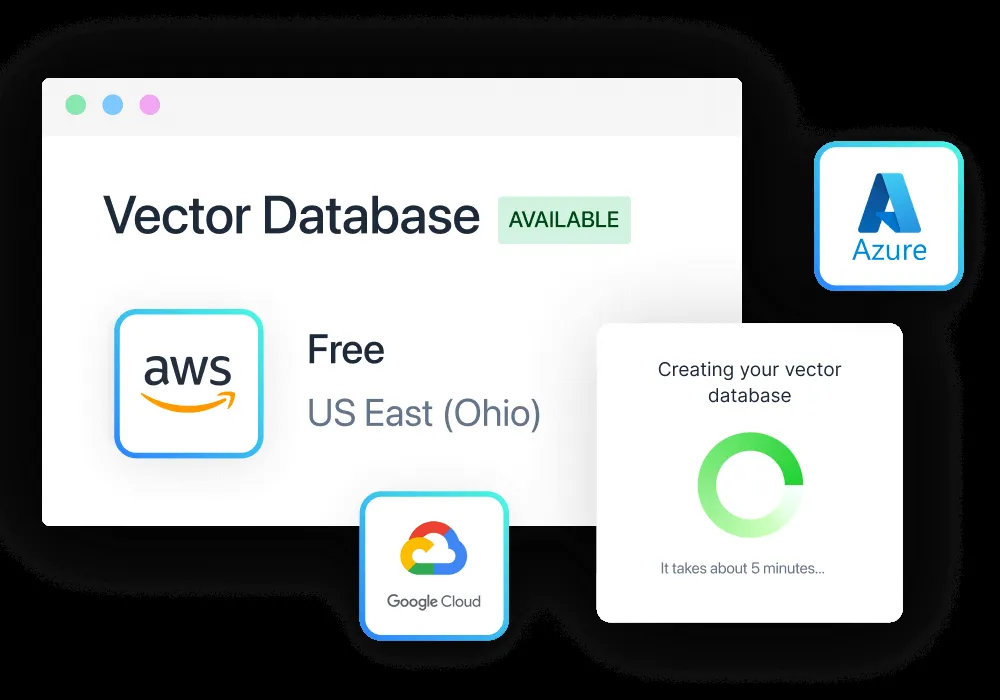
Multi-Cloud Deployment supports AWS, Azure, and GCP across eight regions worldwide. Deployment options include fully managed clusters, serverless endpoints, and bring-your-own-cloud (BYOC) for organizations with strict data residency requirements.
Tiered Storage automatically moves data between hot and cold storage tiers to optimize cost and performance. Combined with elastic scaling, this allows clusters to handle workload fluctuations without over-provisioning resources.
Enterprise Security meets SOC2 Type II and ISO27001 standards, supports SAML 2.0-based SSO, granular RBAC, private endpoints, VPC peering, and CMEK encryption. The Business Critical tier adds HIPAA eligibility.
Ideal Use Cases
Zilliz is best suited for AI engineering teams building production RAG applications that need reliable, low-latency vector retrieval at scale. Teams running LLM-powered applications that retrieve context from millions of documents or knowledge base entries will benefit from Zilliz's managed infrastructure and Cardinal engine performance.
Recommendation system teams building personalized product, content, or media recommendations at scale represent a core Zilliz use case. The platform's dedicated compute and elastic scaling handle the high-throughput, low-latency requirements of production recommendation engines serving millions of users.
Companies building multimodal search across text, images, audio, and video will benefit from Zilliz's hybrid search capability, which supports querying across multiple vector field types in a single request. Rexera reported a 40% accuracy improvement using this feature.
Organizations that currently self-host Milvus and want to reduce operational overhead should evaluate Zilliz Cloud. Shulex reported lower operational costs, increased search speed, and a more stable user experience after migrating from self-hosted Milvus to Zilliz Cloud.
Zilliz is not the best fit for teams with small-scale vector search needs (under a few hundred thousand vectors) where the free tier of simpler solutions like ChromaDB would suffice. It is also overkill for prototyping and experimentation where a local Milvus instance provides sufficient performance.
Strengths & Trade-offs
Pros:
- Free plan includes 5 GB storage, 2.5M vCUs per month, and up to 5 collections for learning and personal projects
- Standard supports serverless and dedicated deployments, with core APIs, backup and restore, basic monitoring, and encryption in transit and at rest
- Enterprise includes a 99.95% uptime SLA, audit logs, SSO, granular RBAC, multi-replica scaling, private endpoints, and VPC peering
- The plans shown support AWS and Google Cloud, while Dedicated Enterprise and Business Critical also list Azure
- Dedicated cluster types offer performance-, capacity-, and tiered-storage options for different search and dataset needs
Cons:
- Enterprise Dedicated pricing starts at $197/month, while Standard pricing differs between Serverless and Dedicated deployments
- Business Critical does not show a dollar amount on the pricing page; it is labeled “Let's Talk,” so buyers need to confirm its commercial terms
- Calculator results are estimates and may differ from actual costs, so projected spending should be validated with a proof of concept
- Dedicated-cluster capacity figures are based on 768-dimensional-vector evaluations, and additional scalar fields may reduce capacity