Decision comparison
ChromaDB vs Milvus
ChromaDB and Milvus are both open-source vector databases licensed under Apache 2.0, but they target different points on the complexity-scale spectrum. ChromaDB is the developer-first choice, offering a unified search platform that combines dense vectors, sparse vectors, full-text, regex, and metadata filtering in a serverless architecture built on object storage. Its zero-ops cloud deployment, automatic data tiering, and deep LLM framework integrations make it the fastest path from prototype to production for AI and RAG applications. Milvus is the scale-first choice, providing a fully distributed architecture with separated storage and computation that handles tens of billions of vectors with high availability. Its Global Index, multiple deployment tiers, and the Zilliz Cloud managed service make it the go-to database for enterprise teams running similarity search at massive scale across production workloads.
Direct comparison. These are reviewed substitutes bought for the same job, so the differences below are the ones that decide between them.
All 2 are vector databases.
Quick Comparison
| Decision factor | ChromaDB | Milvus |
|---|---|---|
| Architecture | Serverless with automatic data tiering on object storage (S3/GCS) | Cloud-native distributed architecture with separated storage and computation |
| Scale Target | Billions of vectors across multi-tenant indexes; 5M records per collection | Tens of billions of vectors with horizontal scaling and high availability |
| Search Methods | Vector, sparse vector (BM25/SPLADE), full-text, regex, and metadata filtering | Vector similarity search, metadata filtering, and hybrid search |
| Deployment Model | Local pip/npm install, Docker, Chroma Cloud (serverless), or BYOC in your VPC | Milvus Lite (pip install), Standalone (Docker), Distributed (Kubernetes), or Zilliz Cloud |
| Pricing Model | Chroma Cloud Starter is $0/month plus usage with $5 in free credits. Usage is $2.50 per GiB written, $0.33 per GiB-month stored, $0.0075 per TiB queried, and $0.09 per GiB returned. Team is $250/month plus usage with $100 credits; Enterprise is custom. | Milvus is free and open source, and free to self-host. Fully managed Milvus is a separate product, Zilliz Cloud, which publishes its own serverless and dedicated tiers and quotes enterprise deployments. |
| Best For | RAG prototyping, LLM applications, and teams wanting zero-ops serverless vector search | Enterprise-scale similarity search, recommendation systems, and production workloads at billion-vector scale |
ChromaDB
- Architecture:
- Serverless with automatic data tiering on object storage (S3/GCS)
- Scale Target:
- Billions of vectors across multi-tenant indexes; 5M records per collection
- Search Methods:
- Vector, sparse vector (BM25/SPLADE), full-text, regex, and metadata filtering
- Deployment Model:
- Local pip/npm install, Docker, Chroma Cloud (serverless), or BYOC in your VPC
- Pricing Model:
- Chroma Cloud Starter is $0/month plus usage with $5 in free credits. Usage is $2.50 per GiB written, $0.33 per GiB-month stored, $0.0075 per TiB queried, and $0.09 per GiB returned. Team is $250/month plus usage with $100 credits; Enterprise is custom.
- Best For:
- RAG prototyping, LLM applications, and teams wanting zero-ops serverless vector search
Milvus
- Architecture:
- Cloud-native distributed architecture with separated storage and computation
- Scale Target:
- Tens of billions of vectors with horizontal scaling and high availability
- Search Methods:
- Vector similarity search, metadata filtering, and hybrid search
- Deployment Model:
- Milvus Lite (pip install), Standalone (Docker), Distributed (Kubernetes), or Zilliz Cloud
- Pricing Model:
- Milvus is free and open source, and free to self-host. Fully managed Milvus is a separate product, Zilliz Cloud, which publishes its own serverless and dedicated tiers and quotes enterprise deployments.
- Best For:
- Enterprise-scale similarity search, recommendation systems, and production workloads at billion-vector scale
Public signals
Verified factual signals only. Bars appear only for like-for-like metrics with five weekly assessments for every tool; missing evidence stays explicit. These signals do not establish enterprise adoption, product quality, or total cost.
| Metric | ChromaDB | Milvus |
|---|---|---|
| Docker Hub pulls(Product adoption) | 8.1M | 79.4M |
| GitHub commits, 90d(Product adoption) | 120 | 653 |
| GitHub stars(Product adoption) | 29,000+ | 46,000+ |
| Search interest(Market interest) | 1 | 1 |
| Hacker News mentions, 90d(Community interest) | 1 | 0 |
| Hugging Face downloads(Product adoption) | 725 | Not available |
| Hugging Face likes(Product adoption) | 427 | Not available |
| npm weekly downloads(Developer adoption) | 245.6k | 147.3k |
| PyPI weekly downloads(Product adoption) | 1.8M | Not available |
| Stack Overflow questions(Community interest) | 266 | 208 |
| PyPI weekly downloads(Developer adoption) | Not available | 759.1k |
As of October 12, 2026 — updated weekly.
Health & risk evidence
Observed public-source checks for mapped package versions and repositories.
ChromaDB
October 12, 2026Package vulnerabilities
npm · chromadb@3.5.0 · PyPI · chromadb@1.5.9
8 vulnerabilities
across 2 packages
Repository security score
Not available
Milvus
October 12, 2026Package vulnerabilities
npm · @zilliz/milvus2-sdk-node@3.0.6 · PyPI · pymilvus@3.0.2
0 vulnerabilities
across 2 packages
Repository security score
Not available
Interface Preview
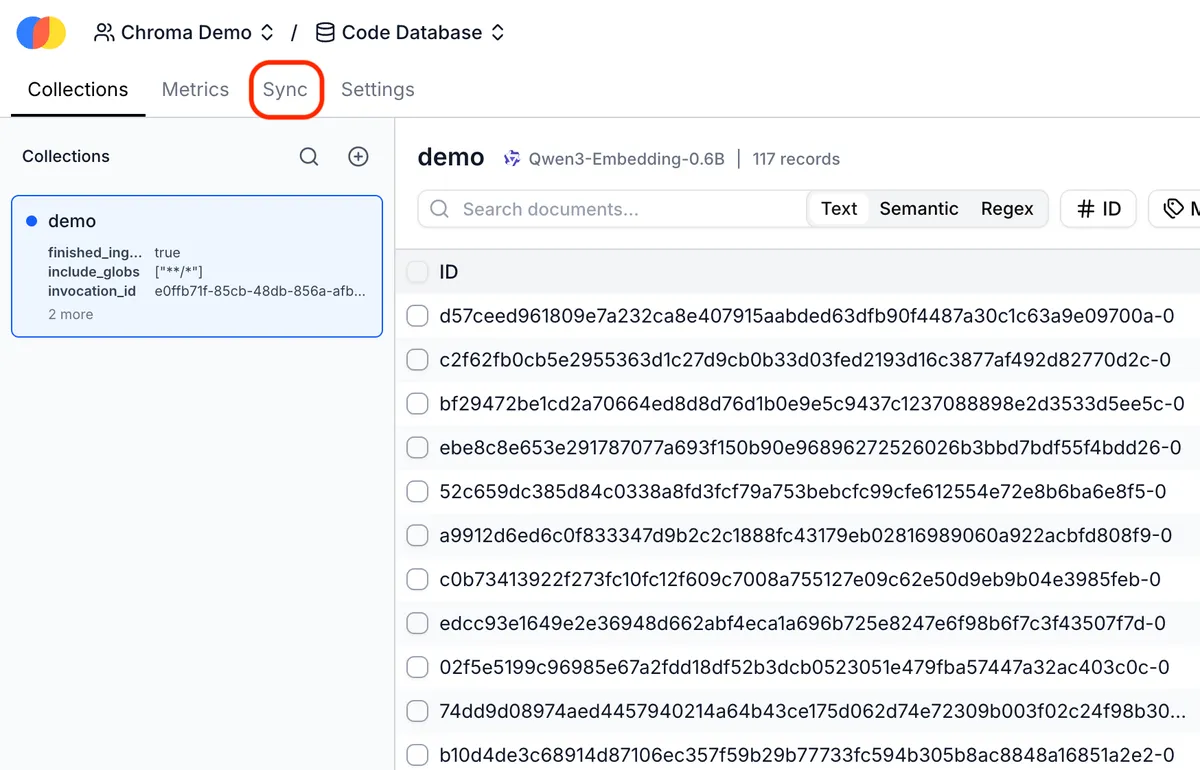
ChromaDB
Milvus
Feature Comparison
| Feature | ChromaDB | Milvus |
|---|---|---|
| Search Capabilities | ||
| Dense Vector Search | Semantic similarity search with 90-100% recall at 5M records per collection | Global Index for fast vector similarity search with minimal performance loss at massive scale |
| Sparse Vector Search | First-class BM25 and SPLADE support for lexical search | Supported through hybrid search capabilities |
| Full-Text and Regex Search | Trigram-based full-text search and regex matching built into the query engine | Not a core capability; primarily focused on vector similarity search |
| Metadata Filtering | Faceted search with filtering across metadata fields alongside vector queries | Feature-rich metadata filtering that can be combined with vector search |
| Scalability & Performance | ||
| Maximum Scale | Billions of vectors across multi-tenant indexes; 5M records per individual collection | Tens of billions of vectors with distributed architecture and horizontal scaling |
| Query Latency | p50 20ms warm / 650ms cold; p99 57ms warm / 1.5s cold at 384 dimensions and 100K vectors | Optimized for high-speed retrieval; specific latency depends on deployment configuration and scale |
| Write Throughput | 30 MB/s (2000+ QPS) per collection with concurrent reads at 200+ QPS | Designed for high-throughput ingestion in distributed mode across multiple nodes |
| Deployment & Operations | ||
| Local Development | pip install or npm install with in-memory or persistent storage for rapid prototyping | Milvus Lite runs in notebooks and laptops via pip install for learning and prototyping |
| Production Deployment | Chroma Cloud (fully managed serverless) or BYOC with VPC support and multi-region replication | Milvus Standalone for single-machine or Milvus Distributed on Kubernetes for enterprise scale |
| Managed Cloud Service | Chroma Cloud with serverless pricing, auto-scaling, and zero operational overhead | Zilliz Cloud (fully managed Milvus) with serverless and dedicated cluster options plus BYOC |
| Developer Experience | ||
| SDK Support | Python, TypeScript/JavaScript, and Rust CLIs with consistent API across all environments | Python SDK (PyMilvus) as the primary interface; additional community SDKs available |
| Dataset Management | Collection forking with copy-on-write for A/B testing, versioning, and rollouts | Collection-based data organization with partition support for efficient data management |
| Open Source Community | Apache 2.0 license; 26K+ GitHub stars; 5M+ monthly downloads; 90K+ dependent repos | Apache 2.0 license; 35K+ GitHub stars; active community with meetups and contributor ecosystem |
| AI Framework Integration | Deep integrations with LangChain, LlamaIndex, and the extensive LLM application ecosystem | Integrates with major AI development tools; guided notebooks for RAG, image search, and hybrid search |
Search Capabilities
Dense Vector Search
Sparse Vector Search
Full-Text and Regex Search
Metadata Filtering
Scalability & Performance
Maximum Scale
Query Latency
Write Throughput
Deployment & Operations
Local Development
Production Deployment
Managed Cloud Service
Developer Experience
SDK Support
Dataset Management
Open Source Community
AI Framework Integration
Which to choose
ChromaDB and Milvus are both open-source vector databases licensed under Apache 2.0, but they target different points on the complexity-scale spectrum. ChromaDB is the developer-first choice, offering a unified search platform that combines dense vectors, sparse vectors, full-text, regex, and metadata filtering in a serverless architecture built on object storage. Its zero-ops cloud deployment, automatic data tiering, and deep LLM framework integrations make it the fastest path from prototype to production for AI and RAG applications. Milvus is the scale-first choice, providing a fully distributed architecture with separated storage and computation that handles tens of billions of vectors with high availability. Its Global Index, multiple deployment tiers, and the Zilliz Cloud managed service make it the go-to database for enterprise teams running similarity search at massive scale across production workloads.
Best-fit scenarios
Choose ChromaDB if:
Choose ChromaDB if you are building LLM-powered applications, RAG pipelines, or AI search features and want the fastest path from development to production. Its serverless architecture eliminates infrastructure management, and its unified search across vector, sparse, full-text, and metadata queries reduces the need for separate search systems. Teams using LangChain or LlamaIndex will find ChromaDB's integrations particularly seamless. The usage-based cloud pricing makes costs predictable for growing workloads, and the open-source codebase ensures no vendor lock-in.
Choose Milvus if:
Choose Milvus if your production workload requires searching across tens of billions of vectors with high availability and horizontal scaling. Its distributed architecture with separated storage and computation gives engineering teams fine-grained control over performance, and the progression from Milvus Lite through Standalone to Distributed means you can grow without rewriting code. Organizations already running Kubernetes infrastructure will find Milvus Distributed a natural fit, and Zilliz Cloud provides a fully managed option for teams that want enterprise-grade scale without self-hosting overhead.
These scenarios reflect the available product evidence. Your requirements, existing stack, and team expertise should guide the final decision.
Frequently Asked Questions
What is the main difference between ChromaDB and Milvus?
ChromaDB is a lightweight, serverless vector database optimized for developer experience and rapid prototyping of LLM and RAG applications. It combines vector search with sparse vector, full-text, regex, and metadata search in a single query interface built on object storage. Milvus is a distributed vector database engineered for enterprise-scale production workloads, capable of handling tens of billions of vectors with horizontal scaling and high availability. ChromaDB prioritizes simplicity and zero-ops deployment, while Milvus prioritizes raw scale and distributed reliability.
Which vector database handles larger datasets better?
Milvus has the edge for extremely large datasets. Its fully distributed architecture with separated storage and computation allows it to scale horizontally to tens of billions of vectors with minimal performance loss. ChromaDB supports billions of vectors across multi-tenant indexes but caps individual collections at 5M records. For datasets in the hundreds of millions to billions of vectors range where horizontal scaling and high availability are critical, Milvus is the stronger choice. For datasets up to low billions where serverless simplicity matters more, ChromaDB is well-suited.
Can ChromaDB and Milvus both be used for RAG applications?
Yes. Both databases are commonly used as the retrieval layer in RAG pipelines. ChromaDB is particularly popular in the RAG ecosystem due to its deep integrations with LangChain and LlamaIndex, its simple API, and its ability to combine dense vector search with sparse vector search (BM25/SPLADE) for better retrieval quality. Milvus also supports RAG workflows and provides guided notebooks for building RAG applications. The choice depends on scale requirements: ChromaDB for rapid development and moderate-scale deployments, Milvus for production systems processing billions of vectors.
How do the pricing models compare between ChromaDB and Milvus?
ChromaDB uses usage-based pricing for its cloud service, starting with free credits and scaling through tiers from $5/mo to $250/mo. The open-source version is free to self-host. Milvus is fully open-source and free to self-host in any deployment mode (Lite, Standalone, or Distributed). For managed cloud services, Zilliz Cloud (the commercial Milvus offering) requires contacting sales for pricing and offers both serverless and dedicated cluster options. Teams on a tight budget can self-host either database for free, but ChromaDB's cloud pricing is more transparent than Zilliz Cloud's contact-for-pricing model.
Which database is easier to get started with?
Both databases offer quick local setup via pip install. ChromaDB is widely considered the easier starting point for developers new to vector databases. Its Python and JavaScript APIs are minimal, and you can go from installation to querying in under 30 seconds according to their documentation. Milvus Lite provides a similar lightweight entry point. The difference becomes more apparent at scale: ChromaDB's serverless cloud removes all operational overhead, while scaling Milvus to its distributed mode requires Kubernetes expertise and more infrastructure management.