Decision comparison
Retool vs Appsmith vs Budibase
Retool leads in enterprise polish and native mobile support, Appsmith wins on open-source transparency and developer control, and Budibase excels at AI-driven operational automation and cost-effective self-hosting.
All 3 are internal tool builders, so the differences below are the ones that decide between them.
Quick Comparison
| Decision factor | Retool | Appsmith | Budibase |
|---|---|---|---|
| Best For | Enterprise engineering teams building mission-critical internal tools with native mobile support and the broadest component library | Engineering teams that prioritize open-source transparency, Git-native development workflows, and deep code-level control | Operations teams and IT departments seeking AI agent automation with a built-in database and generous self-hosted free tier |
| Licensing | Proprietary platform with no source code access; deployment repository on GitHub with 600+ stars | Open-source under Apache 2.0 license with 41,000+ GitHub stars; Community Edition fully maintained with public roadmap | Open-source under GPLv3 license with 28,000+ GitHub stars; source code available for forking and modification |
| Pricing Model | Free tier available, $75 | Community is the free, self-hosted open-source edition. Free is $0 for individual developers and small teams. Business is $15 per user per month. Enterprise is $2,500 per month for 100 users, with custom arrangements quote-based. | Budibase Pro $19/mo, Premium $49/mo, Business $299/mo, Contact sales for Enterprise Budibase cloud plans are priced for yearly billing: Pro $19 per month (1 creator), Premium $49 per month (1 creator) and Business $299 per month (3 creators), with extra creators at $50 per creator per month and end users at $5 per user per month. Monthly billing is the yearly price plus 20%. Verified 2026-10-05 against https://budibase.com/pricing/. |
| AI Capabilities | AI AppGen generates apps from natural language; AI-native building blocks for LLM responses and workflow automation | AI copilot generates JavaScript code and suggests widgets from natural language; integrates with OpenAI and Anthropic APIs | Multi-model AI agents with OpenAI, Anthropic, Mistral, and Google; RAG knowledge retrieval with pgvector support |
| Database Support | 46+ native database integrations including PostgreSQL, MySQL, MongoDB, and BigQuery; built-in managed Postgres database | 25+ databases including PostgreSQL, MySQL, MongoDB, Redis, and Snowflake; no built-in database, requires external sources | PostgreSQL, MySQL, MongoDB, SQL Server, and more; built-in CouchDB database for starting without external setup |
| Deployment | Cloud-hosted or self-hosted via Docker, Kubernetes, AWS, GCP, and Azure with enterprise on-premise options | Self-hosting on any edition including free tier; air-gapped deployments supported; Docker-based with full data sovereignty | Self-hosting via Docker, Kubernetes, or Digital Ocean; GPLv3 allows unlimited users on self-hosted free tier |
Retool
- Best For:
- Enterprise engineering teams building mission-critical internal tools with native mobile support and the broadest component library
- Licensing:
- Proprietary platform with no source code access; deployment repository on GitHub with 600+ stars
- Pricing Model:
- Free tier available, $75
- AI Capabilities:
- AI AppGen generates apps from natural language; AI-native building blocks for LLM responses and workflow automation
- Database Support:
- 46+ native database integrations including PostgreSQL, MySQL, MongoDB, and BigQuery; built-in managed Postgres database
- Deployment:
- Cloud-hosted or self-hosted via Docker, Kubernetes, AWS, GCP, and Azure with enterprise on-premise options
Appsmith
- Best For:
- Engineering teams that prioritize open-source transparency, Git-native development workflows, and deep code-level control
- Licensing:
- Open-source under Apache 2.0 license with 41,000+ GitHub stars; Community Edition fully maintained with public roadmap
- Pricing Model:
- Community is the free, self-hosted open-source edition. Free is $0 for individual developers and small teams. Business is $15 per user per month. Enterprise is $2,500 per month for 100 users, with custom arrangements quote-based.
- AI Capabilities:
- AI copilot generates JavaScript code and suggests widgets from natural language; integrates with OpenAI and Anthropic APIs
- Database Support:
- 25+ databases including PostgreSQL, MySQL, MongoDB, Redis, and Snowflake; no built-in database, requires external sources
- Deployment:
- Self-hosting on any edition including free tier; air-gapped deployments supported; Docker-based with full data sovereignty
Budibase
- Best For:
- Operations teams and IT departments seeking AI agent automation with a built-in database and generous self-hosted free tier
- Licensing:
- Open-source under GPLv3 license with 28,000+ GitHub stars; source code available for forking and modification
- Pricing Model:
- Budibase Pro $19/mo, Premium $49/mo, Business $299/mo, Contact sales for Enterprise Budibase cloud plans are priced for yearly billing: Pro $19 per month (1 creator), Premium $49 per month (1 creator) and Business $299 per month (3 creators), with extra creators at $50 per creator per month and end users at $5 per user per month. Monthly billing is the yearly price plus 20%. Verified 2026-10-05 against https://budibase.com/pricing/.
- AI Capabilities:
- Multi-model AI agents with OpenAI, Anthropic, Mistral, and Google; RAG knowledge retrieval with pgvector support
- Database Support:
- PostgreSQL, MySQL, MongoDB, SQL Server, and more; built-in CouchDB database for starting without external setup
- Deployment:
- Self-hosting via Docker, Kubernetes, or Digital Ocean; GPLv3 allows unlimited users on self-hosted free tier
Public signals
Verified factual signals only. Bars appear only for like-for-like metrics with five weekly assessments for every tool; missing evidence stays explicit. These signals do not establish enterprise adoption, product quality, or total cost.
| Metric | Retool | Appsmith | Budibase |
|---|---|---|---|
| Docker Hub pulls(Product adoption) | 51.8M | 20.2M | 2.3M |
| GitHub commits, 90d(Developer adoption) | 13 | Not available | Not available |
| GitHub stars(Developer adoption) | 685 | Not available | Not available |
| Search interest(Market interest) | 1 | 0 | 0 |
| npm weekly downloads(Developer adoption) | 28.5k | Not available | 6.4k |
| Product Hunt comments(Community interest) | 1 | 0 | 70 |
| Product Hunt rating(Community interest) | Unavailable | 4.9/5 | 5.0/5 |
| Product Hunt reviews(Community interest) | 0 | 32 | 4 |
| Product Hunt votes(Community interest) | 8 | 23 | 308 |
| Stack Overflow questions(Community interest) | 63 | 22 | 7 |
| GitHub commits, 90d(Product adoption) | Not available | 171 | 2.3k |
| GitHub stars(Product adoption) | Not available | 41,000+ | 28,000+ |
As of October 12, 2026 — updated weekly.
Health & risk evidence
Observed public-source checks for mapped package versions and repositories.
Retool
October 12, 2026Package vulnerabilities
npm · @tryretool/custom-component-support@1.9.0
0 vulnerabilities
across 1 package
Repository security score
Not available
Appsmith
Package vulnerabilities
Not available
Repository security score
Not available
Budibase
October 12, 2026Package vulnerabilities
npm · @budibase/client@3.38.1
0 vulnerabilities
across 1 package
Repository security score
Not available
Interface Preview
Retool
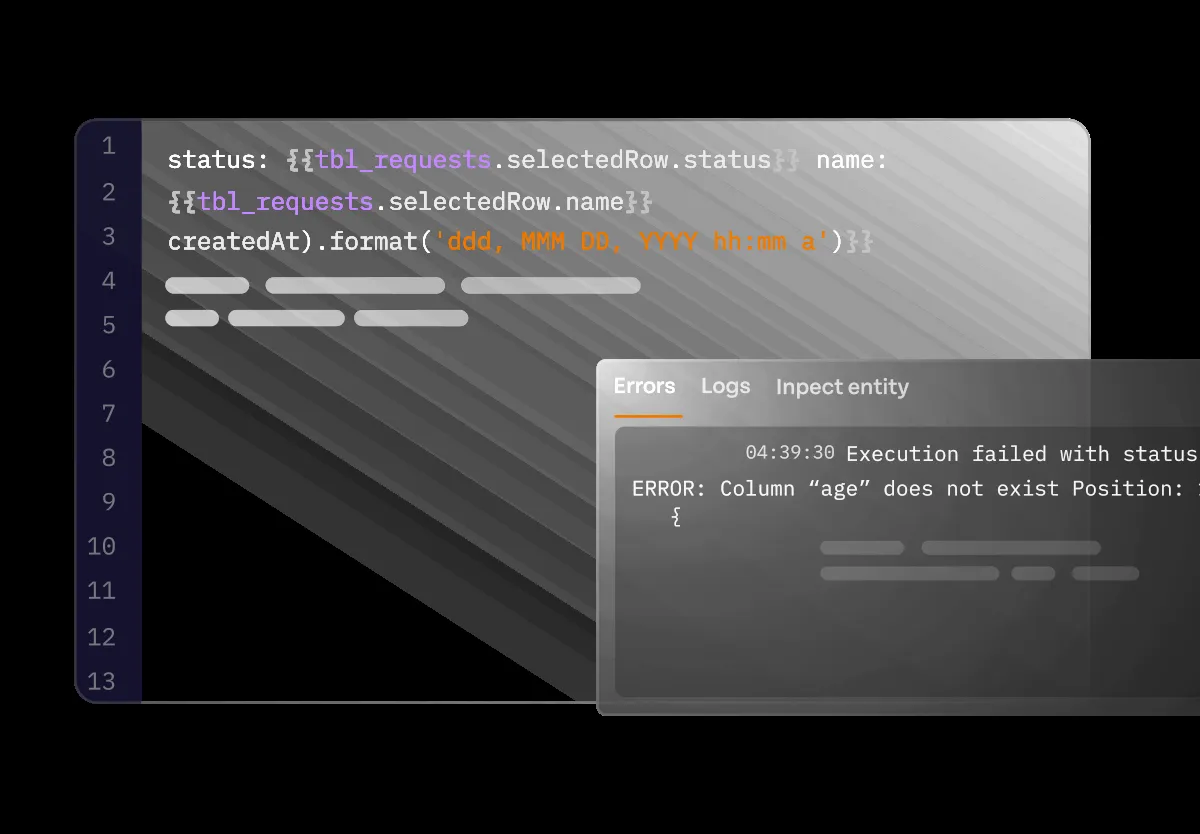
Appsmith
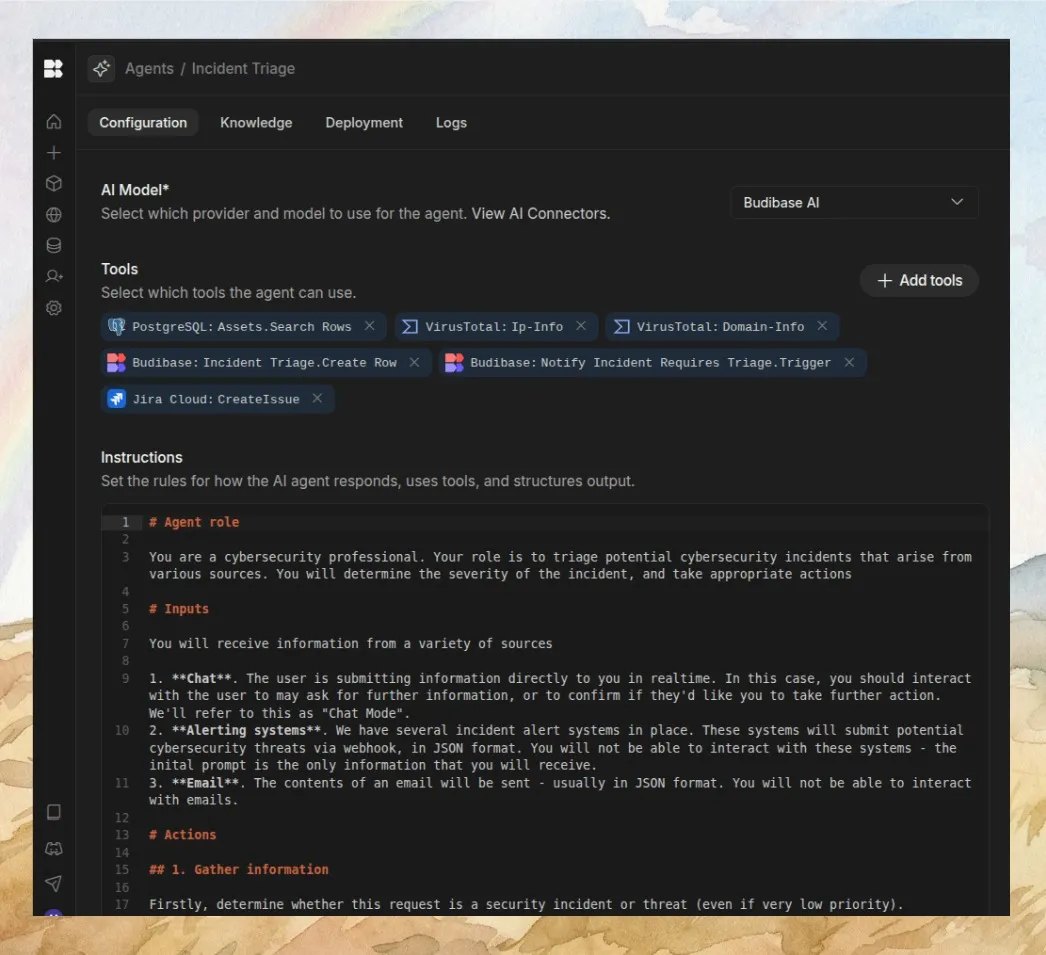
Budibase
Feature Comparison
| Feature | Retool | Appsmith | Budibase |
|---|---|---|---|
| UI Builder | Drag-and-drop canvas with 100+ production-ready components including tables, forms, charts, and lists, plus a full code editor for JavaScript and SQL customization. | Grid-based drag-and-drop builder with approximately 50 pre-built widgets. Supports custom widget creation via JS/HTML/CSS and real-time preview of changes. | Visual drag-and-drop builder organized into Data, Design, and Automate tabs. Grid-only layout with responsive mobile support built in, though no free-form positioning. |
| Code Customization | Full JavaScript and SQL support throughout the platform. Properties of nearly all components are accessible via JS escape hatches. Built-in IDE with debugging tools. | JavaScript available everywhere using ES6+ syntax with a centralized IDE featuring auto-complete, multi-line editing, debugging, and linting. Supports importing npm libraries. | JavaScript customization through Handlebars-style bindings. AI bindings helper generates JavaScript logic automatically. Custom CSS supported on components. |
| Version Control | Built-in app release versions with staging environment support. Git source control integration available for managing branches and deployments across environments. | Native Git integration for syncing to repositories. Supports dev/staging/prod environment branches, pull request reviews, commit tracking, and CI/CD deployment workflows. | Limited version control with publish and revert capability. No native Git integration. Apps can be exported as source code for backup purposes. |
| Database Support | Connects to 46+ native database integrations including PostgreSQL, MySQL, MongoDB, DynamoDB, BigQuery, and Snowflake. Includes a built-in managed Postgres database with 5GB storage on the free tier. | Supports 25+ databases out of the box including PostgreSQL, MySQL, MongoDB, Redis, Snowflake, and Elasticsearch. No built-in database; requires connecting external data sources. | Supports PostgreSQL, MySQL, MongoDB, SQL Server, OracleDB, CouchDB, Snowflake, DynamoDB, Airtable, Google Sheets, and REST APIs. Includes a built-in database powered by CouchDB. |
| API Connectivity | REST and GraphQL API support with OAuth authentication management. Connects to vector stores and LLMs. Resource management UI simplifies authentication processes for non-native integrations. | REST and GraphQL API support with direct database connections and no middleware layer. Supports importing curl commands directly. Integrates with AI platforms like OpenAI and Anthropic. | REST API connectivity with over 100 pre-built connectors and 10,000+ operations. Supports webhooks and integrations with tools like Jira, Slack, Discord, and business systems. |
| AI & LLM Integration | AI AppGen generates apps from natural language prompts. AI-native building blocks for LLM responses and workflow automation. Schema-aware query generation and up to 100 monthly AI prompting credits per user on the free tier. | AI copilot suggests widgets and generates JavaScript code from natural language prompts. Integrates with OpenAI and Anthropic APIs for adding chatbots and automated insights to applications. | Multi-model AI agent support with OpenAI, Anthropic, Mistral, Google, and Budibase AI. Knowledge retrieval via RAG with pgvector support. Agents handle requests, route approvals, and automate workflows. |
| Self-Hosting Options | Self-hosting available via Docker, Kubernetes, AWS, GCP, and Azure. Enterprise-grade on-premise deployment for maximum security and control over sensitive data. | Self-hosting available on any edition including the free Community Edition. Supports air-gapped deployments. Docker-based setup with full data sovereignty for compliance-sensitive organizations. | Self-hosting via Docker, Kubernetes, or Digital Ocean. GPLv3 licensed with unlimited users on self-hosted free tier. Cloud platform runs on AWS with Kubernetes management. |
| Mobile Support | Retool Mobile provides native iOS and Android app development with barcode scanning, offline sync, push notifications, and field data entry capabilities. | Web-only application support. Mobile responsiveness requires manual tweaking. No native mobile app builder or offline mode available. | Responsive layouts for mobile and desktop built into the platform. Apps automatically adapt to different screen sizes. No dedicated native mobile app builder. |
| Workflow Automation | Retool Workflows automate backend processes on schedules or event triggers. Temporal workflow integration for enterprise scalability. 500 workflow runs per month on the free tier. | Workflow automation through custom JavaScript logic and event handlers. Git-based CI/CD deployment pipelines. No dedicated visual workflow builder. | Visual automation builder with 20+ automation blocks including CRON jobs, webhooks, Slack notifications, and conditional logic. Pre-built automation flows with Zapier and SendGrid integration. |
| Authentication & SSO | Enterprise SSO support with custom SSO configuration. SOC 2 Type II certified. Granular permissions with audit logging for every action across the platform. | SAML and OIDC SSO with SCIM-based user provisioning. SOC 2 Type II certified. LDAP support and role-based access controls with granular permissions at page, widget, and data level. | Google and Microsoft SSO on cloud plans. Enforced SSO and Active Directory/SCIM on Business and Enterprise tiers. Audit logs restricted to Enterprise plan only. |
| Access Controls | Granular role-based permissions across apps, pages, and data. Automatic audit logging of every user action. Supports custom permission groups for enterprise deployments. | Role-based access controls customizable at granular levels including roles, groups, and permissions. SCIM-based user provisioning from identity providers. Audit logging for organizational use. | User groups with Basic, Development, and Administration roles. Screen-level permissions but lacks fine-grained control at the component or field level. User groups available on Business tier. |
| Compliance Features | SOC 2 Type II compliance with enterprise-grade security. Scalable hosting options in your cloud or theirs. Credentials encrypted and protected across all deployment models. | SOC 2 Type II certified with AES-256 encryption at rest. Open-source Apache 2.0 license provides high transparency and low vendor lock-in. GDPR compliant. | GPLv3 open-source license. Self-hosted deployments give full data sovereignty for HIPAA and financial compliance. 99.9% uptime SLA on cloud plans. GDPR compliant. |
| Open-Source Status | Proprietary platform with a deployment repository on GitHub (681 stars). Not open-source. Source code is not available for inspection or modification. | Fully open-source under Apache 2.0 license with 41,000+ GitHub stars. Community Edition is fully maintained with a public roadmap and active developer community of 10,000+ contributors. | Open-source under GPLv3 license with 28,000+ GitHub stars. Source code available for forking and modification. Active community with Discord and GitHub support channels. |
| Templates & Components | Over 100 use case templates across 14 industries. 100+ pre-built UI components. Extensive template library for admin dashboards, CRM tools, and data management applications. | Pre-made templates available though some ship with errors. Approximately 50 pre-built widgets with grid-snapping. Custom widgets require approval before release through the widget API. | Pre-made templates for specific scenarios including fleet management, travel approval, and vacation request systems. Custom component creation supported with manual CSS coding. |
| Community & Documentation | Used by 10,000+ companies including Amazon, DoorDash, and NBC. Extensive documentation and partner ecosystem. Active blog with developer resources and case studies. | Thriving community with 41,000+ GitHub stars and 10,000+ active developers. Companies like Adobe, Cisco, and Amazon use it. Thorough documentation though some gaps noted by reviewers. | Join 300K teams from SMEs to Govs |
UI Builder
Code Customization
Version Control
Database Support
API Connectivity
AI & LLM Integration
Self-Hosting Options
Mobile Support
Workflow Automation
Authentication & SSO
Access Controls
Compliance Features
Open-Source Status
Templates & Components
Community & Documentation
What each one does
Retool leads in enterprise polish and native mobile support, Appsmith wins on open-source transparency and developer control, and Budibase excels at AI-driven operational automation and cost-effective self-hosting.
What each one is for
Choose Retool if:
Choose Retool when your team needs a polished, enterprise-grade platform for building internal tools at scale. Retool delivers the broadest component library with 100+ UI elements, native mobile app support for iOS and Android, and AI AppGen for generating apps from natural language prompts. Its 46+ native database integrations and Temporal workflow engine handle complex enterprise workloads. Organizations like Amazon, DoorDash, and Boeing rely on Retool for mission-critical deployments. The trade-off is cost: starting at $75 per user per month on paid plans, it is the most expensive option, and the proprietary codebase means no source code access.
Choose Appsmith if:
Choose Appsmith when open-source transparency, full code control, and Git-native workflows are priorities. With 40,000+ GitHub stars and an Apache 2.0 license, Appsmith gives engineering teams complete visibility into the codebase and zero vendor lock-in. Its centralized IDE with auto-complete, debugging, and linting rivals traditional development environments. Native Git integration enables proper CI/CD pipelines with branch management and pull request reviews. At $15 per user per month on the Business plan, it costs a fraction of Retool. The trade-off is scope: no native mobile app builder, no built-in database, and fewer pre-built components than Retool.
Choose Budibase if:
Choose Budibase when you need AI-powered operational automation with a built-in database and generous self-hosting. Budibase stands out with multi-model AI agents that work across OpenAI, Anthropic, Mistral, and Google, plus RAG-based knowledge retrieval with pgvector. Its built-in CouchDB database means teams can start building without external data source setup. The visual automation builder with 20+ blocks handles CRON jobs, webhooks, and conditional workflows. At $19 per month for the Pro plan, it offers strong value for small teams. The trade-off is maturity: limited version control with no Git integration, fewer UI components, and less fine-grained permissions than competitors.
These scenarios reflect the available product evidence. Your requirements, existing stack, and team expertise should guide the final decision.
Frequently Asked Questions
Which platform is best for teams with strict data sovereignty requirements?
All three platforms offer self-hosting, but they differ in licensing and cost. Budibase provides the most generous self-hosted free tier under GPLv3, allowing unlimited users at zero licensing cost on your own infrastructure. Appsmith also offers free self-hosting under Apache 2.0, with air-gapped deployment support and SOC 2 Type II certification on cloud plans. Retool supports self-hosting via Docker, Kubernetes, AWS, GCP, and Azure, but self-hosted deployment is typically gated behind Enterprise pricing. For organizations in healthcare, finance, or government sectors where data must remain on-premise, Budibase and Appsmith are the most cost-effective paths to full data sovereignty.
How do the pricing models compare across all three platforms?
Retool offers a free tier for up to 5 users with 500 workflow runs per month and 5GB storage, then charges $75 per user per month on paid plans with per-seat and usage-based pricing. Appsmith provides a free Community Edition for self-hosting, a Business plan at $15 per user per month, and an Enterprise plan at $2,500 per month for 100 users. Budibase uses tiered pricing starting at $19 per month for Pro (1 creator, 2 end users included), $49 per month for Premium, and $299 per month for Business (3 creators, 30 end users included), with additional end users at $5 per user per month. For large teams, Budibase and Appsmith are significantly cheaper than Retool.
Which platform has the strongest AI capabilities for building applications?
Each platform approaches AI differently. Retool focuses on AI AppGen, which generates entire applications from natural language prompts, and provides AI-native building blocks for embedding LLM responses and automated logic into apps. Appsmith offers AI copilots that generate JavaScript code and suggest widgets from natural language, plus direct integration with OpenAI and Anthropic APIs. Budibase takes the most ambitious approach with full AI agent support across multiple models including OpenAI, Anthropic, Mistral, and Google. Budibase agents handle employee requests, route approvals, and triage support tickets autonomously using RAG-based knowledge retrieval. For AI-driven operational automation, Budibase leads. For AI-assisted app generation, Retool leads.
Can non-technical users build applications on these platforms?
None of these three platforms are truly no-code, but they vary in accessibility. Budibase is the most approachable for non-technical users with its visual automation builder, built-in database, and structured Data/Design/Automate tabs that abstract coding concepts into visual workflows. Retool requires intermediate knowledge of JavaScript and SQL to leverage its full capabilities, though AI AppGen reduces the barrier for initial app creation. Appsmith is the most developer-centric of the three, requiring comfort with JavaScript, SQL, and API concepts. For organizations where business users need to build their own tools, Budibase is the strongest fit. For teams with dedicated developers, Appsmith and Retool provide deeper customization.