Decision comparison
TimescaleDB vs QuestDB
TimescaleDB and QuestDB represent two distinct philosophies for solving time-series data challenges. TimescaleDB extends PostgreSQL with time-series superpowers, giving teams the best of both worlds: familiar Postgres tooling and SQL with purpose-built partitioning, compression, and analytics functions. QuestDB is an independent engine built from scratch for maximum time-series throughput, delivering 16M+ rows/sec ingest and SIMD-accelerated queries. The right choice depends on whether your priority is PostgreSQL ecosystem compatibility or raw time-series performance.
Direct comparison. These are reviewed substitutes bought for the same job, so the differences below are the ones that decide between them.
All 2 are time-series databases.
Quick Comparison
| Decision factor | TimescaleDB | QuestDB |
|---|---|---|
| Architecture | PostgreSQL extension preserving full Postgres compatibility and ecosystem access | Purpose-built time-series database with SIMD-accelerated columnar engine in Java/C++ |
| Ingestion Speed | High throughput via hypertable partitioning; optimized for steady large-scale ingest | 8 million rows per second per server with write-ahead logging durability |
| SQL Compatibility | Full PostgreSQL SQL with 200+ time-series hyperfunctions on standard Postgres | Standard SQL with time-series extensions; Postgres wire protocol for client compatibility |
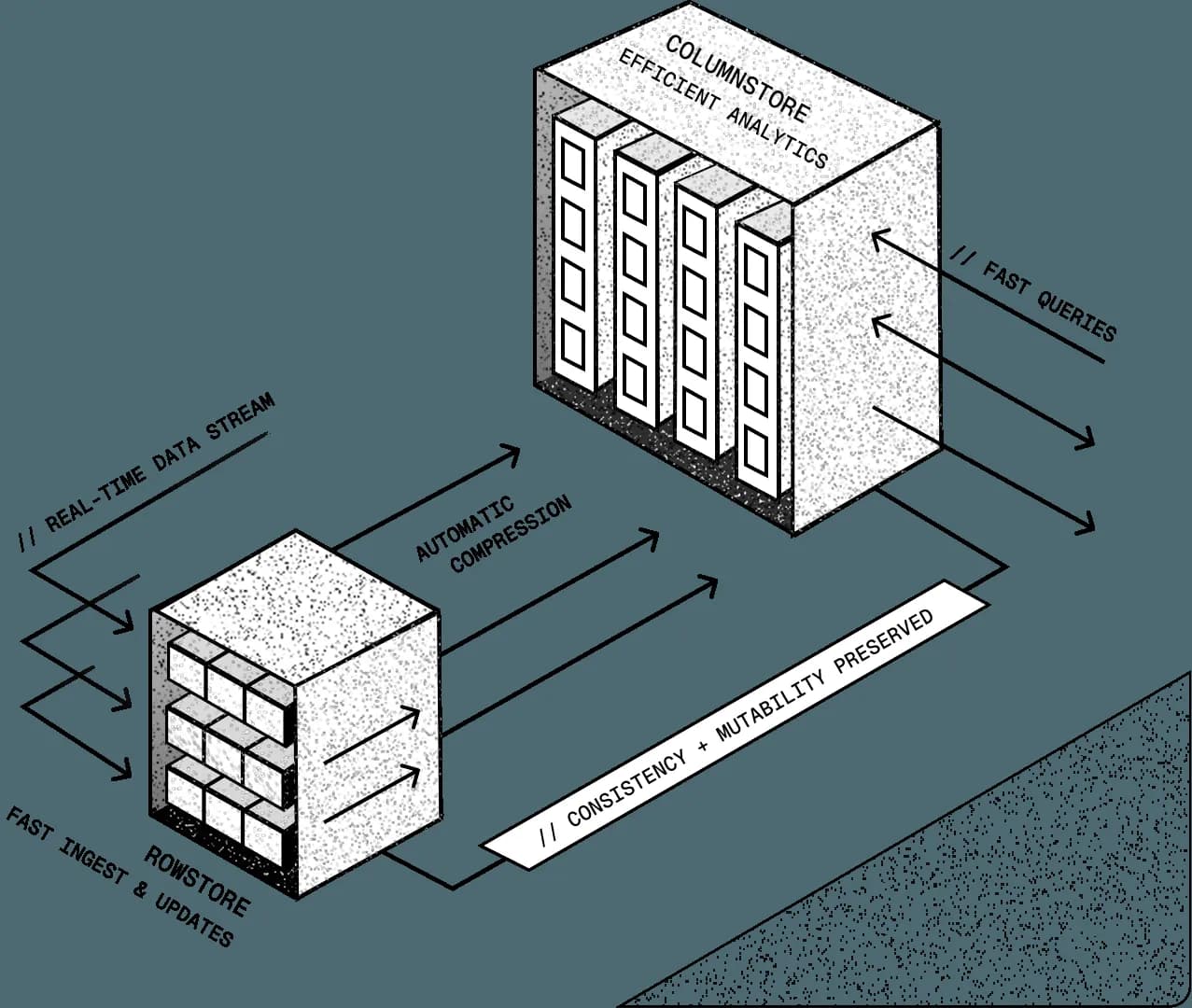
| Storage Engine | Row-columnar hybrid (Hypercore) with native compression up to 95% reduction | Three-tier storage: WAL for durability, native columnar, and Parquet on object storage |
| Pricing Model | Self-hosted free (Time-series, PostgreSQL extension, Full features), Cloud pricing starts at $0.177/GB-month, $30/mo, $36/mo, with a free trial offering $20 in credits | Self-hosted free under Apache-2.0 license. Enterprise features available (contact for pricing details). |
| Best For | PostgreSQL-native teams needing time-series on existing Postgres infrastructure | Capital markets, IoT, and telemetry workloads needing ultra-low latency at scale |
TimescaleDB
- Architecture:
- PostgreSQL extension preserving full Postgres compatibility and ecosystem access
- Ingestion Speed:
- High throughput via hypertable partitioning; optimized for steady large-scale ingest
- SQL Compatibility:
- Full PostgreSQL SQL with 200+ time-series hyperfunctions on standard Postgres
- Storage Engine:
- Row-columnar hybrid (Hypercore) with native compression up to 95% reduction
- Pricing Model:
- Self-hosted free (Time-series, PostgreSQL extension, Full features), Cloud pricing starts at $0.177/GB-month, $30/mo, $36/mo, with a free trial offering $20 in credits
- Best For:
- PostgreSQL-native teams needing time-series on existing Postgres infrastructure
QuestDB
- Architecture:
- Purpose-built time-series database with SIMD-accelerated columnar engine in Java/C++
- Ingestion Speed:
- 8 million rows per second per server with write-ahead logging durability
- SQL Compatibility:
- Standard SQL with time-series extensions; Postgres wire protocol for client compatibility
- Storage Engine:
- Three-tier storage: WAL for durability, native columnar, and Parquet on object storage
- Pricing Model:
- Self-hosted free under Apache-2.0 license. Enterprise features available (contact for pricing details).
- Best For:
- Capital markets, IoT, and telemetry workloads needing ultra-low latency at scale
Public signals
Verified factual signals only. Bars appear only for like-for-like metrics with five weekly assessments for every tool; missing evidence stays explicit. These signals do not establish enterprise adoption, product quality, or total cost.
| Metric | TimescaleDB | QuestDB |
|---|---|---|
| Docker Hub pulls(Product adoption) | 34.9M | 2.8M |
| GitHub commits, 90d(Product adoption) | 341 | 166 |
| GitHub stars(Product adoption) | 23,000+ | 17,000+ |
| Search interest(Market interest) | 0 | 0 |
| Hacker News mentions, 90d(Community interest) | 1 | 9 |
| npm weekly downloads(Ecosystem adoption) | 38.5M | Not available |
| Product Hunt comments(Community interest) | 1 | 28 |
| Product Hunt rating(Community interest) | 5.0/5 | 5.0/5 |
| Product Hunt reviews(Community interest) | 5 | 4 |
| Product Hunt votes(Community interest) | 9 | 194 |
| PyPI weekly downloads(Ecosystem adoption) | 575 | Not available |
| Stack Overflow questions(Community interest) | 775 | 282 |
| npm weekly downloads(Developer adoption) | Not available | 12.4k |
| PyPI weekly downloads(Developer adoption) | Not available | 34.5k |
As of September 21, 2026 — updated weekly.
Health & risk evidence
Observed public-source checks for mapped package versions and repositories.
TimescaleDB
September 21, 2026Package vulnerabilities
npm · pg@8.23.0 · PyPI · timescaledb@0.2.1
0 vulnerabilities
across 2 packages
Repository security score
Not available
QuestDB
September 21, 2026Package vulnerabilities
npm · @questdb/nodejs-client@4.2.0 · PyPI · questdb@5.0.0
0 vulnerabilities
across 2 packages
Repository security score
github.com/questdb/questdb
4.4/10
Interface Preview
TimescaleDB
QuestDB
Feature Comparison
| Feature | TimescaleDB | QuestDB |
|---|---|---|
| Ingestion & Write Performance | ||
| Write-Ahead Logging | Standard PostgreSQL WAL with automatic partitioning across hypertable chunks | Dedicated WAL for instant durability; writes acknowledged before processing begins |
| Data Partitioning | Automatic time-based and key-based partitioning via hypertables with partition skipping at query time | Time-partitioned columnar engine with automatic data ordering and deduplication |
| Bulk Ingestion | Streaming ingestion from Kafka, S3, and other Postgres databases into hypertables | 8 million rows/second per server via InfluxDB Line Protocol and Postgres wire protocol |
| Query Engine & Analytics | ||
| Time-Series SQL Extensions | 200+ native hyperfunctions including time_bucket, interpolation, and gap-filling | SAMPLE BY for time-bucketing, ASOF JOIN with TOLERANCE, and LATEST ON for last-value queries |
| Materialized Views | Continuous aggregates (caggs) with incremental refresh for real-time dashboard rollups | Streaming materialized views with REFRESH IMMEDIATE for live OHLC bars and rollups |
| Advanced Data Structures | Standard PostgreSQL data types with JSONB, arrays, and composite types | N-dimensional arrays for order-book snapshots with vectorized operations like array_sum |
| Storage & Compression | ||
| Compression | Native columnar compression achieving up to 95% storage reduction on historical data | Column-oriented storage with automatic compaction; Parquet format for cold tier |
| Tiered Storage | Hot data on SSD with automatic tiering to low-cost object storage, fully queryable | Three tiers: WAL for durability, native columnar for live queries, Parquet on object storage for cold data |
| Open Formats | Lakehouse integration via Tiger Lake with Apache Iceberg sync to Amazon S3 | Native Parquet and Iceberg support; data readable by any tool in the ecosystem |
| Integration & Protocol Support | ||
| SQL Protocol | Full PostgreSQL protocol with complete access to Postgres ecosystem and extensions | Postgres wire protocol (PGwire) and REST API for broad client compatibility |
| Ecosystem Connectors | Native Kafka, S3, and Postgres connectors plus Grafana, Tableau, and all Postgres-compatible tools | Integrates with Grafana, Kafka, Redpanda, Spark, Polars, Pandas, Telegraf, Flink, and Superset |
| Cloud Provider Support | Tiger Cloud on AWS with managed deployment; also available via Elestio on multiple clouds | BYOC deployment on any cloud, on-prem, or hybrid; no vendor-managed cloud offering |
| Enterprise & Operations | ||
| High Availability | Managed HA with automated backups, point-in-time recovery up to 14 days, and read replicas | Enterprise replication with automatic failover across multiple availability zones |
| Security & Compliance | SOC 2 Type II, GDPR support, encryption at rest and in transit, private networking | TLS encryption, SSO via OAuth 2.0/OIDC, RBAC, and audit logging in Enterprise tier |
| Scalability Architecture | Independent storage and compute scaling with Fluid Storage up to 128TB and 110,000+ IOPS | Petabyte-scale tiered storage with instant scale-out and storage/compute separation |
Ingestion & Write Performance
Write-Ahead Logging
Data Partitioning
Bulk Ingestion
Query Engine & Analytics
Time-Series SQL Extensions
Materialized Views
Advanced Data Structures
Storage & Compression
Compression
Tiered Storage
Open Formats
Integration & Protocol Support
SQL Protocol
Ecosystem Connectors
Cloud Provider Support
Enterprise & Operations
High Availability
Security & Compliance
Scalability Architecture
Which to choose
TimescaleDB and QuestDB represent two distinct philosophies for solving time-series data challenges. TimescaleDB extends PostgreSQL with time-series superpowers, giving teams the best of both worlds: familiar Postgres tooling and SQL with purpose-built partitioning, compression, and analytics functions. QuestDB is an independent engine built from scratch for maximum time-series throughput, delivering 16M+ rows/sec ingest and SIMD-accelerated queries. The right choice depends on whether your priority is PostgreSQL ecosystem compatibility or raw time-series performance.
Best-fit scenarios
Choose TimescaleDB if:
Choose TimescaleDB if your organization already runs PostgreSQL and needs to add time-series capabilities without introducing a new database technology. The full Postgres compatibility means your existing tools, extensions, ORMs, and team knowledge transfer directly. Tiger Cloud's managed offering with 99.9% uptime SLA, SOC 2 Type II compliance, up to 95% compression, and 200+ hyperfunctions makes it production-ready for IoT monitoring, energy analytics, and operational telemetry where PostgreSQL ecosystem integration is a priority compared to peak ingestion speed.
Choose QuestDB if:
Choose QuestDB if your workload demands maximum ingestion throughput and ultra-low query latency on time-series data. Its SIMD-accelerated columnar engine, 16M+ rows/sec ingest, and specialized features like N-dimensional arrays and ASOF JOIN make it the stronger choice for capital markets tick data, high-frequency IoT telemetry, and real-time analytics pipelines. The Apache 2.0 license with native Parquet support ensures zero vendor lock-in, and enterprise deployments at B3 and Laser Digital validate its production readiness for demanding financial workloads.
These scenarios reflect the available product evidence. Your requirements, existing stack, and team expertise should guide the final decision.
Frequently Asked Questions
What is the main difference between TimescaleDB and QuestDB?
TimescaleDB is a PostgreSQL extension that adds time-series capabilities to an existing Postgres installation, preserving full SQL compatibility and access to the entire PostgreSQL ecosystem of tools, extensions, and drivers. QuestDB is a purpose-built time-series database written from scratch in Java and C++ with a column-oriented storage engine that uses SIMD instructions for maximum query throughput. The fundamental trade-off is ecosystem versus raw performance: TimescaleDB gives you PostgreSQL's maturity and tooling, while QuestDB gives you a specialized engine optimized specifically for time-series ingestion and query speed.
Which database has better ingestion performance?
QuestDB publishes a headline figure of 16M+ rows per second ingestion throughput, achieved through its write-ahead log architecture and columnar storage engine. TimescaleDB delivers high ingestion throughput through its hypertable partitioning system, which automatically distributes writes across time-based chunks. QuestDB's purpose-built engine gives it an advantage in raw ingestion benchmarks, particularly for streaming workloads like tick data and IoT telemetry. TimescaleDB's ingestion performance is strong within the PostgreSQL ecosystem and sufficient for most time-series use cases, but its architecture as a Postgres extension means it inherits some of PostgreSQL's write-path overhead.
Can I use standard PostgreSQL tools with both databases?
TimescaleDB offers full PostgreSQL compatibility because it runs as a native Postgres extension. Every PostgreSQL client, ORM, migration tool, monitoring solution, and extension works without modification. QuestDB supports the Postgres wire protocol (PGwire), which means standard Postgres clients like psql and JDBC drivers can connect and run queries. However, QuestDB is not PostgreSQL, so Postgres-specific extensions, stored procedures, and advanced features like foreign data wrappers are not available. If your team relies heavily on PostgreSQL ecosystem tools, TimescaleDB provides a seamless experience, while QuestDB requires verifying compatibility for each tool.
How do TimescaleDB and QuestDB compare on pricing?
TimescaleDB's open-source self-hosted option is free. Tiger Cloud bills consumption hourly for configured compute and actual storage used: Performance compute starts at $30/month with storage priced at $0.177/GB-month, while Scale compute starts at $36/month with storage priced at $0.212/GB-month. The supplied evidence does not provide QuestDB pricing, so it does not support a like-for-like price comparison. Buyers should confirm their expected compute configuration, actual storage use, add-on charges such as high-availability replicas or production support, and whether an Enterprise arrangement is needed; the pricing page lists Enterprise as "Talk to us" and does not state a public Enterprise price.
Which database is better for capital markets and financial data?
QuestDB has a strong focus on capital markets use cases. It powers Brazil's B3 stock exchange and is used by institutions like BTG Pactual and Laser Digital (Nomura Group) for real-time market data. Features like N-dimensional arrays for order-book snapshots, ASOF JOIN for time-bounded event alignment, and nanosecond timestamp precision make it well-suited for tick data and trading analytics. TimescaleDB also serves financial use cases through its time-weighted averages and real-time aggregation functions, with crypto exchanges among its customer base. For pure trading floor workloads requiring ultra-low latency and specialized financial data structures, QuestDB is the stronger choice.