Decision comparison
InfluxDB vs TimescaleDB
InfluxDB and TimescaleDB are both powerful time-series databases that take fundamentally different approaches. InfluxDB is a purpose-built engine optimized for high-velocity IoT, observability, and real-time analytics, while TimescaleDB extends PostgreSQL with time-series capabilities for teams that want full SQL compatibility and the Postgres ecosystem.
Direct comparison. These are reviewed substitutes bought for the same job, so the differences below are the ones that decide between them.
All 2 are time-series databases.
Quick Comparison
| Decision factor | InfluxDB | TimescaleDB |
|---|---|---|
| Architecture | Purpose-built time-series engine with cloud-native diskless architecture and separated compute and storage | PostgreSQL extension adding automatic time-based partitioning, columnar compression, and continuous aggregates |
| Query Language | SQL query engine with FlightSQL and HTTP Query API support; embedded Python VM for plugins and triggers | Full PostgreSQL SQL compatibility with ~200 native time-series functions and standard Postgres tooling |
| Scalability | Handles millions of data points per second with unlimited cardinality across distributed ingest and query nodes | Processes trillions of metrics daily with automatic time- and key-based partitioning for fast reads and writes |
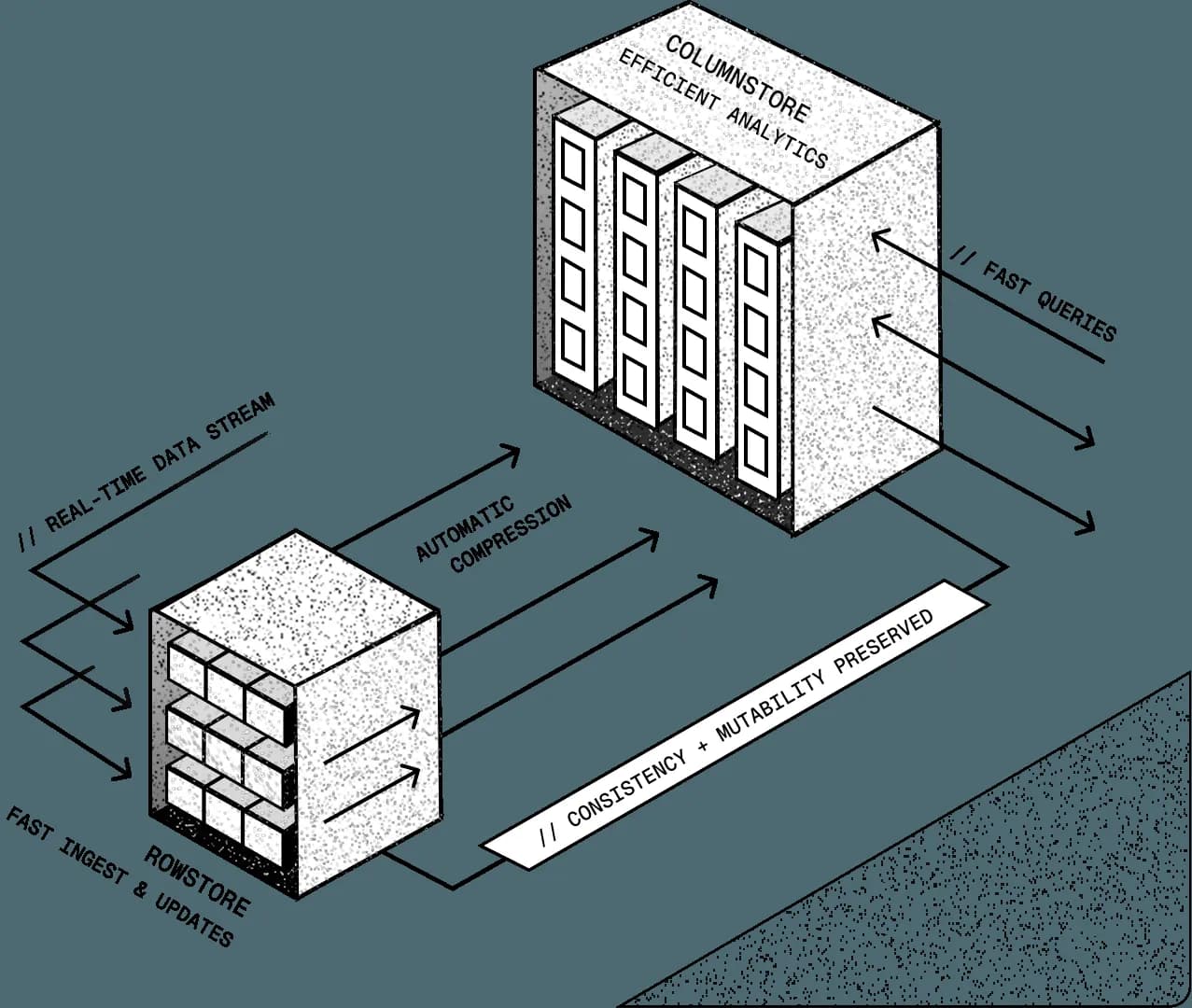
| Data Compression | Parquet file persistence with best-in-class compression and automatic downsampling for cold data eviction | Up to 95% columnar compression with hybrid row-columnar storage and tiered hot/cold data on SSD and object storage |
| Community & Ecosystem | 31,000+ GitHub stars, 2,800+ contributors, 1B+ Docker downloads, Apache-2.0 license, written in Rust | 22,435 GitHub stars, written in C, full PostgreSQL ecosystem compatibility including extensions and BI tools |
| Deployment Options | Self-hosted Community Edition (free), Cloud DBaaS, and Enterprise subscription with on-prem and edge support | Self-hosted free open-source extension, Tiger Cloud managed service starting at $30/mo with free trial |
InfluxDB
- Architecture:
- Purpose-built time-series engine with cloud-native diskless architecture and separated compute and storage
- Query Language:
- SQL query engine with FlightSQL and HTTP Query API support; embedded Python VM for plugins and triggers
- Scalability:
- Handles millions of data points per second with unlimited cardinality across distributed ingest and query nodes
- Data Compression:
- Parquet file persistence with best-in-class compression and automatic downsampling for cold data eviction
- Community & Ecosystem:
- 31,000+ GitHub stars, 2,800+ contributors, 1B+ Docker downloads, Apache-2.0 license, written in Rust
- Deployment Options:
- Self-hosted Community Edition (free), Cloud DBaaS, and Enterprise subscription with on-prem and edge support
TimescaleDB
- Architecture:
- PostgreSQL extension adding automatic time-based partitioning, columnar compression, and continuous aggregates
- Query Language:
- Full PostgreSQL SQL compatibility with ~200 native time-series functions and standard Postgres tooling
- Scalability:
- Processes trillions of metrics daily with automatic time- and key-based partitioning for fast reads and writes
- Data Compression:
- Up to 95% columnar compression with hybrid row-columnar storage and tiered hot/cold data on SSD and object storage
- Community & Ecosystem:
- 22,435 GitHub stars, written in C, full PostgreSQL ecosystem compatibility including extensions and BI tools
- Deployment Options:
- Self-hosted free open-source extension, Tiger Cloud managed service starting at $30/mo with free trial
Public signals
Verified factual signals only. Bars appear only for like-for-like metrics with five weekly assessments for every tool; missing evidence stays explicit. These signals do not establish enterprise adoption, product quality, or total cost.
| Metric | InfluxDB | TimescaleDB |
|---|---|---|
| Docker Hub pulls(Product adoption) | 1.1B | 34.9M |
| GitHub commits, 90d(Product adoption) | 7 | 341 |
| GitHub stars(Product adoption) | 31,000+ | 23,000+ |
| Search interest(Market interest) | 1 | 0 |
| Hacker News mentions, 90d(Community interest) | 1 | 1 |
| npm weekly downloads(Developer adoption) | 113.0k | Not available |
| PyPI weekly downloads(Developer adoption) | 819.2k | Not available |
| Stack Overflow questions(Community interest) | 2.9k | 775 |
| npm weekly downloads(Ecosystem adoption) | Not available | 38.5M |
| Product Hunt comments(Community interest) | Not available | 1 |
| Product Hunt rating(Community interest) | Not available | 5.0/5 |
| Product Hunt reviews(Community interest) | Not available | 5 |
| Product Hunt votes(Community interest) | Not available | 9 |
| PyPI weekly downloads(Ecosystem adoption) | Not available | 575 |
As of September 21, 2026 — updated weekly.
Health & risk evidence
Observed public-source checks for mapped package versions and repositories.
InfluxDB
September 21, 2026Package vulnerabilities
npm · @influxdata/influxdb-client@1.35.0 · PyPI · influxdb-client@1.50.0
0 vulnerabilities
across 2 packages
Repository security score
Not available
TimescaleDB
September 21, 2026Package vulnerabilities
npm · pg@8.23.0 · PyPI · timescaledb@0.2.1
0 vulnerabilities
across 2 packages
Repository security score
Not available
Interface Preview
TimescaleDB
Feature Comparison
| Feature | InfluxDB | TimescaleDB |
|---|---|---|
| Data Ingestion | ||
| High-Volume Ingest | Ingests millions of time-series data points per second with unlimited cardinality and no caps on series count | Uses automatic hypertable partitioning for fast ingest with streaming support from Kafka and S3 sources |
| Data Sources Integration | Connects through 5,000+ integrations via Telegraf agent and supports data interoperability between real-time and historical data | Integrates with the PostgreSQL ecosystem plus native streaming from Kafka, S3, and other Postgres databases into hypertables |
| Real-Time Processing | Data is available instantly for querying through the Last Value Cache, enabling real-time analytics and automation | Continuous aggregates (caggs) provide incrementally refreshed rollups for instant dashboards and real-time analytics |
| Storage & Compression | ||
| Compression Technology | Uses Parquet file persistence for efficient columnar storage with best-in-class compression ratios | Columnar compression achieves up to 95% reduction with hybrid row-columnar storage for balancing writes and analytics |
| Tiered Storage | Automatic cold data eviction streams data into data lakes, warehouses, and AI/ML pipelines via lakehouse integration | Tiered storage keeps hot data on SSD and moves colder data to low-cost object storage automatically |
| Data Retention | Petabyte-scale persistent object storage with unlimited data retention and automatic downsampling for older data | Supports up to 14-day point-in-time recovery with pgBackRest, weekly full backups, daily incrementals, and continuous WAL retention |
| Query Capabilities | ||
| Query Language | Native SQL query engine with FlightSQL and HTTP Query API support for fast analytical queries | Full PostgreSQL SQL compatibility with ~200 native time-series functions built on standard SQL |
| Real-Time Querying | Last Value Cache provides instant access to the most recent data points for real-time monitoring and alerting | Partition skipping at query planning time with efficient index-only scans and skip-scan patterns on composite indexes |
| Analytical Functions | Embedded Python VM enables custom plugins and triggers for anomaly detection and predictive analytics directly in the database | ~200 native SQL functions for time-based analytics including window functions, gap-filling, and continuous aggregates |
| Architecture & Scalability | ||
| Deployment Architecture | Cloud-native diskless architecture with stateless nodes sharing a single object store for zero-downtime failover | PostgreSQL extension that adds time-series capabilities to any existing Postgres deployment |
| High Availability | Instant failover with shared object store; separated compute and storage enables seamless scaling of ingest and query nodes | 99.9% uptime SLA on Tiger Cloud with synchronously replicated HA services and 110,000+ IOPS single-volume throughput |
| Horizontal Scaling | Adds ingest nodes for high-velocity data and query nodes for surging traffic without friction or disruption | Scales through automatic partitioning and one-click hypertable creation with partition size recommendations on Tiger Cloud |
| Security & Enterprise | ||
| Compliance & Certifications | ISO 27001, SOC2 certified with end-to-end encryption for enterprise-grade security | Encryption at rest and in transit with enterprise-ready security features on Tiger Cloud managed service |
| Access Control | Token-based authentication and management through the InfluxDB 3 Explorer UI without writing code | Inherits PostgreSQL role-based access control with full support for GRANT/REVOKE permissions |
| Extensibility | Embedded Python VM processing engine enables custom logic for anomaly detection, triggers, and downstream automation | Full PostgreSQL extension ecosystem including vector search, keyword search, and lakehouse integration via Iceberg replication |
Data Ingestion
High-Volume Ingest
Data Sources Integration
Real-Time Processing
Storage & Compression
Compression Technology
Tiered Storage
Data Retention
Query Capabilities
Query Language
Real-Time Querying
Analytical Functions
Architecture & Scalability
Deployment Architecture
High Availability
Horizontal Scaling
Security & Enterprise
Compliance & Certifications
Access Control
Extensibility
Which to choose
InfluxDB and TimescaleDB are both powerful time-series databases that take fundamentally different approaches. InfluxDB is a purpose-built engine optimized for high-velocity IoT, observability, and real-time analytics, while TimescaleDB extends PostgreSQL with time-series capabilities for teams that want full SQL compatibility and the Postgres ecosystem.
Best-fit scenarios
Choose InfluxDB if:
We recommend InfluxDB for teams building real-time observability, IoT telemetry, and sensor monitoring systems that demand high-velocity ingest at millions of data points per second. Its cloud-native diskless architecture, unlimited cardinality, and 5,000+ Telegraf integrations make it the strongest choice for dedicated time-series workloads where ingestion speed and real-time querying take priority. The embedded Python VM processing engine adds an active intelligence layer for anomaly detection and automated triggers. Organizations in aerospace, energy, and industrial manufacturing that need edge-to-cloud deployments with enterprise security (ISO 27001, SOC2) will find InfluxDB purpose-built for their requirements.
Choose TimescaleDB if:
We recommend TimescaleDB for teams already invested in PostgreSQL who need time-series capabilities without abandoning their existing tooling, extensions, and SQL expertise. Its ~200 native time-series functions, up to 95% columnar compression, and continuous aggregates deliver strong analytical performance while maintaining full Postgres compatibility. The ability to use standard PostgreSQL tools, BI connectors, and the extensive extension ecosystem makes it ideal for organizations that need time-series analytics alongside relational data in a single database. Teams in financial analysis, energy monitoring, and operational analytics who value SQL familiarity and want a managed cloud option with 99.9% uptime SLA will benefit most from TimescaleDB.
These scenarios reflect the available product evidence. Your requirements, existing stack, and team expertise should guide the final decision.
Frequently Asked Questions
Can I migrate from InfluxDB to TimescaleDB or vice versa?
Migration between InfluxDB and TimescaleDB requires data transformation because they use different storage models. InfluxDB stores data in a purpose-built time-series format with Parquet file persistence, while TimescaleDB uses PostgreSQL hypertables with automatic time-based partitioning. For InfluxDB-to-TimescaleDB migration, you export data via the SQL query engine or FlightSQL API and load it into Postgres-compatible hypertables. For the reverse, TimescaleDB data exports as standard SQL which you then ingest through InfluxDB's line protocol or API. Both databases support Parquet format, which provides a common interchange path. The migration complexity depends on your data volume and whether you use database-specific features like InfluxDB's embedded Python triggers or TimescaleDB's continuous aggregates.
Which database performs better for IoT and sensor data workloads?
InfluxDB holds a clear advantage for IoT and sensor data workloads. It is purpose-built for high-velocity time-series ingest, handling millions of data points per second with unlimited cardinality and no caps on series count. Its 400+ Telegraf input/output plugins connect directly to industrial sensors, MQTT brokers, and edge devices. The cloud-native diskless architecture supports hub-and-edge configurations where data is ingested at the edge and synced to a central hub. TimescaleDB handles IoT workloads through PostgreSQL's reliability and automatic hypertable partitioning, but it was designed as a general-purpose time-series extension rather than a dedicated IoT platform. For pure sensor telemetry at industrial scale, InfluxDB is the stronger choice.
How do InfluxDB and TimescaleDB compare on total cost of ownership?
Both databases offer free self-hosted options that reduce licensing costs. InfluxDB Community Edition is free under Apache-2.0, while TimescaleDB's open-source PostgreSQL extension is also free with full features. For managed cloud services, their pricing models differ significantly. InfluxDB Cloud uses usage-based pricing with costs starting from $0.01 per operation and enterprise plans at $250. Tiger Cloud's Performance plan has compute starting at $30/month with storage priced at $0.177/GB-month, while its Scale plan has compute starting at $36/month with storage priced at $0.212/GB-month. Compute is metered hourly and storage is metered by average GB consumption per hour; a free 30-day Performance-plan trial requires no credit card. The true cost depends on your workload: InfluxDB's Parquet compression reduces storage costs for high-volume telemetry, while TimescaleDB's 95% columnar compression keeps analytical storage lean. Teams with existing PostgreSQL infrastructure save on operational costs with TimescaleDB since it leverages existing Postgres expertise and tooling.
Can InfluxDB and TimescaleDB be used together in a data pipeline?
Using InfluxDB and TimescaleDB together in the same pipeline is a practical architecture for certain use cases. InfluxDB serves as the high-speed ingestion layer, capturing millions of sensor readings and telemetry data points per second with its purpose-built time-series engine. Its lakehouse integration then evicts cold data and streams it into downstream systems. TimescaleDB receives this historical data for deep analytical queries using full PostgreSQL SQL, ~200 time-series functions, and joins with relational business data. This pattern works well for organizations that need both real-time monitoring (InfluxDB) and historical analytics with SQL-based reporting tools (TimescaleDB). Both support Parquet as an interchange format, and TimescaleDB's Kafka and S3 streaming ingestion simplifies the data flow between them.