Best AI Agent Stack (2026)
The AI agent stack is the fastest-growing architecture in 2026. It combines a large language model (LLM) for reasoning, an agent framework for orchestration and tool use, and a vector database for retrieval-augmented generation (RAG). This stack powers chatbots, copilots, autonomous agents, and any application that needs LLM-driven intelligence.
Who is this for?
- Teams building RAG-powered chatbots or search
- Companies adding AI copilot features to existing products
- Developers building autonomous agents with tool use
- Anyone evaluating LangChain vs Haystack vs CrewAI
How it works
An LLM provider (OpenAI, Anthropic) handles reasoning and text generation. An agent framework (LangChain, Haystack) orchestrates the LLM with tools, memory, and retrieval. A vector database (Pinecone, Qdrant) stores embeddings for semantic search and RAG. The framework queries the vector DB, augments the prompt with relevant context, and sends it to the LLM.
Scroll horizontally to inspect every architecture layer.
Evidence-backed reference architecture based on selected constraints, public adoption signals, product evidence, and available integration data. See how recommendations are scored.
Estimated cost: Free – $200/mo
Why this recommendation
- Optimized for a default ai agent stack architecture across the required stack layers.
- Combines model access, an agent framework, and vector retrieval for AI application development.
- Balances role fit, adoption, user requirements, and available integration evidence.
Recommended tools
LLM Provider
Agent Framework
Create agentic, context engineered AI systems using Haystack’s modular and customizable building blocks, built for real-world, production-ready applications.
Haystack and LangChain both meet every requirement you set for this layer; nothing you have stated separates them.
Runner-up: LangChain
Vector Database
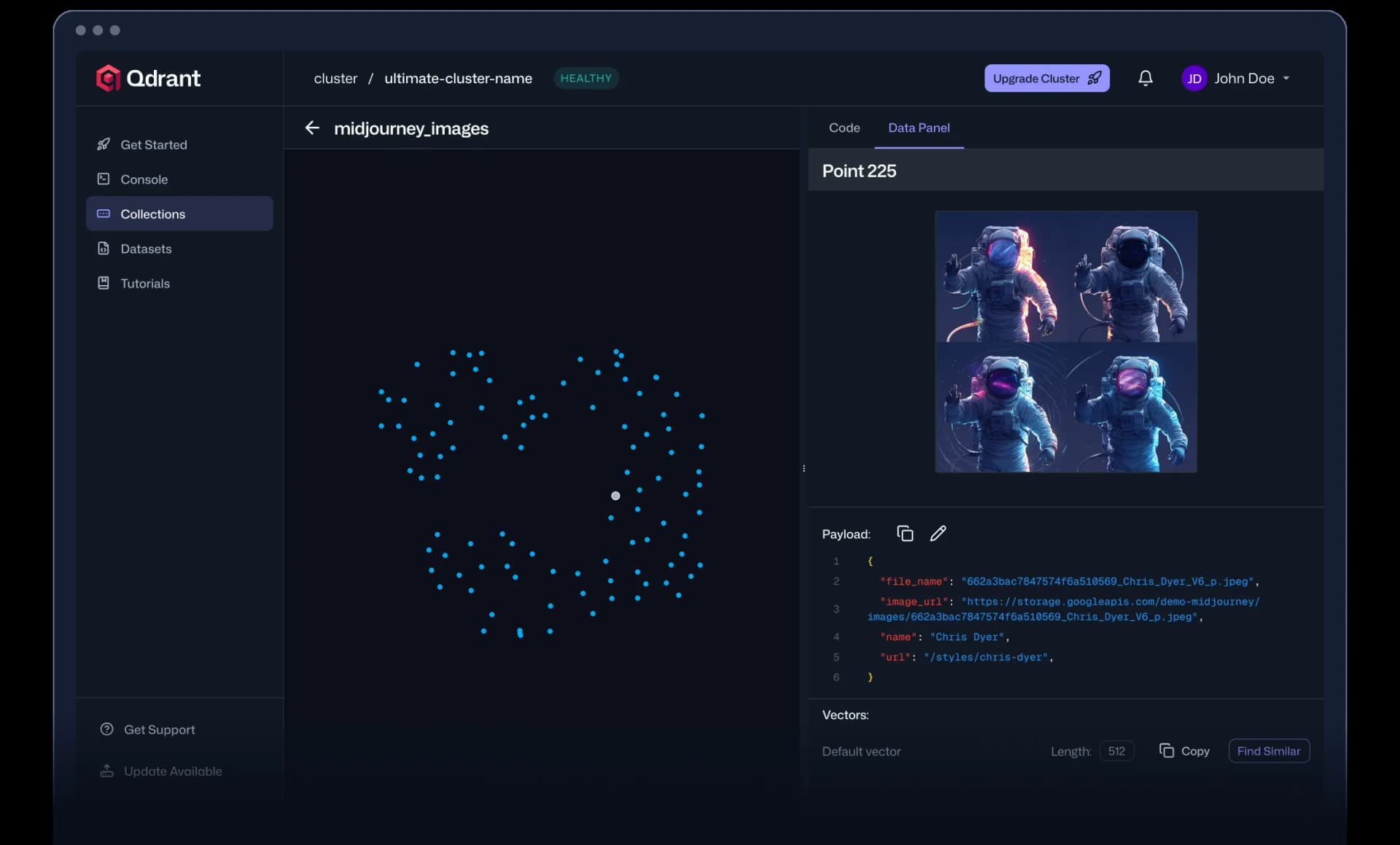
Qdrant is an Open-Source Vector Search Engine written in Rust. It provides fast and scalable vector similarity search service with convenient API.
Qdrant and Weaviate both meet every requirement you set for this layer; nothing you have stated separates them.
Runner-up: Weaviate
How recommendations change with your constraints
The same architecture adapts to your cloud, budget, and deployment preferences. Here's what our algorithm recommends for common scenarios:
Managed Production RAG
Managed model access and vector retrieval for production RAG workloads.
Customize this scenario →Self-hosted Retrieval
Fully self-hosted agent stack: an open-source model runtime, framework, and vector store, with no external model API and no prompt leaving your network.
Customize this scenario →Frequently asked questions
Do I need a vector database?▾
For RAG applications, yes. The vector DB stores document embeddings so the LLM can retrieve relevant context. Without it, the LLM only has its training data. For simple chatbots without document retrieval, you can skip it.
LangChain vs Haystack?▾
LangChain has the larger ecosystem (135k GitHub stars) and more integrations. Haystack is more opinionated and production-focused. LangChain is better for prototyping; Haystack for production pipelines.
Which LLM provider should I use?▾
OpenAI (GPT-4) for general-purpose quality. Anthropic (Claude) for longer context and safety. Groq for speed. Open-source models via Together AI or Replicate for cost control.
Build your ai agent stack
These recommendations use public adoption signals, product evidence, and verified integrations. Customize them for your specific requirements and review the methodology behind the available evidence.