Buying snapshot
License and deployment: Apache 2.0; free to self-host with Docker Compose or Helm.
Instrumentation: Auto-instruments supported LLM providers, frameworks, vector databases, and other AI infrastructure; manual
openlit.init()instrumentation is also available.Telemetry: Uses OpenTelemetry traces and metrics, with OTLP export to OpenLIT or compatible backends such as Grafana, Datadog, New Relic, and SigNoz.
Enterprise scope: Organization-wide governance features including custom roles, audit logs, and alerts are part of OpenLIT Enterprise.
Editorial take
OpenLIT is a strong fit for teams that want a self-hosted, OpenTelemetry-native system around an existing agent harness rather than a replacement for the agent runtime. Its value is in connecting traces, evaluations, runtime controls, prompts, costs, and GPU signals into a workflow for investigating and improving agent behavior.
Evaluate OpenLIT
Comparisons
Where it stands out
It traces LLM calls, tool calls, MCP requests, retrieval, and agent steps through OpenTelemetry-native instrumentation.
Evaluations can run on live traces with LLM-as-a-judge or custom criteria, and the same evaluators can support offline regression testing in CI/CD.
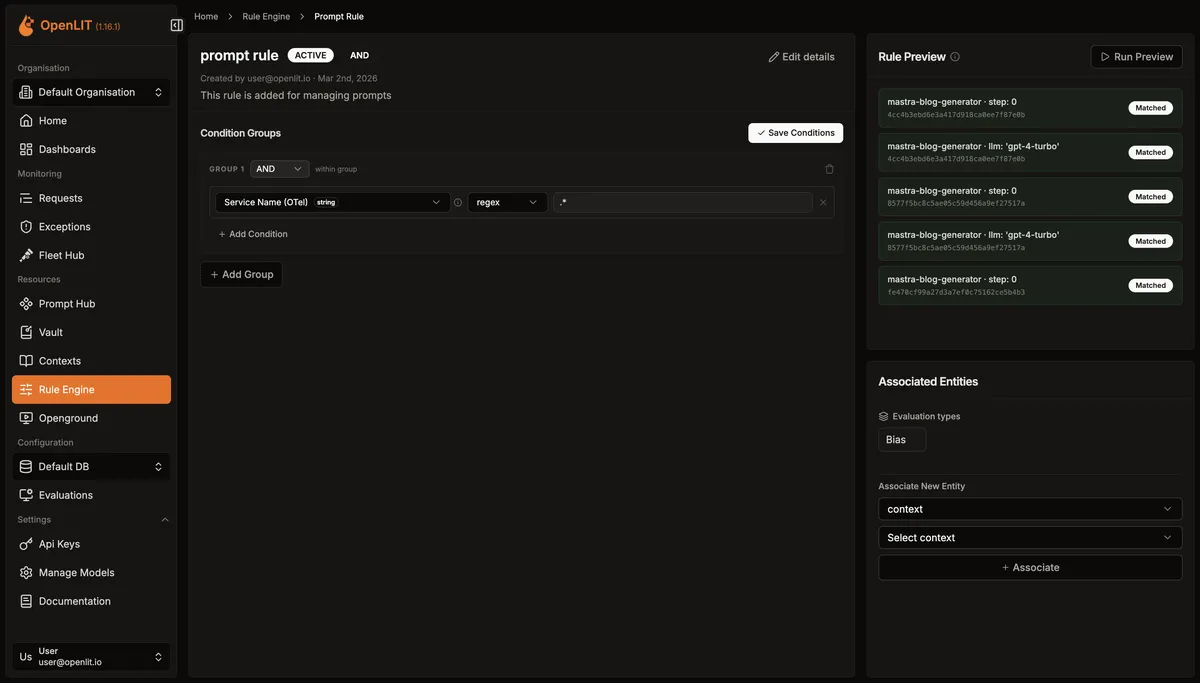
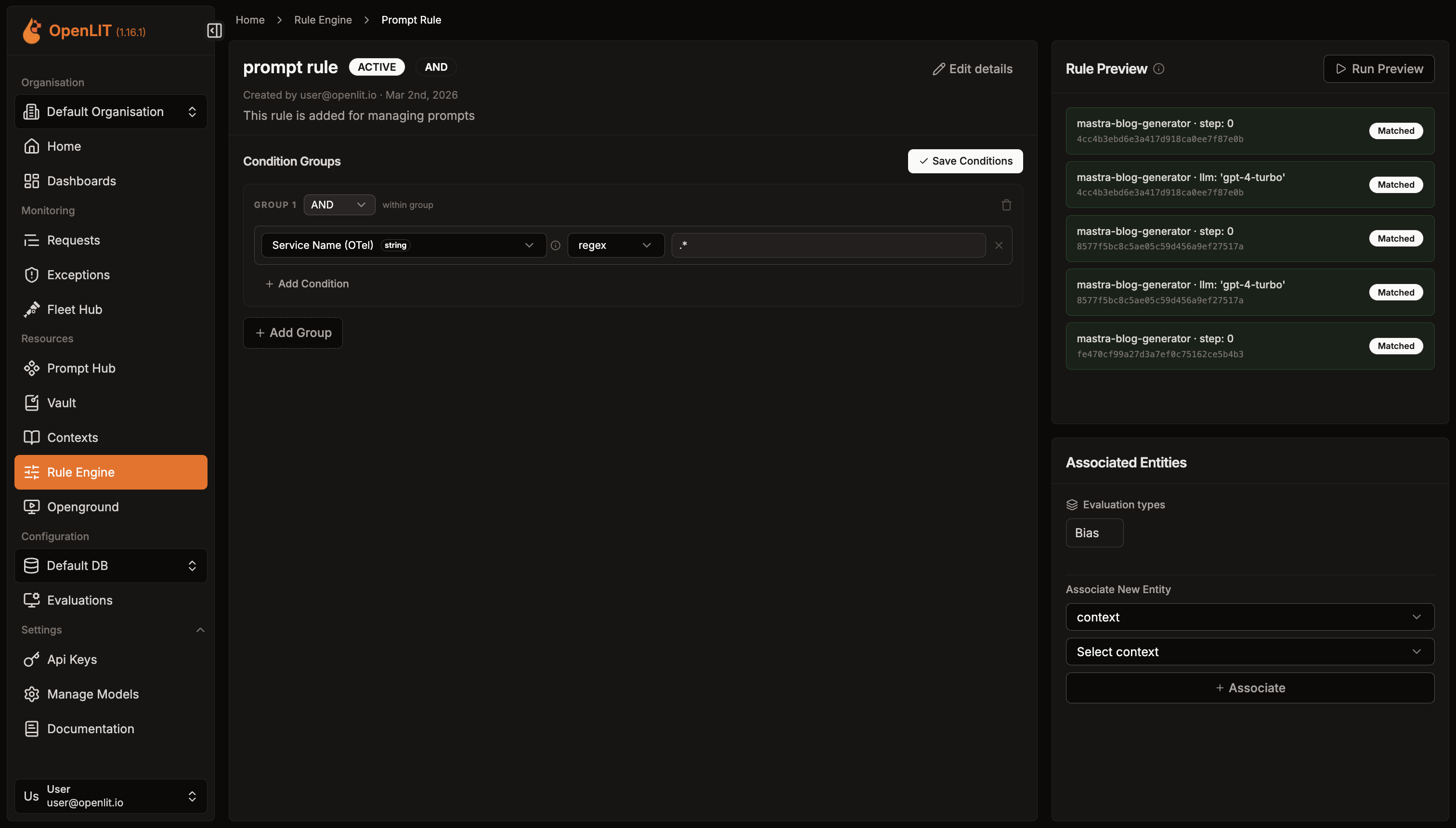
Prompt Hub, Context, Rule Engine, Vault, and guardrails support changes to prompts, context, rules, secrets, and runtime protections without positioning OpenLIT as the agent loop itself.
The CLI supports coding-agent instrumentation for vendors including Claude Code, Cursor, Codex, and OpenCode, with session-level telemetry such as token use and cost.
Its GPU collector monitors NVIDIA, AMD, and Intel inference GPUs and correlates utilization, memory, power, and temperature with traces.
Product screenshot
Trade-offs to weigh
OpenLIT is designed to run in your infrastructure, with telemetry flowing through its OTLP receiver and a typical deployment including ClickHouse and the OpenLIT dashboard. Buyers should therefore assess the operational fit of self-hosting and their preferred OpenTelemetry architecture. It instruments and improves an existing harness; it does not run the agent loop for you.
Pricing and licensing
Self-hosted OpenLIT is free under Apache 2.0, with no license key and no per-trace fee. Enterprise covers organization-wide governance features such as custom roles, audit logs, and alerts.
Public signals
About these signals
Verified factual signals from public sources. They indicate observable activity or interest, not total adoption, product quality, or cost.
138 GitHub commits 90d3.1k GitHub stars0 vulnerabilities across 1 package
See all signals from 3 sources
PyPI · openlit@1.45.0
Alternatives to OpenLIT
The reviewed substitutes for OpenLIT among the LLM observability & evaluation, and what would make each one the better answer.
Direct alternatives
Reviewed substitutes: products bought for the same job, where a team picks one.
- Arize Phoenix
- Arize Phoenix is a local-first tracing and evaluation tool built on OpenTelemetry, licensed under Elastic 2.0, with an upgrade path to Arize's commercial platform. OpenLIT is also OTEL-based and is fully open source, and it adds guardrails and agent-harness tooling. The choice depends on licensing and on whether the buyer values Phoenix's notebook-driven experiment loop and Arize's managed path more than OpenLIT's broader runtime controls.Applies to: OTEL-based agent tracing and evals
- Langfuse
- Langfuse is an open-source LLM engineering platform that combines tracing, prompt management, datasets and evaluation, and it can be self-hosted or run as Langfuse Cloud. OpenLIT covers similar ground but is built natively on OpenTelemetry and adds guardrails. The choice comes down to two things: whether the team wants Langfuse's mature prompt-management and experiment workflow, or OpenLIT's OTEL-first telemetry that plugs into an existing observability stack.Applies to: self-hosted tracing and evaluation of LLM agents
Other approaches
A different approach to the same problem. Each substitutes only for the workload named beside it.
- Helicone
- Helicone is an open-source LLM observability tool that sits in the request path as a gateway proxy, adding logging, caching, rate limiting, provider fallback and cost tracking with a one-line change. OpenLIT instead instruments the application with OpenTelemetry SDKs to trace whole agent runs and run evaluations. The decision turns on whether the buyer wants a gateway that controls traffic and spend, or deep in-process tracing and evaluation of agent behaviour.Applies to: LLM request logging and cost monitoring
Sources
This review is based on OpenLIT’s documentation and its public GitHub repository, observed on 2026-10-26.